Azure Development Company In USA | Hire Certified Azure Developers
Cloud adoption has become the default path for many startups and growing SaaS businesses. Yet one pattern continues to repeat itself. Teams invest heavily in Microsoft Azure, migrate applications, automate deployments, and modernize infrastructure, only to discover that maintaining the platform becomes more difficult with every new release.
The problem usually isn't Azure itself. It's the decisions made during the early stages of development. I've worked with startup engineering teams across the USA, Germany, Australia, Canada, and the UK, and I've seen projects struggle because architecture was designed for imagined future requirements instead of today's business needs.
Many companies searching for an Azure Development Company in the USA assume they're simply hiring developers who know the cloud. In reality, they're choosing a technical partner responsible for decisions that will shape the application's architecture, performance, security, scalability, and operational costs for years. The wrong technical choices may not appear during the first product launch, but they often surface six to twelve months later when engineering teams begin shipping features faster, onboarding more customers, and integrating additional services.
An experienced Azure development team doesn't just write code. It understands how software, cloud infrastructure, and engineering workflows evolve as products mature. That perspective makes the difference between a platform that grows steadily and one that constantly requires expensive refactoring.
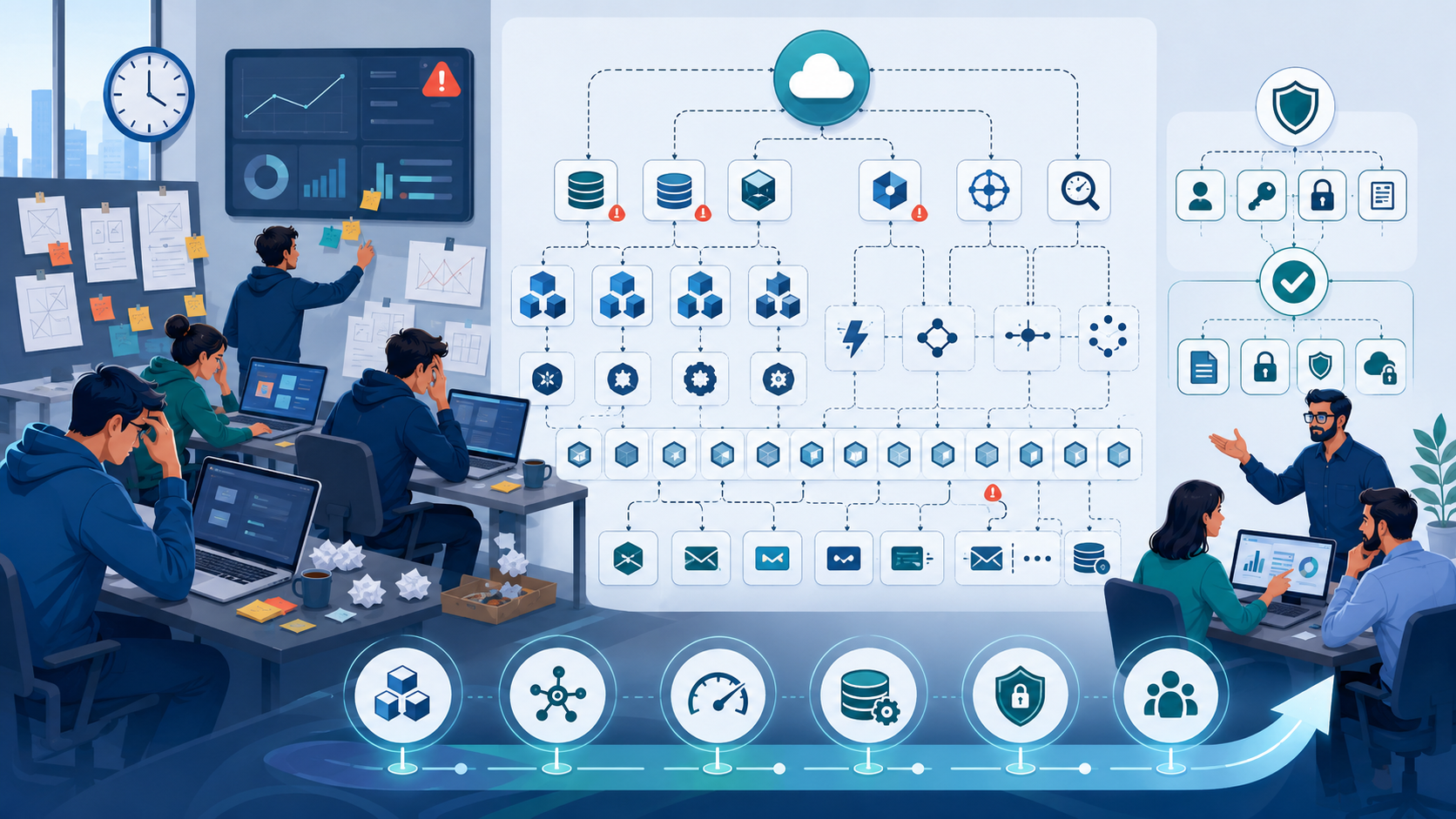
Why This Problem Happens in Real Engineering Teams
Every startup begins with a similar objective: launch quickly, validate the product, and improve it through customer feedback. Under tight deadlines, engineering teams naturally focus on delivering features rather than building perfect systems.
There's nothing wrong with that approach.
The problem begins when temporary technical decisions quietly become permanent architecture.
I've seen this happen in SaaS products of every size. A simple application evolves into a complex platform with multiple APIs, growing databases, background workers, and customer-facing dashboards. As the product grows, each shortcut becomes harder to replace.
Several factors usually contribute to this situation.
Fast Product Timelines
Most early-stage companies measure success by release speed.
When investors or customers expect new functionality every few weeks, engineering teams prioritize delivery over long-term maintainability. Infrastructure decisions that should receive careful planning are often postponed.
Examples include:
- Skipping infrastructure documentation
- Hardcoding deployment settings
- Mixing business logic with cloud-specific services
- Creating manual deployment processes
These decisions save time initially but increase maintenance costs later.
Treating Azure as Just Another Hosting Platform
Azure offers far more than virtual machines.
Modern products often depend on services for storage, database management, analytics, monitoring, identity, and automation.
Teams that only lift and shift existing applications into Azure rarely gain the benefits of the platform. Instead, they continue operating with outdated deployment practices while paying cloud pricing.
Successful projects usually redesign parts of the system to better align with Azure's managed capabilities instead of recreating traditional on-premise environments.
Scaling Before There's a Need
One mistake appears surprisingly often.
Teams expect future growth and immediately introduce technologies designed for companies operating at massive scale.
That can include:
- Complex containerization
- Multiple Kubernetes clusters
- Event-driven architectures
- Excessive microservices
- Distributed messaging systems
These technologies certainly solve real problems—but only after those problems actually exist.
For a startup with five engineers, they often introduce unnecessary operational complexity.
I've worked on projects where developers spent more time maintaining deployment pipelines than building customer features.
Ignoring Operational Workflows
Cloud development isn't only about writing code.
Reliable software also depends on:
- Deployment processes
- Incident response
- Monitoring dashboards
- Security reviews
- Documentation
- Release management
Without mature operational practices, even well-written applications become difficult to maintain.
I've seen engineering teams produce excellent backend code while lacking any meaningful observability, making production issues nearly impossible to diagnose.
Underestimating Security Requirements
Security often becomes an afterthought until customers request compliance certifications.
By that point, redesigning authentication systems becomes significantly more expensive.
Azure provides built-in capabilities for:
- Authentication
- Identity management
- Encryption
- Access control
- Compliance auditing
- Governance policies
The challenge isn't the availability of these services.
It's integrating them correctly before the application reaches production scale.
Treating Cloud Migration as a One-Time Project
Migration isn't the finish line.
It's the beginning of ongoing engineering work.
Applications continue evolving after migration through:
- API expansion
- Performance optimization
- Feature releases
- Infrastructure improvements
- Security updates
- Database tuning
Organizations that treat migration as a completed task often postpone essential maintenance until technical debt becomes unavoidable.

Where Most Teams Make the Wrong Decision
Choosing an Azure development partner is often viewed as a hiring decision.
In practice, it's an architecture decision.
The company building your platform influences almost every technical choice that follows.
Unfortunately, many teams evaluate vendors using criteria that have little connection to long-term engineering success.
Assuming More Services Mean Better Architecture
Some development partners recommend every available Azure capability from the beginning.
The project quickly includes:
- Azure Functions
- Kubernetes
- Service Bus
- Multiple databases
- Event Grid
- Advanced networking
- Numerous deployment environments
On paper, the solution looks modern.
In reality, the engineering team now maintains a platform that's significantly more complex than the business actually requires.
A simpler architecture often delivers higher availability, better reliability, and lower operational costs.
Copying Enterprise Architecture Too Early
Large technology companies solve problems that startups rarely encounter.
Yet many small teams copy their architecture without considering scale.
I've seen products with fewer than ten developers adopt:
- Multiple backend services
- Separate frontend applications
- Independent deployment pipelines
- Several APIs
- Dedicated messaging platforms
- Distributed databases
The engineering overhead quickly exceeded the value delivered.
Small product teams usually benefit from simpler architectures that evolve gradually as usage increases.
Choosing Technology Instead of Engineering Discipline
Modern cloud platforms introduce new services every year.
It's tempting to evaluate development companies based on the number of technologies they advertise.
However, successful projects depend less on technology selection and more on engineering discipline.
Experienced Azure teams consistently prioritize:
- Clear architecture
- Reliable deployment workflows
- Automated testing
- Infrastructure as Code
- Documentation
- Performance monitoring
- Security reviews
Those practices create sustainable systems regardless of which Azure services are used.
Forgetting That Cloud Costs Reflect Architecture Decisions
Many startups are surprised when monthly cloud expenses grow faster than customer adoption.
The reason usually isn't Azure pricing.
It's architecture.
Poor resource planning can result in:
- Overprovisioned compute resources
- Unused virtualization capacity
- Inefficient networking
- Redundant storage
- Duplicate services
- Idle environments
An experienced Azure development company understands that cloud optimization begins during architecture design—not after invoices become a concern.
Building Without Future Integration in Mind
Modern SaaS platforms rarely operate independently.
They connect with payment systems, CRM platforms, authentication providers, analytics tools, reporting services, and internal applications.
Poor integration planning creates fragile systems where every new connection increases maintenance effort.
Successful Azure projects design stable API layers early, allowing future services to integrate without requiring major architectural changes.
Instead of tightly coupling every component, experienced engineering teams build flexible interfaces that support growth while keeping the overall platform easier to maintain.

Practical Fixes That Actually Work
After working with several SaaS teams over the years, I've noticed that successful Azure projects rarely succeed because they use the newest cloud service. They succeed because the engineering team keeps the architecture understandable while introducing complexity only when there's a measurable business reason.
When evaluating US software specialists for Azure product development, I'd pay much more attention to engineering discipline than to the number of Azure certifications listed on their website.
Build Infrastructure That Can Evolve
Many startups begin with a straightforward application and expect to redesign everything later. In reality, major rewrites rarely happen because product teams remain busy shipping features.
Instead of designing for an imagined future, design for gradual evolution.
A practical Azure architecture usually includes:
- Clearly separated backend services
- Independent frontend deployment
- Well-defined API boundaries
- Managed database services
- Secure networking between resources
- Automated infrastructure provisioning
The goal isn't to predict every future requirement. It's to ensure today's architecture won't prevent tomorrow's improvements.
Automate Every Repeatable Process
Manual work eventually becomes operational debt.
Every repetitive engineering task should eventually become automation.
Examples include:
- Environment provisioning
- Deployment approvals
- Infrastructure validation
- Backup scheduling
- Security scanning
- Database migration
- Log collection
Automation improves consistency while allowing engineers to spend more time solving product problems instead of repeating operational tasks.
Treat DevOps as an Engineering Culture
Many organizations still think DevOps is simply another job title.
In healthy engineering teams, DevOps is a shared responsibility.
Developers should understand deployments.
Operations engineers should understand application behavior.
Everyone should understand production systems.
That shared ownership usually leads to:
- Faster incident resolution
- Better deployment quality
- Fewer production surprises
- Stronger collaboration
Create Reliable CI/CD Pipelines
A mature CI/CD pipeline should do more than deploy code.
Every release should automatically verify that the application is healthy before customers interact with new functionality.
Typical pipeline stages include:
- Code validation
- Unit testing
- Integration testing
- Security scanning
- Infrastructure validation
- Performance verification
- Production deployment
- Post-deployment monitoring
Reliable pipelines reduce deployment anxiety and encourage smaller, safer releases.
Use Containers Carefully
Docker has become a standard part of modern software development.
Its biggest advantage isn't scalability.
It's consistency.
Developers can reproduce production environments locally, reducing configuration differences between development and production.
However, containers don't automatically justify using Kubernetes.
I've seen startups maintain Kubernetes clusters with fewer than ten developers while spending more engineering time managing infrastructure than improving customer features.
Unless your workload genuinely requires orchestration at scale, Azure's managed platform services often provide a simpler operational model.
Optimize Performance Before Scaling
One common mistake is assuming additional cloud resources will solve performance problems.
They rarely do.
Most performance issues originate from inefficient software design.
Areas worth reviewing include:
- Slow SQL queries
- Excessive API requests
- Poor database indexing
- Inefficient caching
- Large payload transfers
- Redundant background processing
Improving application performance usually costs less than continuously increasing cloud resources.
Make Monitoring Part of Daily Development
Monitoring should never begin after production incidents.
Engineering teams should regularly review:
- Application response time
- Memory utilization
- CPU consumption
- Failed API requests
- Database performance
- Infrastructure health
- Network latency
Good monitoring helps detect issues.
Strong observability explains why those issues occur.
That distinction becomes increasingly valuable as products grow.
Plan Security Before Customers Ask
Security work becomes significantly more expensive once applications reach production.
Azure already provides mature capabilities for:
- Authentication
- Identity management
- Encryption
- Access policies
- Compliance reporting
- Governance controls
Successful engineering teams integrate these capabilities during development rather than retrofitting them after customer audits.
Design APIs That Will Last
Every growing SaaS product eventually depends on external integrations.
Whether connecting payment providers, CRMs, analytics platforms, or internal services, stable API design reduces future engineering work.
Good API design includes:
- Consistent naming
- Version management
- Predictable error handling
- Clear authentication
- Reliable documentation
Strong API design reduces maintenance while making future integrations significantly easier.
Think Beyond Initial Migration
Many organizations celebrate cloud migration as the project's finish line.
It's actually the beginning.
After migration, engineering teams continue improving:
- Performance
- Availability
- Reliability
- Automation
- Security
- Scalability
- Cost optimization
Cloud platforms should evolve alongside the product.
When This Approach Doesn't Scale
Simple architecture is usually the right decision for startups.
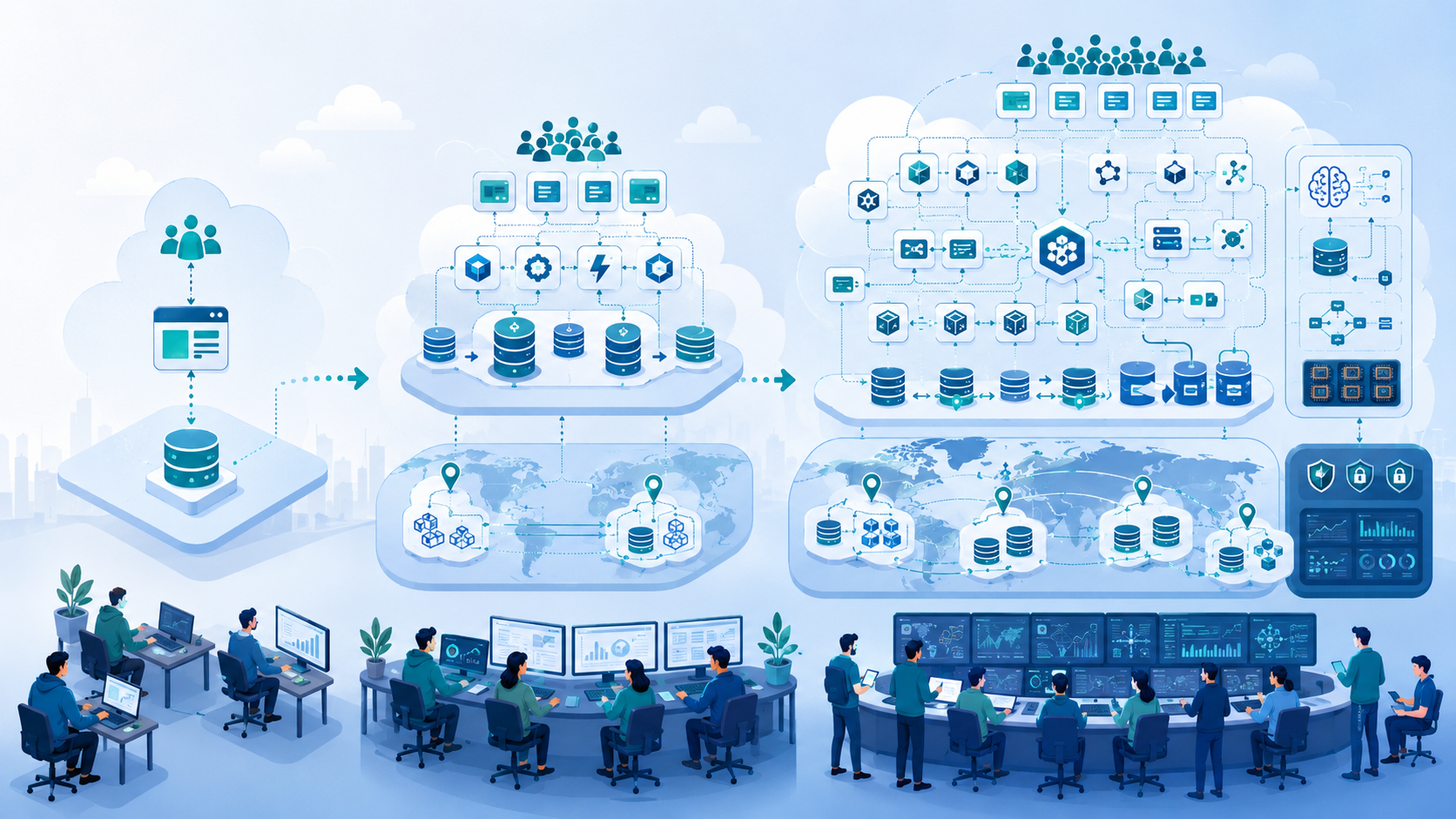
Eventually, however, products become more complex.
Growth introduces challenges that require different engineering strategies.
For example:
A SaaS platform supporting millions of users may eventually require:
- Multiple regional deployments
- Advanced networking
- Distributed databases
- Event-driven microservices
- Specialized platform engineering teams
Similarly, organizations introducing Artificial Intelligence or Machine Learning workloads often need dedicated data infrastructure, separate compute resources, model deployment pipelines, and additional security considerations.
The lesson isn't that simple architecture is wrong.
It's that architecture should evolve because business requirements change—not because technology trends encourage unnecessary complexity.

Sustainable Engineering Practices for Growing Teams
Long-term success isn't determined by the first release.
It's determined by how easily the engineering team can continue delivering software two years later.
Several habits consistently improve long-term maintainability.
Reduce Technical Debt Continuously
Every sprint should include small improvements alongside feature development.
Waiting six months for a major refactoring project rarely succeeds.
Small, continuous improvements keep technical debt manageable.
Document Engineering Decisions
Documentation doesn't need to be lengthy.
Simple records explaining architectural decisions often save future engineers countless hours.
Useful documentation includes:
- Infrastructure diagrams
- Deployment workflows
- API specifications
- Security policies
- Operational procedures
Review Cloud Costs Regularly
Cloud optimization isn't only a financial exercise.
Unexpected increases in Azure costs often indicate architectural inefficiencies.
Engineering reviews should include:
- Storage utilization
- Compute usage
- Networking costs
- Unused services
- Idle resources
- Backup retention
Optimization should become part of normal engineering operations.
Use Managed Services Whenever Practical
Azure offers numerous Managed Services that reduce operational overhead.
Rather than maintaining infrastructure manually, engineering teams can often rely on managed databases, monitoring solutions, identity services, backup systems, and automation tools.
This allows developers to focus on product development instead of infrastructure maintenance.
Support Long-Term Digital Transformation
Many organizations describe Azure adoption as Digital Transformation.
In practice, digital transformation isn't completed after moving workloads into the cloud.
It requires continuous improvement through:
- Better architecture
- Reliable automation
- Strong governance
- Improved security
- Performance optimization
- Engineering collaboration
The organizations that succeed treat Azure as an evolving engineering platform rather than simply another hosting provider.
Conclusion
Choosing an Azure Development Company in USA should never be based solely on certifications or the number of Azure services a team can implement. The more meaningful evaluation is how that team approaches architecture, automation, security, scalability, and long-term maintainability.
The strongest Azure projects are built by engineering teams that understand trade-offs. They know when to keep an architecture simple, when to introduce advanced cloud capabilities, and when to avoid unnecessary complexity. They focus on clean software design, reliable deployment workflows, proactive monitoring, and sustainable engineering practices rather than chasing every new technology.
As your product grows, Azure should become an enabler—not a source of operational burden. Choosing a development partner that values practical engineering over technical hype is one of the most important decisions you'll make for the long-term success of your platform.
Azure Development Company In USA: FAQs
An Azure development company brings specialized expertise in Microsoft's cloud ecosystem, including cloud architecture, infrastructure, security, DevOps, and managed services. This experience helps build applications that are scalable, secure, and easier to maintain as your business grows.
Most Azure development companies offer a wide range of cloud services, including:
- Azure application development
- Cloud migration
- Azure architecture design
- API development and integration
- DevOps and CI/CD implementation
- Infrastructure as Code (IaC)
- Database modernization
- Performance optimization
- Security and compliance consulting
- Ongoing managed services and cloud support
Yes. Azure is well suited for SaaS applications because it provides scalable infrastructure, managed databases, identity management, automation tools, monitoring, analytics, and global deployment capabilities. It also integrates well with Microsoft technologies commonly used by enterprise customers.
Not necessarily. Kubernetes is powerful but adds operational complexity. Many startups achieve excellent results using Azure App Service, Azure Functions, or Azure Container Apps before adopting Kubernetes. It's generally better to introduce Kubernetes only when application scale and operational requirements justify it.
DevOps helps development teams automate software delivery through CI/CD pipelines, infrastructure automation, continuous testing, monitoring, and collaboration between developers and operations teams. This results in faster deployments, fewer production issues, and more reliable releases.
Reference
Written by

Paras Dabhi
VerifiedFull-Stack Developer (Python/Django, React, Node.js)
I build scalable web apps and SaaS products with Django REST, React/Next.js, and Node.js — clean architecture, performance, and production-ready delivery.
LinkedIn