Best Hiring Models for Software Development Projects
Many software projects do not fail because of technology.
They fail because the team structure does not match the project's actual requirements.
I've worked with startup teams, SaaS products, remote developers, and engineering teams across the USA, UK, Germany, Australia, and Canada. One pattern appears repeatedly: teams spend months discussing frontend architecture, backend systems, deployment workflows, and scalability, while overlooking the hiring model that determines how work gets delivered.
The assumption is usually simple.
"If we hire good software developers, the project will succeed."
In practice, that's rarely enough.
A highly skilled development team can still struggle when the wrong hiring approach creates communication gaps, unclear ownership, resource allocation problems, and delivery bottlenecks.
The challenge is not finding developers.
The challenge is choosing a hiring structure that fits the product, timeline, budget, and long-term business objectives.

Why This Problem Happens in Real Teams
Most software projects start with uncertainty.
Requirements change. Product direction evolves. Customer feedback introduces new priorities. Teams discover technical constraints that were not visible during planning.
Yet many organizations lock themselves into a hiring model before understanding what the project actually needs.
Startup Deadlines Create Short-Term Decisions
Early-stage startups often prioritize speed over long-term planning. To meet aggressive timelines, founders may hire quickly without fully assessing future project needs. This can lead to skill gaps, unclear ownership, and delivery challenges as the product evolves.
Under pressure, founders hire the first available development resources rather than evaluating long-term development capacity.
This creates problems later when:
- Project requirements expand
- Technical expertise gaps emerge
- Team expansion becomes necessary
- Ownership becomes unclear
The initial hiring decision starts affecting every aspect of project delivery.
Limited Engineering Resources Increase Risk
Small development teams must handle multiple responsibilities across engineering, infrastructure, testing, and deployment. Without careful workforce planning, important tasks can be overlooked. This increases operational risk and creates bottlenecks as projects grow.
A team of five developers may need to manage:
- Software engineering
- Product development
- Infrastructure
- Security
- Testing
- Documentation
- Deployment workflows
When workforce planning is rushed, critical responsibilities often fall between team members.
Scalability Assumptions Are Usually Wrong
Many teams plan for future growth before validating their product and market demand. Building large hiring structures too early often introduces unnecessary complexity. This can reduce productivity and slow down execution during critical growth stages.
As a result, they optimize for future scale rather than current execution.
I've seen teams build large hiring structures designed for hundreds of employees while trying to launch their first SaaS product.
The result is often reduced team productivity rather than improved scalability.
Process Maturity Takes Time
Processes that work well in large organizations are often too heavy for small engineering teams. Implementing complex management structures too early can create unnecessary overhead. Effective processes should evolve gradually as the team and product mature.
Project management practices, resource management systems, and reporting structures must match the actual team size.
When organizations copy enterprise structures too early, development velocity slows down significantly.

Where Most Teams Make the Wrong Decision
The internet offers plenty of hiring advice.
Unfortunately, much of it ignores the realities of software development projects.
Assuming Dedicated Teams Solve Everything
The dedicated team model is popular because it provides stability.
However, dedicated developers only create value when there is enough consistent work to justify full-time engagement.
I've seen startups hire large dedicated teams before validating product-market fit.
The result:
- Increased development costs
- Lower cost efficiency
- Idle resources
- Slower decision-making
A dedicated team works best when requirements are relatively stable.
Overusing Staff Augmentation
Staff augmentation is excellent for filling skill gaps.
It is less effective when core ownership is missing.
Many companies add contract developers and remote developers without establishing clear technical leadership.
Eventually, nobody owns architecture decisions, deployment workflows, or technical debt management.
The project gains capacity but loses direction.
Treating Outsourcing as a Universal Solution
Development outsourcing and IT outsourcing can work exceptionally well.
I've worked with offshore development, nearshore development, and onshore development teams that delivered excellent results.
The problem occurs when companies outsource responsibility instead of execution.
Successful outsourcing requires:
- Clear project requirements
- Defined ownership
- Strong team collaboration
- Consistent communication
Without these elements, outsourcing magnifies existing problems.
Copying Enterprise Hiring Structures
Large companies often use:
- Managed services
- Multiple vendors
- Complex team structures
- Specialized departments
Small SaaS products rarely need this complexity.
Most small teams underestimate the operational overhead created by excessive coordination.
Practical Fixes That Actually Work
The best hiring model depends on the product stage rather than industry trends. For growing companies, dedicated development teams for US software projects can help match the right team structure with product stage, ownership, communication, delivery capacity, and long-term software goals.
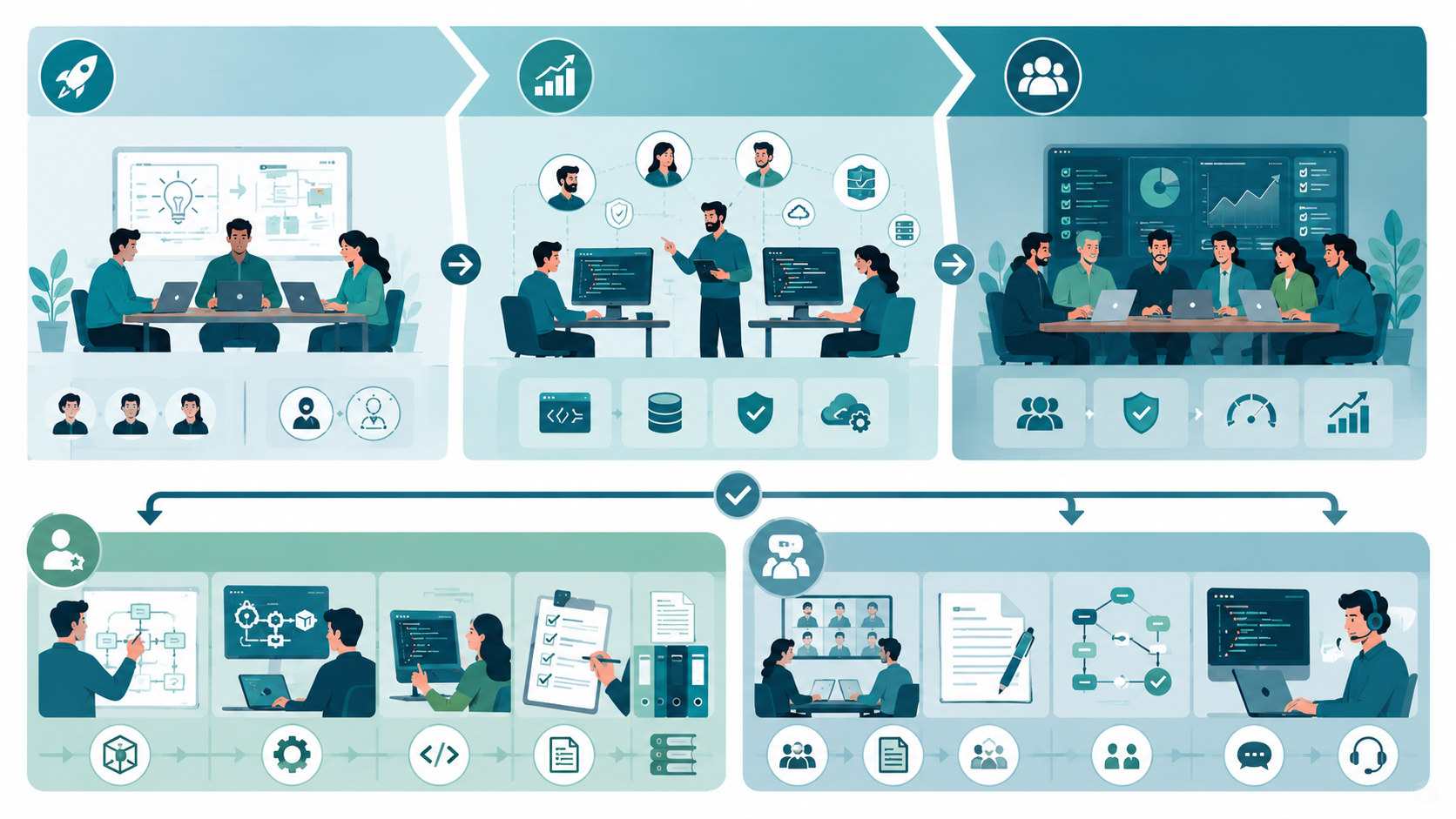
Stage 1: Early MVP Development
During the MVP stage, keeping the team small and focused helps accelerate learning and decision-making. A lean structure with a technical lead and a few specialized contributors allows faster feedback cycles. The primary goal is validating the product before investing in larger development resources.
Recommended approach:
- Small in-house team
- One technical lead
- Limited freelance developers for specialized work
Focus on:
- Fast feedback loops
- Product validation
- Simple development process
Avoid building large teams before confirming market demand.
Stage 2: Product Growth
As the product gains active users, development requirements become clearer and more predictable. Staff augmentation can help fill specific skill gaps without disrupting existing workflows. This approach enables teams to expand capacity while maintaining control over product direction.
This is where staff augmentation often works well.
Add specialists for:
- Backend systems
- Frontend architecture
- Security reviews
- Infrastructure improvements
Maintain ownership internally while expanding development capacity.
Stage 3: Scaling Operations
Once the product reaches a stable growth phase, dedicated teams often provide better long-term results. Consistent team structures improve knowledge retention, productivity, and delivery reliability. Workforce planning becomes essential to support ongoing development and operational needs.
Benefits include:
- Better knowledge retention
- Improved team productivity
- Stronger software lifecycle management
- More predictable project delivery
At this stage, workforce planning becomes increasingly important.
Establish Clear Ownership
Clear ownership ensures that critical technical decisions are made efficiently and consistently. Every team should define responsibility for architecture, code quality, deployment processes, and documentation. Strong ownership reduces confusion and prevents delays caused by unclear accountability.
- Architecture decisions
- Deployment workflows
- Code reviews
- Technical debt
- Documentation
One of the most common engineering bottlenecks comes from unclear ownership.
Optimize Communication Early
Effective communication becomes increasingly important as teams grow and work remotely. Establishing structured processes for documentation, reviews, and technical discussions helps keep everyone aligned. Early communication practices reduce misunderstandings and improve overall collaboration.
Practical improvements include:
- Weekly architecture reviews
- Shared technical documentation
- Clear project management processes
- Written engineering decisions
These practices reduce confusion significantly as the development team grows.

When This Approach Fails
No hiring model works in every situation.
Understanding limitations is important.
Extremely Complex Products
Large platforms often require:
- Specialized software developers
- Dedicated security teams
- Platform engineering groups
- Reliability engineers
A simple hiring structure eventually reaches its limits.
Rapid Hypergrowth
When team expansion accelerates rapidly, informal processes begin breaking down.
Communication overhead increases.
Resource allocation becomes harder.
Decision-making slows.
Organizations must introduce additional structure without creating bureaucracy.
Highly Regulated Industries
Projects involving strict compliance requirements may need:
- Specialized technical expertise
- Dedicated review processes
- Formal governance structures
Lean hiring approaches become harder to maintain.
Multi-Product Organizations
When a company manages several products simultaneously, team structure complexity increases naturally.
A single development partner or small engineering team may no longer provide sufficient coverage.
Sustainable Practices for Small Engineering Teams
The goal is not maximizing headcount.
The goal is maintaining delivery velocity without creating unnecessary complexity.
Reduce Technical Debt Continuously
Technical debt grows fastest when teams expand without clear ownership.
Schedule regular time for:
- Refactoring
- Dependency updates
- Architecture improvements
- Code cleanup
Small improvements prevent expensive rewrites later.
Maintain Strong Documentation
Documentation improves team collaboration and onboarding.
Prioritize:
- Architecture decisions
- Deployment procedures
- API documentation
- Security standards
Documentation becomes increasingly valuable as development resources grow.
Keep Team Structures Simple
Simple team structures usually outperform complicated ones.
A small agile team with clear ownership often delivers faster than a larger organization with overlapping responsibilities.
Focus on Long-Term Partnerships
Whether working with a development partner, dedicated developers, or remote teams, continuity matters.
Long-term partnerships reduce:
- Knowledge loss
- Onboarding effort
- Delivery delays
Consistency creates operational flexibility.
Measure Delivery, Not Activity
Track outcomes instead of hours worked.
Useful indicators include:
- Time-to-market
- Deployment frequency
- Production incidents
- Lead time for features
These metrics reveal whether the hiring model actually supports business objectives.
Protect Engineering Capacity
Development capacity is limited.
Every meeting, process, and approval step consumes resources.
Small teams benefit from eliminating unnecessary operational overhead whenever possible.
Conclusion
The best hiring model for software development projects is rarely the most popular one.
It is the model that matches the current stage of the product.
Most delivery problems I see are not caused by weak software engineering skills. They come from mismatched hiring decisions, unclear ownership, and team structures that introduce complexity before the product actually needs it.
Small SaaS products often succeed with lean agile teams, focused technical leadership, and carefully planned team expansion.
Before adding more developers, vendors, or managed services, evaluate whether the existing structure supports efficient project delivery.
In many cases, improving ownership and communication creates better results than increasing headcount.
FAQ
A small in-house team supported by selective freelance developers or staff augmentation is usually the most practical approach. It keeps communication simple while maintaining flexibility.
They solve different problems. Staff augmentation adds skills to an existing team, while outsourcing transfers execution to an external team. The right choice depends on ownership and project requirements.
Usually after product-market fit is established and development work becomes predictable enough to justify long-term resource commitments.
They can improve cost efficiency, but only when communication, documentation, and ownership are managed properly.
Focus on clear ownership, strong documentation, manageable team structures, and continuous reduction of technical debt before expanding headcount.
Reference
Written by

Paras Dabhi
VerifiedFull-Stack Developer (Python/Django, React, Node.js)
I build scalable web apps and SaaS products with Django REST, React/Next.js, and Node.js — clean architecture, performance, and production-ready delivery.
LinkedIn