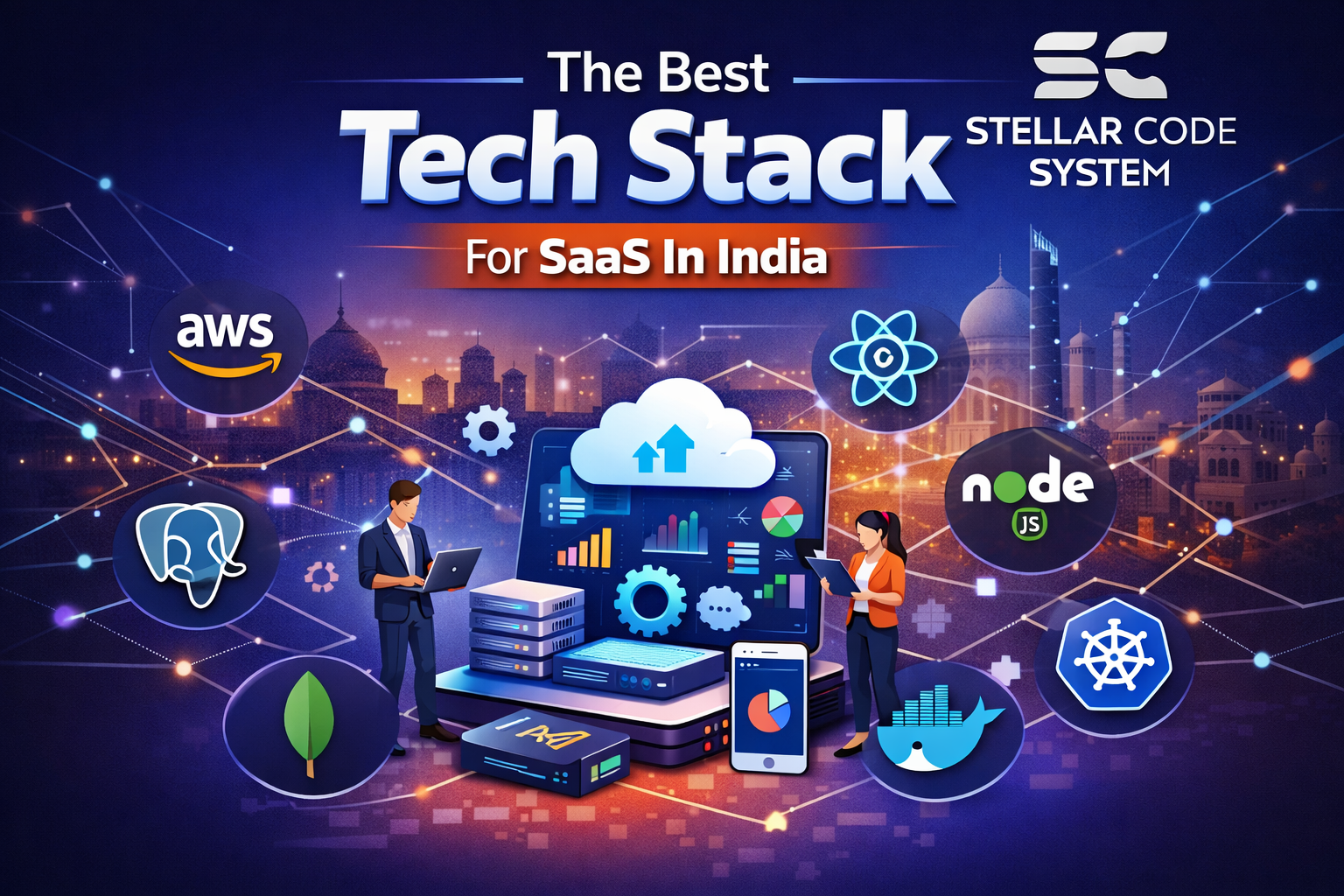
The Best Tech Stack For SaaS In India
Most SaaS teams in India do not struggle because they chose a "bad" language. They struggle because the stack that helped them ship the MVP becomes painful once hiring, support, and enterprise requests start growing.
I've seen this happen repeatedly in 3–5 engineer teams. The MVP launches fast, customers come in, and suddenly every new feature feels slower, every bug takes longer, and hiring the next backend developer becomes unexpectedly expensive.
The real problem is rarely technology alone. It is choosing a stack that fits today's MVP speed but also survives India's hiring and cost realities six months later.

Why Choosing The Right SaaS Stack Is Harder In India
The hard part in India is not "which framework is best." It is balancing speed, hiring, salary budgets, and long-term maintainability at the same time.
In early SaaS teams, founders usually optimize for launch speed. That is understandable. PMF matters more than architectural purity. But after MVP, local hiring realities hit hard. A stack that looks perfect on Hacker News may be painful to hire for in Ahmedabad, Pune, or even Bengaluru unless you are paying top-tier compensation.
The most common constraints I've seen are:
- Limited runway for senior engineers
- Faster availability of Node.js, React, and Python developers
- Fewer strong engineers in niche stacks
- Outsourced MVPs that need in-house ownership later
- Cloud cost sensitivity after free credits expire
- Support pressure from enterprise clients needing fast fixes
- Compliance concerns around Indian customer data
This is why "best tech stack" advice from US startup blogs often fails Indian SaaS teams. The hiring market and cost structure are completely different.

Where Most SaaS Founders And Small Teams Get This Wrong
The most expensive mistake is choosing for trend value instead of team reality. I've seen startups choose Go microservices with a 3-person team and spend more time managing service boundaries, retries, and deployments than shipping product improvements. The architecture looked impressive. The roadmap slowed down.
Another common mistake is using enterprise-grade patterns before enterprise-grade complexity exists. Typical examples:
- Microservices before PMF
- Kubernetes for a simple B2B dashboard
- Event-driven systems without real throughput needs
- Separate auth, analytics, notification, and workflow services too early
- Polyglot stacks that make hiring harder
In most startups, this happens because the first technical decision is made under pressure: "Let's choose what scales." But scale rarely breaks MVPs first. What usually breaks first is onboarding new developers, debugging production issues, shipping features fast enough, managing infra cost, and supporting customer-specific workflows.
That is why early overengineering becomes expensive debt.
Read More → Cost Comparison Custom Software VS SaaS Tools

Practical Stack Decisions That Work In Real SaaS Projects
For most Indian SaaS teams with 2–10 developers, the safest stack is usually boring, widely hireable, and operationally light.
A practical MVP-first SaaS stack: Frontend: Next.js, Backend: Node.js with NestJS, Database: PostgreSQL, Caching/jobs: Redis, Storage: AWS S3, Infra: AWS ECS or DigitalOcean Apps, Containerization: Docker, Monitoring: centralized logs + error alerts, Queue/background jobs: BullMQ or SQS, Analytics: PostHog or basic product events.
This stack consistently works because it reduces friction in three places.
1. Hiring Is Easier In India
For most SaaS startups in India, React and Node.js reduce hiring friction because the talent pool is wider and onboarding is faster. This matters more than theoretical performance gains when your roadmap depends on a small team, and working with an experienced software development partner in India can make those stack decisions far more practical from the beginning. A stack that is easy to hire for lowers delivery risk and avoids rebuild pressure caused by team changes.
React + Node.js has one of the widest hiring pools. For small teams, this matters more than raw performance benchmarks. A backend developer leaving should not put roadmap delivery at risk for 2 months.
This stack makes:
- Replacement hiring faster
- Freelance support easier
- Agency transitions smoother
- Onboarding cheaper
That alone reduces rebuild pressure.
2. Product Iteration Stays Fast
The real advantage of Next.js and NestJS is faster iteration without adding architecture complexity too early. A modular monolith helps teams ship dashboards, auth flows, and customer features quickly while keeping debugging manageable. This structure supports growth without slowing down feature releases in small SaaS teams.
Next.js works well for:
- Dashboard-heavy SaaS
- Admin portals
- Auth workflows
- SEO landing pages
- Customer-facing portals
NestJS keeps backend code structured enough for growth without forcing microservices early. The real win is clear module boundaries inside a monolith. That gives you shared validation, simpler debugging, fewer deployment pipelines, and easier local setup.
3. Infra Cost Remains Predictable
For Indian SaaS startups, infra cost surprises are dangerous after cloud credits end. A modular monolith on ECS, Render, Railway, or DigitalOcean often stays far cheaper than early Kubernetes.
PostgreSQL + Redis handles most B2B SaaS needs:
- Tenant workflows
- Scheduled jobs
- Approval systems
- Reporting
- Notification queues
- Usage tracking
The trade-off is that some heavy async workflows may later need extraction into dedicated services. That is acceptable because the product already has usage proof by then.
When This Stack Approach Does NOT Work
This approach is not universal. There are cases where this stack starts showing limits earlier.
Heavy AI SaaS
When a SaaS product depends on model inference, vector search, or GPU-heavy pipelines, the stack priorities change quickly. In these cases, Python-based services usually fit better because the ecosystem around ML tooling, async workers, and data processing is stronger. A general MVP stack may still work around it, but the AI layer often needs its own specialized architecture early.
Real-Time Streaming Products
Real-time products create a very different scaling problem compared to standard B2B SaaS workflows. As live events, socket traffic, and stream persistence grow, a simple Node monolith can become harder to tune and isolate under load. This is usually the point where teams need dedicated streaming services, event pipelines, or distributed workers.
For products dealing with live video, IoT streams, stock ticks, or multiplayer collaboration, a Node monolith may become harder to optimize.
Fintech Or Deep Compliance
For fintech, lending, insurance, or RBI-sensitive workflows, engineering decisions are driven more by auditability than speed alone. Strongly typed ecosystems like Java often become safer because they support clearer governance, transaction control, and compliance-heavy workflows. In these products, predictable system behavior matters more than rapid MVP iteration.
Massive Analytics Platforms
Analytics-heavy SaaS products hit data architecture limits much faster than standard transactional systems. Once ingestion volume, reporting complexity, and event processing scale up, the default monolith stack may start slowing query performance and data pipelines. This is where separate processing services, warehouses, and stream-based architectures usually become necessary.
The lesson is simple: choose the simple stack until product behavior proves complexity is necessary. Do not pay architecture tax before usage patterns justify it.
Read More → SaaS Product Development Cost Breakdown

Best Practices For SaaS Teams In India
The best stack decision is usually less about tools and more about decision discipline. What has worked best in real projects:
- Choose stacks with large hiring pools
- Prefer modular monoliths before microservices
- Reduce DevOps ownership burden
- Standardize local development setup
- Use Docker from day one
- Add structured logs early
- Keep deployment pipelines boring
- Avoid multi-language backend stacks early
- Document domain modules clearly
- Delay Kubernetes until real scale pain appears
The biggest long-term win is maintainability under hiring changes. Indian SaaS teams often face fast hiring changes during growth. A stack that new developers can understand in 3–5 days is more valuable than a theoretically superior architecture. Maintainability beats trend value every time.
Conclusion
The best tech stack for SaaS in India is rarely the most modern one.
It is the stack your small team can hire for quickly, ship features with confidence, and maintain after the MVP starts attracting real customers.
In most cases, Next.js + NestJS + PostgreSQL + Redis gives the right balance of speed, hiring flexibility, infra simplicity, and scale runway.
The costly rebuilds usually do not happen because the stack was weak. They happen because the team chose complexity before the product earned it.
Best Tech Stack For SaaS In India: FAQ
Node.js, Python, and Java are usually the easiest because the talent pool is large and salary expectations are more predictable.
Yes. It works especially well for dashboard products, auth flows, customer portals, and marketing pages in one codebase.
Usually no. For teams under 5 developers, it often slows delivery and increases infrastructure debugging work.
PostgreSQL remains the safest default because it handles transactional workflows, reporting, and scaling needs very well.
Usually when independent scaling, queue bottlenecks, or domain ownership between multiple teams becomes a recurring issue.
References
Written by

Paras Dabhi
VerifiedFull-Stack Developer (Python/Django, React, Node.js)
I build scalable web apps and SaaS products with Django REST, React/Next.js, and Node.js — clean architecture, performance, and production-ready delivery.
LinkedIn