Cloud Application Development Company In USA
Cloud adoption has become the default choice for startups and growing software businesses, but building a cloud application that performs well in production is still much harder than most teams expect. I've worked with small engineering teams that launched quickly only to discover that their application struggled with deployment, scaling, security, and maintenance once real users arrived.
One pattern appears repeatedly. Teams spend months debating technologies, but very little time discussing how the application will evolve after launch. The initial release works, yet every new feature increases complexity because the underlying architecture wasn't designed for long-term growth.
A reliable Cloud Application Development Company in USA doesn't simply write code or migrate an existing application to the cloud. Experienced engineering teams focus on designing software that remains stable as workloads increase, customer expectations change, and product requirements evolve.
From my experience across SaaS products and remote engineering teams, successful cloud projects rarely depend on choosing the newest platform. They succeed because development decisions are made with scalability, maintainability, automation, and operational reliability in mind from the beginning.
Why Businesses Choose a Cloud Application Development Company in USA
Many organizations begin cloud initiatives because they need greater flexibility than traditional infrastructure can provide. The challenge isn't moving applications to the cloud—it's ensuring those applications continue performing well as the business grows.
I've seen companies migrate applications successfully only to encounter unexpected performance issues because the original software wasn't designed for distributed environments. Simply hosting an application on a cloud platform doesn't make it cloud-native.
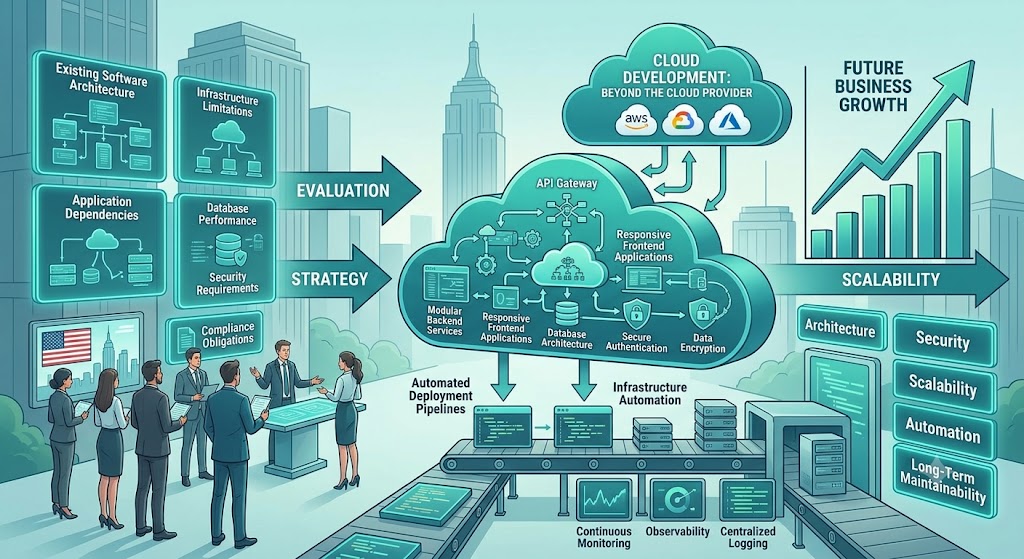
Experienced engineering teams typically begin by evaluating several technical factors:
- Existing software architecture
- Infrastructure limitations
- Application dependencies
- Database performance
- Security requirements
- Compliance obligations
- Networking design
- Storage requirements
- Expected compute demand
- Future business growth
Skipping this assessment often leads to expensive modernization efforts later.
Cloud Development Is More Than Infrastructure
One misconception I frequently encounter is that cloud development only involves selecting a provider such as AWS, Azure, or Google Cloud. In practice, cloud development touches almost every part of an application.
A production-ready cloud solution generally includes:
- Well-designed APIs
- Modular backend services
- Responsive frontend applications
- Reliable database architecture
- Secure authentication
- Data encryption
- Automated deployment pipelines
- Continuous monitoring
- Observability and centralized logging
- Infrastructure automation
Each component affects the long-term stability of the product.
Why Early Architecture Decisions Matter More Than Technology Choices
Many startups spend significant time comparing frameworks while paying little attention to architectural decisions.
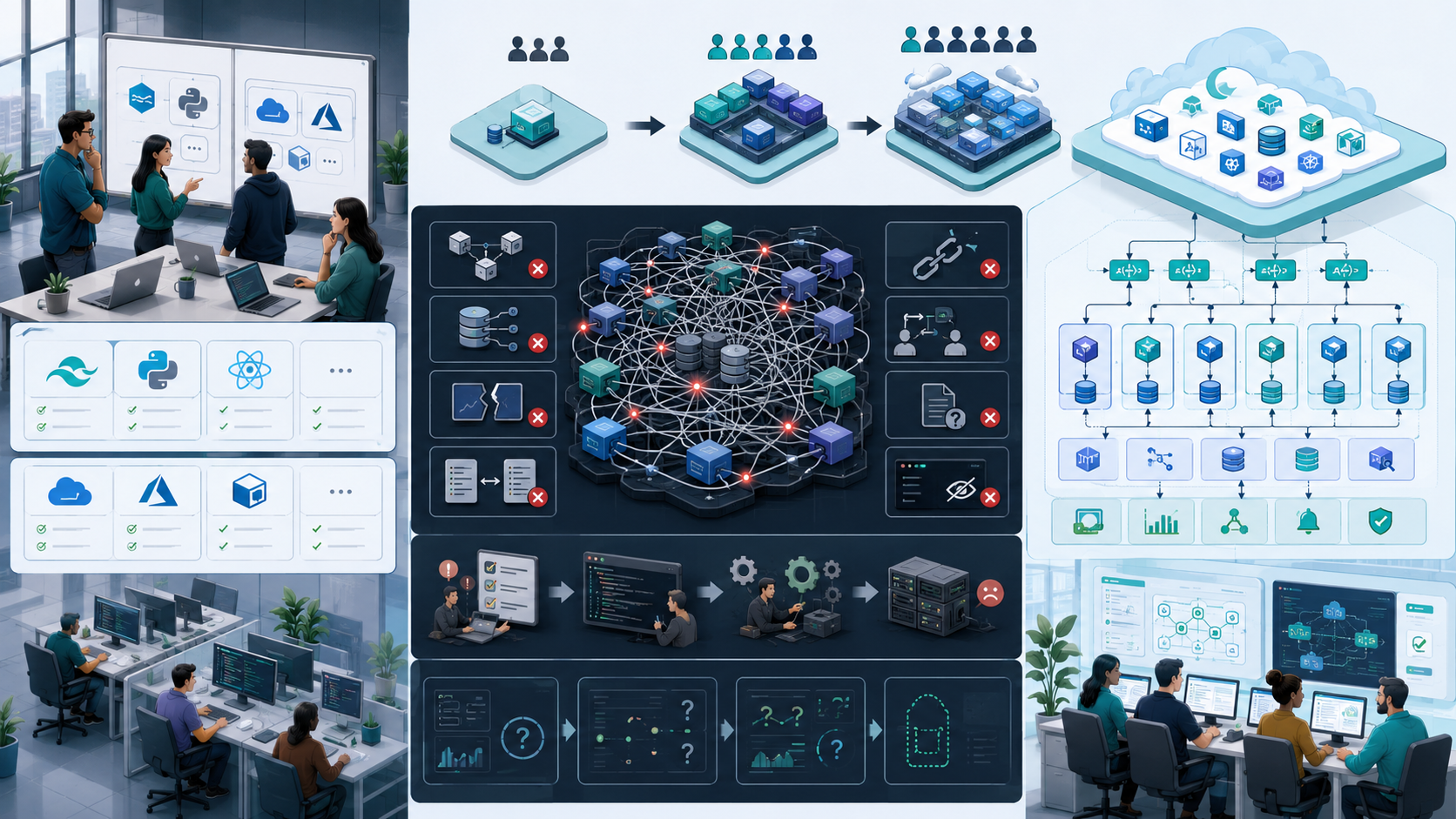
In several SaaS projects I've worked on, technical problems weren't caused by programming languages or cloud providers. They resulted from architectural shortcuts made during early development.
Common examples include:
- Tightly coupled services
- Shared databases across unrelated modules
- Poor API boundaries
- Duplicate business logic
- Manual deployment processes
- Missing documentation
- No observability strategy
Initially, these decisions appear harmless because the product has only a few users. Problems emerge once traffic increases, additional developers join the project, and product requirements become more complex.
Good architecture creates room for change without forcing teams to rewrite large portions of the application.
Common Mistakes Companies Make During Cloud Application Development
Cloud technology offers tremendous flexibility, but flexibility also increases the number of poor engineering decisions teams can make.
Building for Millions of Users Too Early
One recurring pattern is premature scalability.
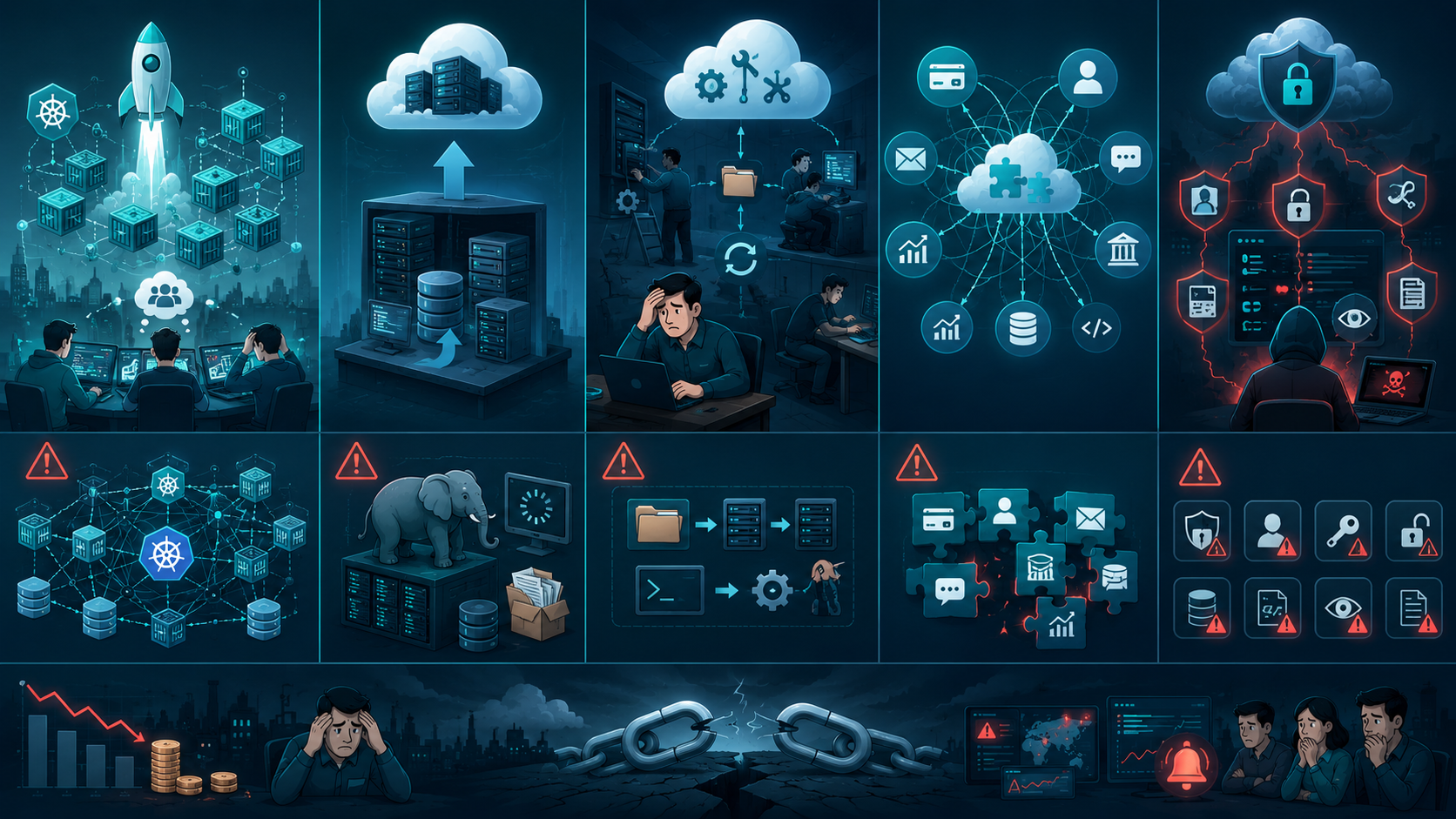
I've seen startup teams introduce Kubernetes, complex containerization strategies, multiple microservices, advanced orchestration, and distributed networking before acquiring their first paying customers.
The result is usually:
- Higher operational costs
- Slower feature delivery
- Increased maintenance
- Difficult debugging
- Longer onboarding for new developers
Most early-stage SaaS products benefit from a simpler architecture that evolves gradually.
Scalability should solve existing problems—not hypothetical ones.
Treating Cloud Migration as a Lift-and-Shift Project
Migration often becomes synonymous with copying existing applications into cloud infrastructure.
Technically, the application may run successfully after migration, but underlying issues remain:
- Slow database queries
- Monolithic application design
- Manual deployment
- Weak security practices
- Poor API structure
- Inefficient storage usage
Cloud modernization should improve how software operates rather than simply changing where it runs.
Sometimes modernization includes:
- Breaking large services into manageable modules
- Improving deployment automation
- Introducing Infrastructure as Code
- Simplifying backend services
- Optimizing networking
- Improving application performance
Migration without modernization frequently postpones technical debt instead of eliminating it.
Ignoring DevOps Until Production
Another common mistake is postponing DevOps practices until after launch. Working with a cloud application development partner for US startups helps teams plan CI/CD, automated testing, rollback procedures, deployment workflows, and cloud reliability before production issues begin.
Development progresses quickly, but releases depend on manual steps:
- Copying files
- Editing configuration manually
- Restarting services
- Updating databases by hand
As releases become more frequent, these manual processes introduce avoidable deployment failures.
Continuous Integration and Continuous Delivery (CI/CD) pipelines reduce these risks by automating:
- Code validation
- Testing
- Build processes
- Deployment
- Rollback procedures
Automation isn't just about speed—it improves consistency.
Poor Integration Between Services
As applications grow, integration becomes one of the biggest engineering challenges.
Backend services interact with:
- Payment providers
- Authentication systems
- Messaging platforms
- Analytics tools
- Third-party APIs
- Internal repositories
Without consistent API design and clear documentation, integrations become increasingly difficult to maintain.
I've worked on projects where adding a simple feature required modifying five unrelated services because integration boundaries were never clearly defined.
Good API design significantly reduces long-term maintenance.
Overlooking Security During Early Development
Security is often viewed as something to address before launch.
Unfortunately, many vulnerabilities originate much earlier.
Examples include:
- Weak authentication
- Missing authorization checks
- Unencrypted sensitive data
- Hardcoded credentials
- Inadequate logging
- Limited monitoring
- Poor governance policies
Security should become part of everyday engineering practices rather than a final checklist.
A strong cloud application architecture incorporates:
- Identity management
- Encryption
- Secure API communication
- Role-based permissions
- Compliance validation
- Continuous monitoring
These measures are considerably easier to implement during development than after production incidents occur.
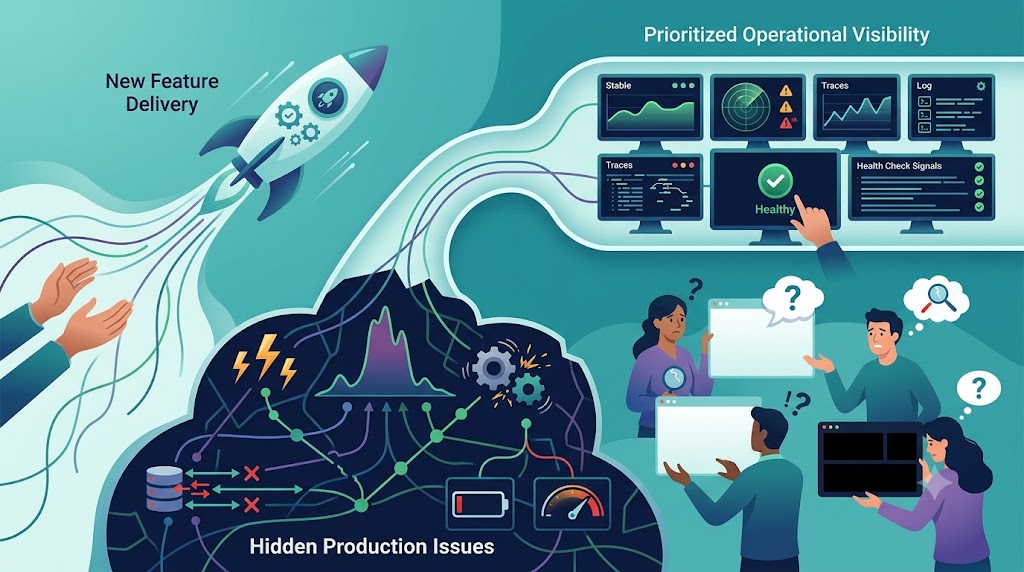
Prioritizing Features Over Operational Visibility
Shipping features is exciting.
Operating software is where engineering discipline matters.
Applications eventually experience:
- Unexpected traffic spikes
- Infrastructure failures
- Performance bottlenecks
- Database contention
- Networking interruptions
- Compute resource exhaustion
Without monitoring, observability, and centralized logging, diagnosing these issues becomes time-consuming.
Operational visibility allows engineering teams to identify problems before customers report them.
Successful cloud platforms treat observability as part of the product rather than an afterthought.
Practical Development Approach That Actually Works
After working on cloud projects across SaaS products, internal business platforms, and customer-facing applications, I've found that successful engineering teams usually follow a predictable pattern. They avoid unnecessary complexity during the early stages while leaving enough flexibility for future growth.
Instead of chasing every new cloud trend, they build a solid foundation that can evolve with the product.
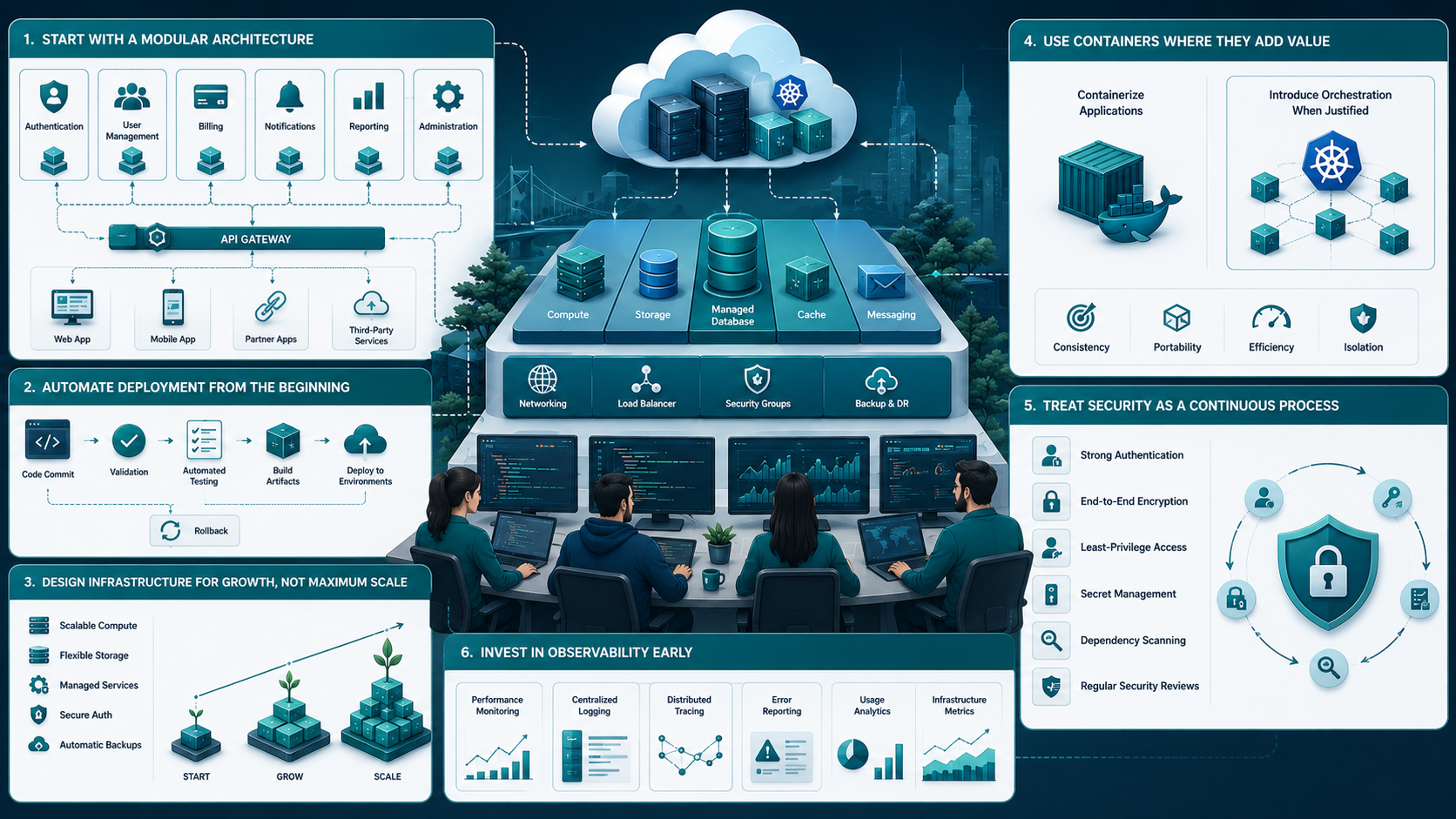
1. Start with a Modular Architecture
A modular architecture provides a balance between simplicity and flexibility. Rather than splitting everything into independent microservices immediately, organize the application into clear functional modules.
For example:
- Authentication
- User management
- Billing
- Notifications
- Reporting
- Administration
Each module should have well-defined responsibilities and communicate through stable API contracts. This approach makes future modernization easier if the application eventually needs to transition to a distributed architecture.
2. Automate Deployment from the Beginning
Even small engineering teams benefit from automation.
A basic CI/CD pipeline should handle:
- Source code validation
- Automated testing
- Build generation
- Deployment
- Rollback procedures
A consistent pipeline reduces deployment errors and allows developers to release changes with confidence. Manual deployments might work for a few releases, but they quickly become a bottleneck as the product grows.
3. Design Infrastructure for Growth, Not Maximum Scale
There's a difference between preparing for growth and overengineering.
A practical cloud environment should include:
- Scalable compute resources
- Flexible storage
- Reliable networking
- Managed database services
- Secure authentication
- Automatic backups
This provides enough scalability without introducing unnecessary operational complexity.
4. Use Containers Where They Add Value
Containerization has become a standard practice because it creates consistent development and production environments.
Tools like Docker make application packaging predictable, while Kubernetes becomes valuable when workloads require advanced scheduling, self-healing, and orchestration across multiple environments.
For smaller SaaS products, however, Kubernetes may introduce more operational overhead than business value. A simpler deployment model is often easier to maintain during the early stages.
Choose technology based on operational requirements rather than industry trends.
5. Treat Security as a Continuous Process
Security isn't a milestone before launch—it should be part of every sprint.
Good engineering practices include:
- Strong authentication
- End-to-end encryption
- Least-privilege access policies
- Secret management
- Dependency scanning
- Regular security reviews
These habits improve both compliance and long-term system reliability.
6. Invest in Observability Early
Many production issues aren't caused by bugs—they're caused by a lack of visibility.
A healthy cloud application should include:
- Performance monitoring
- Centralized logging
- Distributed tracing
- Error reporting
- Usage analytics
- Infrastructure metrics
Strong observability allows engineering teams to resolve problems before they affect customers.
When This Approach Doesn't Work
No architecture fits every product.
There are situations where a straightforward cloud-native approach needs to evolve.
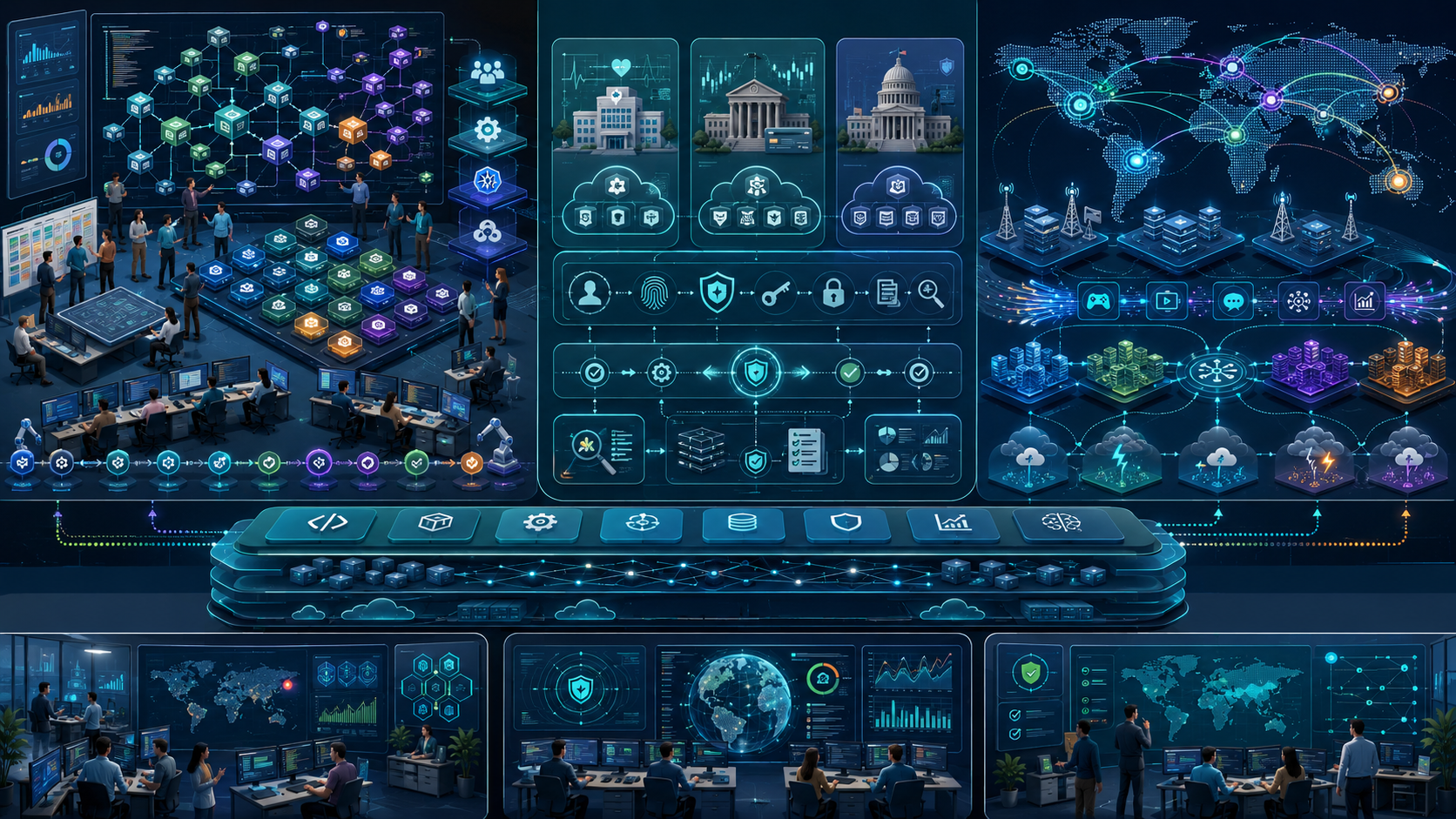
Extremely Large Engineering Organizations
When multiple teams independently develop dozens of services, a more advanced architecture becomes necessary.
Organizations with hundreds of developers often require:
- Service discovery
- Advanced orchestration
- Dedicated platform engineering
- Internal developer platforms
- Sophisticated governance policies
The operational challenges at that scale differ significantly from those faced by startups or small SaaS companies.
Highly Regulated Industries
Applications operating in healthcare, banking, or government environments often have stricter compliance requirements.
Additional considerations may include:
- Detailed audit trails
- Regional data residency
- Identity management
- Continuous security validation
- Regulatory reporting
These requirements influence architectural decisions from the beginning of the project.
Real-Time High-Volume Systems
Applications processing millions of concurrent transactions require specialized optimization.
Examples include:
- Financial trading platforms
- Large-scale streaming services
- Global communication systems
- Real-time gaming platforms
In these environments, performance, availability, and resilience become primary design objectives, and infrastructure decisions are often driven by latency and throughput rather than developer convenience.
Sustainable Practices for Small Engineering Teams
The most successful engineering teams I've worked with weren't necessarily the ones using the newest technologies.
They consistently followed disciplined development practices.
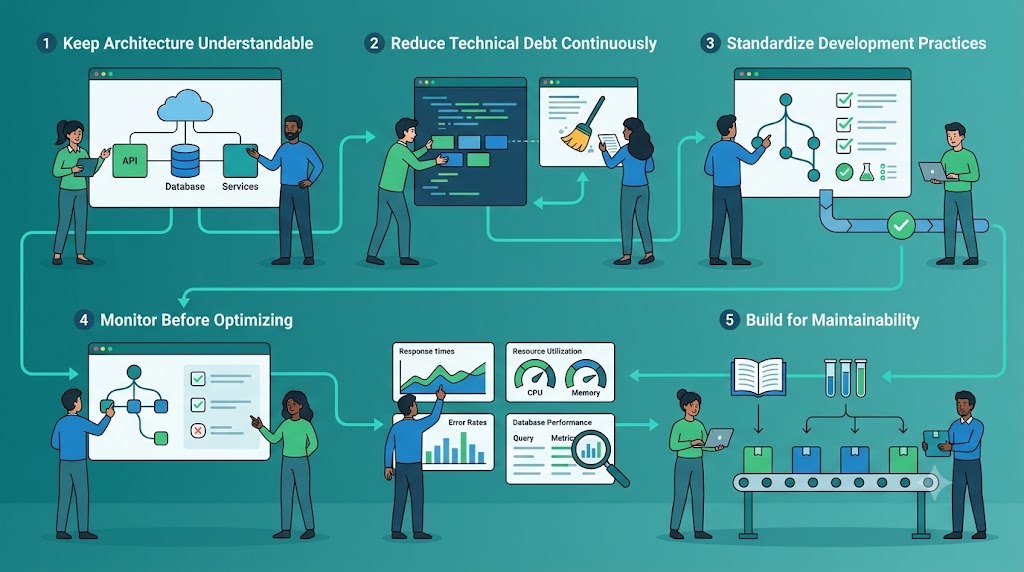
Keep Architecture Understandable
Simple architecture is easier to build, maintain, and scale over time. Before adding new layers or services, ensure they solve a real business or technical need. Clear, understandable systems help teams collaborate efficiently and reduce long-term maintenance challenges.
Ask before introducing new components:
- Does this solve a real problem?
- Will every developer understand it?
- Can we maintain it six months from now?
Simple systems are usually easier to improve than complicated ones.
Reduce Technical Debt Continuously
Technical debt grows with every shortcut taken during development. Addressing small issues regularly, such as improving code quality and documentation, prevents larger refactoring efforts later. Consistent maintenance keeps the application stable and easier to evolve.
Instead of scheduling large refactoring projects every year, dedicate time during each sprint to:
- Remove duplicated code
- Improve documentation
- Simplify APIs
- Optimize slow queries
- Clean unused repositories
- Improve code readability
Small improvements prevent large maintenance efforts later.
Standardize Development Practices
Establishing consistent development workflows helps engineering teams work more efficiently. Standard practices for code reviews, testing, documentation, and deployments reduce errors and make onboarding new developers much smoother. Consistency leads to higher software quality.
Consistency improves collaboration.
Agree on standards for:
- Branch management
- Code reviews
- Testing
- Documentation
- Deployment workflows
- Release procedures
This reduces onboarding time for new developers and minimizes production mistakes.
Monitor Before Optimizing
Performance improvements should be based on measurable data rather than assumptions. Monitoring key metrics helps identify actual bottlenecks before investing time in optimization. A data-driven approach prevents unnecessary architectural changes and improves engineering decisions.
Before rewriting backend services or redesigning architecture, review actual metrics:
- Response times
- Resource utilization
- Error rates
- User behavior
- Database performance
Many perceived performance problems disappear after proper measurement.
Build for Maintainability
Maintainable software is easier to update, debug, and extend as business requirements change. Writing clean, modular code supported by reliable documentation and testing reduces future maintenance costs. This approach helps engineering teams deliver new features without sacrificing development speed.
Prioritize:
- Clear naming
- Modular code
- Reliable documentation
- Automated testing
- Stable integrations
- Consistent deployment processes
Maintainable software allows engineering teams to continue delivering value without slowing development velocity.
Conclusion
Building a successful cloud application isn't about selecting the most popular platform or adopting every emerging technology. It's about making practical engineering decisions that support long-term product growth.
A capable Cloud Application Development Company in USA understands that reliable software depends on thoughtful architecture, disciplined engineering, and sustainable development practices—not just cloud infrastructure.
The strongest cloud applications balance innovation with simplicity. They use automation where it creates consistency, adopt containerization and virtualization when they solve real operational challenges, and prioritize security, performance, and reliability throughout the development lifecycle.
In my experience, the teams that succeed over the long term aren't the ones with the most complex systems. They're the teams that build software their developers can confidently understand, deploy, monitor, and improve as customer needs evolve.
Cloud Application Development Company In USA: FAQs
A cloud application development company usually offers cloud architecture design, application development, cloud migration, modernization, API integration, deployment automation, security implementation, infrastructure management, monitoring, and ongoing application maintenance.
No. Kubernetes is valuable for large-scale distributed applications, but many startups and small SaaS products operate efficiently with simpler deployment models until operational complexity justifies container orchestration.
Common reasons include poor architecture decisions, growing technical debt, inconsistent API design, manual deployment processes, insufficient documentation, and a lack of monitoring or observability.
Focus on modular architecture, automated CI/CD pipelines, strong security practices, centralized logging, continuous monitoring, performance optimization, and incremental improvements instead of large-scale rewrites.
Look for proven engineering experience, cloud architecture expertise, security knowledge, scalable development practices, DevOps capabilities, migration experience, clear communication, and a practical approach to long-term software maintenance rather than just technology selection.
Reference
Written by

Paras Dabhi
VerifiedFull-Stack Developer (Python/Django, React, Node.js)
I build scalable web apps and SaaS products with Django REST, React/Next.js, and Node.js — clean architecture, performance, and production-ready delivery.
LinkedIn