Cloud-Native Application Development In usa
Building a cloud-native application sounds like the obvious choice for almost every modern startup. Between conference talks, engineering blogs, and success stories from companies like Netflix and Spotify, it's easy to believe that every new product should begin with containers, Kubernetes clusters, serverless functions, and a sophisticated deployment pipeline.
In practice, that assumption creates problems much earlier than it solves them.
I've worked with startup teams ranging from three developers to engineering organizations with dozens of engineers spread across multiple countries. One pattern keeps repeating itself: teams invest heavily in cloud-native infrastructure before they fully understand the workload their product will handle. They optimize for future scalability while today's application still serves a few hundred users.
The result isn't a stronger product. Instead, the engineering team spends more time maintaining infrastructure than delivering features customers actually request. Development slows down, debugging becomes difficult, and every deployment feels riskier than it should.
Cloud-native architecture is incredibly powerful when it's introduced at the right stage. The challenge isn't whether you should adopt it—it's knowing when the complexity begins creating value instead of becoming another maintenance burden.

Why This Problem Happens in Real Teams
Every startup begins with uncertainty. Product requirements change weekly, customer feedback reshapes priorities, and engineering teams work under constant pressure to release features quickly.
That environment often encourages architectural decisions based on future expectations rather than present realities.
One common mistake is assuming that cloud-native development automatically produces better software. While technologies like Docker, Kubernetes, and Microservices solve important scaling problems, they also introduce additional operational responsibilities that many small teams underestimate.
I've seen founders ask for a complete cloud-native architecture before the product even reached its first paying customer. The reasoning usually sounds familiar:
- We'll need to scale eventually.
- We don't want to rebuild later.
- Large SaaS companies use this architecture.
Those statements aren't wrong—but they're incomplete.
Large engineering organizations also have dedicated platform engineers, SRE teams, security specialists, and operations staff responsible for maintaining that infrastructure. Most startups don't.
Instead, the same backend developer writing business logic is suddenly responsible for Containerization, Networking, Deployment, monitoring production incidents, and troubleshooting cluster failures.
The architecture becomes technically impressive while the product itself progresses more slowly.
Early Infrastructure Decisions Usually Last Longer Than Expected
Most engineering teams expect architecture to evolve naturally over time.
In reality, infrastructure decisions become surprisingly permanent.
Once an application depends on a particular Platform, deployment workflow, or orchestration model, changing direction becomes expensive. Every API, backend service, database connection, and automation script begins relying on those early assumptions.
I've seen products remain tied to unnecessary infrastructure years after launch simply because replacing it required too much engineering effort.

Where Most Teams Make the Wrong Decision
One of the biggest misconceptions I see is that cloud-native application development is defined by the tools you use rather than the problems you're solving.
Small teams often spend weeks building a sophisticated Cloud environment with Kubernetes, Containerization, CI/CD pipelines, advanced Monitoring, and Observability dashboards before they've validated whether customers even need the product.
From the outside, the architecture looks impressive.
Inside the engineering team, however, every release requires more coordination than it should.
Mistaking Complexity for Scalability
I once worked with a SaaS startup that had fewer than 1,000 active users but maintained:
- Multiple Microservices
- Dedicated API gateways
- Separate Database instances
- Auto-scaling infrastructure
- Service mesh configuration
- Complex deployment workflows
The engineering team spent more time maintaining infrastructure than improving customer-facing features.
Their application wasn't failing because it lacked scalability.
It was slowing down because every change required updating multiple services, coordinating releases, and troubleshooting communication between systems.
The architecture had become the bottleneck.
Copying Big-Tech Too Early
Many engineering blogs explain how companies like Netflix or Uber manage distributed systems.
What often gets overlooked is why those companies adopted those patterns.
They were solving problems caused by millions of users, thousands of deployments, and hundreds of engineering teams.
A startup with five developers simply doesn't face those same challenges.
Using Microservices instead of a well-structured modular application frequently increases:
- Deployment complexity
- Service communication failures
- Debugging effort
- Testing time
- Operational overhead
Sometimes a well-organized monolith delivers better Performance, simpler Maintenance, and faster feature development.
Overengineering the Infrastructure
Another common mistake is treating every project as though it requires enterprise-grade infrastructure from day one.
I've reviewed applications using:
- Multiple Backend services
- Separate Frontend deployments
- Dedicated authentication services
- Message queues
- Event processing
- Advanced Orchestration
- Multi-region environments
Meanwhile, the application only handled a few thousand requests each day.
Every additional component increased operational responsibility without improving customer experience.
Good architecture isn't about having more services.
It's about having only the services you actually need.
Ignoring Operational Costs
Cloud-native systems don't stop after deployment.
They require continuous attention.
Engineering teams must think about:
- Security updates
- Compliance requirements
- Infrastructure Monitoring
- Application Observability
- Encryption
- Backup strategies
- Incident response
- Production troubleshooting
These aren't optional tasks.
Every new service increases the operational workload.
Small teams often underestimate how much engineering time disappears into infrastructure management.
Practical Fixes That Actually Work
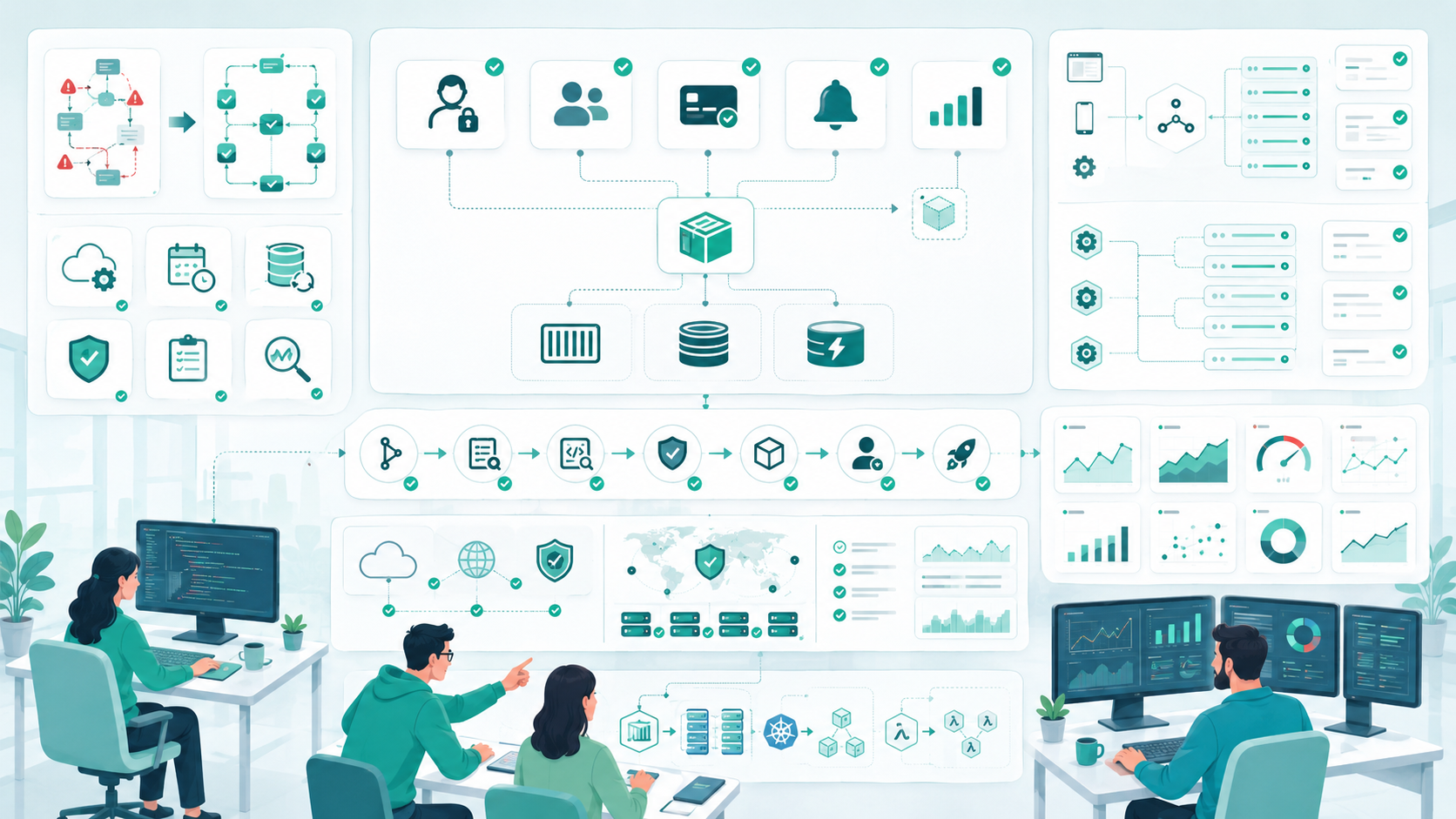
Cloud-native development becomes valuable when it's introduced gradually instead of all at once. Working with a US application engineering partner for cloud-ready products helps teams plan modular architecture, containerization, CI/CD, APIs, automation, monitoring, and scalable cloud infrastructure based on real product needs instead of assumptions.
Over the years, I've found that successful startup teams focus on solving today's problems while keeping enough flexibility for tomorrow.
1. Start with a Modular Application
A modular architecture gives you many of the benefits of Microservices without the operational burden.
Instead of creating ten separate services, organize your code into independent modules.
For example:
- Authentication
- Billing
- Notifications
- User management
- Reporting
Each module has clear responsibilities while sharing the same deployment.
If traffic eventually grows, individual modules can be extracted later with far less risk.
2. Containerize Only What Needs Consistency
Docker is useful because it creates consistent environments between development, testing, and production.
It doesn't mean every supporting tool needs its own container.
Keep the setup simple.
Most early-stage products only need:
- Application container
- Database container
- Cache (if required)
Avoid building dozens of containers simply because tutorials recommend it.
3. Build CI/CD Around Team Productivity
Many developers treat CI/CD as a checkbox.
Instead, build pipelines that remove repetitive work.
A practical deployment workflow might include:
- Automatic testing
- Code quality checks
- Security scanning
- Build validation
- Deployment approval
- Production release
The goal isn't a longer pipeline.
The goal is fewer production mistakes.
4. Design APIs for Growth, Not Perfection
Many teams spend months designing "future-proof" APIs.
In reality, product requirements change constantly.
Keep your API design:
- Consistent
- Versioned
- Well documented
- Easy to modify
Good APIs evolve.
Perfect APIs rarely survive first contact with customers.
5. Use Automation Selectively
Automation saves time when it removes repetitive manual work.
Examples include:
- Infrastructure provisioning
- Backup scheduling
- Deployment verification
- Log collection
- Testing
- Security validation
Don't automate unstable processes.
Fix the workflow first.
Then automate it.
6. Scale Based on Real Metrics
Instead of assuming future demand, measure it.
Track:
- CPU utilization
- Memory consumption
- Response time
- Database performance
- Request latency
- Deployment frequency
- Error rates
Only introduce Scalability, Elasticity, or advanced Serverless patterns when the data shows they're necessary.
Good engineering decisions are driven by measurements—not assumptions.
7. Invest in Platform Stability
As the product grows, begin improving your engineering foundation.
Focus on:
- Reliable Infrastructure
- Consistent Deployment
- Better Integration
- Production Monitoring
- System Observability
- Improved Networking
- Infrastructure Optimization
- Stable Workload management
A dependable platform gives developers confidence to ship changes quickly without increasing operational risk.
These improvements usually deliver far more value than adding another framework or rebuilding the architecture every six months.

When This Approach Fails
No architectural decision works forever, including the "keep it simple" approach.
I've seen startups stay on a modular application for years with excellent results. I've also seen teams hold onto the same architecture long after it became the bottleneck. The key is recognizing when your current design is limiting the business instead of enabling it.
One common sign is that independent teams can no longer work without blocking each other. If every release requires multiple developers to coordinate changes in the same codebase, development velocity begins to slow.
Another warning sign is rapidly increasing Workload. As customer traffic grows, certain parts of the application may require significantly more computing resources than others. Scaling the entire application just to support one heavily used feature becomes inefficient.
Operational requirements also become more demanding as products mature. Industries with strict Compliance requirements often need stronger Governance, enhanced Encryption, detailed audit trails, and stricter access controls. At that stage, separating services may simplify security reviews and regulatory processes.
Growing engineering organizations face another challenge: ownership.
A team of five developers can usually understand the entire application. A team of fifty cannot. As ownership becomes distributed, independent services often provide clearer boundaries and reduce coordination between teams.
That said, moving to a distributed architecture introduces its own costs.
Expect additional investment in:
- Service communication
- Distributed logging
- Advanced Observability
- Infrastructure Monitoring
- API version management
- Incident response
- Production support
These investments are worthwhile only when your product complexity actually demands them.
The biggest mistake isn't adopting cloud-native architecture.
It's adopting it before the business has reached the point where the benefits outweigh the operational overhead.

Sustainable Practices for Small Engineering Teams
Over the past decade, I've noticed that successful engineering teams rarely succeed because they chose the perfect technology stack.
They succeed because they consistently make practical decisions that keep development predictable and sustainable.
Prioritize Simplicity Over Novelty
Every new framework, platform, or architectural pattern increases the learning curve for the team.
Before introducing new technology, ask one question:
"Does this solve a problem we're experiencing today?"
If the answer is no, it's probably unnecessary.
Simple systems are easier to understand, maintain, and improve.
Document Architecture Decisions
Documentation doesn't need to be lengthy.
A short explanation covering:
- Why a decision was made
- Alternatives considered
- Known trade-offs
- Future migration plans
helps new developers contribute much faster.
Good documentation reduces repeated discussions and preserves engineering knowledge as the team grows.
Treat Technical Debt as Planned Work
Technical debt isn't always bad.
Sometimes it's the fastest way to validate an idea.
The problem begins when teams ignore it for months.
Schedule regular engineering work to improve:
- Code quality
- Backend structure
- Frontend organization
- Database optimization
- API consistency
- Test coverage
Small improvements made continuously prevent large and expensive rewrites later.
Improve Deployment Confidence
Reliable Deployment processes reduce stress across the entire engineering team.
Every production release should be:
- Repeatable
- Automated where appropriate
- Easy to roll back
- Clearly documented
Strong deployment practices allow developers to focus on building features instead of worrying about production failures.
Monitor What Actually Matters
Collecting thousands of metrics doesn't automatically improve reliability.
Instead, monitor indicators that directly affect users, such as:
- Application availability
- Response times
- Error rates
- Failed deployments
- Database health
- API latency
Meaningful analytics help engineering teams identify problems before customers notice them.
Optimize Gradually
Many startups treat Optimization as a one-time project.
In reality, performance improvements happen through continuous iteration.
Review your application regularly and identify opportunities to improve:
- Resource utilization
- Infrastructure efficiency
- Database queries
- Network requests
- Build times
- Application startup performance
Small, consistent improvements often produce better long-term results than major architectural rewrites.
Build for Adaptability
One of the biggest advantages of Cloud-Native thinking isn't unlimited scalability.
It's flexible.
Applications designed with clear boundaries, well-defined APIs, reliable Integration, and strong engineering practices are easier to evolve as business requirements change.
That adaptability becomes far more valuable than chasing every new technology trend.
Whether you're building a modern SaaS product or an internal business platform, long-term success depends on creating systems that your team can confidently understand, maintain, and improve—not just systems that look impressive on an architecture diagram.
Conclusion
Cloud-native application development isn't about using every modern technology available. It's about choosing the right level of complexity for your product's current stage.
One of the biggest mistakes I see startup teams make is designing infrastructure for millions of users before they've validated their first few thousand. They invest in distributed architectures, advanced orchestration, and sophisticated deployment pipelines while the real challenge is still finding product-market fit.
The teams that build sustainable products usually take a different approach. They begin with a clean architecture, automate repetitive tasks, monitor production carefully, and evolve their infrastructure only when real usage data justifies the change.
As your application grows, your architecture should grow with it—not ahead of it. Cloud-native development delivers its greatest value when every decision is driven by measurable business needs instead of assumptions about future scale.
The objective isn't to build the most complex system.
It's to build a system your engineering team can confidently develop, maintain, and improve over the long term.
Cloud-Native Application Development In usa: FAQs
Cloud-native application development is the practice of building applications that fully leverage cloud infrastructure. It commonly includes containers, microservices, automation, continuous deployment, scalable infrastructure, and managed cloud services to improve reliability, flexibility, and operational efficiency.
Usually not. Most early-stage startups don't have the operational complexity that justifies Kubernetes. A well-structured application running in Docker containers with a simple deployment pipeline is often easier to manage until the product experiences significant growth.
Not always. For small engineering teams, a modular monolithic architecture is often easier to develop, test, and maintain. Microservices become valuable when independent teams, large workloads, or separate scaling requirements make service isolation beneficial.
Focus on solving current business problems rather than preparing for every possible future scenario. Use automation where it removes repetitive work, maintain clear documentation, monitor production systems, and introduce new infrastructure only when measurable growth requires it.
A migration makes sense when application traffic, deployment frequency, engineering team size, or operational requirements begin exceeding what the current architecture can efficiently support. The decision should be based on real performance metrics and business needs rather than technology trends.
Reference
Written by

Paras Dabhi
VerifiedFull-Stack Developer (Python/Django, React, Node.js)
I build scalable web apps and SaaS products with Django REST, React/Next.js, and Node.js — clean architecture, performance, and production-ready delivery.
LinkedIn