
Ecommerce Software Development Company In Ahmedabad
Ecommerce projects don't usually fail in the beginning — they fail a few weeks in, when real complexity starts showing up.
Deadlines begin to slip, checkout issues appear late, and teams end up rewriting flows they thought were already done.
In most small teams, especially in Ahmedabad-based projects, this isn't a coding problem. It's a planning and scoping problem — where product structure, payment logic, and feature expectations were never clearly defined from day one.
If your ecommerce build keeps getting delayed or breaking mid-development, the issue is likely not your team — it's how the system was designed before the first line of code was written.
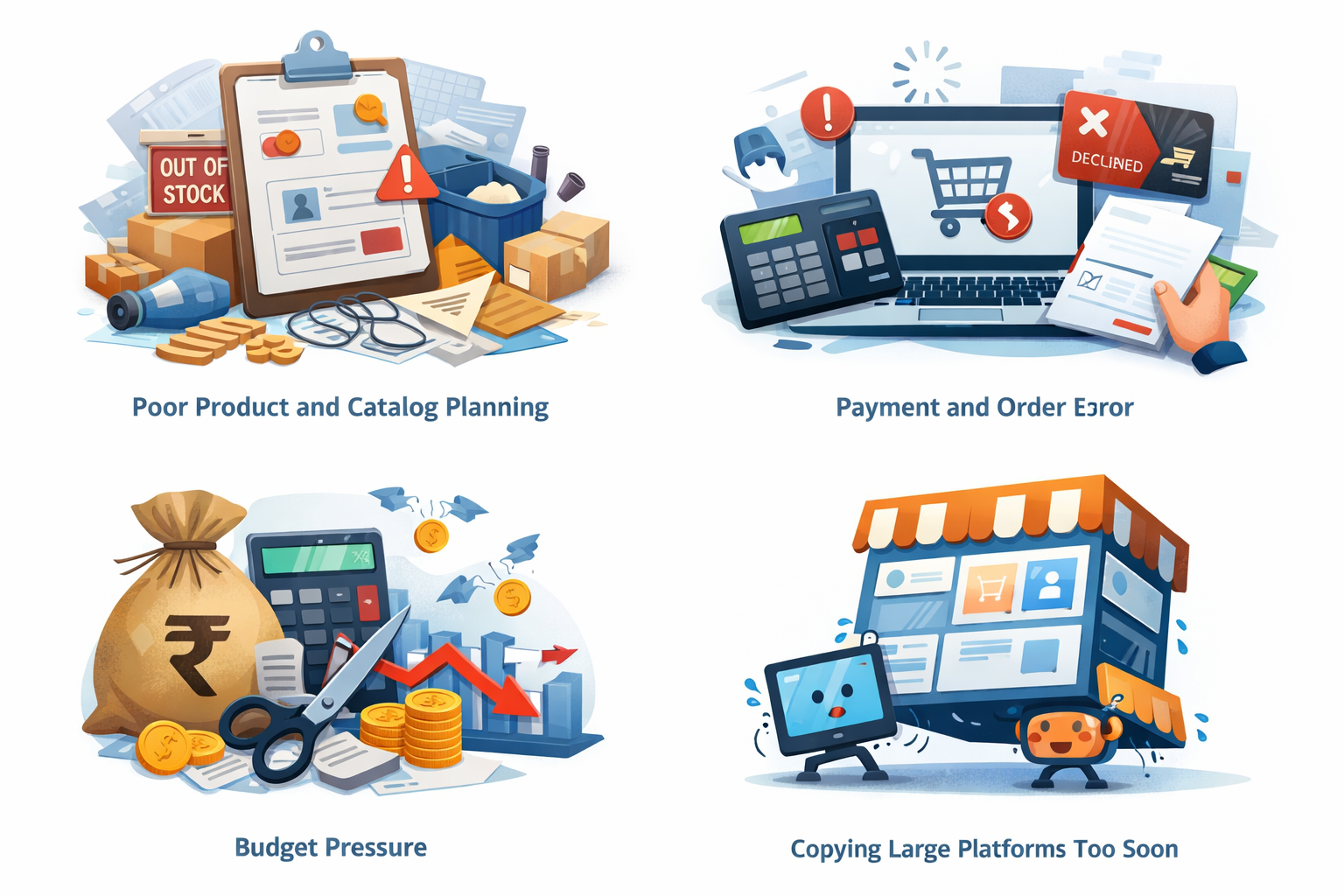
Why this problem actually happens
Most small teams don't fail because ecommerce is "hard." They fail because they underestimate where the complexity actually lives.
Poor product and catalog planning
Most teams start with a simple product model without thinking about how it will evolve. As filters, variants, and categories grow, the structure becomes messy and hard to manage. This is where proper Ecommerce Development planning matters early, because fixing catalog complexity later is much harder than designing it properly from the start. This leads to frequent schema changes and backend confusion.
Payment and order logic is underestimated
Payments are not just "success or failure." They involve retries, partial payments, refunds, and syncing with orders. Many teams don't design for these cases early, which is why stronger product-specific planning becomes important once ecommerce flows start depending on project-specific payment and order logic. As a result, bugs appear during real transactions, not during development.
Budget pressure (common in Ahmedabad projects)
Limited budgets push teams to take shortcuts in architecture and planning. Founders expect more features within tight constraints. This leads to rushed decisions and technical compromises. These shortcuts usually cause bigger problems later.
Trying to copy large platforms too early
Teams often try to replicate features from big ecommerce platforms in the first version. This includes multi-vendor, advanced search, and complex pricing systems. Small teams struggle to handle this level of complexity. It slows development and increases instability.
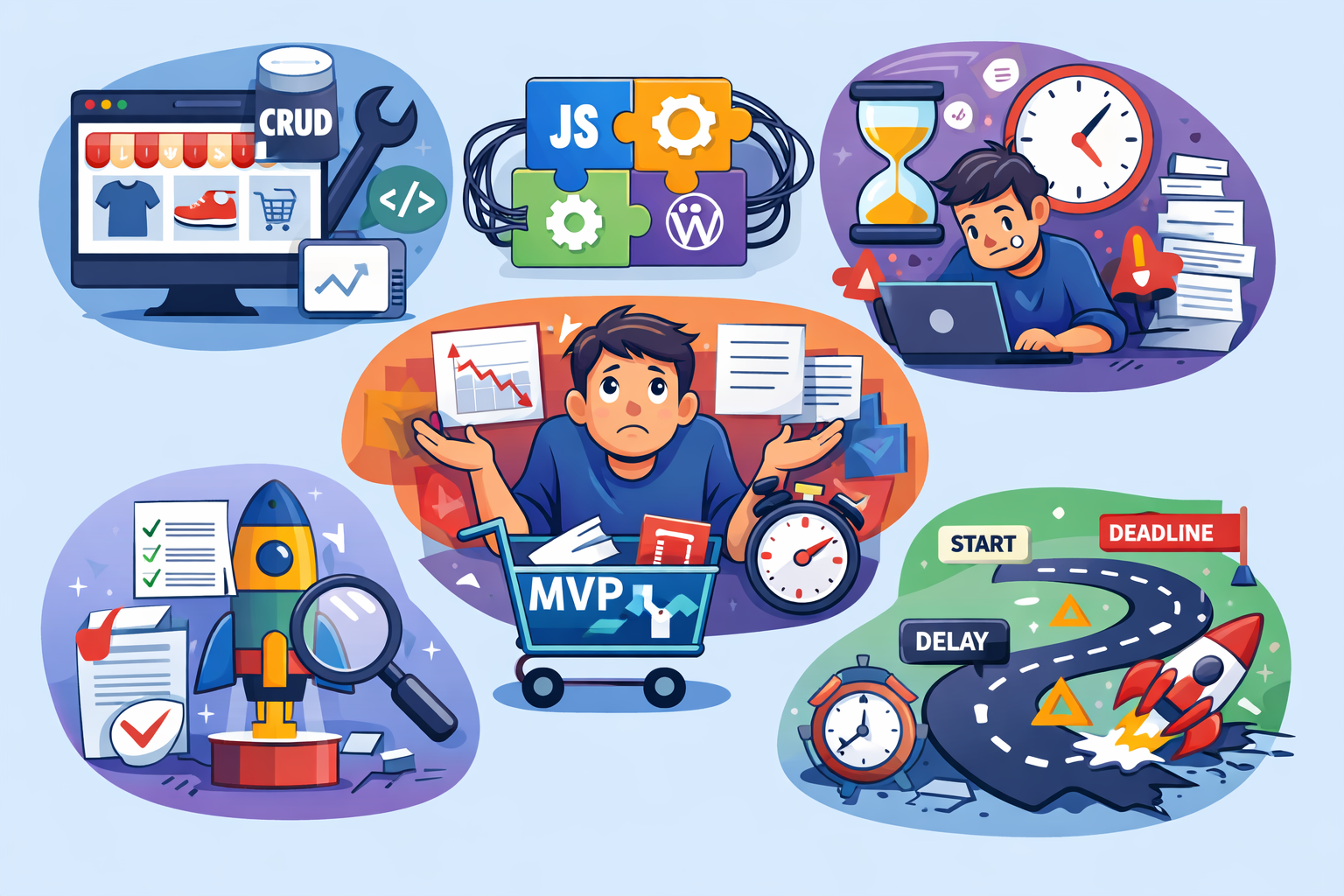
Where most developers or teams get this wrong
I've seen teams build checkout logic 3 times in the same project.
Treating ecommerce like a simple CRUD system
Ecommerce is often assumed to be basic create-read-update-delete operations. But the real complexity lies in edge cases like failed payments or stock conflicts. Ignoring this leads to fragile systems. The basic flows work, but real-world usage breaks them.
Overusing plugins or frameworks
Developers rely on tools expecting them to handle most problems. But these tools have limitations that aren't obvious at the start. When customisation is needed, things get complicated quickly, especially in builds that begin as simple product development but later grow into more complex ecommerce workflows. This results in time loss and unstable integrations.
Rushed execution due to pressure
Teams are often pushed to deliver fast without fully understanding requirements. This leads to quick but weak implementations. Important decisions are made without proper validation. Over time, these shortcuts create technical debt.
Expecting a full-featured MVP
Founders often want all features in the first version — wishlist, coupons, analytics, and more. Adding everything at once increases complexity and delays delivery. It also makes the system harder to stabilise.
Overpromised timelines
To win projects, timelines are often underestimated. Developers then struggle to meet unrealistic expectations. This results in rushed work and incomplete features. The overall quality of the product suffers.
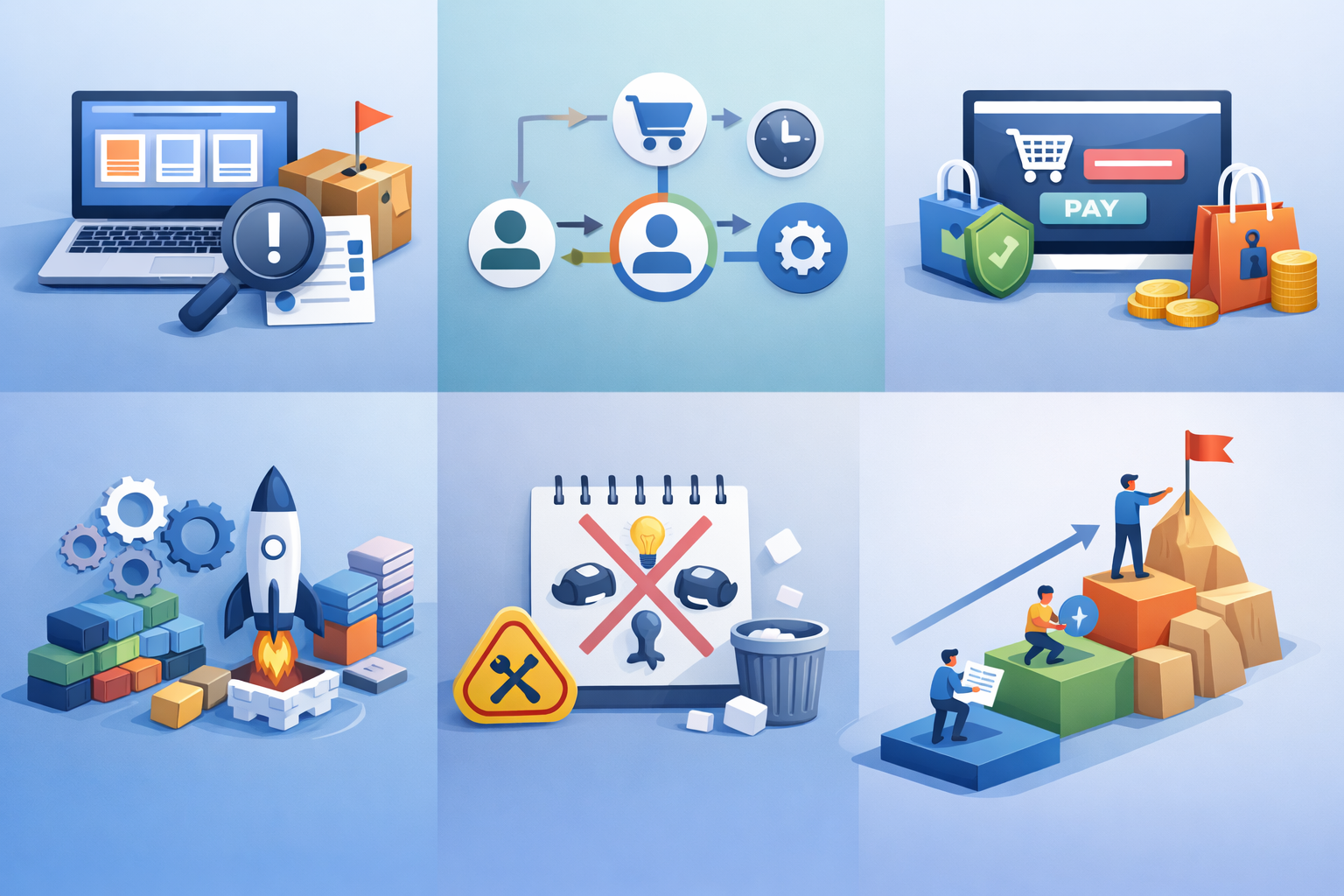
Practical solutions that work in real projects
These are things that have actually worked across projects.
Start with a limited catalog model
Keeping the product structure simple helps teams move faster. It reduces confusion in backend logic and frontend rendering. This approach allows better testing and fewer bugs. Complexity can be added later when needed.
- Simple products + basic variants
- Minimal category structure
- No advanced filtering early on
Less flexibility early, but faster and more stable development.
Separate core flows early
Breaking the system into product, order, and payment flows improves clarity. Each part can be developed and tested independently. This reduces the risk of system-wide failures. It also makes debugging easier.
- Product and catalog
- Order management
- Payment system
Each part works independently, reducing risk of system-wide failures.
Build checkout as a standalone module
Checkout is the most sensitive part of ecommerce systems. Treating it as a separate module helps manage complexity. It allows proper handling of retries, failures, and states, and this is exactly where disciplined validation becomes critical before real users start placing orders. This makes the system more reliable.
When checkout logic is scattered, debugging becomes extremely hard.
- Handle retries properly
- Store intermediate states
- Log each step
Avoid over-engineering early
Trying to build a scalable system too early adds unnecessary complexity. Small teams benefit from simple and direct solutions. Over-engineering slows development and increases confusion. It's better to optimise later when needed.
- Skip microservices initially
- Skip complex API layers
- Avoid premature optimisations
You may refactor later, but early simplicity saves time.
Define "what NOT to build"
Clear boundaries are important for managing scope. Deciding what to exclude prevents feature creep. This helps teams stay focused on core functionality. It also improves delivery speed.
- No multi-vendor in v1
- No complex discount engine
- No custom analytics
Keeps scope realistic and manageable.
Build in phases, not features
Instead of building everything at once, divide development into phases. This reduces pressure and improves quality. This approach also creates a stronger foundation for ecommerce software solutions for growing businesses by allowing teams to stabilise core flows first before expanding into more complex features.
Phase 1: Basic browsing + ordering
Focus only on essential user actions like viewing products and placing orders. Keep the flow simple and stable. This ensures the foundation works properly and allows faster initial launch.
Phase 2: Payment improvements
Once basic ordering works, improve payment handling. Add retries, better error handling, and integrations. This phase strengthens reliability and prepares the system for real users.
Phase 3: Enhancements
After core flows are stable, additional features can be added. This includes performance improvements and extra functionality. The system is now ready for gradual scaling.

When this approach does NOT work
This approach has limits.
High growth or scaling systems
Simple systems may fail under heavy traffic. Performance bottlenecks start appearing. This requires better architecture and optimisation, and stronger infrastructure planning usually becomes necessary once ecommerce traffic, checkout load, and background processing start increasing. Scaling needs a different approach than initial development.
Multi-vendor or marketplace models
These systems introduce multiple layers of complexity. Each vendor may have different pricing and rules. Orders may need to be split and managed separately. This requires careful system design from the start.
Frequently changing business models
When business requirements change often, the system becomes unstable. Constant modifications lead to messy code and logic conflicts. A more flexible architecture is needed in such cases. Otherwise, development slows down.

Best practices for small development teams
Keep scope tight
Limiting features helps maintain control over the project. It reduces confusion and development time. Teams can focus on what actually matters. This leads to more stable outcomes.
Write clear, predictable logic
Simple and readable code is easier to maintain. Complex logic increases the chance of bugs. Predictable behaviour helps in debugging and scaling. Clarity is more important than cleverness.
Maintain strong communication
Miscommunication causes more issues than technical problems. Clear discussions prevent incorrect assumptions. Regular alignment keeps everyone on the same page. It improves overall project quality.
Log critical flows
Tracking orders and payments is essential. Logs help identify where things go wrong. Without logs, debugging becomes difficult. Good logging improves reliability and support.
Accept refactoring as part of the process
No system is perfect from the start. Changes and improvements are inevitable. Refactoring helps clean up and improve structure. Accepting this makes long-term development smoother.
Conclusion
Ecommerce projects don't usually fail because the team isn't capable. In most cases, the developers know what they're doing. The real issue is how the project is approached from the beginning — too many assumptions, too much scope, and not enough structure.
What I've seen repeatedly is teams trying to build a "complete" ecommerce system in one go. That decision alone creates unnecessary pressure. When everything is built together — catalog, orders, payments, discounts — small issues quickly turn into bigger problems that are hard to trace and fix.
The projects that actually survive are the ones where teams simplify early decisions. They keep the catalog manageable, isolate critical flows like checkout and payments, and avoid adding features that aren't immediately needed. This doesn't make the system perfect, but it makes it stable enough to handle real users.
Another important shift is thinking in phases instead of completeness. Instead of asking "What all features do we need?", better teams ask "What is the smallest version that works reliably?" That mindset reduces rework and helps teams move forward with clarity.
Ecommerce Software Development Company In Ahmedabad: FAQs
Only if your business model is unique; otherwise, it adds unnecessary complexity early on.
Because order, payment, and edge-case handling are more complex than they appear.
Yes, if scope is controlled and development happens in phases.
Because it involves multiple states and failure handling that are often underestimated.
No, adding too many features early usually leads to instability and delays.
References
Written by

Paras Dabhi
VerifiedFull-Stack Developer (Python/Django, React, Node.js)
I build scalable web apps and SaaS products with Django REST, React/Next.js, and Node.js — clean architecture, performance, and production-ready delivery.
LinkedIn