End To End Software Development Company In Ahmedabad
A lot of founders come in saying they want an "end-to-end development team." What they usually mean is simple: "Handle everything so I don't have to."
But in real projects, this is where things start going wrong.
I've worked on projects where "end-to-end" sounded clean in theory — but turned into unclear ownership, delays, and messy handoffs.

Why this problem actually happens
Unrealistic expectations from small teams
Small teams are often expected to deliver like full-scale companies, which isn't realistic. Founders assume a few developers can handle planning, development, testing, and deployment without trade-offs. This leads to rushed work and missed details, especially when the product is expected to cover both backend delivery and mobile needs from the very beginning. The gap between expectations and capacity is where most problems begin.
Lack of role separation
When roles aren't clearly defined, everyone ends up doing a bit of everything. This creates confusion around ownership and slows decision-making. Important tasks get delayed because no one is fully responsible for them. Even in small teams, some level of role clarity is necessary to keep things moving.
Context switching kills productivity
Frequent switching between tasks like coding, meetings, and debugging breaks focus. Developers lose momentum every time they shift context, which reduces efficiency. It might feel like progress is happening, but actual output slows down. Deep work needs uninterrupted time, which most teams fail to protect.
"End-to-end development" sounds efficient, but small teams aren't structured for it the way larger companies are. In most startups or small agencies, the same 3–6 people are expected to:
- Define requirements
- Design the system
- Write backend + frontend
- Handle deployment
- Fix bugs
- Talk to the client
That's not a process — that's overload. The real issue is no clear separation between decision-making and execution, founders expecting strategy and development from the same people, and developers switching context too often.

Where most developers or teams get this wrong
The biggest mistake is assuming "end-to-end" means one team doing everything equally well. That's rarely true.
I've seen teams:
- Start coding before requirements are stable
- Skip proper system design to "move faster"
- Mix client communication with deep technical work
- Treat deployment as an afterthought
In most startups, this happens because there's pressure to show progress quickly, founders don't want to manage multiple people, and teams try to avoid "overhead" like documentation or planning.
The hidden cost of "one team does everything"
There's a common belief: "If one team handles everything, things will be simpler." In reality, it often becomes harder to track who is responsible for what, why something was built a certain way, and where delays are coming from. This gets worse when teams try to combine delivery, reviews, and validation without clear ownership inside the project.
Read More → How Local Businesses Build Software In Ahmedabad
Practical solutions that work in real projects
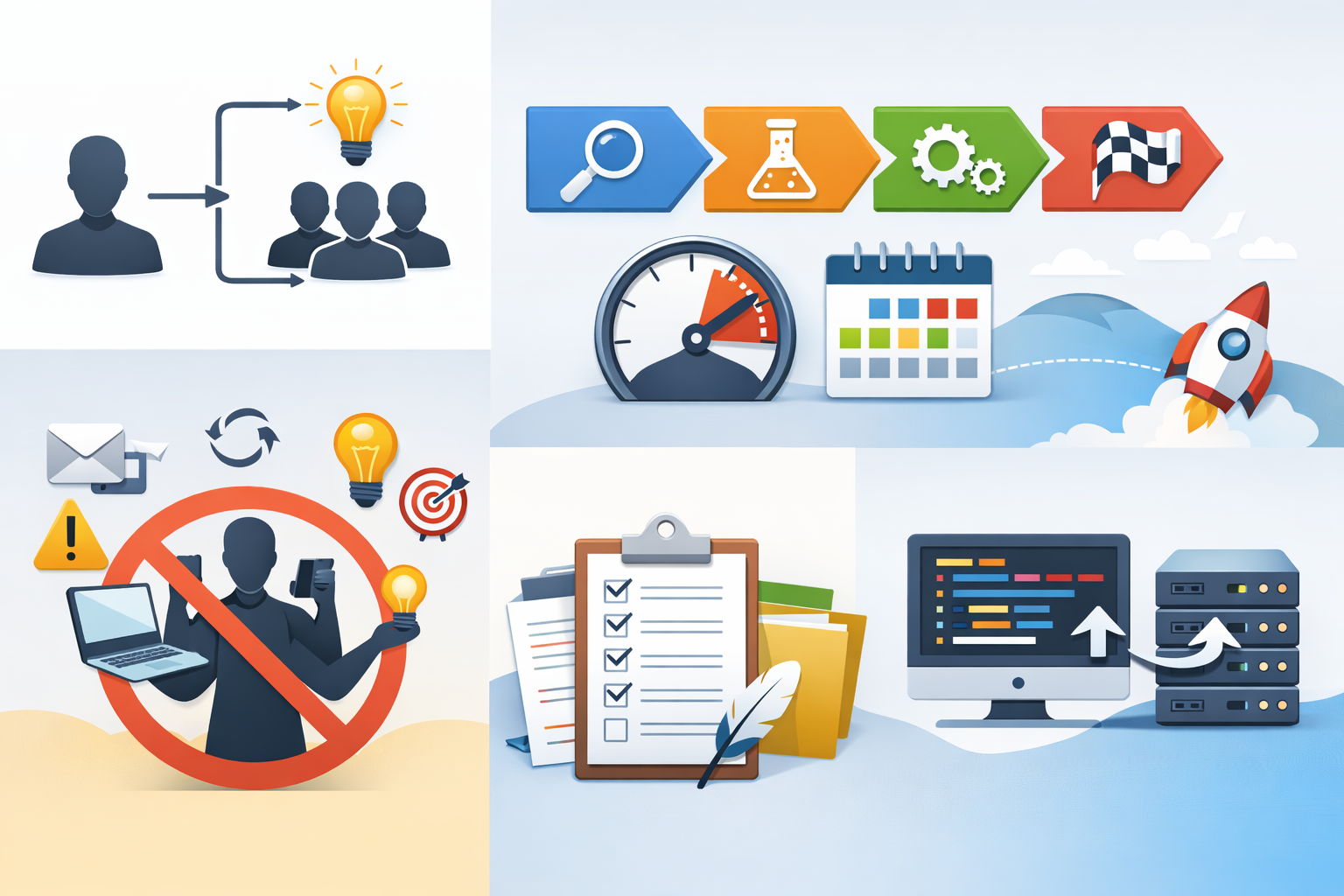
Instead of forcing "end-to-end" as a single block, what works better is structured ownership within small teams.
1. Separate decision-making from execution
In small teams, problems start when everyone is both deciding and building at the same time. It slows things down and creates confusion. One person should take responsibility for technical direction, while others focus on execution.
Even in a 4–5 person team:
- One person owns technical decisions (architecture, stack, structure)
- Others focus on execution (building features, fixing issues)
This avoids situations where everyone is doing everything halfway.
2. Define phases clearly (even if timelines are tight)
Skipping phases feels faster, but it usually leads to mistakes later. Even in tight deadlines, you need basic clarity before moving forward. This is why full-cycle software development services in Ahmedabad are usually more effective when each stage is handled with clear ownership instead of rushing everything at once. You can overlap slightly, but skipping phases entirely creates rework later.
- Phase 1 → Requirements clarity
- Phase 2 → System design
- Phase 3 → Development
- Phase 4 → Deployment + feedback
3. Limit context switching
Switching between coding, meetings, and debugging kills productivity more than most teams realise. Developers need uninterrupted time to actually build things. Too many interruptions slow progress and increase mistakes, especially when delivery also depends on release coordination being handled by the same small group.
- Batch meetings into fixed slots
- Keep uninterrupted development time
- Assign one person for client communication
4. Use lightweight documentation (not heavy processes)
You don't need long documents, but you do need clarity somewhere. Writing down key decisions saves time later. I've seen teams waste days re-discussing things that were already decided — just because nothing was documented.
At minimum:
- API structure
- Database decisions
- Feature logic
5. Treat deployment as part of development, not the end
Many teams delay deployment setup until the last stage, which creates unnecessary stress. A common mistake is saying "We'll handle deployment later" — that "later" becomes a bottleneck.
- Set up deployment early
- Push small changes frequently
- Catch issues before they pile up

When this approach does NOT work
This structured approach isn't perfect. It can break in certain situations.
Extremely early-stage ideas
When requirements change daily, structure slows you down. At this stage, flexibility matters more than defined phases. The team needs to move quickly and adjust constantly. Structured phases don't work when the idea itself isn't settled.
Very small teams (1–2 developers)
With only one or two developers, strict role separation isn't practical. Everyone has to be flexible and handle whatever comes up. Structure helps, but rigid role definitions will create friction. Keep it light and focused on outcomes.
Founders who want constant changes without prioritisation
If the direction keeps shifting, no structure can hold. Even a well-run team can't stay stable under constant reprioritisation. This is a product decision problem, not a development one. Resolve direction first, then apply structure.
Teams lacking experience
If the team lacks experience, even defined roles won't help much — decisions will still be weak. Structure only helps when combined with technical judgement. In these cases, investing in better people matters more than better processes, especially if the roadmap may later involve data-heavy features that require stronger technical foundations from the start.

Best practices for small development teams
From experience, these are the habits that actually keep projects stable.
Keep roles clear, even if people overlap
In small teams, one person may handle multiple responsibilities, and that's fine. But ownership should still be clearly defined. If everyone is responsible for everything, no one is truly accountable. Clear roles help avoid confusion and delays during execution.
Don't skip system thinking
If the team lacks experience, even defined roles won't help much — decisions will still be weak. Structure only helps when combined with technical judgement. In these cases, investing in better people matters more than better processes, especially if the roadmap may later involve data-heavy features that require stronger technical foundations from the start.
- Basic architecture
- Data flow clarity
Skipping this always leads to rework.
Avoid "build first, fix later" mindset
This approach feels fast in the beginning but usually backfires. Problems stack up quickly and become harder to fix later. Teams end up spending more time debugging than building. It's better to build carefully than rush into technical debt.
Communicate decisions, not just progress
Saying "it's done" isn't enough in real projects. Teams need to understand how and why something was built. Instead of just saying "Feature is done", explain how it works and why it was built that way. This avoids confusion when changes are needed later.
Prioritise stability over speed
Speed is useful, but only if the system remains stable. Constant bugs and breaking features slow everything down eventually. A stable system allows consistent progress without repeated fixes. Long-term efficiency always beats short-term speed.
- Bugs increase
- Features break
- Timelines keep shifting
Fast delivery doesn't matter if all three of these are happening.
Conclusion
"End-to-end development" isn't the problem. The problem is how it's interpreted.
In small teams, trying to do everything at once usually leads to unclear ownership, constant context switching, and avoidable delays.
What actually works is simple: define ownership, structure the work, and reduce unnecessary overlap.
Not perfect systems — just clearer ones.
FAQ
It can work, but only if roles and responsibilities are clearly defined within the team.
Because the same people handle multiple responsibilities, leading to context switching and unclear ownership.
By structuring work better, reducing overlap, and assigning clear ownership for decisions and execution.
It works only for very small projects; beyond that, it creates bottlenecks and quality issues.
Starting development without clear requirements or system design.
References
Written by

Paras Dabhi
VerifiedFull-Stack Developer (Python/Django, React, Node.js)
I build scalable web apps and SaaS products with Django REST, React/Next.js, and Node.js — clean architecture, performance, and production-ready delivery.
LinkedIn