Enterprise Software Development Cost In Ahmedabad
A founder approves a budget thinking the system will cost ₹15–20 lakhs. Three months in, it's already crossed ₹30 lakhs — and still not complete.
This isn't rare. I've seen this happen across multiple enterprise projects in Ahmedabad.
The real issue isn't just high cost — it's unpredictable cost. And that's what makes planning difficult.

Why enterprise software costs become unpredictable in Ahmedabad
Incomplete requirements at the start
Most enterprise projects begin with partial clarity. Teams know the goal but not the detailed workflows, edge cases, or integrations. This leads to estimates based on assumptions, not facts. Later, when details emerge, the cost naturally increases.
Pressure to give low initial estimates
In competitive markets, vendors often feel forced to quote lower just to win the project. These estimates rarely reflect real complexity, especially in systems that may later need broader delivery across multiple business flows and user roles. The missing effort shows up later as change requests or timeline extensions. This is one of the most common reasons budgets break.
Frequent stakeholder changes
Enterprise projects involve multiple decision-makers, and priorities often shift mid-way. New inputs lead to rework, redesign, or added features. Each change impacts both timeline and cost, especially when the product is already moving through workflow changes across the system. Without control, this becomes a continuous cycle.
Lack of technical ownership
When no one internally understands or owns technical decisions, everything depends on the vendor. This creates blind spots in architecture, estimation, and scalability. Businesses end up reacting instead of controlling. That lack of oversight increases risk and cost.
Expectation vs reality mismatch
Clients often expect a fully polished system within a fixed budget and timeline. But enterprise systems evolve as real use cases emerge. This mismatch creates frustration on both sides. It also leads to unplanned cost increases.
Where most teams and businesses get this wrong
Treating enterprise projects like small apps
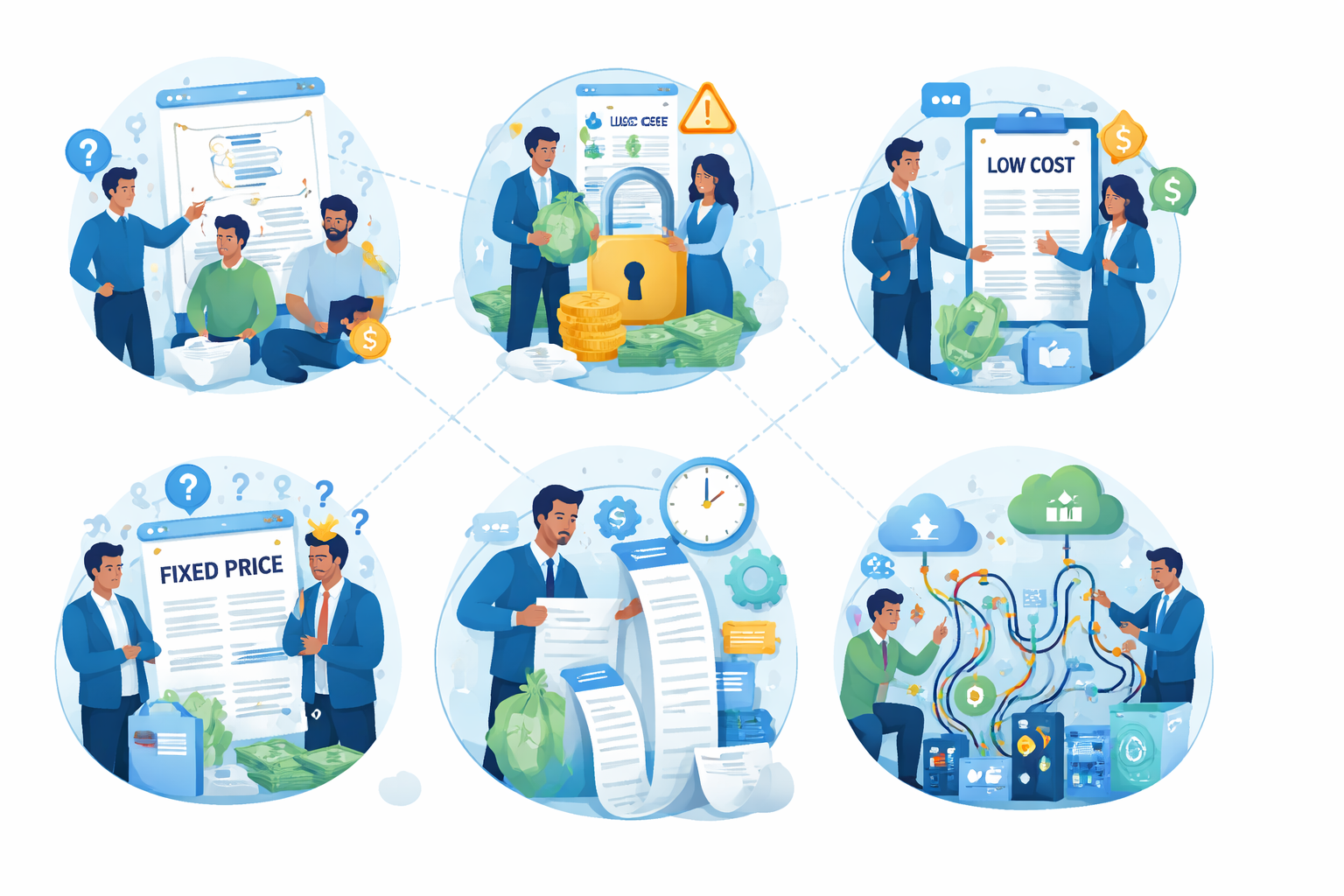
Enterprise systems involve complexity — integrations, permissions, data flows, and edge cases. Treating them like simple apps leads to underestimation. Teams miss hidden work early on. This causes budget and timeline issues later.
Locking budget before defining the system
Fixing a budget before understanding the system properly is risky. Without clear scope, the estimate is just a guess. As real requirements surface, costs go beyond the locked number. This creates tension between client and team.
Choosing vendors based only on lower cost
A lower quote often means something is missing — scope, effort, or future flexibility. It may look cost-effective initially, but problems appear later. Businesses end up paying more through changes and fixes. Cost should never be the only decision factor.
A lower quote usually hides:
- Missing scope
- Underestimated complexity
- Future dependency on paid changes
Expecting fixed pricing with unclear scope
Fixed pricing works only when everything is clearly defined. Without clarity, either quality is compromised or cost increases later. It also leads to constant negotiation during development. This slows down progress and affects delivery.
This creates conflict where either quality drops or cost increases later.
Ignoring long-term costs
Most teams focus only on development cost and ignore what comes after. Maintenance, infrastructure, scaling, and updates add ongoing expenses. These costs often exceed initial expectations. Not planning for them leads to budget stress later.
What teams forget to include:
- Maintenance
- Infrastructure
- Scaling
- Bug fixing after launch
Underestimating integration complexity
Common integrations that cause cost issues:
- ERP systems
- CRM tools
- Payment gateways
- Internal legacy software

Practical ways to control enterprise software cost (that actually work)
Break the project into smaller deliverables
Dividing the project into phases improves control and visibility. Teams can validate progress early and adjust direction if needed. It reduces the risk of large failures. This approach keeps both cost and expectations in check.
Example breakdown:
- Core workflows first
- Secondary features next
- Advanced automation last
Define scope before estimation
Estimation without scope is just guesswork. Even basic flow diagrams or feature breakdowns can improve accuracy. Clear scope helps teams understand effort properly. It reduces unexpected changes later.
Use milestone-based costing
Instead of committing to full-project pricing, break payments into milestones. This allows evaluation at each stage. Both client and team can adjust based on progress, which works especially well in projects that may later expand into additional platforms after the core system is validated. It creates transparency and reduces financial risk.
Keep the first version limited
Trying to build everything in version one increases complexity and cost. A focused first version helps validate real usage. It also reduces initial investment. Future improvements can be based on actual feedback.
Version one should include:
- Core functionality only
- Stable and tested workflows
- Enough for real usage feedback
Set weekly checkpoints
Long feedback cycles lead to bigger mistakes. Weekly checkpoints help catch issues early. Small corrections are easier and cheaper to fix. This keeps the project aligned with expectations.
Trade-offs you should be aware of
Cost control comes with trade-offs. Better planning may slow initial progress. Smaller releases need discipline and consistency. Understanding these trade-offs helps teams make better decisions.
Planning vs speed
Spending time on planning delays development. But it reduces confusion and rework later. Skipping planning may feel faster but usually increases cost. It's a trade-off between short-term speed and long-term stability.
Smaller releases vs discipline
Releasing in smaller phases improves control and feedback. But it requires teams to stay disciplined and focused. Without consistency, this approach fails. It's effective only when properly followed.
Frequent checkpoints vs time investment
Regular reviews take time from stakeholders. But they prevent major issues later. Skipping them saves time short-term but increases risk. It's an investment in smoother execution.

When these cost-control approaches don't work
Constant change in direction
If business goals keep shifting, the system keeps changing. This leads to repeated rework and wasted effort. No estimation can handle constant changes. Stability in direction is critical for cost control.
Lack of leadership involvement
Without active leadership, decisions get delayed or unclear. Teams may build based on assumptions. This results in rework and inefficiency. Strong involvement keeps projects aligned and controlled.
What happens without leadership:
- Delayed decisions across the project
- Confusion in priorities and direction
Inexperienced teams in enterprise systems
Enterprise projects need experience in handling complexity. Businesses usually make better long-term decisions when they work with custom software experts for enterprise-level projects because experienced teams are less likely to overbuild or miss critical aspects. Both situations increase cost. Experience helps in making balanced decisions.
Common technical mistakes from inexperience:
- Over-engineering simple features
- Poor scalability planning from the start
Unrealistic deadlines
Tight deadlines force teams to rush development. Planning, testing, and validation are often skipped, and this becomes even riskier when the system depends on stable releases, environments, and operational support to handle enterprise-level delivery properly. This leads to bugs and rework later. In the end, cost increases instead of decreasing.
What rushing causes:
- Skipped planning and design
- Less testing before launch
- More rework after release

Best practices for managing enterprise software budgets in small teams
Clear ownership
Every project needs clear responsibility on both sides. One person should handle technical decisions, another business requirements. Without ownership, confusion spreads quickly. Clear roles improve efficiency.
Required roles:
- Technical decision owner
- Business requirement owner
Realistic estimation habits
Estimates should include uncertainty, not just best-case scenarios. Teams should account for delays, integrations, and feedback cycles. Honest estimation builds trust. It also reduces surprises later.
What to always include in estimates:
- Buffer for unknowns
- Integration delays
- Feedback and revision cycles
Documentation before development
Basic documentation prevents misunderstandings. It helps align expectations between client and team. Even simple flow diagrams or API notes can save time. Lack of documentation leads to rework.
What to document at minimum:
- User flows
- APIs and data contracts
- Data structures
Avoid over-engineering early
Building complex architecture too early increases cost and effort. Most systems don't need advanced scaling at the start, and they usually don't need high-complexity technical layers unless the actual product requirements clearly demand them. Keep things simple until there is real demand. Complexity should come later, not upfront.
Keep architecture flexible
The system should be adaptable, but not overbuilt. Over-flexibility increases unnecessary complexity. At the same time, rigid systems fail when requirements change. Balance is key for long-term stability.
The balance to maintain:
- Not too simple to limit future growth
- Not too complex to slow current development
Conclusion
Enterprise software development cost in Ahmedabad doesn't increase randomly.
It increases when:
- Scope is unclear
- Decisions are delayed
- Expectations are misaligned
Most overruns are decision problems, not technical ones. Clarity controls cost more than negotiation ever will.
What I've seen consistently is this: teams that invest time in understanding the system early rarely face major cost shocks later. On the other hand, projects that rush into development without alignment almost always pay the price.
Enterprise projects don't fail because they are complex — they fail because complexity is ignored at the start.
FAQ
It varies widely. Basic systems may start around ₹10–15 lakhs, while complex platforms cost significantly more due to integrations and scope.
Changing requirements, weak planning, and underestimated complexity are the main reasons.
Only if scope is clearly defined — otherwise it leads to conflict or compromises.
By breaking work into smaller deliverables and maintaining tight scope control.
Integration complexity and ongoing changes — both are often underestimated initially.
References
Written by

Paras Dabhi
VerifiedFull-Stack Developer (Python/Django, React, Node.js)
I build scalable web apps and SaaS products with Django REST, React/Next.js, and Node.js — clean architecture, performance, and production-ready delivery.
LinkedIn