
How To Avoid Delays In Software Development Projects
If your sprint deadlines keep moving, the problem is usually not that your developers are slow.
In small teams, delays often start when "small" changes keep entering the sprint, approvals come late, or one blocked API quietly stops three other tasks. I've seen teams spend more time waiting, reworking, and retesting than actually building.
The frustrating part is that everyone stays busy, yet the release date still slips.
Most of the time, the fix is not adding more developers. It's removing the delivery patterns that create invisible delays.
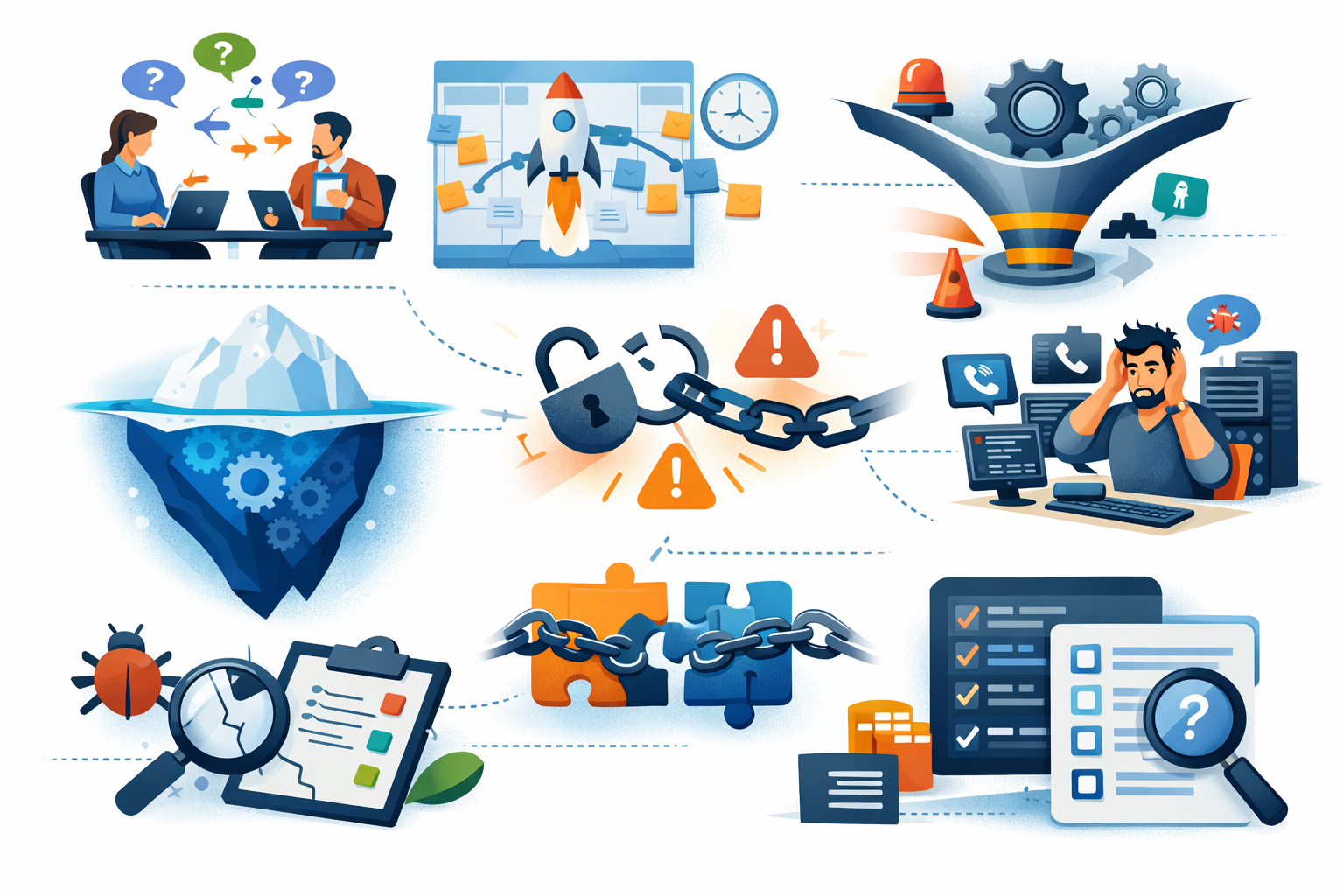
Why Software Project Delays Actually Happen
In real projects, delays rarely come from coding effort alone, which is why Custom Software Development works best when delivery structure, ownership, and technical planning are handled with the same seriousness as coding itself.
The most common issue is unclear ownership. A feature moves from product to design to frontend to backend, but nobody is responsible for final delivery. When bugs appear or requirements shift, everyone assumes someone else will handle it.
Another common issue is requirements changing mid-sprint. In startups, founders often spot new opportunities during demos or testing. The request feels small — one more field, one extra workflow, one quick validation — but every change creates rework across frontend, backend, QA, and deployment.
Small teams also suffer from dependency bottlenecks. I've worked with teams where one senior backend developer handled:
- API architecture
- Deployment pipelines
- Database migrations
- Production bug fixes
The moment that person gets pulled into urgent support, feature delivery slows down everywhere.
Then there's hidden technical debt. A feature estimated at two days suddenly becomes five because old authentication logic breaks, shared components are tightly coupled, or test coverage is missing. These issues rarely show up during planning, but they surface during execution.

Where Most Teams Get This Wrong
The biggest mistake I see is estimating before technical discovery. Teams commit sprint deadlines before validating API complexity, third-party limitations, or edge-case workflows. The estimate looks fine on paper, but the unknowns were never discussed.
I've seen teams lose almost a week because the front end started building against assumed API contracts. Once the backend finalized the response structure, multiple screens had to be rebuilt.
Another mistake is starting UI work before workflows are frozen, which is why user journeys should be locked early so the team does not waste time rebuilding screens after every approval round.
A hidden delay pattern is too much work-in-progress. When developers juggle:
- One urgent production bug
- Two sprint tasks
- One client revision
- QA support
- Release fixes
Nothing actually finishes on time. Busy teams often mistake movement for progress.
The other major issue is treating every request as urgent. This destroys sprint integrity. Once teams normalize mid-sprint interruptions, timelines become impossible to trust.
Read More → How To Reduce Software Development Costs
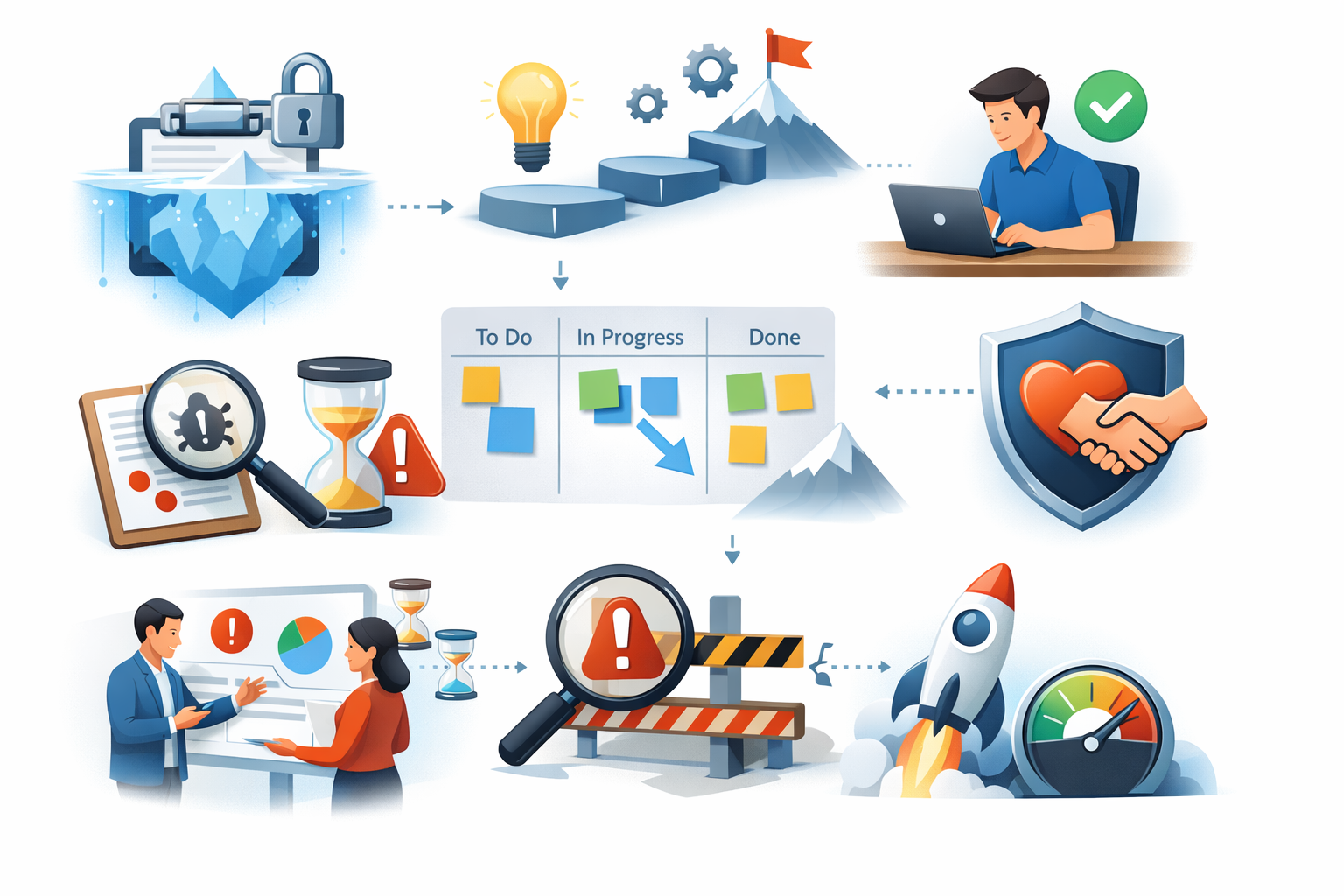
Practical Ways To Avoid Delays In Real Software Projects
These fixes have worked far better for me than simply increasing team size.
1. Freeze Scope Before Sprint Execution
Once a sprint starts, the biggest risk is unplanned work quietly entering the cycle. Even small founder or client changes create rework across development, QA, and release validation. A strict scope freeze keeps delivery predictable and forces teams to make conscious trade-offs instead of extending deadlines by habit.
A simple rule that works:
- New request enters backlog
- PM decides whether it replaces current sprint work
- QA impact is reviewed first
- Release date changes only if scope officially changes
This protects delivery trust.
2. Break Features Into Dependency-Based Milestones
Large feature tickets hide blockers until it is too late, which is why delivery becomes more effective when backend readiness, integrations, and release dependencies are tracked as separate checkpoints.
Do not track features as one large task. Split them into:
- API readiness
- Schema validation
- Frontend integration
- QA checkpoints
- Release checklist
- Rollback safety
This makes blockers visible early. For example, frontend should never be marked "in progress" if API payloads are still changing.
3. Assign One Owner Per Feature
When multiple people touch the same feature without a clear owner, blockers usually sit unresolved. One delivery owner keeps approvals, API contracts, testing status, and release readiness moving in one direction. In small teams, this reduces confusion and avoids the classic "I thought someone else had it" delay.
Every feature needs one delivery owner — not necessarily the best coder, but the person responsible for:
- Tracking blockers
- Getting approvals
- Confirming API contracts
- Checking test coverage
- Pushing release readiness
Without ownership, blockers stay invisible until standup. In small teams, this one change alone dramatically reduces "I thought someone else was doing it."
4. Review Delivery Risk Every 2–3 Days
Task status alone does not show whether the release is actually safe. Risk reviews every few days expose issues like unclear requirements, late approvals, environment problems, or third-party blockers before they become missed deadlines, which is why many teams rely on software experts for faster project execution in Ahmedabad who can identify delivery risks early and keep releases moving before small blockers become deadline failures. This habit helps teams solve delivery threats while there is still time to adjust.
Most teams review task status, but not delivery risk. What actually needs review:
- Unclear requirements
- Late founder feedback
- Pending client approvals
- Third-party API dependencies
- Test environment issues
- Deployment risk
- Edge cases not yet validated
I prefer risk reviews every 48 hours for active releases. This catches sprint slips before they become deadline failures.
5. Reduce Work-in-Progress
Too many active tasks slow teams down because developers keep switching context between bugs, features, reviews, and support issues, which is why release quality also improves when fewer tasks reach QA in a rushed, half-finished state.
Parallel tasks create hidden context-switching costs. A better rule for small teams:
- Maximum 1 primary task
- 1 secondary blocker task
- No third active feature unless first is in review
This improves actual completion speed, even if it feels slower at first.
Be honest about the trade-offs: faster delivery may reduce code elegance, strict scope freeze can frustrate founders, fewer parallel tasks may feel slower, and quick patches can increase future debugging cost. The goal is predictable releases, not perfect sprint aesthetics.

When This Approach Does NOT Work
This process discipline won't fully solve delays in every situation. It struggles when:
- Client requirements change daily
- MVP workflows are still research-heavy
- Third-party APIs are undocumented
- Legacy systems have no automated tests
- The team works part-time across multiple products
- Only one founder can approve everything
In these cases, the issue is not sprint execution. The issue is decision latency and unknown technical risk. Even the best sprint process cannot protect timelines if major assumptions are still unstable.
Read More → Why Choose Small Software Teams In Ahmedabad

Best Practices For Small Development Teams
The teams that consistently ship on time usually follow simple delivery habits, which is why release discipline, deployment checklists, and blocker visibility directly affect delivery speed in small teams.
The most practical ones are:
- Keep sprint scope smaller than what feels "possible"
- Measure rework as a delay warning sign
- Use release checklists for every deployment
- Lock API contracts before frontend starts
- Keep one product decision-maker
- Document edge cases before QA
- Track repeated blockers across sprints
- Avoid side tasks hidden in Slack or calls
- Reserve 15–20% sprint capacity for bug spillover
- Never close tasks before test environment validation
The real long-term win is not speed. It's predictability without increasing technical debt every sprint.
Conclusion
Most software project delays are rarely caused by how fast developers write code. In small teams, the real problems usually come from unclear ownership, shifting scope, blocked dependencies, approval bottlenecks, and too many parallel tasks competing for attention. By the time technical unknowns surface late in the sprint, the timeline has already started slipping.
What consistently works is stronger delivery discipline — clear ownership, early blocker visibility, smaller active scope, and faster decision-making around risks. In my experience, small teams improve release speed far more by fixing how work moves through the sprint than by simply adding more developers.
They come from:
- Unclear ownership
- Moving scope
- Blocked dependencies
- Approval bottlenecks
- Too much parallel work
- Technical unknowns discovered too late
The fix is usually better delivery discipline, earlier blocker visibility, and fewer moving parts inside the sprint. In small teams, better decision timing almost always improves delivery more than hiring extra developers.
How To Avoid Delays In Software Development Projects: FAQs
Because the main issue is usually unclear scope, blocked dependencies, or delayed approvals — not coding speed.
Reduce sprint scope, assign one feature owner, and review blockers every 2–3 days instead of waiting for sprint-end surprises.
Only if capacity is the real issue. If delays come from poor ownership or constant scope changes, more people often slow coordination further.
Every mid-sprint change creates rework in development, QA, documentation, and release validation, which compounds timeline risk quickly.
Untracked dependencies — especially API blockers, founder approvals, and legacy code surprises — cause the most invisible delays.
References
Written by

Paras Dabhi
VerifiedFull-Stack Developer (Python/Django, React, Node.js)
I build scalable web apps and SaaS products with Django REST, React/Next.js, and Node.js — clean architecture, performance, and production-ready delivery.
LinkedIn