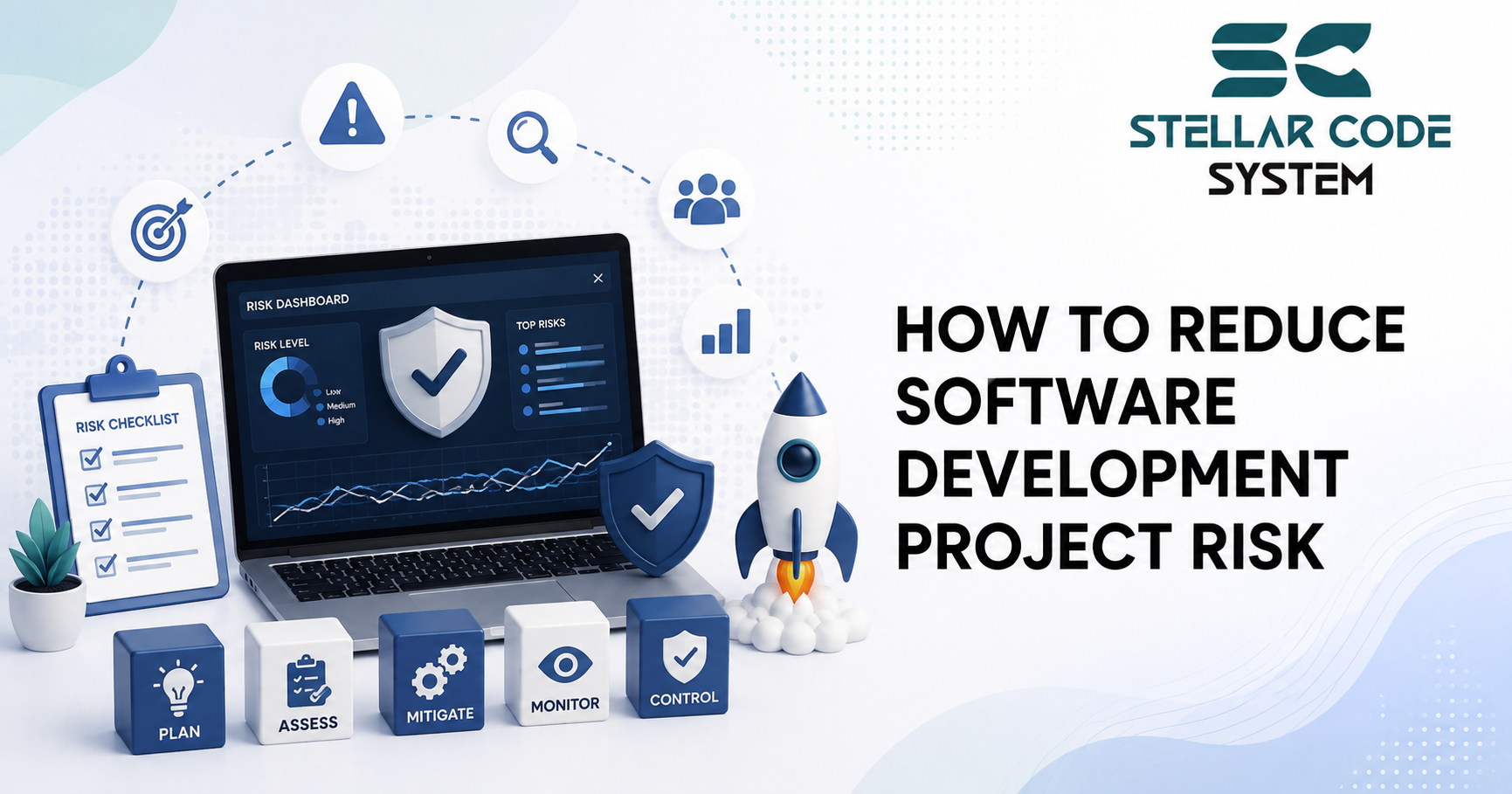
How To Reduce Software Development Project Risk
Most software projects don't fail because developers lack technical skills. They fail because small risks go unnoticed until they're expensive to fix. A feature that seemed straightforward suddenly depends on an undocumented API. A deadline slips because a third-party integration behaves differently in production. A deployment introduces regressions that weren't caught during testing. These issues rarely appear overnight—they build up gradually.
I've worked with startup teams across the US, Europe, Australia, and remote engineering groups spread across multiple time zones. Regardless of company size, the projects that stayed on schedule weren't the ones with the largest budgets or the most developers. They were the ones that treated risk assessment as part of everyday engineering instead of something reserved for project managers.
One pattern I've noticed is that teams often associate project risk with catastrophic failures like security breaches or complete system outages. In reality, the biggest threats usually come from ordinary engineering decisions: vague requirements, optimistic estimations, poor documentation, hidden dependencies, and rushed deployment cycles. Individually, these seem manageable. Combined, they quietly reduce predictability and make every sprint more difficult than the last.
Reducing software development project risk isn't about eliminating uncertainty. That's impossible. The goal is to make uncertainty visible early enough that the team can respond before it affects delivery, product quality, or customer trust.
Why This Problem Happens in Real Teams
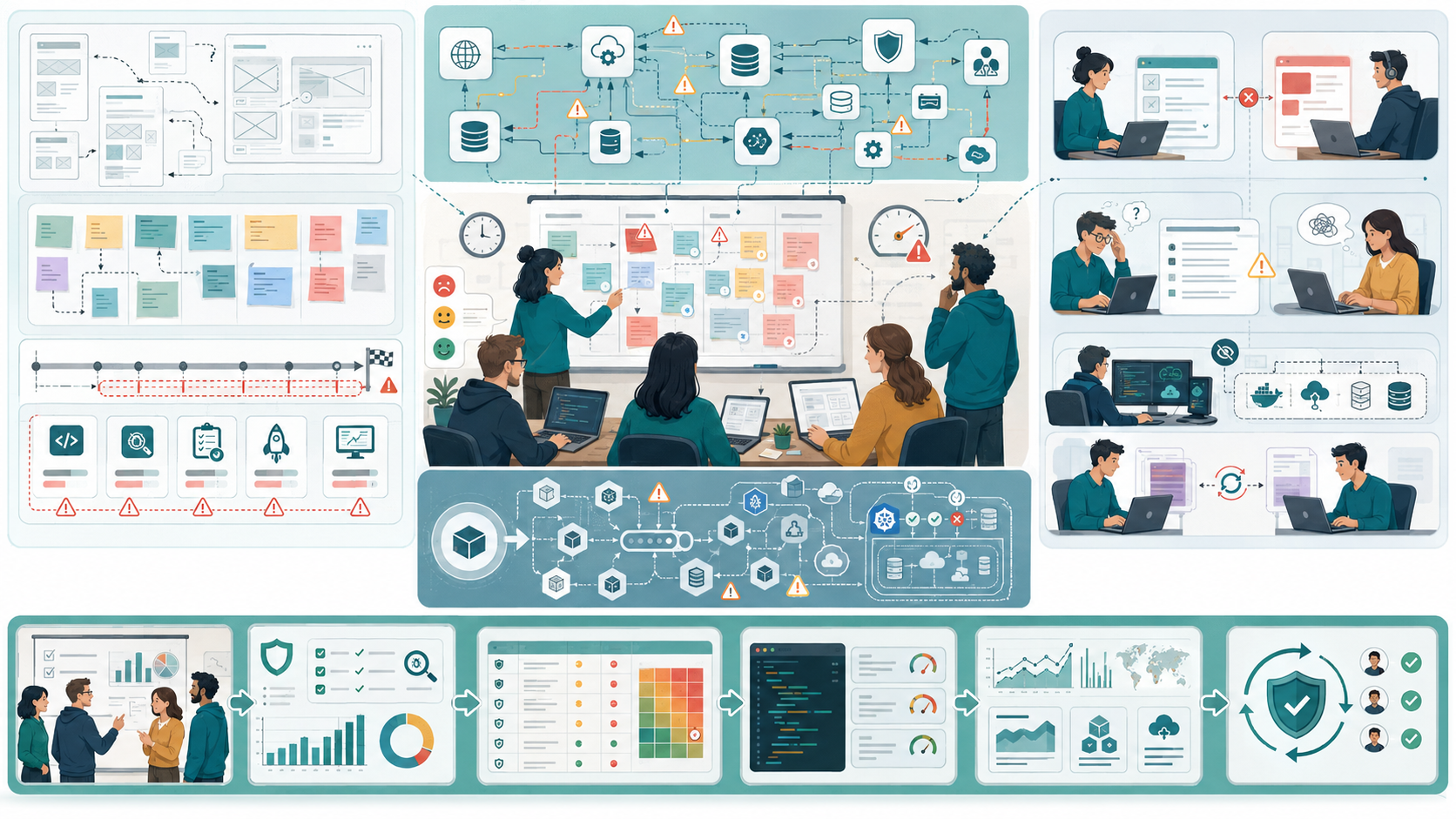
Software projects rarely become risky because someone intentionally makes poor decisions. More often, engineering teams are working under real business pressure. Product roadmaps change, customer feedback arrives unexpectedly, budgets tighten, and release dates move closer. In that environment, short-term delivery naturally takes priority over long-term stability.
Planning Starts Before Requirements Are Clear
One of the most common risks appears before development even begins.
I've seen teams begin implementation while business requirements were still evolving. Everyone understood the overall product vision, but important technical details remained undecided. Developers started building features based on assumptions, expecting unanswered questions to be resolved later.
Unfortunately, "later" usually means rewriting completed work.
Without clear requirements, it's difficult to:
- Estimate development effort accurately
- Define realistic milestones
- Identify technical dependencies
- Allocate engineering resources effectively
- Plan testing and validation activities
The result isn't just additional development time. It also creates uncertainty that affects every future sprint.
Optimistic Estimation Creates Invisible Pressure
Early-stage startups often need aggressive timelines to satisfy investors or launch before competitors. There's nothing wrong with ambitious schedules, but problems begin when estimation becomes wishful thinking instead of technical analysis.
I've reviewed projects where every feature estimate assumed:
- No unexpected debugging
- Perfect third-party integrations
- Stable APIs
- Zero architecture changes
- Smooth deployment
- No production defects
Real software projects never behave this way.
Every backend service, frontend application, database migration, or infrastructure update introduces variables that affect scheduling. Ignoring these variables doesn't reduce project risk—it simply delays when the team discovers it.
Accurate estimation should always include reasonable buffers for:
- Testing
- Code review
- Integration verification
- Performance optimization
- Production monitoring
- Bug fixing
These activities are part of software development, not optional extras.
Hidden Dependencies Slow Down Entire Projects
Dependencies are one of the least visible sources of project risk.
A feature might appear nearly complete until the team realizes it depends on:
- A payment provider updating its API
- Authentication changes from another engineering team
- Cloud infrastructure configuration
- Database schema modifications
- Compliance approval
- Security verification
Suddenly, a task expected to take two days becomes a two-week delay.
This is why experienced engineering teams invest time in dependency mapping during project planning. Understanding how systems interact improves predictability and allows teams to identify potential bottlenecks before implementation begins.
Communication Breakdowns Compound Technical Problems
Technical challenges are usually solvable.
Communication failures are harder.
Remote engineering teams often work across multiple time zones. Without consistent documentation and transparent communication, small misunderstandings quickly become technical debt.
I've seen situations where:
- Backend developers changed API contracts without notifying frontend engineers.
- Product requirements evolved during sprint execution without updating documentation.
- Infrastructure teams deployed configuration changes that application developers weren't aware of.
- Multiple developers solved the same problem independently because ownership wasn't clearly defined.
None of these issues required advanced technical solutions.
They required better collaboration, accountability, and documentation.
Clear communication reduces project risk because it keeps engineering decisions visible across the team rather than locked inside individual conversations.
Architecture Decisions Made Too Early Can Increase Risk
Another common mistake is treating scalability as the highest priority from day one.
Many startups adopt complex architectures because successful technology companies use them. Microservices, event-driven systems, distributed messaging, and sophisticated deployment pipelines all have legitimate use cases—but they also introduce operational complexity.
For a small engineering team, every additional service increases:
- Maintenance effort
- Monitoring requirements
- Deployment coordination
- Testing complexity
- Integration challenges
- Security considerations
A simple architecture that's well documented and thoroughly tested usually provides better reliability than an unnecessarily complex system built for hypothetical future scale.
Good architecture isn't about using the newest framework. It's about matching technical decisions to current product requirements and available engineering resources.
Risk Management Should Be Continuous, Not Reactive
Many teams perform risk analysis only during project kickoff.
After development begins, attention shifts entirely to feature delivery.
This is where small issues become expensive.
Successful engineering teams continuously monitor project health throughout every iteration. They regularly review:
- Requirement changes
- Sprint progress
- Budget consumption
- Technical debt
- Code quality
- Testing coverage
- Deployment outcomes
- Performance metrics
- Security concerns
- Outstanding backlog items
Continuous monitoring improves transparency and gives teams the opportunity to apply mitigation strategies before risks affect deliverables or release schedules.
Over time, this creates something every engineering organization values: predictable delivery. Projects become easier to estimate, collaboration improves, deployment failures decrease, and stakeholders gain greater confidence in the team's ability to deliver high-quality software consistently.

Where Most Teams Make the Wrong Decision
One of the biggest misconceptions in software development is that reducing project risk means adding more processes, more meetings, or more tools.
In reality, I've seen small engineering teams become less productive after introducing heavyweight workflows that were designed for organizations ten times their size.
The problem isn't a lack of process.
It's adopting the wrong process for the team's current stage.
Mistake #1: Treating Every Risk the Same
Not every risk deserves the same attention.
A missing icon on an admin dashboard shouldn't receive the same urgency as an authentication vulnerability or a database migration that could corrupt production data.
Experienced teams perform continuous risk analysis and categorize work based on business impact.
Instead of reacting emotionally to every issue, ask three simple questions:
- How likely is this problem to happen?
- What happens if it does?
- Can we detect it before customers notice?
This simple assessment helps teams focus their resources on the problems that actually threaten delivery.
Mistake #2: Building Complex Architecture Too Early
This is probably the most common mistake I've seen in startups.
A team reads about how Netflix, Uber, or Amazon built distributed systems and assumes they should follow the same path.
Six months later they have:
- Multiple microservices
- Event queues
- Service discovery
- Complex deployment pipelines
- API gateways
- Infrastructure automation
- Monitoring dashboards everywhere
Yet only three developers are maintaining everything.
The result isn't better scalability.
It's slower development.
Every new feature now requires additional integration, deployment coordination, testing, and documentation.
For most SaaS products, a well-structured modular monolith provides:
- Better reliability
- Easier debugging
- Faster deployment
- Simpler maintenance
- Lower operational risk
Architecture should solve today's problems—not tomorrow's assumptions.
Mistake #3: Assuming Testing Happens at the End
Many teams still think of testing as the final phase before release.
That's one of the fastest ways to create project risk.
When validation is delayed until the end of a sprint, developers discover issues after multiple features have already been merged together.
Now every bug becomes harder to isolate.
Instead, testing should happen continuously.
In healthy engineering teams:
- Unit tests verify business logic.
- Integration tests validate system communication.
- Manual testing confirms user workflows.
- Regression testing protects existing functionality.
- Deployment verification confirms production readiness.
Finding defects earlier dramatically improves software quality while reducing debugging time.
Mistake #4: Ignoring Technical Debt Because "We’ll Fix It Later"
Every engineering team creates technical debt.
The difference is whether it's intentional.
Sometimes shipping quickly is the correct decision.
The problem starts when temporary solutions become permanent architecture.
I've reviewed projects where developers repeatedly added small shortcuts:
- Hardcoded configuration
- Duplicate business logic
- Large controller files
- Poor documentation
- Weak error handling
- Missing code reviews
None of these decisions looked dangerous individually.
A year later they collectively reduced system reliability and slowed every future sprint.
Technical debt compounds quietly.
Refactoring becomes more expensive.
Testing becomes harder.
Deployment confidence decreases.
Eventually even small feature requests require significant investigation.
Reducing project risk means paying down technical debt continuously rather than waiting for a complete rewrite.
Mistake #5: Measuring Progress by Features Instead of Stability
Many stakeholders ask one question during sprint reviews:
"How many features did we finish?"
A better question is:
"How stable is what we built?"
Shipping features quickly means very little if every release introduces production incidents.
Healthy engineering teams monitor indicators like:
- Build stability
- Deployment success rate
- Test coverage
- Production defects
- Performance trends
- Security findings
- Customer-reported issues
These metrics improve predictability far more than simply counting completed tickets.
Mistake #6: Poor Documentation Creates Long-Term Risk
Documentation often feels like something developers write after finishing the code.
That rarely happens.
Months later someone needs to update a feature, and nobody remembers why an important architectural decision was made.
Documentation doesn't need to be lengthy.
It simply needs to answer practical questions like:
- Why was this approach chosen?
- Which services depend on this component?
- What assumptions exist?
- What should never be changed without review?
Good documentation improves collaboration, supports accountability, and reduces onboarding time for new developers.
Practical Fixes That Actually Work
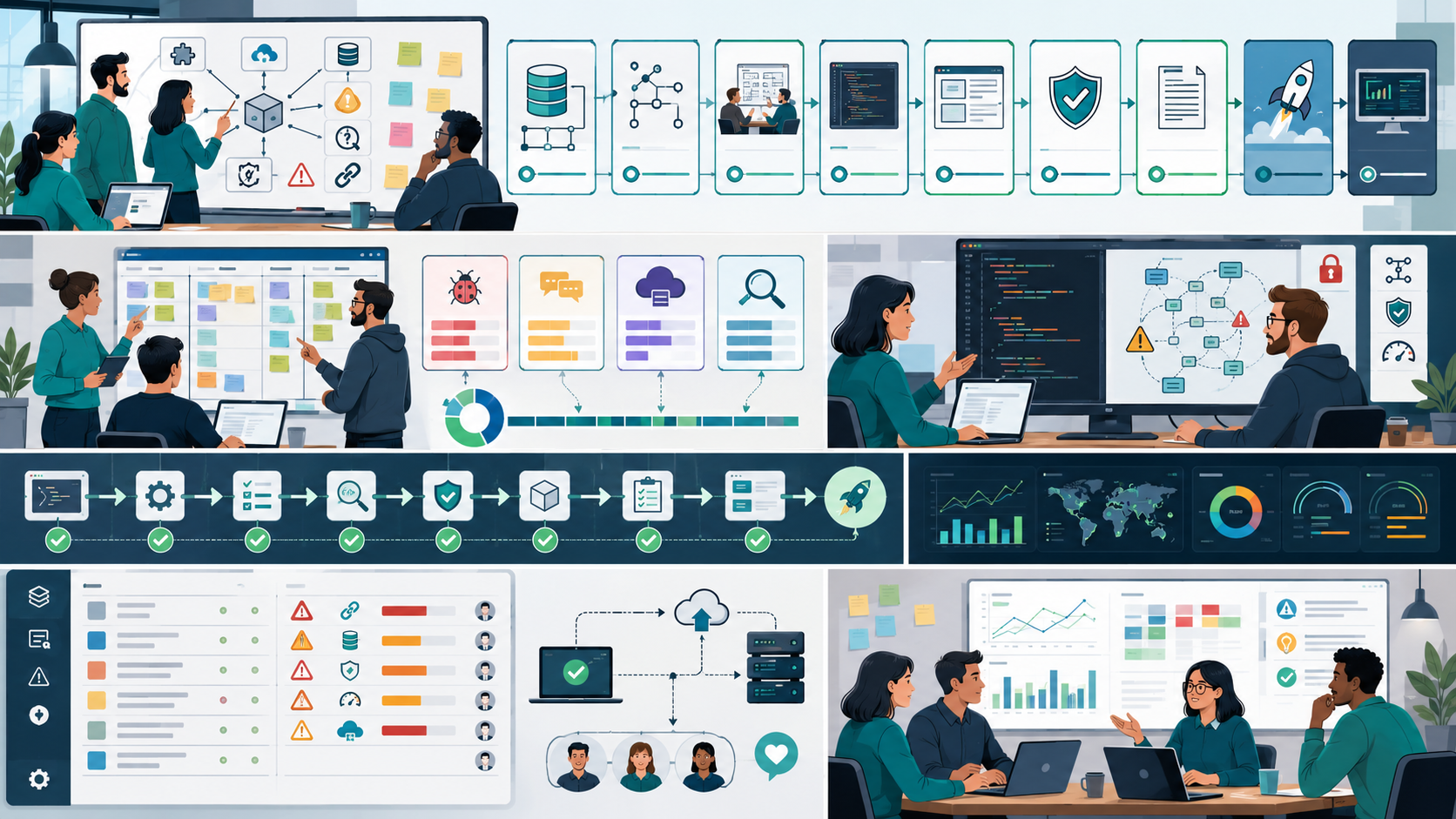
Reducing software development project risk doesn't require expensive tools or enterprise-sized processes. Working with a US software engineering team for lower-risk delivery helps businesses improve requirement clarity, estimation, dependency mapping, code reviews, automated validation, deployment discipline, and technical debt control before issues affect delivery.
Most improvements come from building consistent engineering habits.
Here are the practices I've repeatedly seen improve delivery across startup teams.
1. Start Every Feature With Risk Assessment
Before writing code, spend ten minutes identifying what could fail.
For each feature ask:
- Which systems are affected?
- What integrations are involved?
- Are there security concerns?
- Could performance change?
- Are requirements completely understood?
- Which dependencies might delay delivery?
This short discussion often prevents days of rework later.
2. Break Large Deliverables Into Smaller Milestones
Large projects become risky because progress becomes difficult to measure.
Instead of delivering one massive feature after six weeks, divide work into smaller milestones.
For example:
Week 1
- Database design
- API contracts
- Architecture review
Week 2
- Backend implementation
- Initial testing
- Documentation updates
Week 3
- Frontend integration
- Validation
- Performance optimization
Week 4
- Production deployment
- Monitoring
- Final verification
Smaller deliverables improve visibility while making scheduling more predictable.
3. Keep Sprint Planning Realistic
Sprint planning should balance ambition with engineering reality.
Avoid filling every sprint to 100% capacity.
Unexpected work always appears:
- Bug fixes
- Customer feedback
- Infrastructure issues
- Production incidents
- Requirement clarification
Leaving some flexibility prevents teams from sacrificing quality just to meet sprint commitments.
4. Make Code Reviews About Risk, Not Style
Many code reviews focus on formatting.
Experienced engineers focus on long-term maintainability.
During reviews ask:
- Does this increase technical debt?
- Is ownership clear?
- Can another developer maintain this?
- Does it introduce hidden dependencies?
- Is the implementation resilient?
- Are security requirements satisfied?
This mindset improves software quality without slowing development.
5. Automate Repetitive Validation
Manual work introduces inconsistency.
Automation improves predictability.
Good candidates for automation include:
- Build verification
- Unit testing
- Static analysis
- Security scanning
- Deployment validation
- Regression testing
Developers spend less time repeating routine tasks and more time solving meaningful engineering problems.
6. Track Risks Alongside the Backlog
Most teams manage features well.
Few manage project risks with the same discipline.
Maintain a lightweight risk register alongside the product backlog.
Include:
| Risk | Impact | Mitigation |
|---|---|---|
| Third-party API changes | High | Version monitoring |
| Database migration | High | Backup and rollback plan |
| Security review delay | Medium | Schedule early validation |
| Performance bottlenecks | Medium | Continuous monitoring |
| Infrastructure dependency | High | Failover planning |
Review these during sprint planning just like any other work item.
When risks remain visible, they rarely become surprises.
7. Review Every Deployment
Every production release teaches something.
After deployment, spend a few minutes reviewing:
- What worked?
- What slowed deployment?
- Which assumptions were wrong?
- Were estimates accurate?
- Did monitoring reveal unexpected behavior?
- Should documentation be updated?
This continuous feedback loop gradually improves planning, estimation, deployment workflows, and overall project success.
Instead of relying on luck, the team builds a repeatable engineering process where every iteration becomes more predictable than the last.

When This Approach Fails
No engineering process works in every situation. The practices discussed above significantly reduce software development project risk, but they aren't universal solutions. Every team operates with different constraints, and recognizing those limits is part of good engineering judgment.
Large Organizations Need More Than Lightweight Processes
The workflows that help a team of five developers won't necessarily work for an organization with hundreds of engineers.
As organizations grow, additional layers of governance become necessary because multiple teams are working on shared systems.
Larger environments usually require:
- Formal architecture reviews
- Compliance and regulatory approvals
- Dedicated security assessments
- Cross-team dependency management
- Release governance
- Change management processes
Trying to manage enterprise-scale software with startup-style processes often creates communication gaps and reduces accountability.
Highly Regulated Industries Have Additional Requirements
Healthcare, banking, insurance, and government projects involve far more than delivering working software.
Engineering teams must also satisfy:
- Compliance standards
- Security audits
- Traceability requirements
- Verification procedures
- Validation documentation
- Risk assessments
- Approval workflows
In these environments, moving quickly without sufficient documentation introduces significant operational and legal risk.
Reducing project risk sometimes means accepting slower delivery in exchange for greater predictability and regulatory confidence.
Tight Budgets Limit Risk Mitigation
Every engineering recommendation has a cost.
Automated testing takes time to build.
Monitoring infrastructure requires maintenance.
Documentation needs regular updates.
Performance optimization consumes engineering effort.
For startups with limited funding, trying to implement every best practice immediately may actually delay product validation.
In these situations, prioritization becomes essential.
Focus first on activities that provide the highest return:
- Clear requirements
- Reliable deployment
- Automated testing for critical workflows
- Documentation for complex systems
- Regular code reviews
Perfect engineering isn't always realistic.
Consistent engineering usually is.
Fast Product Changes Can Outdate Plans
Product strategy evolves.
Customer feedback changes priorities.
Market opportunities appear unexpectedly.
No amount of planning prevents these changes.
I've worked with SaaS teams where the roadmap changed three times within a single quarter.
The teams that adapted successfully weren't the ones with the most detailed project plans.
They were the ones with:
- Flexible architecture
- Short iterations
- Clear ownership
- Well-defined requirements
- Continuous communication
Risk reduction should improve adaptability, not reduce it.
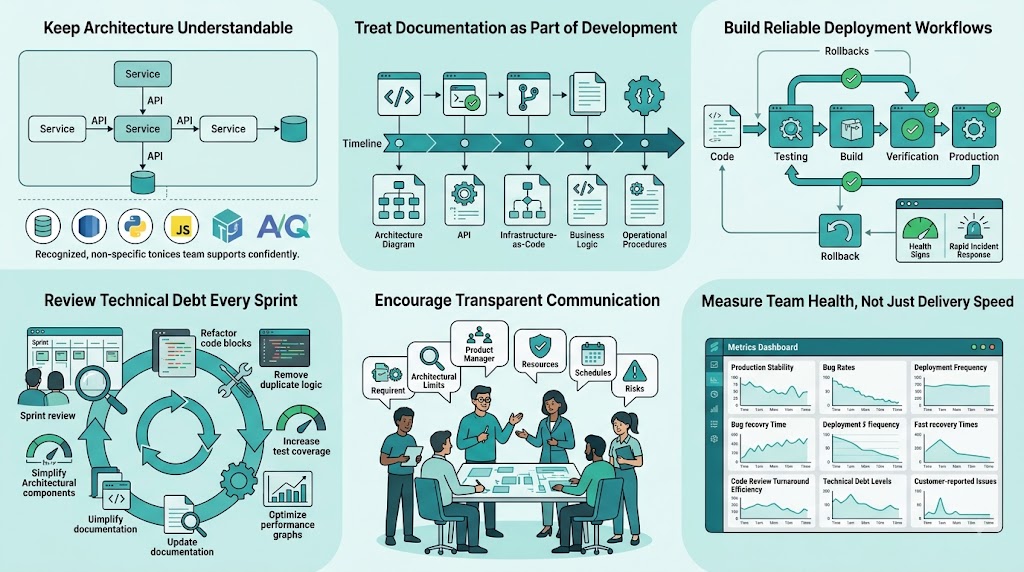
Sustainable Practices for Small Engineering Teams
Reducing project risk isn't something teams do before a release.
It's something they build into their daily engineering habits.
The healthiest software projects I've worked on shared several long-term practices.
Keep Architecture Understandable
Simple architecture is easier to maintain.
Every new service, dependency, framework, or integration increases operational complexity.
Before introducing new technology, ask:
- Does this solve an existing problem?
- Can the current team support it?
- Will it improve long-term reliability?
- Is there a simpler solution?
Simple systems are usually easier to debug, monitor, optimize, and maintain.
Treat Documentation as Part of Development
Documentation should evolve alongside the codebase.
Useful documentation includes:
- System architecture
- API behavior
- Deployment workflows
- Infrastructure decisions
- Business assumptions
- Operational procedures
Good documentation improves collaboration while reducing onboarding time for new developers.
It also prevents valuable engineering knowledge from existing only inside one person's memory.
Review Technical Debt Every Sprint
Technical debt grows quietly.
Ignoring it makes future development slower.
Instead of waiting for a complete rewrite, reserve time during every sprint for:
- Refactoring
- Removing duplicate code
- Improving testing
- Updating documentation
- Simplifying architecture
- Optimizing performance
Small improvements made consistently prevent large maintenance problems later.
Build Reliable Deployment Workflows
Deployment should become routine.
Not stressful.
Reliable deployment workflows typically include:
- Automated testing
- Continuous integration
- Deployment verification
- Rollback procedures
- Production monitoring
- Incident documentation
The objective isn't just faster releases.
It's making releases predictable.
Encourage Transparent Communication
Engineering problems rarely stay technical for long.
Without open communication, small misunderstandings become project delays.
Healthy teams encourage developers to raise concerns early.
This includes:
- Unclear requirements
- Unrealistic scheduling
- Security concerns
- Architecture limitations
- Resource constraints
- Integration risks
Transparency helps identify problems while they're still inexpensive to fix.
Measure Team Health, Not Just Delivery Speed
Velocity matters.
But sustainable engineering requires a broader perspective.
Track indicators like:
- Production stability
- Bug trends
- Deployment frequency
- Lead time
- Recovery time
- Code review turnaround
- Technical debt
- Customer-reported issues
These metrics provide a more accurate picture of long-term project success than feature count alone.
Conclusion
Reducing software development project risk isn't about eliminating uncertainty. Every project involves changing requirements, evolving priorities, and unexpected technical challenges. What separates successful engineering teams from struggling ones is how early they identify those risks and how consistently they respond to them.
The biggest mistake I see is assuming risk management is a one-time planning exercise. In practice, it's a continuous process built into every sprint, every deployment, and every architectural decision. Teams that regularly assess dependencies, improve documentation, automate validation, monitor production systems, and address technical debt create software that's easier to maintain and far more predictable to deliver.
Successful projects aren't the ones that avoid problems entirely. They're the ones that detect issues early, communicate openly, and adapt without sacrificing quality, reliability, or team sustainability.
How To Reduce Software Development Project Risk: FAQs
The biggest risk is usually unclear requirements. When product goals, business rules, or technical expectations aren't well defined, teams make assumptions that lead to rework, missed deadlines, budget overruns, and lower software quality.
Agile teams reduce risk by working in short iterations, prioritizing the backlog, validating features continuously, automating testing, reviewing progress after every sprint, and responding quickly to changing requirements instead of waiting until the end of the project.
Projects often exceed estimates because teams underestimate dependencies, debugging effort, testing time, deployment activities, and requirement changes. Realistic estimation should include contingency for unexpected technical challenges.
Yes, but focus on critical business workflows first. Automating tests for authentication, payments, APIs, and core user journeys improves reliability and reduces deployment risk without requiring a large upfront investment.
Small teams achieve sustainable success by keeping architecture simple, maintaining clear documentation, reviewing technical debt regularly, monitoring production systems, improving communication, and making incremental process improvements instead of introducing unnecessary complexity.
Reference
Written by

Paras Dabhi
VerifiedFull-Stack Developer (Python/Django, React, Node.js)
I build scalable web apps and SaaS products with Django REST, React/Next.js, and Node.js — clean architecture, performance, and production-ready delivery.
LinkedIn