Is Python Good for Backend Development?

The developers are now using the power of backend programming languages like Python, Java, PHP and Node.js when building this hidden engine. These languages take care of data storage, API connection as well as system performance. The difference between selecting the right one is enormous in terms of scalability, speed, and maintenance.
So, is Python good for backend development?
Yes, yes, yes,Jesus,amenteoder, net... Python is characterized by its clean syntax, well-supported libraries and powerful frameworks, such as Django, Flask, and Fast API which simplify and speed up the process of backend development. It is very simple, and the developers are able to concentrate on the problem solving aspect instead of large code structures because it is a perfect pick among novices and expert developers. Since major technological powerhouses, such as Instagram, Spotify, and Netflix, use Python as their backends, it is evident that Python is not merely a good language but one of the best languages to program the backend in 2025 and beyond.
Understanding Python's Role in Backend Development
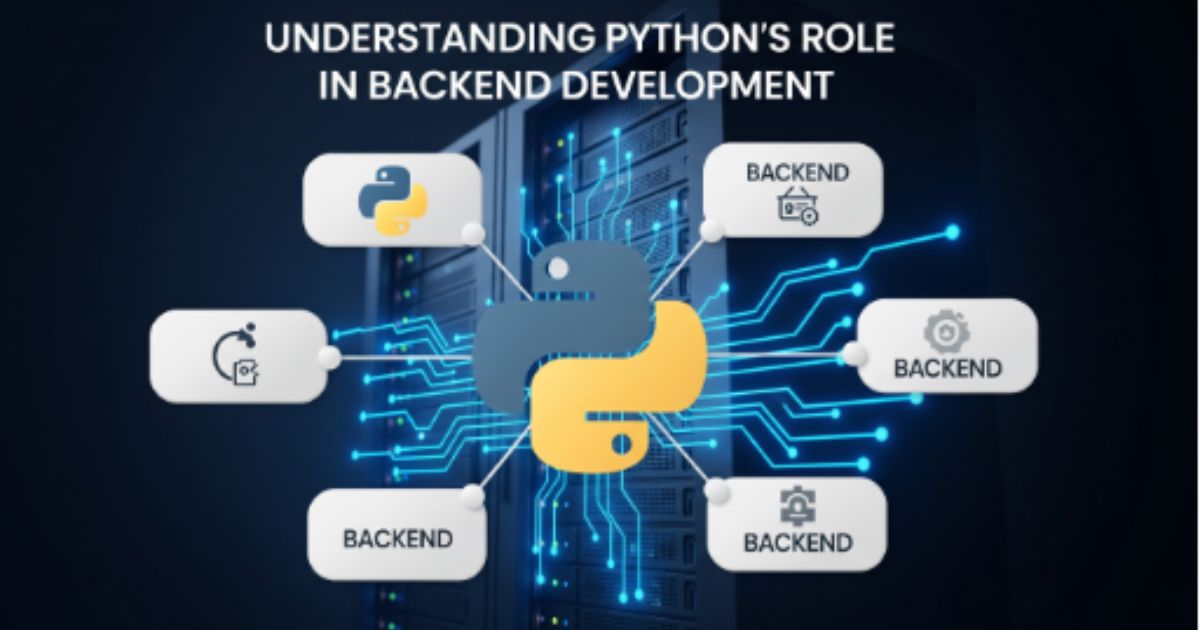
Overview of Python as a backend language
Python is a high-level and general-purpose programming language that is useful in backend development. It drives web servers, works with databases and APIs without difficulties. Python is useful in complex tasks in the backend and this is made simple by its readability and huge library ecosystem. It is the most suitable option in constructing scalable, security-aware, and high-end web applications with the help of frameworks such as Django, Flask, and FastAPI.
Key features that make Python great for backend
The Python code provides an ideal combination of simplicity, flexibility, and power in endpoint development. It encourages quick application development through structures, database interchangeability and security on top level. The ability to integrate with sophisticated technology such as AI and machine learning, and its cross-platform compatibility add to its backend capabilities.
Easy-to-learn syntax
The simplicity of Python is a major strength because of simple syntax that can be understood by humans. The learning curve of new developers decreases, as developers can create and maintain the code more quickly. This easiness increases productivity and enables staff to concentrate more on logic and functionality as opposed to complex Syntax rules.
Strong community support
The developer community of Python is one of the most active and the biggest in the world. This translates to the plenty of tutorials, libraries, open-source tools, and prompt development assistance to any development issue. The perpetual updates and input of the community make Python reliable, secure and future-proof in regard to the development of backend applications.
Huge library ecosystem
The extensive python library ecosystem has been dubbed as one of its best assets on backend development. It provides thousands of ready-to-use modules to perform such tasks as database management, authentication, data processing, and API integration. Django REST Framework frameworks and libraries like SQLAlchemy assist the developers in creating robust applications without much code writing.
Use cases of Python in backend applications
Python finds application in various industries in the form of backend systems that are powerful and capable of being scaled. Its flexibility can be likened to nothing as it has led to the creation of the social media and eCommerce platforms, along with the ability to drive AI-led applications. Python is applied to the backend architecture of major brands, such as Instagram, Dropbox, and Netflix, and it can be seen that it is reliable and capable of working under the conditions of the real world.
Advantages of Using Python for Backend Development
High scalability and flexibility
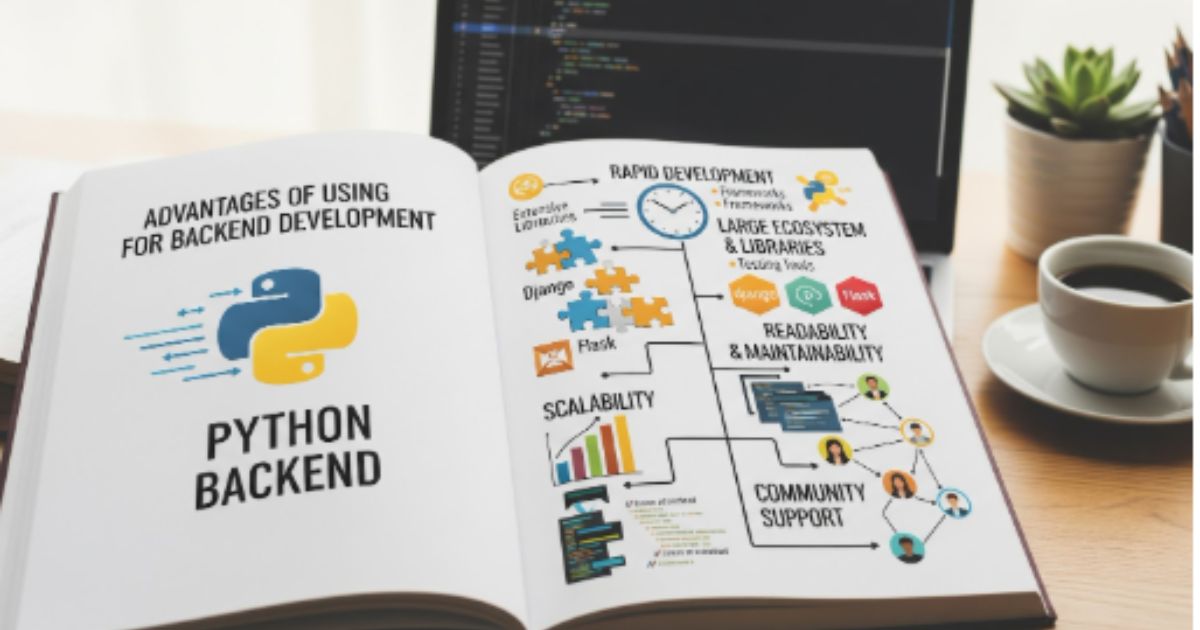
Python is exceptionally scaled and flexible in its application to backing up. It has a modular structure and dynamic typing and thus it is highly scalable by the developer at the time of expansion of traffic. Against the backdrop of cloud integration, and microservices support capabilities, python is capable of operating both small startup projects to full scale enterprise systems effectively.
Excellent frameworks for backend development
The rich frameworks of Python make Python faster, cleaner and more efficient in the back-end development. Routing, security, and database management tools are ready to use and found in frameworks, such as Django, Flask, and FastAPI. The frameworks minimize manual codes, which guarantee fast deployment and high performance of contemporary web applications.
Django — "The all-in-one backend solution"
Django is a full stack Python, which is based on the philosophy of batteries-included. It has inbuilt authentication, ORM and security features, and thus it is ideal to be applied to large-scale applications. Its object-oriented approach assists developers to create durable, maintainable, and robust backs-ends in the quickest amount of time.
Flask — "Lightweight and flexible framework"
Flask is a micro-framework which is both fully flexible and controllable to the developer. It is also lightweight and can be customized well as smaller projects or APIs which do not need a massive structure. Flask is simple, which enables it to be prototyped easily yet is scalable and performance-intensive.
FastAPI — "Modern backend with async support"
FastAPI is a Python backend development framework that is rapidly increasing. It is created to support high-performance APIs with asynchronous capabilities, and so it is ideal with real-time and data-intensive applications. It is popular among the current developers due to its automatic documentation and speed optimization.
Integration with AI, ML, and Data Science tools
Python is a natural language that is compatible with artificial intelligence, machine learning, and data science products. This makes it the ideal option in the backend systems that require analytics, automation, or predictive systems. Tensors Libraries such as TensorFlow, NumPy, and Pandas have assisted developers to create intelligent, information-driven web applications.
Strong security and testing capabilities
Python is provided with powerful inbuilt security and testing frameworks. PyTest, UnitTest and Django security modules are some of the tools that aid a developer to identify vulnerabilities and maintain a stable code. Its community also regularly patches its security laws, which protects the backend applications and makes them safe and reliable.
Limitations of Python in Backend Development
Performance speed compared to compiled languages
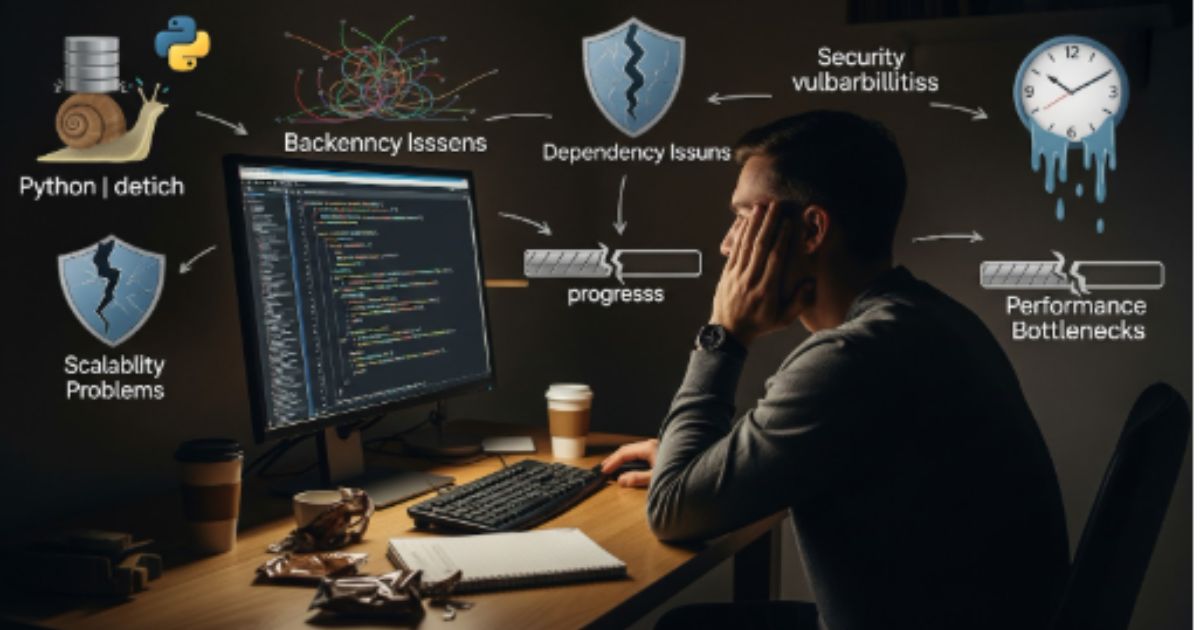
Python is an interpreted language thus slower compared to compiled languages such as Java or C++. Python is not necessarily the right choice in the case of performance intensive applications that need real time processing. Nevertheless, performance can be optimized with the help of such frameworks as FastAPI and Cython.
High memory consumption in large-scale systems
The dynamic model of Python results in increased memory consumption which is a weakness when running in large scale or resource constrained environments. Applications that accept large amounts of data or need to be responsive could need to be optimized or be added to other faster services.
Less suited for mobile-based backend processing
Though Python has had strong performance on web and AI backends, it is not popular in training mobile backends. Swift or Kotlin have both done better at producing lightweight, low-latency processing, which is required by mobile environments. Nevertheless, mobile APIs can be supported by Python using such frameworks as Kivy or BeeWare.
Python vs Other Backend Languages
Python vs Node.js — Performance and scalability
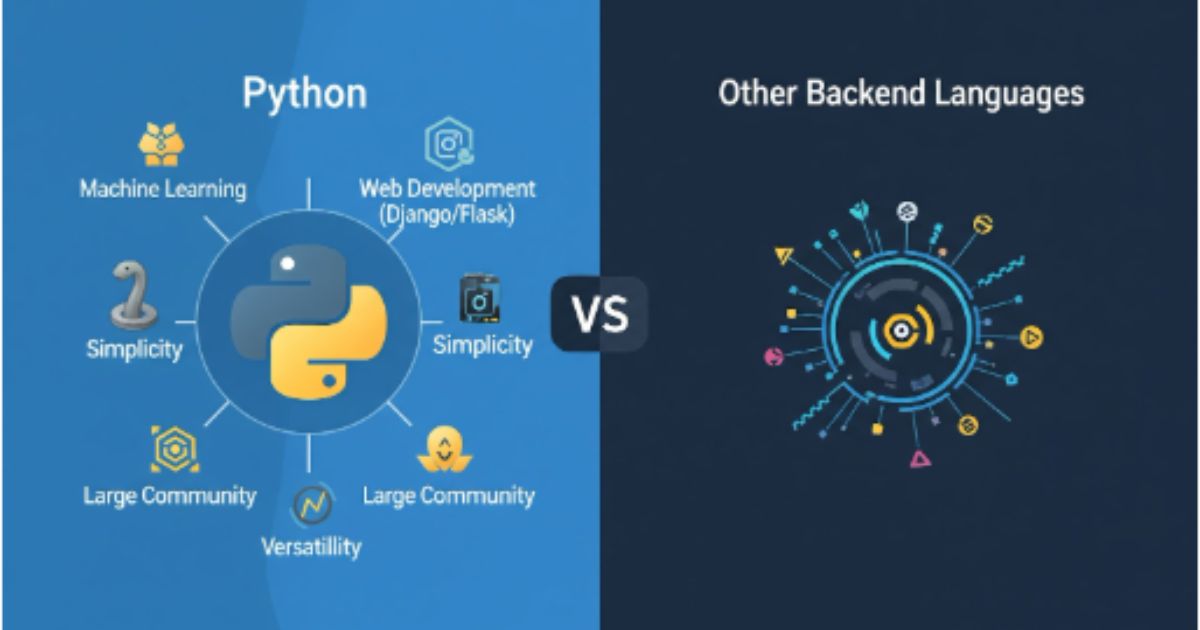
The event-oriented, non-blocking nature of Node.js has been credited as an advantage making it more appropriate in performance and scalability of real-time applications. Python is a little slower but is easier to read and has good frameworks in favor of writing a fast backend. CPU intensive tasks and scalable APIs can be handled better by Node.js which is faster, whereas Python is quicker in development speed and adaptability.
Python vs Java — Enterprise and structure
Java is compiled and a structured programming language, and it is used mostly in large organization applications because it is robust and fast. Python is however flexible and simple to learn thus suitable for startups and agile teams. Although Java is leading in enterprise-level applications, Python is gaining popularity due to its flexibility and a highly developed ecosystem as a modern backend developer.
Python vs PHP — Ease of use and ecosystem
PHP has been used extensively as the language of web backend, particularly in content-based systems, such as WordPress. Nevertheless, Python has a more modern and cleaner syntax, and better AI and data tool integration. PHP will continue being useful in conventional websites but Python offers greater scalability and future scalability of web applications.
When to choose Python over others
Python is recommended when you need to develop features fast and simply and want to integrate it with advanced technologies such as AI or machine learning. It suits start-ups, SaaS applications, and applications depending on data. Assuming that your project is sensitive to readability, maintainability, and scalability in the future, then Python is the best backend system.
Real-World Examples of Python Backend Use
Popular companies using Python for backend
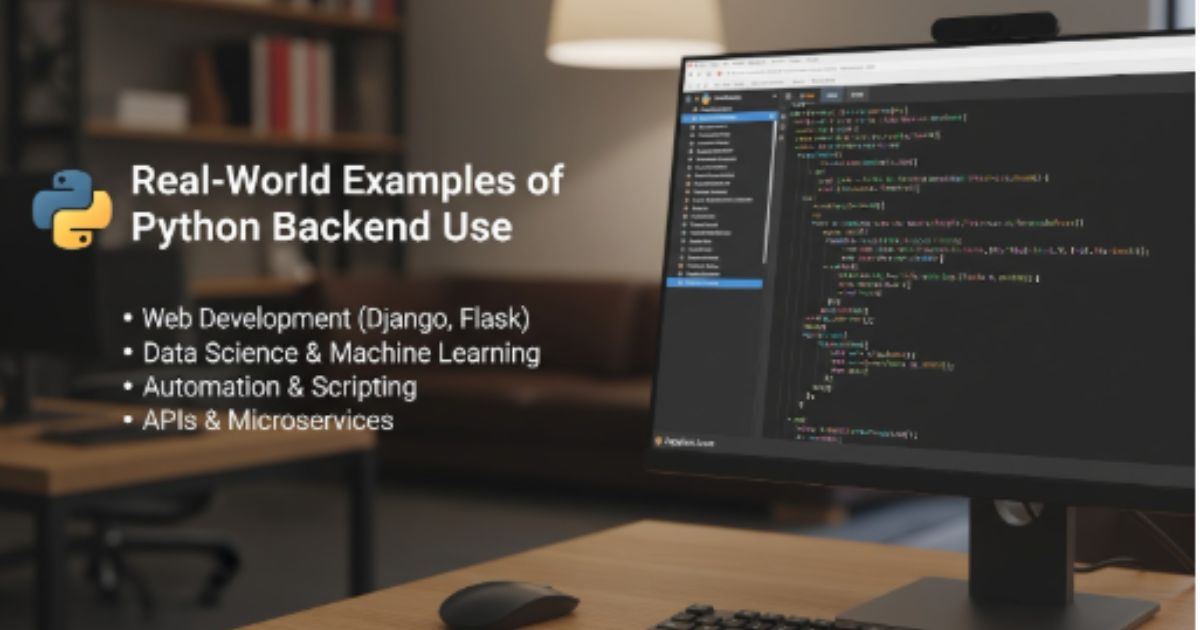
Python is used by many world technologies to operate their backends on the base of its scalability, flexibility and speed. Python supports millions of daily transactions from social media networks to streaming platforms. Its engines such as Django and Flask are perfect to support complex and data intensive operations in the backend.
The python programming language is used in Instagram especially Django to handle its large user base and real time data flow. The framework allows rapid iteration, effective scaling, and excellent security, which is essential to work with more than one billion active users. The ease of Python allows Instagram developers to be innovative and roll out new features in the shortest time possible.
Spotify
Spotify uses Python in backend data mining, recommendation, and running servers. Spotify uses Python due to its flexibility and machine learning capabilities that enable it to provide users with customized playlists as well as real-time user experiences. Its back-end design works best with the Python capability of managing big data.
Netflix
Netflix is a large-scale user of Python in the automation of its back end, data analytics, and recommendation. The scalability has enabled Netflix to easily handle millions of user requests per second, with Python. The backend functions are based on Python to create high-quality streaming experiences of a personalized nature across the world.
Case study: How Django powers large-scale web apps
The scalability of Django and its functional modular construction are what makes it ideal when building and scaling a large web-based application. It includes authentication, ORM, and security capabilities and makes less time to develop. Django is used by big brands to ensure high performance and dependability when serving a large number of users.
Tools and Frameworks for Python Backend Developers
Top Backend Frameworks (Django, Flask, FastAPI)
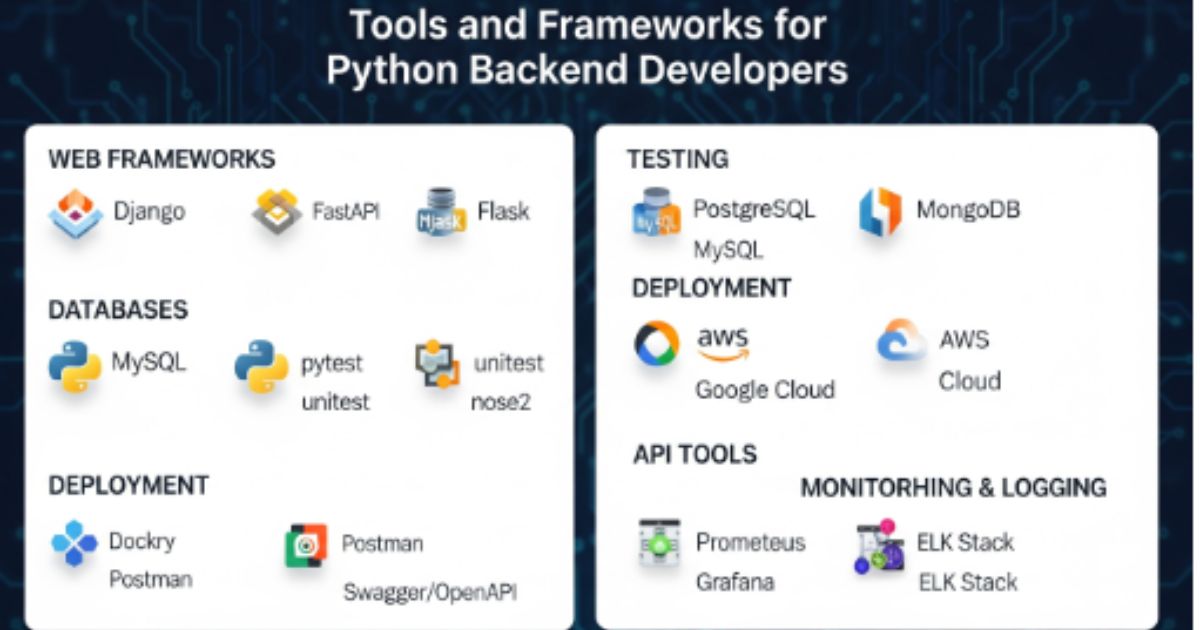
Python offers several top frameworks that simplify backend development. Django is ideal for full-featured web apps, Flask suits lightweight projects, and FastAPI excels in building modern APIs. These frameworks enhance productivity, reduce code complexity, and ensure secure, scalable application development.
Essential Tools for Python Backend Development
Backend developers rely on tools that streamline workflows and improve performance. From environment management to testing and deployment, these tools make backend coding more efficient and reliable.
Virtualenv, Gunicorn, Docker, Postman
Virtualenv helps manage dependencies across projects, ensuring clean environments. Gunicorn serves as a reliable WSGI server for deploying Python apps. Docker allows easy containerization for consistent deployment, while Postman simplifies API testing and integration during backend development.
Recommended Databases for Python (PostgreSQL, MongoDB, MySQL)
Python works seamlessly with major databases like PostgreSQL, MongoDB, and MySQL. PostgreSQL offers advanced relational features, MongoDB excels with unstructured data, and MySQL provides stability for large-scale systems. Using ORM tools like SQLAlchemy or Django ORM ensures smooth database integration.
Future Scope of Python in Backend Development (2025 & Beyond)
Growing Demand for Python Developers
Python backend development is growing fast, and highly sought-after professionals are demanded in all sectors. Python is appreciated by all software companies due to its ability to be popular with a wide range of applications, which is easy to maintain, as well as being a technology capable of integrating with the latest technologies. With the growing pace of digital transformation, there will continue to be a strong demand in backend positions which focus on Python.
AI and Automation Integration with Backend
Python can integrate with AI and automation technology and this aspect provides it with an advantage in the development of the back end. Structures such as TensorFlow and PyTorch allow backend applications to incorporate the ability to perform machine learning, which drives smarter and data-driven applications. This is a trend that is defining the new generation of smart web platforms.
Industry Predictions and Trends
Analysts forecast that Python will remain the leader in the backend development industry because it has simplicity, reconfigured structures, and cross-domain application. The emergence of cloud native applications, automation, and information-driven technologies will contribute even further to making Python one of the most popular backend languages in 2025 and even later.
Conclusion
Python remains popular in the backend application due to its simplicity, flexibility and robust frameworks. Its clean syntax also reduces the amount of time spent developing the program, and such frameworks as Django, Flask, and FastAPI enable the creation of scaling, secure, and high-performance web applications easier than ever. Python has been shown to be reliable and flexible to a wide range of backend applications, both in small startups and larger organizations, such as Netflix and Instagram.
Python should be your next backend project in case you value fast and maintainable code, and the need to integrate with current technologies, such as AI, automation, or data analytics. It is ideal for the developers who want to have a language that can be used easily yet scalable to a professional level. Python is a future-proof language that will be defining the future of backend development regardless of whether you are developing APIs, web platforms or data-driven systems.
FAQs About Python for Backend Development
Yes Python is scalable to high-traffic backend systems optimally. Frameworks such as Django, Flask, FastAPi are expected to support thousands of requests in a second. Python applications can easily be scaled to thousands of active users using caching systems, load balancing, and asynchronous programming to support millions of active users, such as Instagram and Netflix.
Absolutely. Python is the most suitable language in making API since it is not complex and has strong frameworks. Flask and GraphQLors are used with Flask and Fastapi to develop graphical and RESTful API quickly and easily. Python is an agent of choice when developers are developing modern web and mobile API backends, because databases combine with ease, authentication is straightforward, and endpoints are readily tested.
Flask, Django, and FastAPI are the best frameworks to begin with among the beginners. Lightweight and with the purpose of learning the fundamentals of backend, Flask is the best choice. Django offers a full-stack web app framework whereas FastAPI is an API software that is well suited towards the creation of fast and asynchronous applications. These structures are associated with vibrant communities and extensive documentation, which are ideal in case of new programmers.
Python is not mainly in frontend development. It deals with database, server code and APIs whereas frontend languages such as HTML, CSS and Javascript control the interface. Nevertheless, Python may still be used with frontend technologies such as Django or Flask, providing a full stack development, which is non-disruptive.
About the Author
Paras Dabhi
VerifiedFull-Stack Developer (Python/Django, React, Node.js) · Stellar Code System
Hi, I’m Paras Dabhi. I build scalable web applications and SaaS products with Django REST, React/Next.js, and Node.js. I focus on clean architecture, performance, and production-ready delivery with modern UI/UX.

Paras Dabhi
Stellar Code System
Building scalable CRM & SaaS products
Clean architecture · Performance · UI/UX