Machine Learning Applications for Modern Businesses: Benefits, Examples & Trends
A few years ago, many startups believed machine learning would instantly solve growth, efficiency, and customer experience problems.
The reality looked very different.
I've worked with SaaS products, startup teams, and international engineering groups where machine learning projects consumed months of development time and produced very little business impact. I've also seen relatively simple machine learning implementations generate measurable improvements in revenue, operational efficiency, and customer retention.
The difference was rarely the technology itself.
Most successful projects started with a clear business problem and applied machine learning only where traditional software logic could no longer scale effectively.
For modern businesses, machine learning is no longer an experimental technology reserved for large enterprises. It has become a practical tool for automating decisions, identifying patterns in data, improving customer experiences, and supporting business operations.
The challenge is understanding which applications genuinely create value and which become expensive technical distractions.

Why Machine Learning Adoption Happens in Real Businesses
Most organizations don't start using machine learning because they're interested in artificial intelligence.
They start because existing systems stop solving growing business problems.
Common triggers include:
- Customer data growing faster than teams can analyze manually
- Sales forecasting becoming increasingly inaccurate
- Support teams struggling with ticket volume
- Fraud risks increasing with transaction growth
- Marketing campaigns generating too much data for manual optimization
- Supply chain decisions becoming harder as operations scale
In startup environments, engineering teams often reach a point where rule-based systems become difficult to maintain.
For example:
A recommendation engine built with manually configured rules might work for the first 5,000 customers.
At 500,000 customers, maintaining those rules becomes nearly impossible.
This is where machine learning models often provide a practical advantage.
Rather than defining every decision manually, the system learns patterns from historical data and continuously improves predictions over time.
The businesses seeing the greatest success with machine learning usually focus on specific operational problems instead of broad digital transformation initiatives.

Where Most Teams Make the Wrong Decision
One of the most common mistakes I see is treating machine learning as a product feature instead of a business capability.
Teams often ask:
"How can we add AI to our platform?"
Instead of asking:
"What decision-making process can be improved with data?"
That distinction matters.
Chasing AI Trends Instead of Business Outcomes
Many businesses adopt AI technologies like chatbots, large language models, and computer vision because they are popular, not because they solve a specific problem. This often leads to lengthy projects with little measurable impact. Successful machine learning initiatives focus on improving business outcomes rather than following industry trends.
Many organizations rush into:
- Chatbots
- Deep learning projects
- Large language models
- Computer vision systems
Without first validating whether simpler automation could solve the problem.
In several SaaS projects I've reviewed, teams spent months building AI-powered features that users rarely used.
Meanwhile, straightforward predictive analytics could have delivered measurable business value much faster.
Collecting Data Without a Strategy
Gathering large amounts of data does not automatically create value. Organizations need a clear plan for how data will support forecasting, customer analytics, risk management, or operational improvements. Without defined objectives, data becomes an expensive asset that provides limited business benefits.
Useful value emerges when data supports:
- Forecasting
- Customer segmentation
- Risk management
- Operational optimization
- Revenue growth
Overcomplicating Machine Learning Infrastructure
Startup teams often replicate the complex machine learning architectures used by large technology companies. Introducing advanced pipelines, distributed systems, and extensive monitoring too early can increase operational overhead. Simpler infrastructure is usually easier to maintain and more effective for growing businesses.
They introduce:
- Multiple data pipelines
- Distributed model training
- Complex cloud computing environments
- Excessive monitoring layers
Long before their business requirements justify the complexity.
The result is often increased maintenance costs and slower development velocity.
Practical Machine Learning Applications That Actually Work
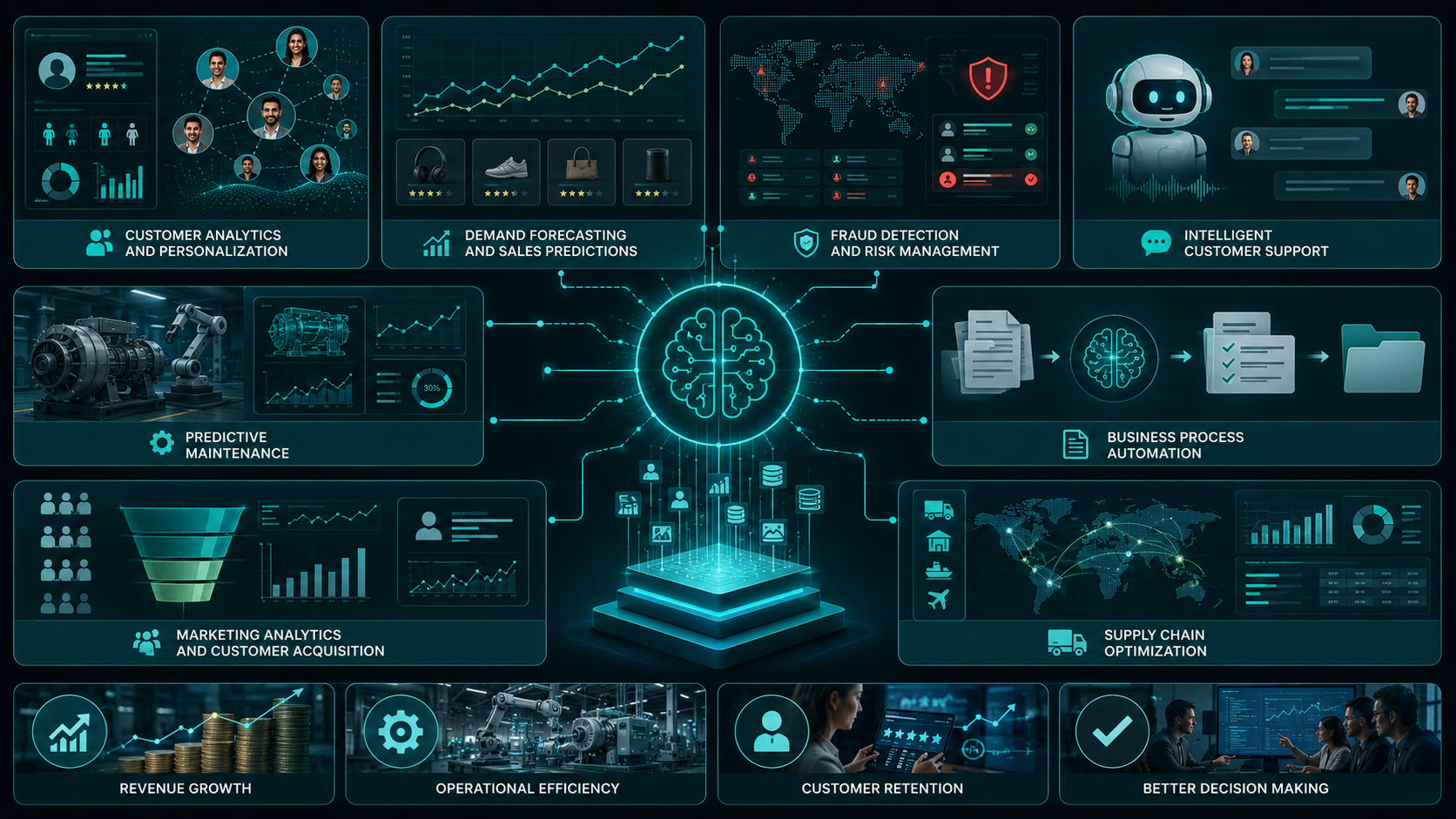
The most successful machine learning implementations usually focus on a narrow business objective. Choosing a software development company in USA for machine learning solutions helps businesses connect data strategy, automation, predictive analytics, and scalable software architecture with measurable outcomes.
Below are the applications I've consistently seen create measurable value across startups, SaaS companies, and growing organizations.
Customer Analytics and Personalization
Machine learning helps businesses analyze customer behavior at scale and uncover patterns that would be difficult to identify manually. By understanding purchasing habits, engagement trends, and customer preferences, organizations can deliver more personalized experiences. This often leads to higher customer satisfaction, retention, and revenue growth.
Machine learning models help identify:
- Purchasing patterns
- User engagement trends
- Retention risks
- Upsell opportunities
Practical applications include:
- Personalized recommendations
- Customer segmentation
- Product usage analysis
- Behavioral targeting
Companies using recommendation engines often increase customer engagement because users discover relevant products faster.
Examples include:
- E-commerce recommendations
- SaaS feature suggestions
- Content personalization
This combines predictive modeling, customer analytics, and intelligent decision systems.
Demand Forecasting and Sales Predictions
Accurate forecasting is essential for planning inventory, budgets, and business growth. Machine learning models use historical and real-time data to predict future demand more effectively than traditional methods. This helps businesses reduce uncertainty and make smarter operational decisions.
Traditional forecasting methods often struggle with:
- Seasonal changes
- Market fluctuations
- Rapid growth
- Multiple sales channels
Machine learning improves forecasting accuracy by analyzing:
- Historical sales data
- Customer demand trends
- External market signals
- Inventory movement
Benefits include:
- Better inventory management
- Reduced stock shortages
- Improved budgeting
- More accurate revenue planning
This application is widely used across retail, SaaS, logistics, and manufacturing sectors.
Fraud Detection and Risk Management
Machine learning strengthens security by identifying unusual activities and suspicious behavior in real time. Unlike static rule-based systems, it continuously adapts to evolving fraud patterns and emerging threats. This allows businesses to reduce financial losses while improving risk management processes.
Machine learning systems can identify unusual behavior by analyzing:
- Transaction histories
- User activity
- Geographic patterns
- Device fingerprints
Benefits include:
- Faster fraud detection
- Lower financial losses
- Reduced false positives
- Improved security operations
Modern cybersecurity analytics increasingly rely on machine learning because attacks adapt too quickly for static rules alone.
Intelligent Customer Support
As customer inquiries increase, machine learning helps support teams handle requests more efficiently. It can automate ticket routing, classify issues, and prioritize responses based on urgency. The result is faster support delivery and an improved customer experience without significantly expanding support teams.
Machine learning enables:
- Ticket classification
- Sentiment analysis
- Chatbots
- Virtual assistants
- Response prioritization
The biggest gains usually come from reducing repetitive work rather than replacing human agents.
Effective implementations focus on:
- Routing requests
- Finding relevant documentation
- Categorizing issues automatically
This improves customer experience enhancement without significantly increasing support headcount.
Predictive Maintenance
Predictive maintenance uses machine learning to detect potential equipment failures before they occur. By analyzing operational data and performance trends, businesses can schedule maintenance proactively. This reduces downtime, lowers repair costs, and improves overall operational reliability.
Machine learning analyzes:
- Sensor readings
- Usage patterns
- Historical failures
- Environmental conditions
The goal is identifying failures before they occur.
Benefits include:
- Reduced downtime
- Lower maintenance costs
- Better operational efficiency
- Improved asset utilization
This application has become particularly valuable in manufacturing, logistics, transportation, and industrial operations.
Business Process Automation
Machine learning enables organizations to automate repetitive tasks and routine decision-making processes. From document handling to workflow management, automation reduces manual effort and increases efficiency. This allows teams to focus more on strategic and high-value activities.
Machine learning supports:
- Invoice processing
- Document classification
- Workflow routing
- Data extraction
- Approval recommendations
Combining intelligent automation with business process automation allows teams to eliminate significant amounts of manual work.
In remote organizations, this often improves scalability without requiring proportional hiring increases.
Marketing Analytics and Customer Acquisition
Machine learning helps marketing teams gain deeper insights into customer behavior and campaign performance. It supports audience targeting, lead qualification, and conversion prediction using data-driven analysis. This enables businesses to optimize marketing investments and improve customer acquisition results.
Machine learning improves:
- Audience targeting
- Campaign optimization
- Lead scoring
- Conversion prediction
- Customer lifetime value estimation
Instead of relying solely on historical reporting, teams gain AI-powered insights that support future decision-making.
This enables more efficient budget allocation and stronger customer acquisition strategies.
Supply Chain Optimization
Supply chains generate large volumes of operational data that machine learning can analyze for better decision-making. Businesses can optimize inventory levels, transportation planning, and supplier performance through predictive analytics. This leads to lower operational costs and more reliable supply chain operations.
Machine learning helps optimize:
- Inventory levels
- Transportation routes
- Procurement planning
- Supplier performance
- Demand variability
Organizations using predictive analytics for supply chain optimization often achieve significant cost reductions while improving service reliability.
When This Approach Fails
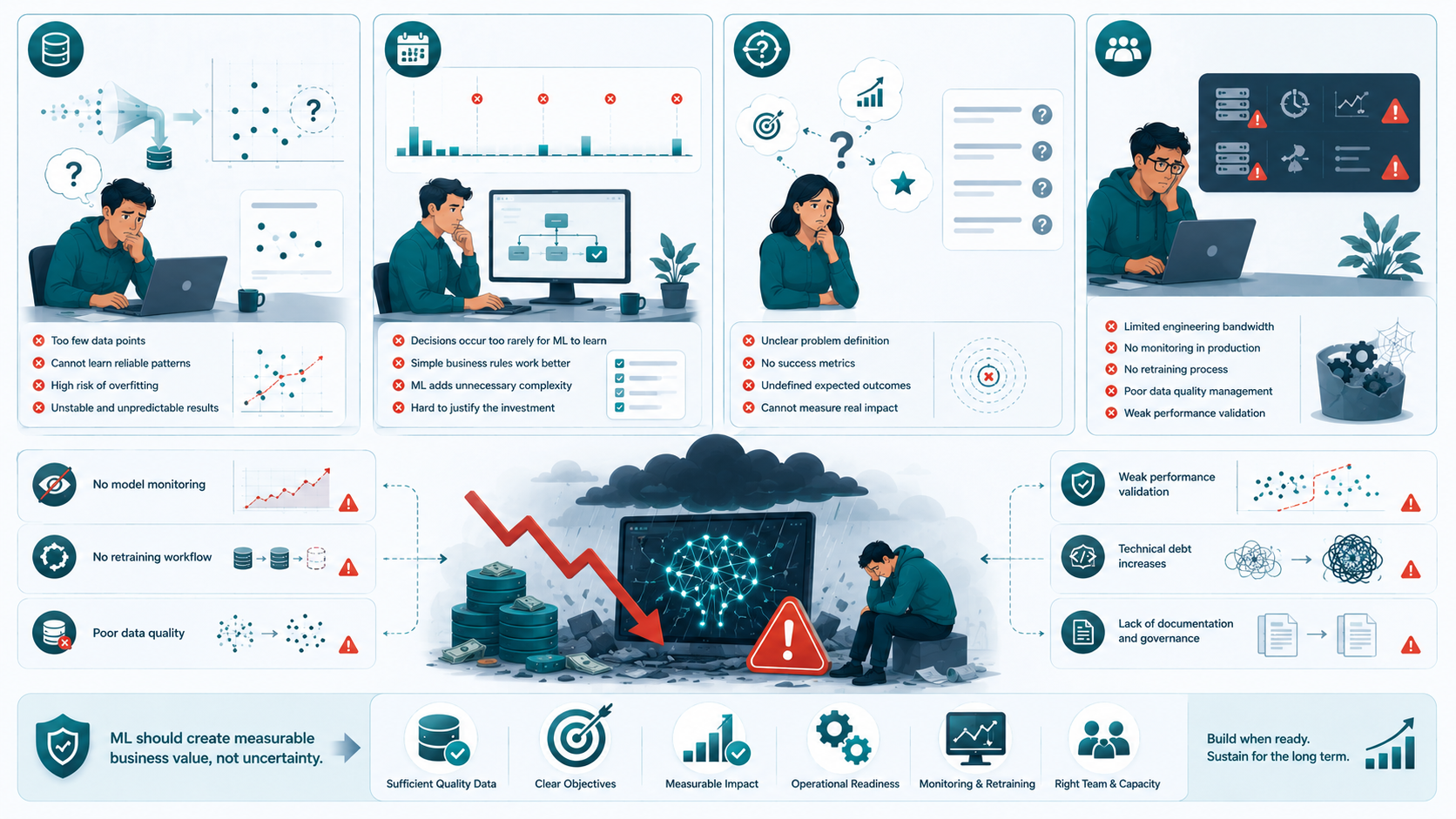
Machine learning is not always the correct solution.
There are situations where implementation costs outweigh the benefits.
Small Datasets
Machine learning models depend on large volumes of historical data to identify meaningful patterns. When datasets are too small, predictions become less accurate and reliable. In such situations, traditional analytics and rule-based approaches often provide better business value with lower complexity.
Low-Frequency Decisions
Machine learning performs best when it can learn from frequent and repetitive events. Business processes that occur rarely may not generate enough data for effective model training. Simple decision rules are often more practical and easier to maintain for low-frequency scenarios.
Simple business rules are often more effective.
Unclear Business Objectives
Successful machine learning projects require clearly defined goals and measurable outcomes. Without specific success metrics, teams struggle to evaluate performance and business impact. Clear objectives help ensure that machine learning initiatives solve real business problems rather than becoming experimental projects.
Projects frequently fail when teams cannot define:
- Success metrics
- Expected outcomes
- Operational improvements
Without measurable goals, machine learning becomes a technology experiment rather than a business solution.
Limited Operational Capacity
Machine learning systems require ongoing monitoring, maintenance, and periodic retraining to remain effective. Organizations must allocate resources for data quality management and performance validation. Small teams often underestimate these long-term operational responsibilities, leading to sustainability challenges.
Teams need resources for:
- Model monitoring
- Retraining
- Data quality management
- Performance validation
Small engineering teams sometimes underestimate these ongoing responsibilities.

Sustainable Practices for Small Engineering Teams
The most successful machine learning projects are usually the simplest.
For startup teams and SaaS products, sustainability matters more than sophistication.
Start With a Business Problem
Effective machine learning projects begin with a clearly defined business challenge rather than a technology choice. Teams should focus on problems that create measurable costs, inefficiencies, or scalability limitations. This approach increases the likelihood of delivering meaningful business outcomes.
Start with questions like:
- Which decisions consume the most time?
- Where do prediction errors cost money?
- Which processes struggle to scale?
Build Baselines First
Before implementing machine learning, organizations should establish current performance benchmarks and key performance indicators. Creating simple rule-based solutions provides a valuable comparison point for future improvements. Baselines help teams accurately measure the value generated by machine learning.
Before introducing machine learning:
- Measure current performance
- Establish KPIs
- Create simple rule-based solutions
This helps quantify actual improvements.
Prioritize Data Quality
High-quality data is the foundation of successful machine learning systems. Consistent collection methods, validation processes, and data cleaning practices improve model accuracy and reliability. In many cases, better data quality delivers greater business benefits than more advanced algorithms.
Invest in:
- Consistent data collection
- Validation processes
- Data cleaning workflows
- Monitoring systems
Data quality often contributes more value than model complexity.
Keep Architecture Simple
Many organizations introduce unnecessary complexity when deploying machine learning solutions. Starting with straightforward infrastructure, monitoring, and deployment processes reduces operational overhead. Complexity should only be added when clear business or technical requirements justify it.
Start with:
- Simple deployment workflows
- Basic monitoring
- Manageable pipelines
Add complexity only when operational requirements justify it.
Document Assumptions
Every machine learning system is built on assumptions about data, objectives, and operating conditions. Documenting these assumptions improves transparency and helps teams understand system limitations. Proper documentation also reduces technical debt and simplifies future maintenance efforts.
Document:
- Training data limitations
- Model objectives
- Known weaknesses
- Operational constraints
This prevents future engineering bottlenecks and reduces technical debt.
Conclusion
The most valuable machine learning applications for modern businesses are rarely the most complex.
Organizations create meaningful results when they focus on specific business problems rather than chasing artificial intelligence trends.
Customer analytics, predictive maintenance, fraud detection, demand forecasting, intelligent automation, and recommendation systems consistently deliver measurable business value because they improve real operational decisions.
The biggest mistake teams make is introducing machine learning before understanding the problem they're trying to solve.
In practice, successful machine learning projects start with business outcomes, maintain simple architectures, prioritize high-quality data, and scale gradually as organizational needs grow.
Machine Learning Applications for Modern Businesses: FAQs
No. Many small SaaS products and startup teams successfully use machine learning for forecasting, customer analytics, recommendation systems, and business automation.
Customer analytics, predictive modeling, recommendation engines, and demand forecasting are among the most widely adopted applications.
There is no universal number. The required amount depends on the problem, but reliable machine learning models generally need enough historical data to identify meaningful patterns.
Yes. Machine learning can automate repetitive decisions, optimize workflows, improve forecasting accuracy, and reduce manual operational tasks.
Common reasons include poor data quality, unclear objectives, unrealistic expectations, insufficient maintenance resources, and implementing AI without a defined business problem.
Reference
Written by

Paras Dabhi
VerifiedFull-Stack Developer (Python/Django, React, Node.js)
I build scalable web apps and SaaS products with Django REST, React/Next.js, and Node.js — clean architecture, performance, and production-ready delivery.
LinkedIn