
MVP Development Guide For Startups In Usa
Launching a startup often begins with excitement, a promising idea, and a long list of features that seem essential. I've worked with founders across the USA, Europe, Australia, and Canada who believed their first release had to impress everyone. In reality, that approach usually delays the launch, increases development costs, and creates unnecessary complexity before the product reaches real users.
One of the biggest mistakes I continue to see is treating an MVP as a smaller version of the final product. It isn't. A Minimum Viable Product exists to answer one critical question: Will customers actually use and pay for this solution? Everything else is secondary.
Small engineering teams rarely struggle because they lack technical talent. More often, they struggle because they try to solve too many problems at once. Features are added without proper validation, the product roadmap expands every week, and the original objective becomes unclear. Eventually, the team spends months building functionality that customers never requested.
A successful MVP focuses on learning, not perfection. It helps founders validate assumptions, collect customer feedback, and make informed decisions before investing heavily in architecture, scalability, or advanced engineering. Building less in the beginning often leads to building the right product later.
This guide shares the practical lessons I've learned from working with startup teams and SaaS products where early decisions had a lasting impact on growth. Rather than discussing theory, we'll focus on what actually works when resources, time, and budgets are limited.
Why This Problem Happens in Real Teams
Every startup begins with uncertainty. The challenge isn't writing code—it's deciding what deserves to be built first.
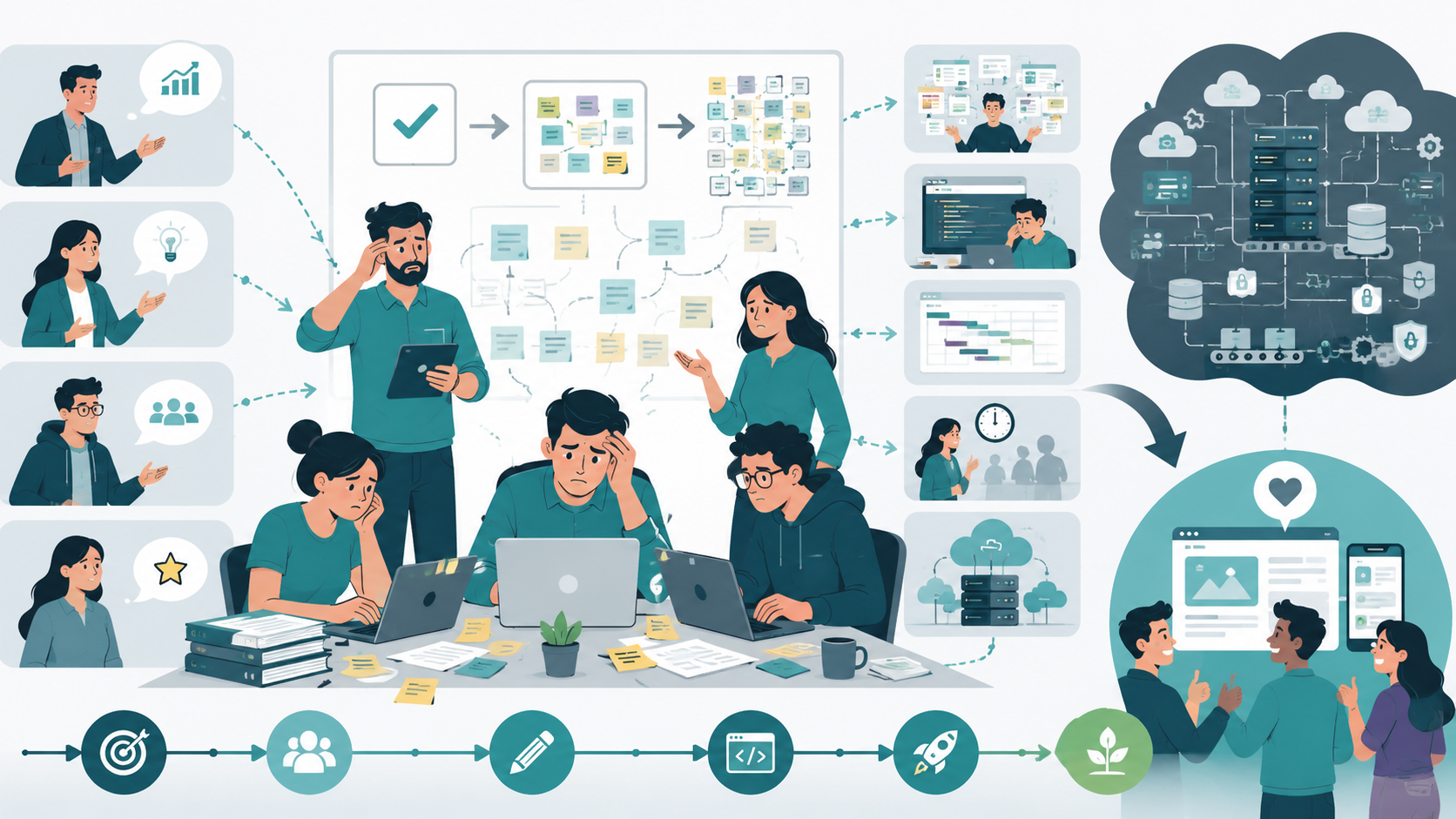
Founders often receive suggestions from investors, advisors, early users, and potential customers simultaneously. Each conversation introduces new ideas, and before long, the original product vision becomes overloaded with additional requirements.
From an engineering perspective, this creates immediate problems. Development shifts from solving one customer problem to accommodating every feature request. Instead of creating a simple prototype for validation, teams start designing an entire software ecosystem.
I've seen this happen repeatedly in early-stage SaaS companies. A project intended to launch in twelve weeks grows into a six-month effort because the scope expands faster than the engineering team can deliver.
Several factors usually contribute to this situation.
The Product Vision Isn't Clearly Defined
Without a clear product strategy, every new suggestion feels important.
When the team lacks agreement on its primary customer problem, every meeting adds another feature to the backlog. Eventually, development priorities become driven by opinions instead of research and market evidence.
Successful startups spend more time defining the problem than expanding the solution.
Teams Confuse Features with Value
Adding more functionality doesn't automatically create a better product.
The most successful MVPs I've worked on delivered only a handful of carefully selected features, each designed to solve one meaningful customer challenge.
When every feature appears equally important, nothing receives the attention it deserves.
Instead of asking:
"What else should we build?"
high-performing product teams ask:
"What is the smallest solution that proves our assumption?"
That shift changes every engineering decision afterward.
Limited Engineering Resources Increase Complexity
Most startups don't have twenty developers.
Many begin with two to eight engineers responsible for frontend development, backend services, infrastructure, testing, deployment, documentation, APIs, databases, and customer support.
Because resources are limited, every unnecessary feature increases technical debt.
Simple architecture quickly becomes difficult to maintain when engineers continuously add functionality that hasn't been validated.
Keeping the initial application focused allows small teams to maintain quality without sacrificing delivery speed.
Planning Often Ends After Development Starts
Many founders create detailed planning documents before development begins but rarely revisit them afterward.
As new ideas appear, the original roadmap slowly disappears.
I've found that successful startup teams review their roadmap every sprint. If a feature doesn't directly improve validation or customer learning, it usually moves to a later release.
This discipline prevents constant scope expansion and helps maintain development momentum.
Customer Feedback Arrives Too Late
Another common issue is delaying customer involvement.
Some startups spend six to nine months building before showing anything to potential users.
By then, changing the application becomes expensive because the architecture, database design, API integrations, and deployment workflows are already established.
Collecting feedback early allows teams to improve usability, simplify interfaces, and adjust functionality before large engineering investments are made.
Scalability Becomes an Early Obsession
Every founder hopes their startup grows rapidly.
Unfortunately, many teams begin designing for millions of users before serving their first hundred.
I've seen startups introduce distributed cloud infrastructure, advanced backend architecture, complex integrations, and enterprise-grade deployment pipelines long before real traffic justified the investment.
Those decisions consume valuable engineering time without improving product validation.
Scalability matters—but only after customers demonstrate consistent demand.
During the MVP stage, simplicity almost always wins.

Where Most Teams Make the Wrong Decision
The internet is full of startup advice that sounds impressive but rarely fits early-stage companies.
Founders are encouraged to adopt the latest architecture patterns, build highly scalable systems, and prepare for explosive growth from day one.
That advice may work for organizations with hundreds of engineers.
It usually doesn't work for startups with four developers and six months of runway.
Building the Product Instead of Validating the Idea
The most expensive mistake isn't choosing the wrong technology.
It's building a complete product before confirming anyone actually needs it.
I've reviewed projects where months of engineering effort produced dozens of polished screens, extensive backend services, advanced analytics, and sophisticated integrations—yet almost no customers actively used the application.
The startup had successfully built software.
It hadn't successfully validated a business.
Treating Every Feature as Essential
Every founder believes their favorite feature will differentiate the product.
Most customers simply want their immediate problem solved.
A disciplined MVP focuses on delivering one complete workflow exceptionally well rather than ten incomplete experiences.
If users can't achieve the primary objective quickly, additional functionality rarely improves adoption.
Overengineering the Architecture
One pattern appears repeatedly across startup projects.
Teams begin discussing microservices, event-driven architecture, container orchestration, and advanced cloud deployments before finishing the first usable version.
In practice, these decisions often slow development instead of improving it.
A simple architecture with clean engineering practices is easier to maintain, test, and optimize.
Complexity should solve a real operational problem—not an imaginary future requirement.
Ignoring User Experience During Early Development
Some founders believe UI and UX improvements can wait until after launch.
In reality, usability heavily influences customer perception.
A product with fewer features but a cleaner interface often performs better than one packed with functionality that users struggle to navigate.
Wireframes, mockups, and simple user testing frequently reveal issues before developers invest weeks building the wrong workflows.
Measuring Progress by Code Instead of Learning
Writing more code doesn't always mean making more progress. The real success of an MVP comes from learning how customers interact with the product, gathering actionable feedback, and using those insights to guide future development decisions.
It's measured by how quickly the team learns.
Every deployment should answer questions like:
- Are customers completing the primary workflow?
- Which feature receives the most engagement?
- Where do users abandon the application?
- What assumptions proved incorrect?
- Which improvements deliver measurable growth?
The best MVPs aren't the ones with the most code.
They're the ones that generate the most useful feedback with the least engineering effort.
Practical Fixes That Actually Work
After working with startup teams across different countries and product stages, I've noticed that successful MVPs rarely stand out because of the technology stack. Working with a US MVP software partner for early-stage products helps founders focus on one core workflow, simple architecture, customer validation, feature prioritization, and disciplined product development before investing in full-scale software.
The goal isn't to build the fastest application or the most advanced platform. The goal is to learn whether you're solving a real customer problem before investing months of engineering effort.
Here are the practices that have consistently delivered better outcomes.
Start with One Core Workflow
Every successful MVP begins by solving one specific customer problem through a single, well-defined workflow. Keeping the initial scope focused helps startups launch faster, gather meaningful feedback, and avoid unnecessary development complexity. Once the core workflow is validated, additional functionality can be added with greater confidence.
Instead, define the single workflow that represents your product's primary value.
For example:
A project management application doesn't need reporting, automation, notifications, and integrations on day one.
It only needs to prove that teams can successfully create, organize, and complete projects.
Everything else should support that objective—not compete with it.
When engineers understand the primary workflow, architecture decisions become much simpler.
Prioritize Features Based on Validation
Features should be selected based on their ability to validate your product idea, not on assumptions or personal preferences. Prioritizing functionality that delivers measurable customer value helps engineering teams stay focused, reduce development time, and make informed decisions based on real user feedback.
Every feature should answer one question:
Does this help validate our business assumption?
If the answer is no, postpone it.
I usually recommend dividing the backlog into three categories.
Must Have
- User authentication
- Core product functionality
- Essential database models
- Basic API endpoints
- Reliable deployment
- Error handling
Should Have
- User profile management
- Notifications
- Basic analytics
- Search
- Reporting
Can Wait
- AI enhancements
- Advanced dashboards
- Multiple user roles
- Workflow automation
- Enterprise permissions
- Complex integrations
This simple prioritization keeps development focused and reduces unnecessary engineering work.
Keep the Architecture Simple
One of the biggest advantages small engineering teams have is speed.
Don't lose that advantage by introducing unnecessary complexity.
I've seen startups delay launches by several months because they attempted to build infrastructure designed for companies a hundred times their size.
A straightforward architecture is usually enough:
- Frontend application
- Backend API
- Relational database
- Cloud hosting
- Authentication service
- Monitoring
- Backup strategy
That's enough for thousands of users in many SaaS products.
Architecture should evolve alongside actual business growth—not anticipated growth.
Build Small, Release Frequently
Long development cycles create blind spots.
Instead of waiting three or four months before releasing, deploy smaller improvements regularly.
Each deployment provides:
- Better customer feedback
- Earlier validation
- Faster iteration
- Lower deployment risk
- Easier debugging
I've found that startup teams releasing every one or two weeks make better product decisions than teams waiting for "the perfect version."
Let Customer Feedback Drive the Roadmap
Roadmaps should evolve through evidence, not assumptions.
Every release should generate feedback that influences the next sprint.
Useful questions include:
- Which features are customers actually using?
- Where do users abandon the application?
- Which workflows create confusion?
- What problems appear repeatedly during onboarding?
Analytics can explain what users are doing.
Conversations explain why they're doing it.
Both are equally valuable.
Measure Success Beyond Code
Engineering progress isn't simply measured by completed tickets.
Meaningful MVP metrics include:
- User activation rate
- Customer retention
- Product engagement
- Feature adoption
- Customer interviews
- Conversion rate
- Session completion
- Support requests
These metrics reveal whether the product is creating value.
Shipping code without learning from users only increases technical debt.
Design for Change, Not Perfection
One lesson I've learned repeatedly is this:
Your first assumptions will probably be wrong.
That's normal.
An MVP should make change inexpensive.
Simple interfaces, modular backend services, clean APIs, and organized database structures allow engineers to adapt without rewriting the entire application.
Flexibility matters more than perfection during the early stages.
Practical Example
Here's an approach I've seen work well.
Week 1–2
- Product discovery
- Customer research
- Wireframes
- Technical planning
Week 3–5
- Backend development
- Frontend implementation
- Authentication
- Database setup
- Core functionality
Week 6
- Internal testing
- Deployment
- Customer validation
Week 7–8
- Collect feedback
- Improve usability
- Remove unnecessary functionality
- Optimize performance
Instead of spending six months guessing what customers want, the team learns from real usage within two months.
That dramatically improves future development decisions.
When This Approach Fails
Although building a lean MVP works well for most startups, it isn't the right strategy in every situation.
Understanding its limitations is just as important as understanding its benefits.
Highly Regulated Industries
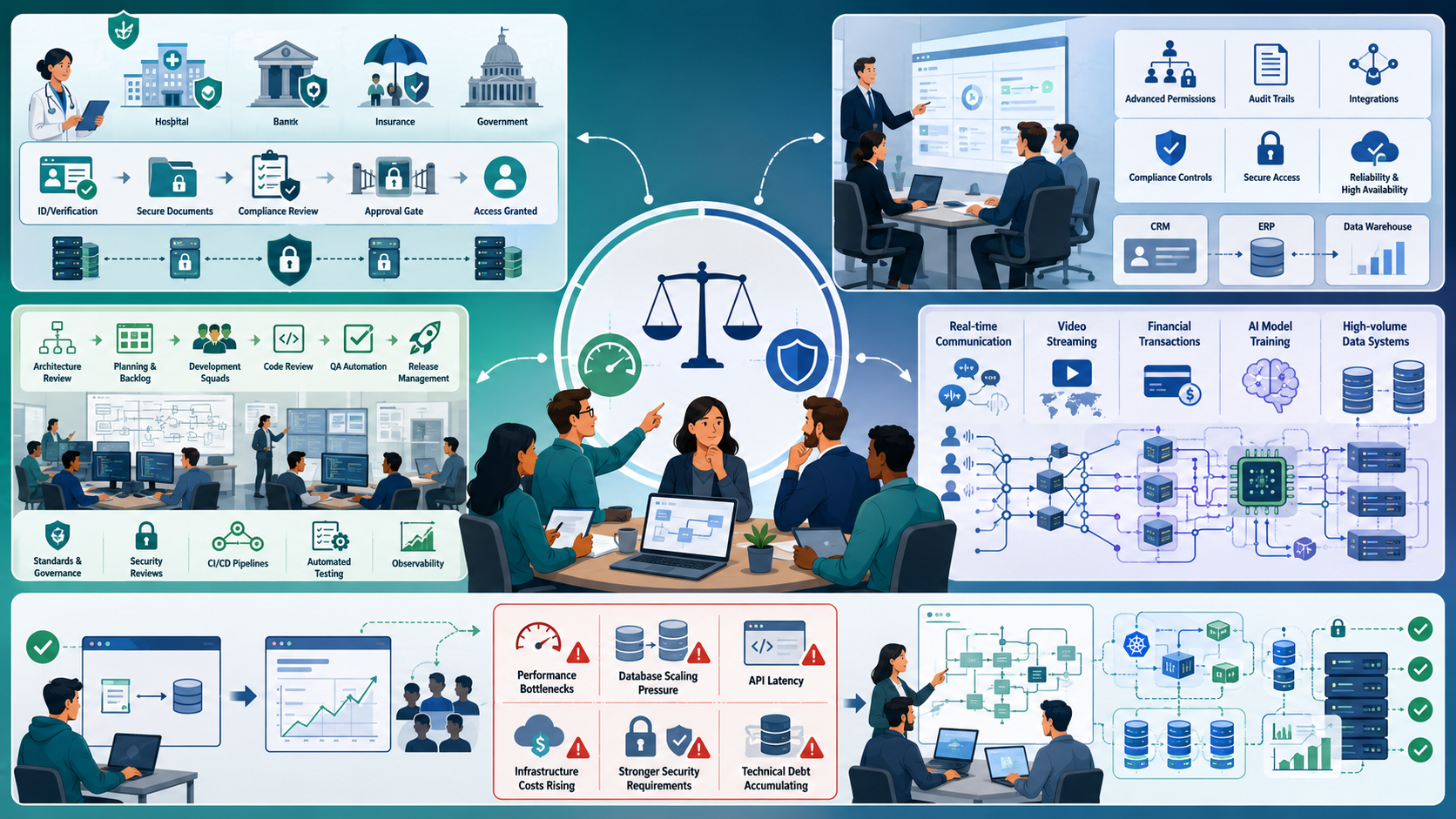
Products built for healthcare, banking, insurance, or government services often require extensive compliance before users can access the application.
Security, documentation, audits, and regulatory approvals cannot be postponed.
In these environments, releasing an incomplete MVP may introduce unacceptable risks.
Enterprise Software
Enterprise customers usually expect:
- Advanced security
- Permission management
- Audit logs
- High availability
- Reliable integrations
- Compliance documentation
A minimal product may not satisfy procurement requirements, regardless of how useful the core solution is.
The MVP still matters, but expectations are much higher.
Large Engineering Teams
The advice in this guide is intended for startup teams of roughly 2–15 engineers.
Once organizations grow beyond several development squads, coordination becomes more complex.
Additional processes become necessary:
- Dedicated architecture reviews
- QA automation
- Release management
- Technical governance
- Platform engineering
Keeping everything informal eventually becomes difficult.
Products with Complex Infrastructure
Some applications require substantial infrastructure before customers receive any value.
Examples include:
- Real-time communication platforms
- Video streaming
- Financial transaction systems
- AI model training platforms
- High-volume data processing systems
Here, significant engineering investment may be unavoidable before validation becomes possible.
The objective should still be reducing unnecessary complexity wherever possible.
Growth Can Create New Challenges
Ironically, a successful MVP eventually creates new engineering problems.
As adoption increases, startups often encounter:
- Performance bottlenecks
- Database scaling issues
- API latency
- Infrastructure costs
- Security improvements
- Technical debt
This is when architecture should evolve—not six months before launch.
Growing systems deserve growing architecture.
Early-stage products usually don't.

Sustainable Practices for Small Engineering Teams
Launching an MVP is only the beginning.
Maintaining development velocity without exhausting the team requires long-term discipline.
The startups that continue growing aren't always the ones with the smartest engineers.
They're often the ones with the simplest engineering habits.
Keep Technical Debt Visible
Technical debt isn't automatically harmful.
Ignoring it is.
Create a shared backlog where engineers document:
- Code duplication
- Performance concerns
- Refactoring opportunities
- Outdated dependencies
- Security improvements
Review this backlog regularly.
Small improvements prevent major rewrites later.
Document Important Decisions
Documentation doesn't need to be lengthy.
Simple records explaining why decisions were made save enormous amounts of time later.
Useful documentation includes:
- API contracts
- Database relationships
- Deployment process
- Architecture diagrams
- Product assumptions
- Development standards
New engineers become productive much faster when knowledge isn't trapped inside someone's memory.
Standardize Deployment Workflows
Manual deployments introduce unnecessary risk.
Even simple automation reduces mistakes.
A consistent deployment workflow should include:
- Automated testing
- Code review
- Version control
- Rollback procedures
- Monitoring
- Logging
Reliable deployment processes allow teams to release confidently.
Protect Engineering Focus
Constant interruptions slow development more than difficult technical problems.
Successful product teams usually protect uninterrupted development time by:
- Limiting unnecessary meetings
- Defining sprint priorities
- Avoiding mid-sprint scope changes
- Reducing context switching
Focused engineers consistently produce higher-quality software.
Encourage Cross-Functional Collaboration
The best startup products emerge when developers, designers, founders, and product managers solve problems together.
Instead of working in isolation:
- Engineers contribute during product discovery.
- Designers participate in usability discussions.
- Founders review customer feedback.
- Product teams prioritize based on research and analytics.
This collaboration creates better decisions long before development begins.
Optimize Only When Evidence Exists
Performance optimization often becomes an unnecessary distraction.
I've reviewed applications where engineers spent weeks optimizing code that handled only a few hundred users.
Optimization should be driven by metrics—not assumptions.
Measure first.
Improve second.
That mindset prevents wasted effort and allows teams to focus on customer value instead of hypothetical bottlenecks.
Conclusion
Building an MVP isn't about delivering the smallest product possible. It's about delivering the right product to the right customers as quickly as possible while learning from every release.
One mistake I've seen repeatedly is startups treating their first version as the final product. They spend months expanding the feature list, refining the architecture, and preparing for growth that hasn't happened yet. By the time they launch, they've invested significant engineering effort without confirming whether the market actually wants what they've built.
The startups that make steady progress take a different approach. They define one problem, build one practical solution, launch early, and let customer feedback shape every iteration. Their roadmap evolves through research, analytics, and real user behavior—not assumptions.
An MVP should reduce uncertainty, not eliminate it. The goal is to validate your product, understand your market, and create a foundation that can grow sustainably without accumulating unnecessary technical debt.
If your engineering team can consistently prioritize simplicity, maintain a clean architecture, release frequently, and make decisions based on measurable data, you'll be in a much stronger position when it's time to scale.
Successful startups don't win because they build more.
They win because they learn faster.
MVP Development Guide For Startups In Usa: FAQs
The primary goal of an MVP is to validate a business idea with real customers before investing heavily in product development. It helps founders confirm product-market fit, gather feedback, and reduce the risk of building features that users don't need.
An MVP should include only the core functionality required to solve one specific customer problem. Every additional feature increases development time, complexity, and maintenance without necessarily improving product validation.
For most startups with a focused scope, an MVP can usually be developed in 8 to 12 weeks. The timeline depends on product complexity, engineering resources, integrations, and the level of user testing required before launch.
Not usually. Most early-stage startups benefit from a simple, maintainable architecture that supports current users. Scalability should evolve alongside customer growth rather than being optimized prematurely.
A startup should expand beyond the MVP once it has validated customer demand through measurable indicators such as consistent user engagement, positive retention, recurring revenue, and actionable customer feedback. At that point, new features should be driven by proven business needs rather than assumptions.
Reference
Written by

Paras Dabhi
VerifiedFull-Stack Developer (Python/Django, React, Node.js)
I build scalable web apps and SaaS products with Django REST, React/Next.js, and Node.js — clean architecture, performance, and production-ready delivery.
LinkedIn