
Software Development Contract Essentials
A software project can have a strong engineering team, a sensible architecture, and a clear product roadmap—and still become difficult because the contract was vague.
I have seen this happen on client projects where everyone started with the same understanding of the product, but six months later the scope, deliverables, payment, and responsibility were being interpreted differently by the client and development team.
The problem usually isn't that someone wrote a bad contract intentionally. It is that software is difficult to describe completely before development begins. Features change, technical assumptions become clearer, integrations behave differently than expected, and priorities move.
A contract that simply says “build a SaaS application according to the agreed requirements” doesn't protect either side very well.
A useful software development contract should establish who owns what, who is responsible for what, how changes are handled, when work is considered complete, what happens when something goes wrong, and how the relationship can end without creating unnecessary conflict.

Why Software Development Contracts Become a Problem in Real Teams
The biggest mistake is treating a software contract as administrative paperwork instead of part of the engineering process.
On a small project, everyone may communicate directly through Slack, email, Jira, or meetings. That can create a false sense that everything is understood.
Then the project grows.
A developer assumes a feature is included. The client assumes it was part of the original requirements. A product manager requests a modification. The development team considers it a new request. Nobody checks the original agreement because the contract doesn't explain the situation clearly.
This is where disagreements start.
Several factors make this common.
Time pressure
Startups often want development to begin immediately. Contract discussions can feel like unnecessary delays when everyone is excited about the product.
That pressure leads teams to accept vague language such as:
- Build the platform.
- Complete the application.
- Provide ongoing support.
- Implement required integrations.
These descriptions sound reasonable but don't establish enough detail.
Limited engineering resources
A team of two to five developers cannot absorb unlimited changes without affecting the timeline, quality, or budget.
If the contract doesn't establish boundaries, every additional request can become a negotiation.
Requirements change
Changing requirements are normal in software development.
The problem isn't change itself. The problem is changing requirements without a clear change process.
Different definitions of completion
A client may think a feature is complete when it works in a demonstration.
An engineering team may consider it complete when it passes testing, meets the agreed acceptance criteria, and is ready for deployment.
Those are not always the same thing.
Different assumptions about ownership
Questions about ownership, copyright, source code, third-party libraries, and licensing can become serious after launch if they were never addressed.
These issues are much easier to solve before development starts than after several months of work.
Where Most Teams Make the Wrong Decision
One common mistake is keeping the contract extremely short because the team wants to stay flexible.
Flexibility is useful, but ambiguity isn't.
I've worked with teams where the technical work was actually progressing well, but the project relationship deteriorated because the commercial terms were not aligned with the engineering reality.
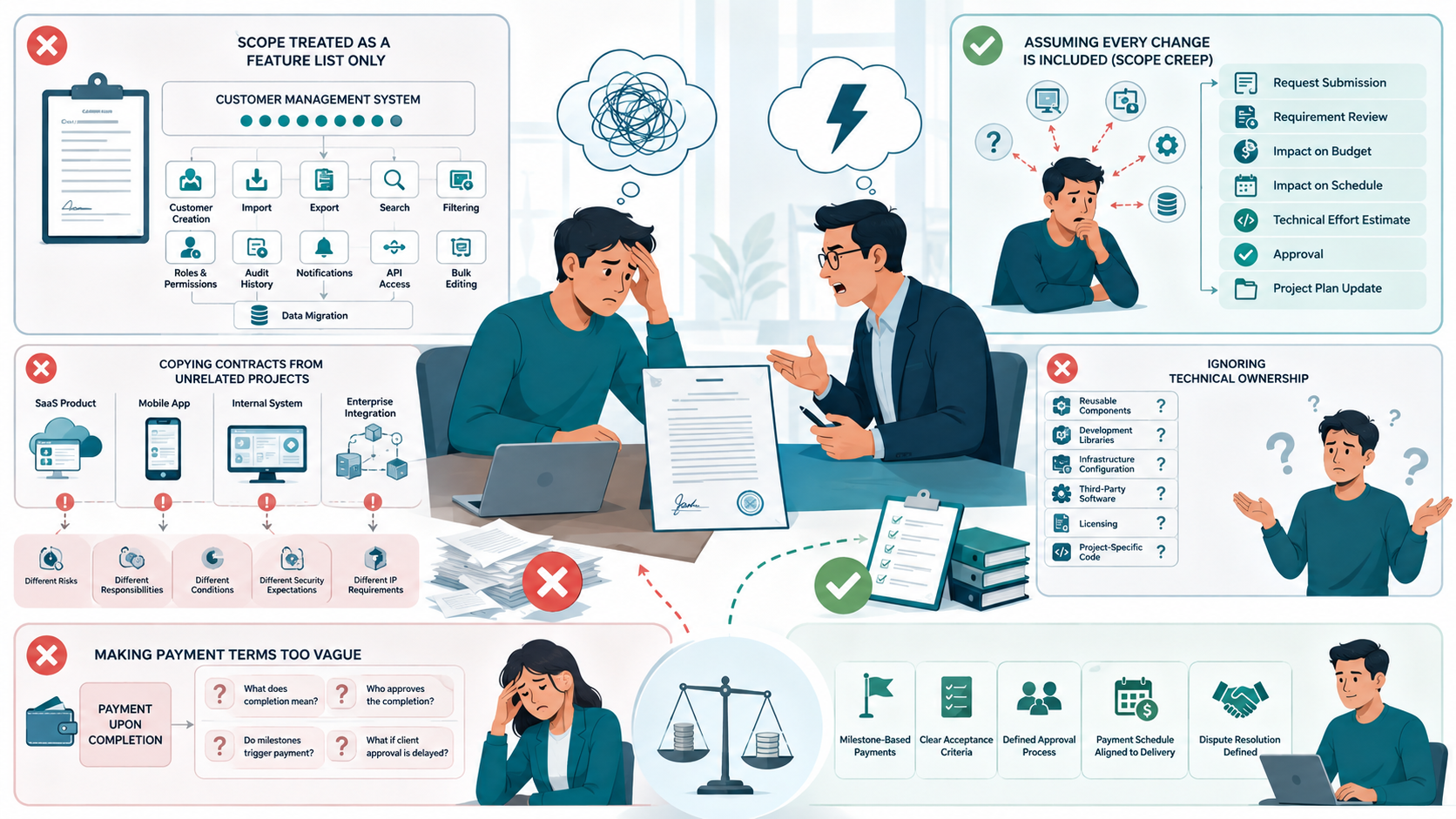
1. Treating the scope as a feature list
A list of features isn't necessarily a complete scope definition.
For example:
Customer management system
doesn't tell a developer whether the system includes:
- Customer creation
- Import and export
- Search
- Filtering
- Roles
- Audit history
- Notifications
- API access
- Bulk editing
- Data migration
A better contract connects the requirements to measurable deliverables.
2. Assuming every change is included
This is one of the fastest ways to create scope creep.
A useful contract should explain how a requested change is evaluated.
The process can be simple:
- Client submits the request.
- Development team reviews the requirement.
- Impact on budget, schedule, and technical work is estimated.
- Both parties approve the modification.
- Work is added to the project plan.
The goal isn't to prevent changes. It is to make changes visible.
3. Copying contracts from unrelated projects
A SaaS product, mobile application, internal business system, and enterprise integration project can have completely different risks.
Copying an old contract may leave important areas uncovered.
The conditions, responsibilities, security expectations, and intellectual property requirements should reflect the actual project.
4. Ignoring technical ownership
I've seen projects where everyone assumed the client would own the final software, but nobody discussed reusable components, development libraries, infrastructure configuration, or third-party software.
That creates unnecessary conflict later.
The contract should distinguish between project-specific work and components that may have separate licensing or ownership arrangements.
5. Making payment terms too vague
Payment upon completion sounds straightforward until the project lasts nine months.
What does completion mean?
Who decides whether it is complete?
Is payment connected to milestones?
What happens if the client delays approval?
Clear payment conditions reduce these arguments.

Practical Fixes That Actually Work
A good contract doesn't need to be hundreds of pages. It needs to answer the questions that are most likely to create disagreement. Working with a US software development partner for contract-ready projects helps teams define scope, deliverables, responsibilities, payment milestones, IP ownership, licensing, confidentiality, acceptance criteria, change requests, warranty, maintenance, and termination before development begins.
1. Define the project scope precisely
Start with a practical description of what is being built.
Document:
- Product purpose
- Major functionality
- Technical requirements
- Platforms
- Integrations
- Expected users
- Key constraints
- Explicit exclusions
The exclusions are particularly important.
If the project includes web application development but not a native mobile application, say so.
If hosting is the client's responsibility, state it.
If data migration is outside the agreed work, document it.
Clear boundaries protect both sides.
2. Define responsibilities instead of assuming them
A contract should identify the responsibility of each party.
For example, the development team may be responsible for:
- Software implementation
- Code review
- Testing
- Technical documentation
- Deployment assistance
The client may be responsible for:
- Providing business requirements
- Supplying content
- Providing credentials
- Reviewing deliverables
- Providing timely feedback
- Approving milestones
This creates accountability.
It also prevents a situation where a project is delayed because one side is waiting for something the other side assumed was already available.
3. Establish measurable deliverables
Each major deliverable should have an understandable definition.
For example:
Deliverable: Customer management module
Includes:
- Customer creation
- Editing
- Search
- Filtering
- Role-based access
Acceptance: The agreed functionality operates according to the documented requirements and passes the defined testing process.
This is much stronger than simply saying customer management module.
4. Connect milestones to payment
For larger projects, milestone-based payment is often easier to manage than waiting until the entire product is finished.
A project might have:
- Discovery milestone
- UI completion milestone
- Core backend milestone
- Feature completion milestone
- User acceptance milestone
- Production deployment milestone
The payment schedule should clearly identify what triggers each payment.
This makes the pricing and compensation structure easier to understand and gives both parties a predictable financial process.
5. Define the change process
A change request should not automatically become a dispute.
Document how a modification is handled.
A simple change request can contain:
- Requested change
- Reason
- Technical impact
- Additional effort
- Timeline impact
- Cost impact
- Approval
This creates a record of why the project changed.
It also gives the development team enough authority to explain the engineering consequences of a request instead of simply accepting every new feature.
6. Clarify intellectual property and licensing
This is one of the most important areas of a software development agreement.
The contract should explain the intellectual property arrangements surrounding:
- Source code
- UI designs
- Documentation
- Database structures
- Custom modules
- Existing libraries
- Third-party software
- Open-source components
Copyright ownership should also be clear.
For example, does the client receive ownership after full payment? Does the development team retain ownership of reusable frameworks? Are third-party components transferred or merely licensed?
These are contractual questions, not things the engineering team should have to guess.
7. Protect confidential information and data
Software projects frequently involve sensitive business information.
The contract should address confidentiality, privacy, and security expectations.
Depending on the product, this can include:
- Customer information
- Authentication credentials
- Source code
- Business processes
- Internal documentation
- Financial information
- Production data
The contract should also establish who has access to systems and what happens when access is no longer required.
8. Define acceptance and approval
Client approval is too vague by itself.
The contract should explain how acceptance works.
For example:
- Development team submits a milestone.
- Client reviews it against agreed requirements.
- Client identifies specific issues.
- Development team addresses valid issues.
- Client provides final approval.
This gives the project a clear path from development to completion.
9. Address warranty and maintenance separately
A completed software product can still have bugs.
That doesn't necessarily mean the entire project is unfinished.
A contract should distinguish between a warranty period for correcting defects and ongoing maintenance or feature development.
For example:
- Warranty: correction of defects related to agreed functionality.
- Maintenance: ongoing technical improvements.
- New features: separately evaluated development work.
This distinction prevents every future request from being treated as a bug fix.
10. Establish security and compliance expectations
Security requirements should match the actual product.
For a basic internal application, requirements may differ significantly from a healthcare, financial, or enterprise SaaS platform.
The contract can define relevant compliance requirements, security responsibilities, access controls, infrastructure expectations, and incident procedures.
Avoid promising vague phrases such as 100% secure.
Instead, document specific technical and operational responsibilities.
What Happens When Something Goes Wrong?
Even good projects encounter problems.
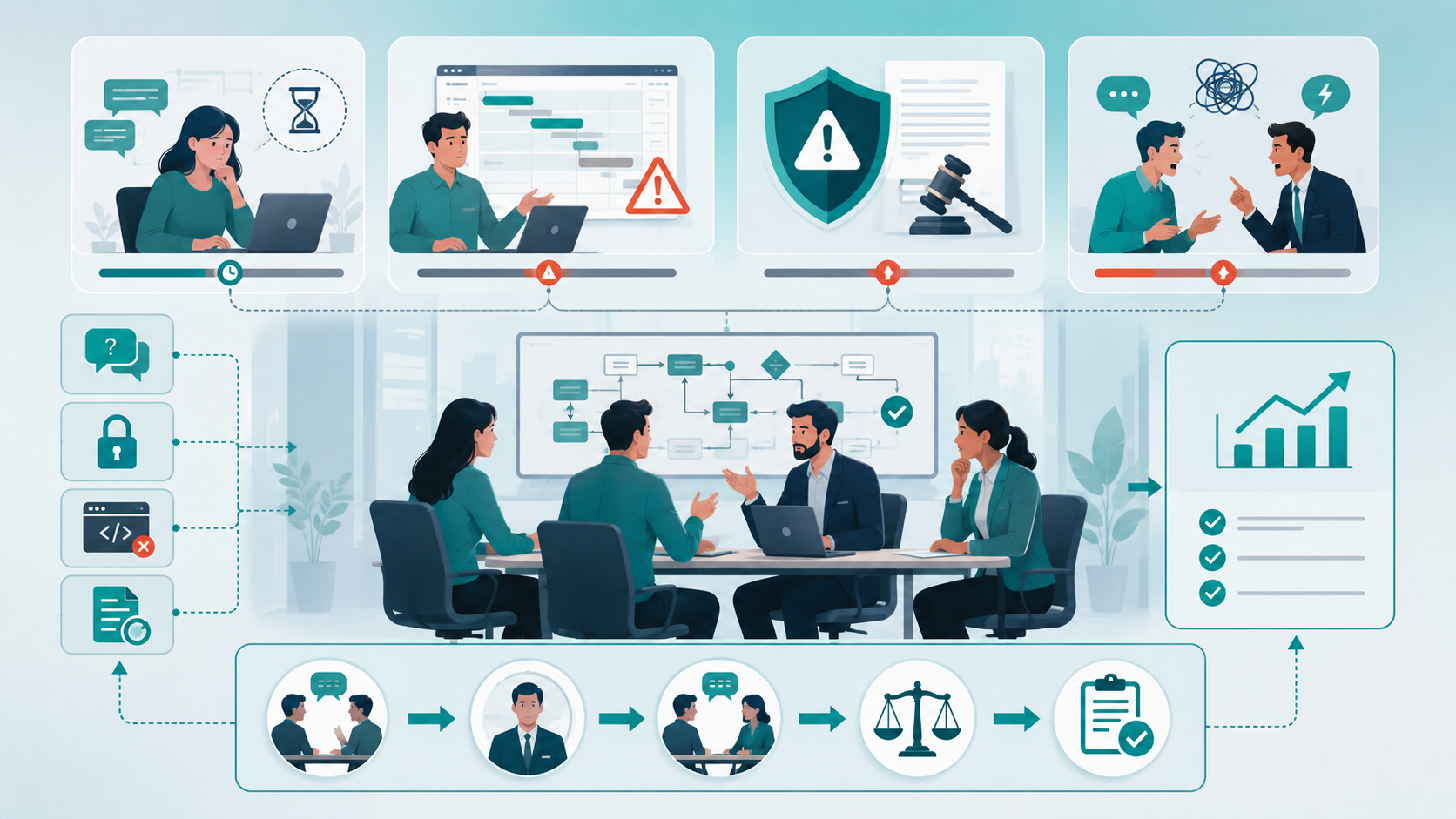
A vendor may miss a milestone. A client may delay feedback. An integration may become unavailable. Requirements may change dramatically.
The contract should explain what happens next.
Delayed client feedback
If the development team cannot continue because required information or approval hasn't been provided, the project schedule may need to move.
That should be documented rather than handled through informal arguments.
Missed development deadlines
The team should communicate the reason for the delay and its effect on the remaining timeline.
Some delays are caused by technical discoveries or dependencies that weren't reasonably predictable at the beginning.
Contract breach
A breach occurs when a party fails to meet a contractual obligation.
The contract should define the process for addressing serious breaches before immediately jumping to termination.
Disputes
Not every disagreement needs to become a legal battle.
Contracts can establish a dispute resolution process such as:
- Direct discussion
- Management escalation
- Mediation
- Arbitration or other agreed legal process
The appropriate process depends on the parties, project, and applicable jurisdiction.
When a Detailed Contract Still Fails
A contract isn't a replacement for good project management.
I've seen detailed agreements fail because the teams stopped communicating after signing them.
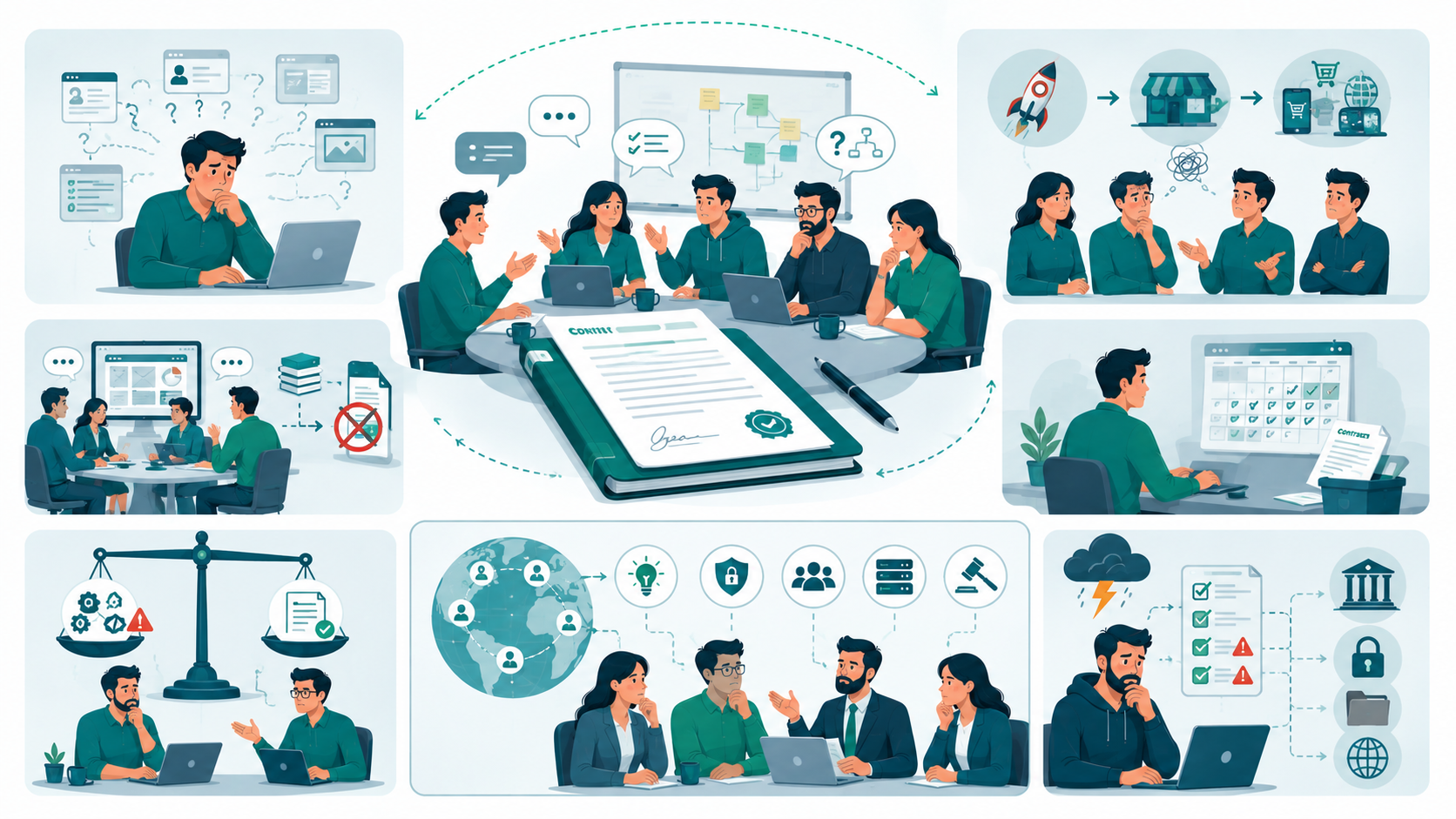
There are several situations where even a well-written contract can struggle.
Requirements are fundamentally unclear
If nobody understands what the product should actually do, adding more contractual language won't solve the underlying product problem.
The product changes completely
A startup may begin with one business model and discover a different market six months later.
At that point, the original contract may need significant change.
The team ignores documentation
If decisions happen in meetings but aren't recorded, people can develop different interpretations of the agreement.
Nobody reviews the contract during the project
A contract should not disappear into a folder after signing.
When major requirements, milestones, or responsibilities change, the relevant documentation should be updated through the agreed process.
Legal complexity exceeds the team's expertise
Software contracts can involve intellectual property, international parties, taxation, privacy, liability, and regulatory requirements.
For significant projects, legal review is sensible. Engineers can identify technical risks, but they should not pretend to replace qualified legal advice.

Sustainable Practices for Small Engineering Teams
Small teams don't need complicated bureaucracy. They need enough structure to prevent predictable problems.
Keep one source of truth
The contract should connect with the project documentation.
Requirements, deliverables, decisions, and major changes should be traceable.
Review obligations before every major milestone
Before starting a milestone, confirm:
- What needs to be delivered?
- Who owns each task?
- What dependencies exist?
- What constitutes acceptance?
- What payment is connected to completion?
This takes very little time and prevents many misunderstandings.
Document important decisions
Good documentation doesn't mean writing everything down.
Record decisions that affect:
- Scope
- Architecture
- Security
- Ownership
- Schedule
- Budget
- Deliverables
Keep communication explicit
In remote teams, communication becomes especially important.
A conversation in a video call can disappear from everyone's memory.
Important decisions should be written down afterward.
Don't confuse flexibility with informality
A flexible project can still have clear boundaries.
In fact, clear boundaries usually make it easier to collaborate because everyone understands how changes will be handled.
Build accountability into the workflow
Accountability shouldn't mean blaming people.
It means making responsibilities visible.
When the client owns a requirement and the developer owns implementation, both sides can identify where a project is blocked without turning every problem into a personal disagreement.
Conclusion
The most important lesson I've learned from software projects is that a development contract should not try to predict every possible problem.
It should create a clear way to handle the problems that are most likely to happen.
A strong agreement establishes rights, duties, obligations, responsibility, authority, ownership, terms, and conditions without making the engineering process unnecessarily complicated.
It should define the scope, requirements, deliverables, milestones, timeline, payment, and acceptance process. It should also address confidentiality, privacy, security, liability, indemnity, warranty, termination, renewal, dispute, jurisdiction, governance, licensing, and copyright.
Most importantly, the contract should match the way the team actually develops software.
The best contract is not the longest one. It is the one that makes difficult conversations easier before they become expensive problems.
Software Development Contract Essentials: FAQs
It should generally define the scope, requirements, deliverables, responsibilities, payment terms, milestones, intellectual property, confidentiality, security, acceptance criteria, change process, warranty, liability, dispute resolution, and termination conditions.
A clear scope establishes what the development team is expected to build and what is outside the agreement. This helps reduce misunderstandings and uncontrolled scope changes.
Ownership depends on the contractual arrangement. The agreement should explicitly state when and how source code, copyright, custom software, documentation, and other intellectual property are transferred or licensed.
A change should be documented, evaluated for technical and schedule impact, priced when necessary, and approved before implementation. This prevents informal requests from becoming uncontrolled scope expansion.
Even small projects benefit from a written agreement. The document can be relatively simple, but it should still clarify scope, payment, ownership, responsibilities, acceptance, confidentiality, and what happens if the project changes or ends.
Reference
Written by

Paras Dabhi
VerifiedFull-Stack Developer (Python/Django, React, Node.js)
I build scalable web apps and SaaS products with Django REST, React/Next.js, and Node.js — clean architecture, performance, and production-ready delivery.
LinkedIn