Software Development Cost in India: How to Estimate It Without Getting Burned

I’ve worked with small Indian dev teams, early-stage startups, and client agencies for over a decade.
One pattern keeps repeating.
A founder chooses the lowest quote to reduce software development cost in India, thinking they’re being financially smart.
Six months later, the product is slower, harder to change, and costs more to fix than to rebuild.
This isn’t about blaming “cheap developers.”
It’s about how cost decisions are usually made — and why they backfire in small teams.
Why this problem actually happens
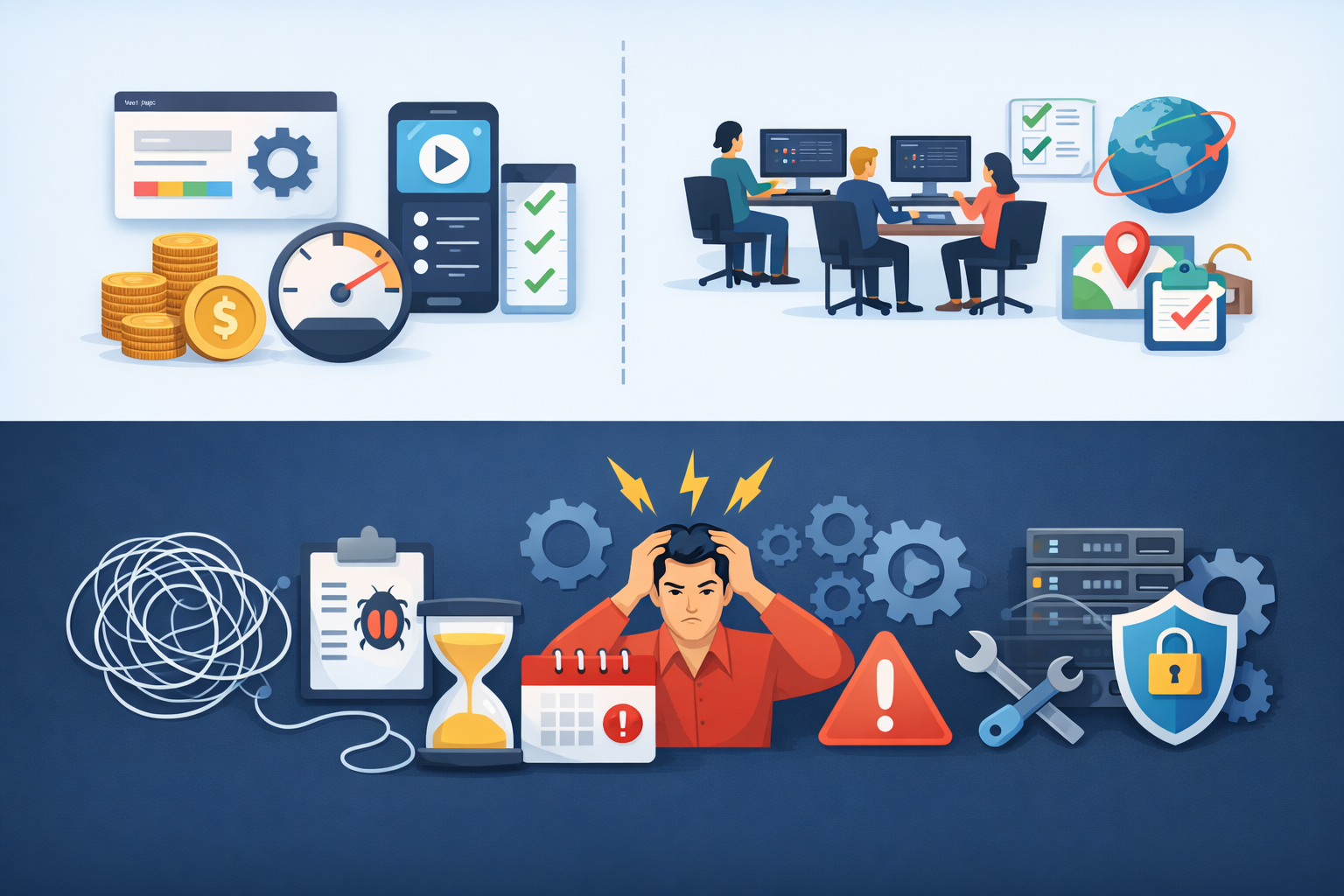
When founders compare development costs, they usually compare:
In early-stage startups, budget pressure is real.
I’ve been in rooms where the only goal was:
“Ship something usable in 3 months under ₹X.”
So teams:
Cut documentation
Skip automated tests
Hardcode logic for speed
Avoid refactoring
It works — temporarily.
The real issue isn’t low cost.
It’s optimizing for initial build cost instead of cost of change.
And in small teams, change is constant.
- Hourly rate
- Total project quote
- Delivery timeline
But they rarely compare:
- Code maintainability
- Decision-making ownership
- Architectural trade-offs
- Post-launch change cost
Where most developers or teams get this wrong
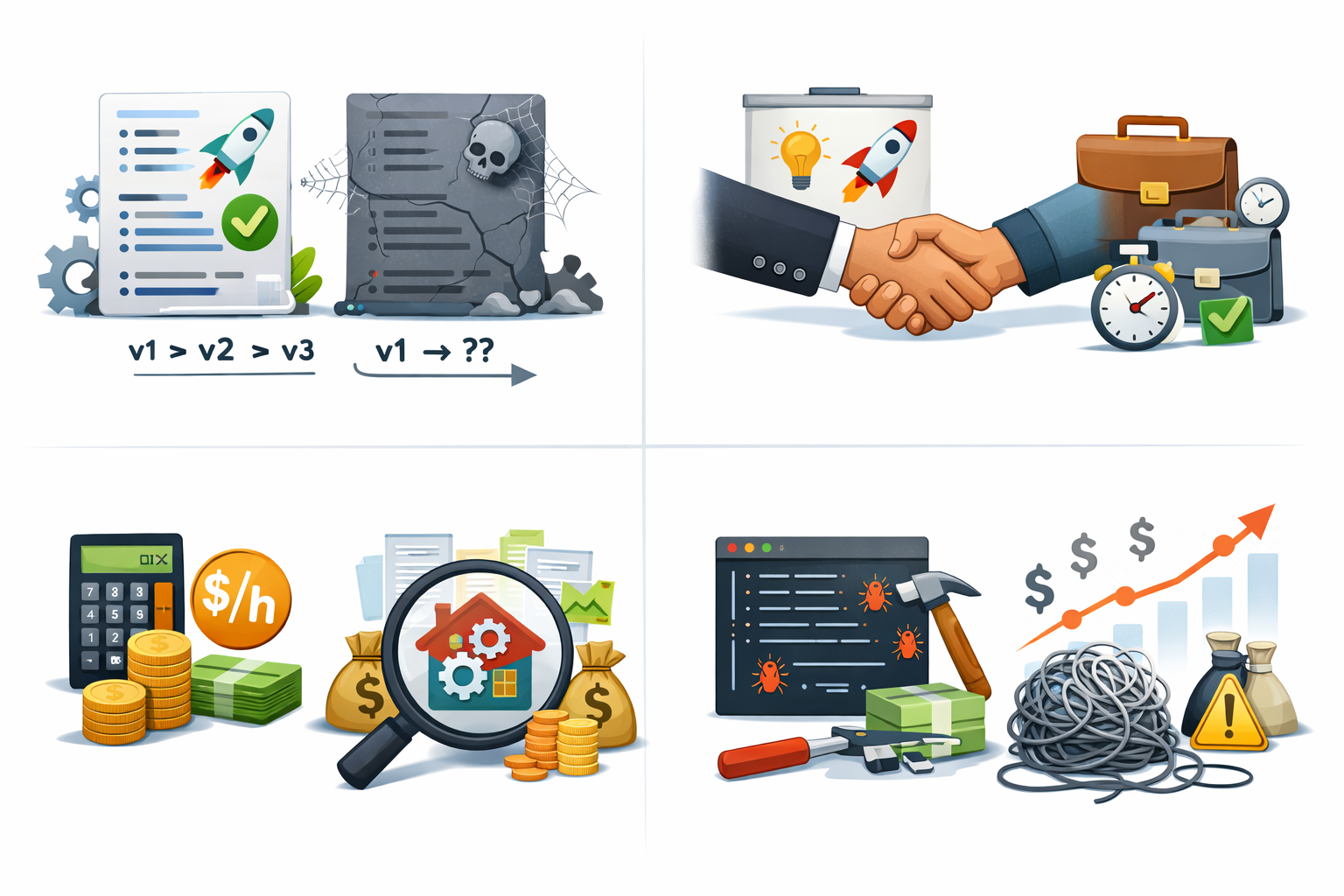
1. They assume all codebases age the same
Most teams think technical debt grows at a predictable, manageable pace.
In reality, poorly structured code becomes harder to change exponentially, while clean, modular systems stay flexible much longer.
I’ve seen founders say:
“We’ll clean it later.”
Later never comes.
Because once real users arrive, the team is always busy fixing bugs or shipping features.
Technical shortcuts compound.
2. They treat agencies like product partners
Many founders assume an external agency will think long-term like an in-house product team.
In reality, agencies are usually optimized for delivery milestones, not multi-year maintainability.
Without internal technical ownership, key architectural decisions may prioritize speed over sustainability.
In most startups, this happens because:
- The internal team is non-technical
- The agency controls architecture decisions
- There’s no internal code review capability
The agency optimizes for delivery.
They don’t optimize for your next 3 years.
That’s not malicious — it’s just incentives.
3. They focus on hourly rate instead of ownership cost
Choosing developers based only on a lower hourly rate often ignores the real expense — long-term ownership.
Poor structure, unclear logic, and weak documentation increase maintenance time and future change cost.
What looks cheaper upfront can quietly become expensive every time the product evolves.
A ₹1,200/hour developer who writes maintainable code can be cheaper than a ₹600/hour developer who:
- Overcomplicates structure
- Copies code everywhere
- Avoids documentation
I’ve inherited projects where feature changes took 4–5 days for something that should take 4–5 hours.
That’s where “cheap” becomes expensive.
4. They underestimate refactoring cost
Refactoring isn’t just cleaning up code — it affects testing, deployments, and sometimes even database structure.
Small changes can trigger unexpected side effects in tightly coupled systems.
Teams often assume it’s a quick fix, but in reality, refactoring can slow feature delivery for weeks.
Refactoring isn’t just rewriting code.
It involves:
- Re-testing flows
- Migrating data
- Coordinating deployments
- Updating infra configs
In small teams (2–6 devs), even small rewrites can stall roadmap progress for weeks.
Practical solutions that work in real projects

Here’s what I’ve seen actually reduce long-term cost without inflating initial budgets.
1. Define “change cost” before writing code
Before starting development, think about how often core logic, pricing, or workflows might change.
If changes are likely, structure the system to isolate business rules from the UI and database early.
A small upfront effort here can significantly reduce future rework and feature delays.
Before development starts, ask:
- How often will business rules change?
- Will pricing models evolve?
- Will user roles expand?
If the answer is “likely,” then:
- Separate business logic from UI early
- Avoid hardcoding workflows
- Keep database schema simple
It adds maybe 10–15% effort upfront.
It can reduce change cost by 40–50% later.
2. Keep architecture boring
Small teams don’t need complex patterns to look “advanced.”
Simple structure, clear modules, and a single codebase are easier to maintain and debug.
Boring architecture reduces cognitive load and keeps long-term development cost under control.
In small teams, complexity kills velocity.
What works better:
- Single codebase
- Minimal microservices
- Clear module boundaries
- Simple folder structure
I’ve seen teams introduce event-driven architectures for products with 500 users.
It looked impressive.
It slowed everything down.
Boring systems are cheaper to maintain.
3. Freeze scope during sprints
Changing requirements mid-sprint breaks focus and increases hidden costs.
Even small additions create context switching and rushed implementations.
Freezing scope protects delivery speed and keeps technical decisions intentional.
Most cost overruns don’t come from engineering mistakes.
They come from mid-sprint feature additions.
Real rule we follow:
- No scope changes inside sprint
- Urgent items go to next cycle
- Bug fixes only if production-critical
It protects focus.
Focus reduces waste.
4. Track time per feature
When small features start taking several days, it’s usually a structural problem — not a slow developer.
Tracking time per feature helps expose hidden complexity, tight coupling, or unclear logic early.
It’s one of the simplest ways to detect when your codebase is becoming expensive to maintain.
If small features start taking 5–7 days consistently, something is wrong.
Common causes:
- Tight coupling
- Poor naming
- Hidden side effects
- Lack of test coverage
Tracking time reveals structural decay early.
5. Retain repository ownership
Always keep control of your source code, deployment access, and infrastructure credentials — even when working with an external team.
Without repository ownership, you risk delays, disputes, or being locked out of your own product.
Ownership isn’t about trust issues — it’s about long-term stability and operational control.
This is critical when outsourcing.
Founders should:
- Own Git access
- Control deployment credentials
- Have documentation for infra
I’ve seen startups lose weeks because agency access was revoked during disputes.
Ownership reduces long-term risk.
6. Budget for post-launch
Launch is not the finish line — it’s where real issues start showing up.
User behavior, edge cases, and performance gaps only become visible after real usage.
If you don’t budget for stabilization and iteration, post-launch fixes will feel like unexpected cost overruns.
Real cost structure I usually suggest:
- 70% build
- 30% post-launch stabilization (first 3–6 months)
Because real-world users expose design flaws no planning session can predict.
Ignoring this budget creates panic later.
When this approach does NOT work

The “keep it simple and optimize for change” approach fails in certain cases:
1. Deep-tech or heavy-scale systems
Some products demand serious architectural planning from day one.
If you’re building high-throughput, real-time, or infrastructure-heavy systems, “keep it simple” can become risky.
In these cases, underestimating complexity early can create scaling bottlenecks that are expensive to fix later.
If you're building:
- Real-time trading systems
- High-volume streaming platforms
- AI infrastructure-heavy products
You may need more upfront architecture.
2. Strict compliance environments
In regulated industries, shortcuts are not just risky — they can be legally dangerous.
Audit trails, documentation, security controls, and process discipline add overhead, but they’re non-negotiable.
Trying to “move fast and fix later” in these environments usually leads to expensive rework or compliance failures.
Healthcare, fintech, enterprise SaaS with regulatory constraints —
You cannot “iterate later” casually.
Documentation and process add cost — but skipping them is dangerous.
3. Teams with no technical decision owner
When no one owns the final technical call, architecture becomes a group debate instead of a direction.
Small disagreements turn into inconsistent patterns across the codebase.
Without a clear decision owner, systems slowly become fragmented and expensive to maintain.
If no one can say:
“We are not doing this.”
Then even simple architecture becomes messy.
Small teams need clear technical authority.
Best practices for small development teams
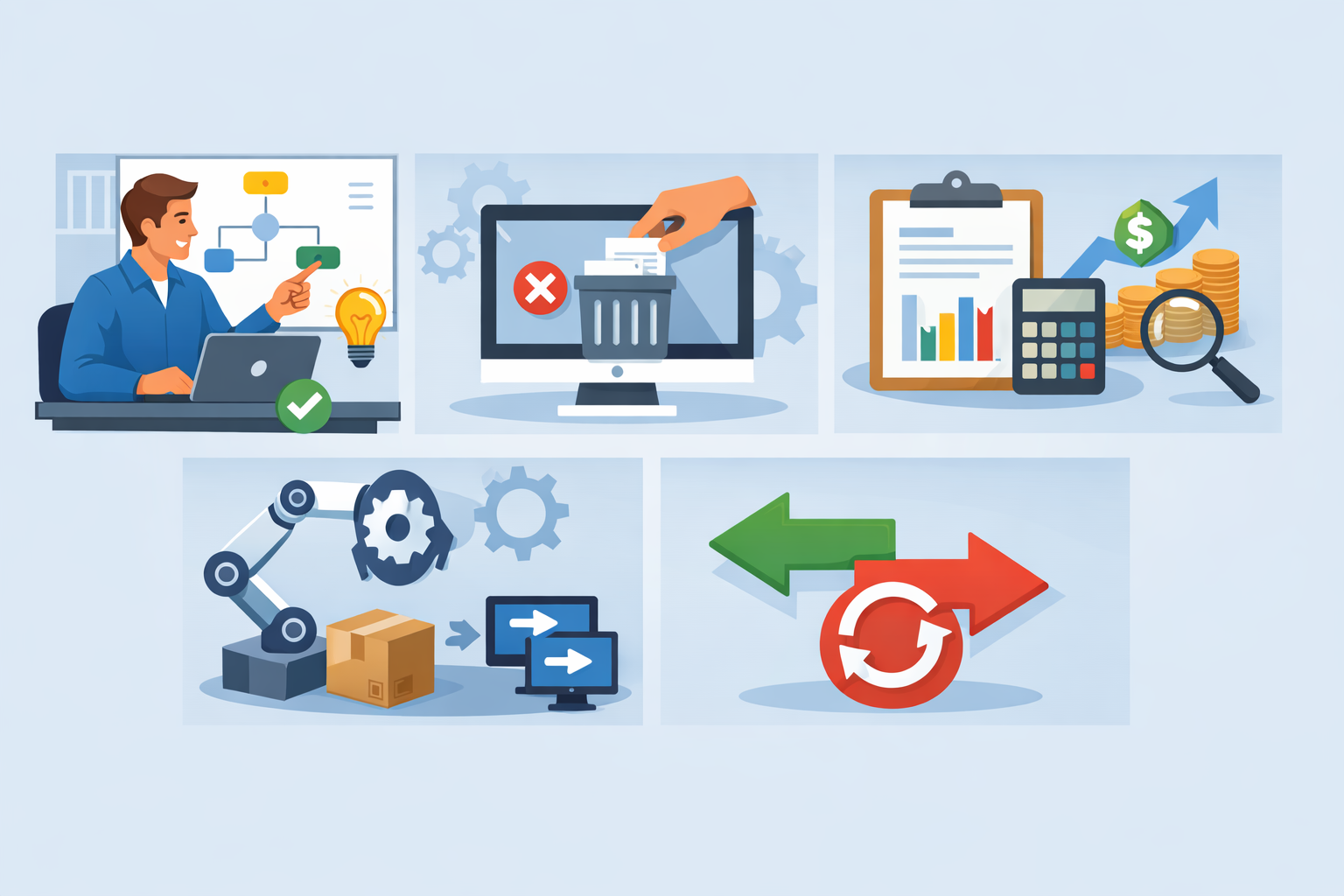
These have consistently reduced long-term cost in teams under 10 developers.
1. Appoint one technical decision owner
Small teams move faster when one person is accountable for technical direction.
Not every architectural choice needs a group discussion or consensus.
A clear decision owner reduces confusion, avoids conflicting patterns, and keeps the system consistent over time.
Not everyone should debate architecture endlessly.
One accountable person makes final calls.
Consensus-driven architecture slows teams.
2. Prefer deletion over addition
Every new library, abstraction, or feature increases maintenance cost.
Removing unused code, simplifying logic, and reducing dependencies often creates more stability than adding something new.
In small teams, less surface area usually means fewer bugs and faster iteration.
Every new library, abstraction, or tool increases surface area.
Ask:
- Can we remove something instead?
- Can we simplify?
Less code = fewer bugs = lower cost.
3. Review infrastructure cost monthly
Cloud expenses rarely spike overnight — they creep up quietly.
Unused instances, over-provisioned databases, and forgotten services slowly inflate monthly costs.
A simple monthly review keeps spending intentional and prevents small inefficiencies from becoming long-term financial drains.
Cloud bills creep quietly.
Small inefficiencies become large recurring expenses.
Monthly review keeps spending intentional.
4. Design for replaceability
External services will change — pricing increases, APIs evolve, or vendors shut down.
If core logic is tightly coupled to one provider, switching becomes painful and expensive.
Keeping integrations loosely connected makes future changes manageable instead of disruptive.
Can you swap:
- Payment provider?
- Email service?
- Storage provider?
If switching requires rewriting half your code, long-term cost is locked in.
5. Keep decisions reversible
Early-stage teams shouldn’t lock themselves into choices that are hard to undo.
When decisions are reversible, experimentation becomes safer and less expensive.
The goal isn’t perfection — it’s maintaining the flexibility to adjust without major rewrites.
Early-stage teams should avoid decisions that are:
- Hard to undo
- Deeply embedded
- Vendor-locked
Reversible decisions are cheaper decisions.
Conclusion
Lower upfront software development cost in India isn’t the problem.
Optimizing only for upfront costs is.
Small teams survive by reducing change friction — not by reducing hourly rate.
The real question isn’t:
“How much does this build cost?”
It’s:
“How expensive will change be after we ship?”
If you answer the second question honestly, your total cost usually drops — even if the first number looks slightly higher.
FAQs
Because they optimize for delivery speed, not maintainability or adaptability.
No, but lower rates often mean less attention to structure and long-term clarity.
Keep architecture simple, separate business logic properly, and freeze sprint scope.
Usually no. Most products don’t need advanced scaling decisions in year one.
Change cost, ownership control, and how easily the system can evolve.
About the Author
Paras Dabhi
VerifiedFull-Stack Developer (Python/Django, React, Node.js) · Stellar Code System
Hi, I’m Paras Dabhi. I build scalable web applications and SaaS products with Django REST, React/Next.js, and Node.js. I focus on clean architecture, performance, and production-ready delivery with modern UI/UX.

Paras Dabhi
Stellar Code System
Building scalable CRM & SaaS products
Clean architecture · Performance · UI/UX