Software Development Partner Evaluation: What to Check
Choosing a software development partner looks straightforward until the project is already underway.
A team can have strong technical expertise, an impressive portfolio, competitive pricing, and a convincing reputation, yet still become difficult to work with after the first few months. The problem is often not coding ability. It is a mismatch in expectations, communication, ownership, technical capability, or delivery practices.
I have seen this happen with small SaaS teams, startup products, and remote engineering groups. The initial assessment focuses heavily on technology and cost. Later, the real problems appear: unclear requirements, missed deadlines, poor communication, inconsistent quality, weak documentation, or an architecture that nobody on the client side fully understands.
A better software development partner evaluation looks beyond technical skills. You need to understand how a team thinks, makes decisions, handles risk, manages resources, responds when something breaks, and takes ownership when the original plan no longer works.
The goal is not to find the cheapest or most impressive vendor. It is to find a team whose experience, strategy, technology, processes, and working style fit the product you are actually trying to build.

Why Software Development Partner Evaluation Is Difficult in Real Teams
The biggest mistake is treating partner selection like a simple comparison between companies.
Many teams create a spreadsheet with columns for:
- Experience
- Pricing
- Technology
- Portfolio
- Timeline
- Reviews
- Team size
That is useful, but it does not tell you how the partnership will behave six months into development.
A software project creates hundreds of small decisions. Someone has to decide whether a feature belongs in the current scope, whether an API should be changed, whether a database query needs optimization, whether technical debt should be addressed now, and whether a deadline should move when a requirement changes.
That is where competence, accountability, collaboration, and ownership become more important than a sales presentation.
Time pressure changes decision quality
Startups rarely have unlimited time.
A founder may want an MVP launched within three months. A product team may already have customers waiting. Investors may expect a release. Internal developers may be working on several priorities simultaneously.
Under that pressure, teams sometimes select a partner based almost entirely on availability.
That can be dangerous.
A team that can start tomorrow is not necessarily a team that can maintain the product six months from now.
Requirements are rarely complete
Another common issue is assuming that the initial requirements document represents the entire project.
It usually doesn't.
As development progresses, teams discover new edge cases, integration requirements, security concerns, performance limitations, and user expectations.
A good partner needs the adaptability to handle these changes without turning every adjustment into a major conflict.
Architecture decisions have long-term consequences
Early technical decisions influence future scalability, performance, security, maintenance, and flexibility.
The right partner should be able to explain those trade-offs without automatically choosing the most complicated solution.
For a small product, a modular monolith may be more practical than a collection of microservices. A managed database may be preferable to operating complex infrastructure internally. A simple deployment pipeline may be better than building an elaborate platform engineering setup too early.
Good architecture is not about maximum complexity. It is about appropriate complexity.
Where Most Teams Make the Wrong Decision
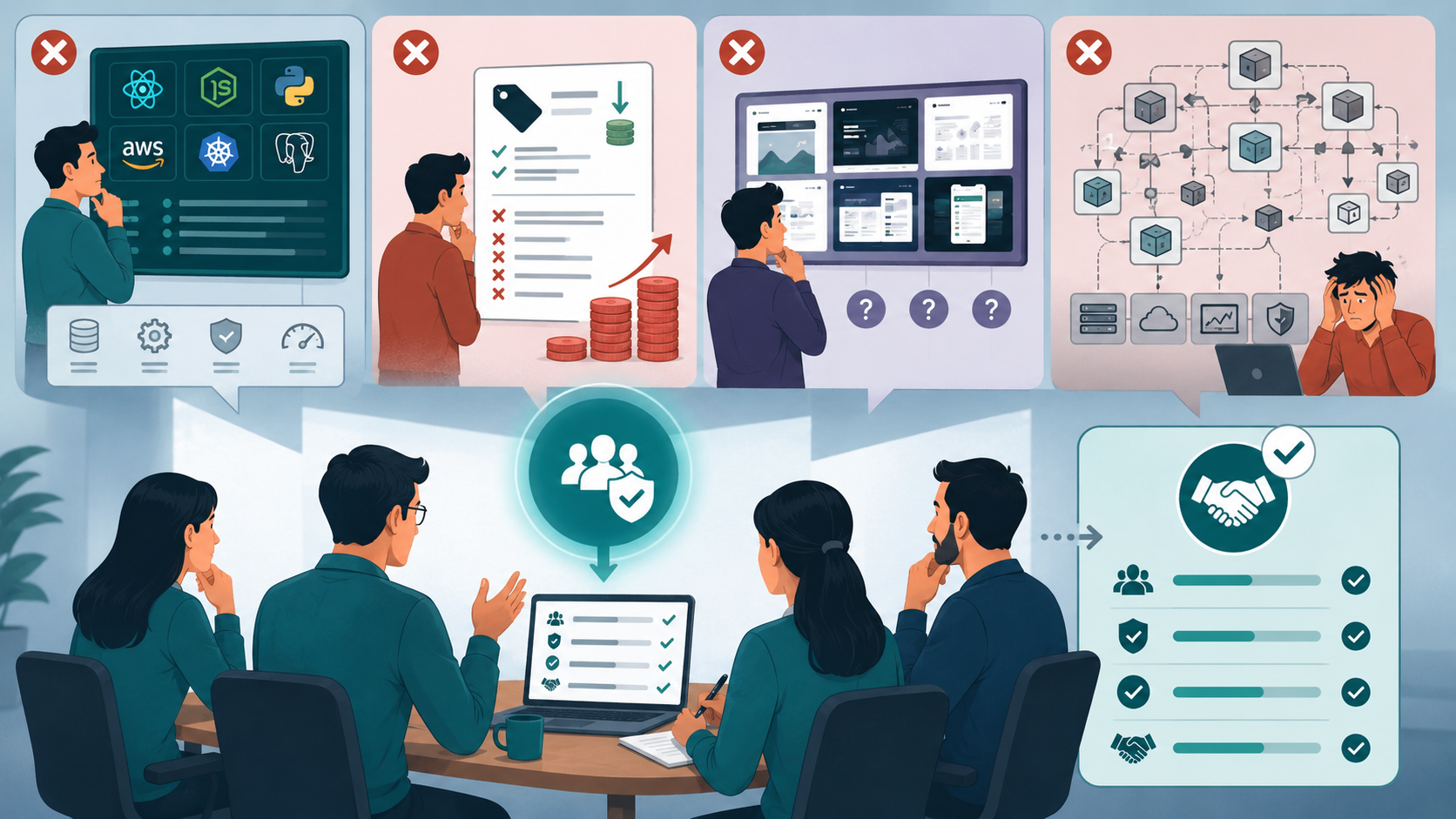
The biggest evaluation mistake I see is confusing technical capability with partnership capability.
A developer can be excellent at programming and still be difficult to work with.
A company can have strong engineers and weak project governance.
A vendor can deliver quickly and still create substantial technical debt.
Overvaluing technology
Teams often ask:
Do you work with React, Node.js, Python, AWS, Kubernetes, or PostgreSQL?
Those questions matter, but they are only part of the technology evaluation.
A better question is:
Why would you choose this technology for our specific problem?
The answer tells you much more about engineering judgment.
You want to see whether the team considers:
- Product requirements
- Existing systems
- Performance
- Security
- Team capability
- Operational complexity
- Future scalability
- Maintenance requirements
- Budget
- Delivery constraints
Technology should support the product rather than become the product strategy.
Choosing based on the lowest pricing
Budget matters. Nobody wants an uncontrolled development cost.
But the lowest pricing can become expensive when the project requires repeated corrections.
For example, suppose one partner proposes a six-month project with a higher initial estimate while another promises delivery in three months at half the cost.
The cheaper option may look attractive.
But if the faster estimate excludes testing, documentation, security work, deployment, maintenance, or realistic requirements analysis, the apparent saving disappears later.
Evaluate the total cost of delivery, not just the initial quotation.
Believing a polished portfolio proves competence
A portfolio demonstrates previous experience, but it does not automatically prove that the same team will work on your project.
Ask:
- Who actually built those projects?
- Will those developers work on ours?
- What was the team's role?
- What technical problems did they solve?
- What changed during development?
- How were problems handled?
- What happens after launch?
A strong track record is valuable, but you should understand what produced it.
Copying large-company architecture
I have seen small teams adopt infrastructure designed for organizations with hundreds of engineers.
The result is often unnecessary operational overhead.
More services mean more deployments, monitoring, logs, networking, permissions, testing, and maintenance.
A partner should demonstrate judgment, not simply technical ambition.
How to Evaluate a Software Development Partner Properly
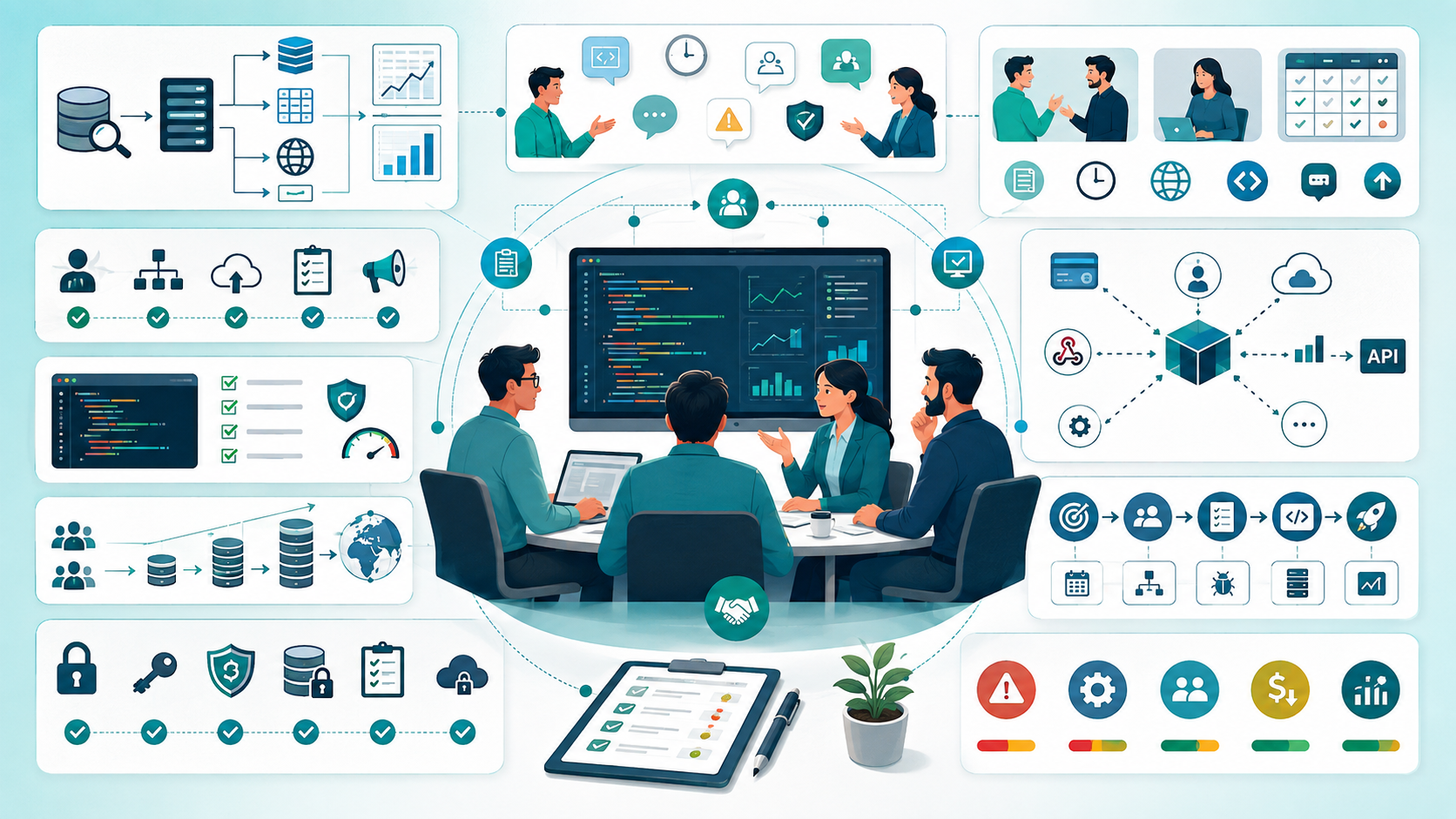
A useful evaluation should examine several dimensions instead of relying on one score. Working with a US software engineering partner for reliable vendor selection helps businesses evaluate technical expertise, communication quality, architecture decisions, security practices, integration experience, delivery planning, ownership, risk management, and long-term software support before choosing a development partner.
1. Assess technical expertise through decisions
Don't only ask what technologies the team knows.
Ask them to review a simplified version of your actual problem.
For example:
We have a SaaS application with 5,000 active users. The API response time is increasing as data grows. How would you investigate the problem?
You are not looking for one perfect answer.
You are evaluating their competence and reasoning.
A good discussion might include:
- Database query analysis
- Application profiling
- Caching
- Indexing
- Network latency
- API design
- Monitoring
- Load testing
- Data growth patterns
The important part is how they arrive at a decision.
2. Evaluate communication before development starts
Communication is often underestimated because everyone communicates well during sales discussions.
The real test comes when something goes wrong.
Ask how they handle:
We found a problem with the integration. It adds five days to the timeline, and here are two options.
That type of communication creates trust.
- Requirement changes
- Delayed dependencies
- Failed deployments
- Scope changes
- Security incidents
- Missed milestones
- Technical disagreements
You want transparency, not reassurance.
A partner saying everything is on track when there are obvious risks is much worse than a partner saying:
3. Check compatibility with your team
Technical ability does not guarantee compatibility.
A two-person startup and a large engineering vendor may have completely different working styles.
Consider:
- Meeting frequency
- Decision-making
- Documentation
- Working hours
- Time-zone overlap
- Code review practices
- Project management
- Escalation procedures
- Feedback expectations
For remote teams, this becomes particularly important.
A technically excellent partner can still fail if your teams cannot collaborate efficiently.
4. Examine ownership and accountability
One of the most important evaluation questions is:
What happens when something goes wrong?
Listen carefully to the answer.
A strong partner should have clear accountability for delivery and should not immediately blame the client, requirements, developers, or third-party systems.
This does not mean the partner must accept responsibility for everything.
It means there should be clear ownership.
For example:
- Who investigates production issues?
- Who approves architecture changes?
- Who manages releases?
- Who maintains documentation?
- Who handles testing?
- Who communicates delivery risks?
Clear responsibility prevents problems from falling between teams.
5. Evaluate quality beyond “does it work?”
Software quality is more than whether a feature works during a demonstration.
Look at:
- Code structure
- Testing
- Error handling
- Security
- Documentation
- Monitoring
- Deployment
- Maintainability
- Performance
A feature that works today but becomes difficult to change next month is not necessarily high-quality software.
Ask the partner how they balance delivery speed with long-term maintenance.
6. Understand their approach to scalability
Don't accept generic claims such as:
Our solutions are highly scalable.
Ask what scalability means for your product.
Does it mean:
- More users?
- More transactions?
- More database records?
- More API requests?
- More geographic regions?
- More development teams?
A partner should understand the current capacity of the system and identify when additional infrastructure will actually become necessary.
The best solution is usually one that can evolve.
7. Evaluate security and compliance early
Security should not be something discussed immediately before launch.
Depending on the product, evaluate:
- Authentication
- Authorization
- Secrets management
- Data protection
- Dependency management
- Access controls
- Logging
- Backups
- Vulnerability management
- Compliance requirements
If your product operates across different countries, understand how the partner approaches applicable privacy and compliance requirements.
You do not necessarily need a large security team.
You need disciplined engineering practices.
8. Examine integration and development practices
Modern software rarely exists alone.
Your partner may need to work with:
- Payment systems
- CRM platforms
- ERP systems
- Authentication providers
- Analytics tools
- Cloud services
- Internal APIs
- Third-party platforms
Ask how they approach integration failures, API changes, retries, webhooks, authentication, and monitoring.
This is where practical development experience becomes obvious.
9. Review delivery and project planning
A realistic timeline should connect requirements, resources, dependencies, testing, and deployment.
Ask how the partner converts requirements into milestones.
A good planning process should make it possible to answer:
- What is being delivered?
- When will it be delivered?
- Who owns it?
- What dependencies exist?
- What could delay it?
- How will progress be measured?
Don't accept a date simply because it sounds attractive.
10. Discuss risk before signing
Every project has risk.
The question is whether your partner identifies it early.
Ask:
What are the three biggest technical risks you see in this project?
A thoughtful answer is a positive signal.
They may identify:
- Unclear requirements
- Legacy integration
- Data migration
- Performance
- Security
- Third-party dependencies
- Limited developer availability
- Unrealistic delivery expectations
A partner who identifies risks early is more useful than one who promises that nothing will go wrong.

When This Evaluation Approach Fails
Even a detailed evaluation cannot eliminate every problem.
Some issues only become visible after development starts.
A partner may perform well during technical discussions but struggle with the actual product workflow.
You may also discover that the original scope was unrealistic.
Sometimes the client organization itself becomes the bottleneck because decisions take too long or requirements continually change.
There are also cases where a partner is technically capable but no longer has enough resources to support the project.
That is why evaluation should continue after selection.
Track:
- Delivery consistency
- Defect rates
- Communication quality
- Technical debt
- Response times
- Documentation
- Team stability
- Budget changes
Partner evaluation is not a one-time activity.
It is an ongoing assessment of whether the relationship is producing the expected value.

Sustainable Practices for Long-Term Software Partnerships
The best development relationships are built around predictable collaboration rather than constant supervision.
Keep requirements visible
Maintain a clear source of truth for requirements and changes.
When something changes, document:
- What changed
- Why it changed
- Impact on scope
- Impact on timeline
- Impact on budget
This improves transparency and prevents misunderstandings.
Review architecture periodically
Architecture should evolve with the product.
A system designed for 100 users may need different decisions at 100,000 users.
Review major technical decisions as the product grows rather than trying to predict everything on day one.
Protect development quality
Fast delivery is useful only if the team can maintain the system afterward.
Make room for:
- Testing
- Refactoring
- Documentation
- Monitoring
- Dependency updates
- Security improvements
- Technical debt reduction
This protects long-term productivity.
Build shared ownership
The healthiest partnerships do not create a permanent wall between client and developer.
Both sides should understand the product strategy, technical constraints, priorities, and business objectives.
That creates better alignment.
Measure the relationship, not just the output
A partner can deliver hundreds of tickets while still creating problems.
Look at whether the partnership improves:
- Delivery
- Reliability
- Quality
- Efficiency
- Product knowledge
- Technical decision-making
- Team confidence
Ultimately, the goal is a sustainable partnership, not simply completed tasks.
Conclusion
A strong software development partner is not necessarily the company with the largest team, lowest price, or longest technology list.
The better choice is usually the team that demonstrates strong expertise, experience, reliability, communication, accountability, adaptability, and technical judgment.
Evaluate how they think before evaluating how quickly they promise to build.
Look at their architecture, technology decisions, testing, security, integration practices, maintenance approach, delivery process, resources, risk management, governance, and support.
Most importantly, evaluate whether their working style is compatible with yours.
A good partner should help you make better engineering decisions, not simply execute a specification.
When the relationship is built on trust, transparency, commitment, ownership, and shared responsibility, the development process becomes much more predictable—and the resulting software has a better chance of remaining reliable, flexible, and sustainable as the product grows.
Software Development Partner Evaluation: FAQs
Evaluate technical expertise, experience, communication, reliability, development practices, security, scalability, pricing, project management, resources, and post-launch support. Also assess whether the partner's working style aligns with your team and product goals.
Ask the team to explain how they would approach your actual technical challenges rather than only asking which technologies they use. Review their architecture decisions, testing practices, code quality, security approach, scalability strategy, and previous project experience.
No. Pricing should be one evaluation factor, not the deciding factor. A low initial cost can become expensive if it results in poor quality, technical debt, missed timelines, or repeated development work. Consider the overall value and long-term maintenance cost.
Good communication creates transparency, accountability, and trust. Development projects frequently involve changing requirements, technical risks, delays, and unexpected issues. A reliable partner should communicate these problems early instead of hiding them.
Review its track record, client references, delivery history, team stability, project management practices, communication process, and support model. Ask how the team handles missed deadlines, production issues, changing requirements, and technical problems.
Reference
Written by

Paras Dabhi
VerifiedFull-Stack Developer (Python/Django, React, Node.js)
I build scalable web apps and SaaS products with Django REST, React/Next.js, and Node.js — clean architecture, performance, and production-ready delivery.
LinkedIn