
Software Development Scope Validation
A software project can start with a requirements document that looks complete. The objectives are written down, the features are listed, the timeline has been estimated, and stakeholders have approved the deliverables.
Six weeks later, the team is discussing features that were never part of the original plan.
This happens more often than most teams admit. The problem usually isn't that developers ignored the scope. It is that the scope was never properly validated against the actual business needs, workflows, technical constraints, and acceptance criteria.
I've seen this happen in small SaaS teams where everyone agrees on the product during an initial meeting, but each person leaves with a slightly different interpretation. The product owner thinks one thing, the developer builds another, and the stakeholder expects something else.
By the time the differences become visible, changing direction is expensive.
Software development scope validation exists to catch those differences before they become development work. Done properly, it isn't just a documentation exercise. It is a practical way to confirm what the team is actually building, what it is not building, and how everyone will determine whether the final product is acceptable.
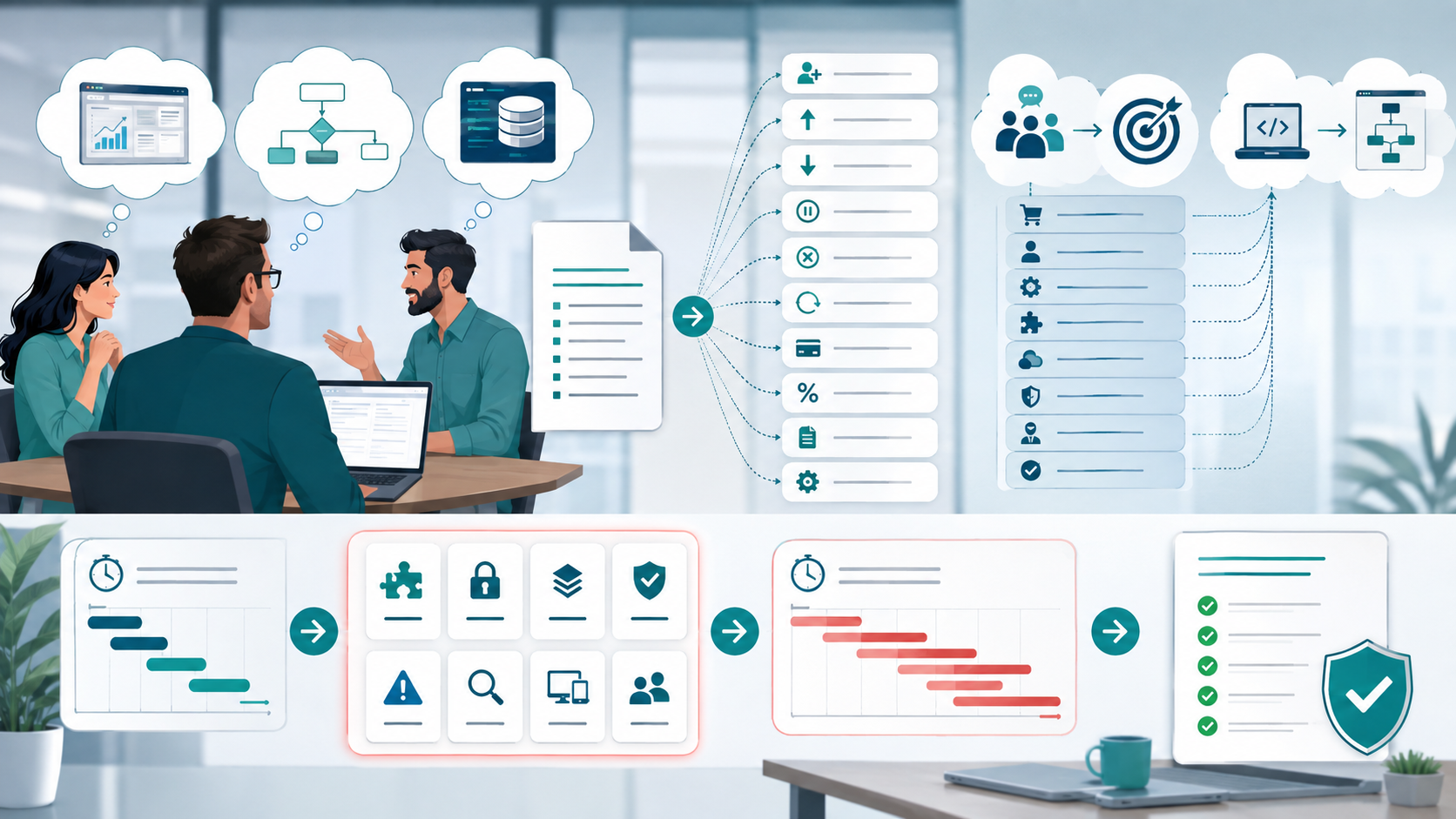
Why This Problem Happens in Real Teams
Scope problems rarely come from a single bad decision. They usually develop through several small gaps.
Requirements Are Not the Same as Understanding
A requirements document may say:
Users should be able to manage subscriptions.
That sounds reasonable until development begins.
Does subscription management include:
- Creating subscriptions?
- Upgrading plans?
- Downgrading plans?
- Pausing subscriptions?
- Canceling subscriptions?
- Refunds?
- Failed payments?
- Proration?
- Invoice history?
- Admin overrides?
The requirement exists, but the specification is incomplete.
This is why requirements need validation rather than simple approval.
The team needs to understand the intended functionality, user stories, use cases, workflows, business rules, and acceptance criteria behind each major requirement.
Stakeholders Often Describe Outcomes, Not Behavior
Business stakeholders usually explain what they want the software to achieve.
Developers need to understand what the system actually needs to do.
For example:
Business expectation:
Customers should receive faster order processing.
Development questions:
- Which orders qualify?
- Who initiates processing?
- What happens after submission?
- Which systems need integration?
- What happens when an external API fails?
- Who can override an order?
- What is considered successful processing?
Without those answers, the team is estimating against assumptions.
Early Estimates Create False Confidence
Estimation is useful, but an estimate is only as reliable as the scope behind it.
A team might estimate a feature at two weeks because the visible functionality appears simple.
Then dependencies appear.
An external integration needs additional authentication. The existing architecture cannot support the required workflow cleanly. Security requirements change the implementation. Testing reveals edge cases. Stakeholders add exceptions.
The original estimate wasn't necessarily poor.
The scope was incomplete.

Where Most Teams Make the Wrong Decision
One common mistake is treating scope approval as scope validation.
A stakeholder says, “Looks good,” and the project moves forward.
That approval doesn't necessarily mean the scope is technically understood.
I've seen teams spend hours reviewing a requirements document but almost no time validating the assumptions behind it.
Overengineering the Validation Process
The opposite problem also happens.
Some teams create enormous specifications before writing a line of code.
Every possible scenario is documented, every future feature is discussed, and architecture decisions are made for requirements that may never exist.
For small engineering teams, this creates its own bottleneck.
The goal isn't to predict everything.
The goal is to remove enough uncertainty that developers can make reliable implementation decisions.
Copying Enterprise Processes Into Small Teams
A 100-person engineering organization may have dedicated business analysts, architects, project managers, QA teams, and technical writers.
A five-person startup probably doesn't.
Trying to reproduce the same process can slow development without improving understanding.
For a small team, scope validation often works better as a focused engineering exercise involving the founder or product owner, developer, designer, and whoever will validate the finished functionality.
Ignoring Dependencies
A feature can appear completely defined while hiding important dependencies.
For example:
Feature: Customer notifications
Potential dependencies include:
- Email provider
- Notification templates
- User preferences
- Authentication
- Background jobs
- Database records
- Retry handling
- Logging
- Compliance requirements
If these dependencies aren't identified during validation, they appear later as unexpected work.
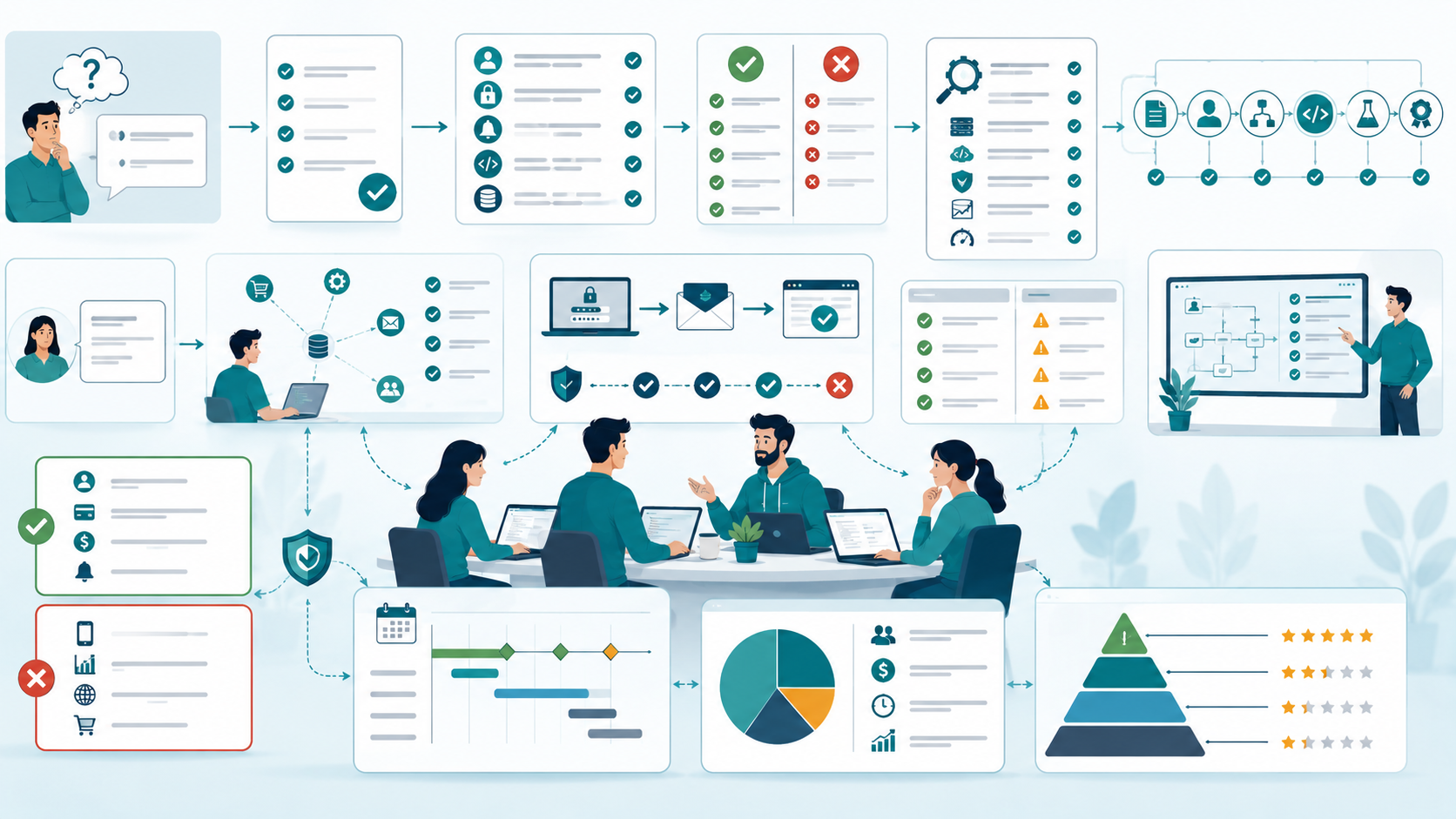
Practical Fixes That Actually Work
The most useful scope validation process I've used is not complicated. Working with a US software team for validated project scope helps businesses confirm requirements, user stories, workflows, assumptions, dependencies, acceptance criteria, technical feasibility, timeline, budget, resources, and project boundaries before development work becomes expensive to change.
It is mainly about forcing the team to answer the right questions before committing to implementation.
1. Convert Business Requirements Into Testable Behavior
Start with the business requirement.
Then translate it into something developers can implement and testers can verify.
Instead of:
Users can manage their accounts.
Define:
- User can update their profile.
- User can change their password.
- User can update notification preferences.
- User cannot change restricted account fields.
- Invalid input generates a defined validation response.
- Successful changes are persisted.
- Account changes are reflected across relevant workflows.
Now the functionality is much easier to estimate and validate.
2. Validate User Stories Against Real Use Cases
User stories provide useful context, but use cases expose complexity.
Consider:
As an administrator, I want to deactivate a customer account.
The basic use case is straightforward.
But validation should ask:
- What happens to active subscriptions?
- Can the customer log in afterward?
- Are existing records retained?
- Can the account be restored?
- Does deactivation trigger notifications?
- What happens to connected integrations?
- Is the action logged?
- Who has permission to perform it?
These questions expose hidden requirements before implementation.
3. Create Explicit Acceptance Criteria
Acceptance criteria should remove ambiguity.
For example:
Feature: Password reset
Acceptance criteria could include:
- A registered user can request a password reset.
- The reset link expires after a defined period.
- The token can only be used once.
- Invalid tokens are rejected.
- A successful password change invalidates the previous credential.
- The system does not reveal whether an email address exists.
Now QA, developers, and stakeholders have a common validation target.
4. Separate Requirements From Assumptions
This is one of the simplest improvements a small team can make.
Create two lists.
Confirmed requirements
- Users must authenticate using email and password.
- Administrators can disable accounts.
- Account changes must be logged.
Assumptions
- Email delivery will use the existing provider.
- The current authentication service can support the workflow.
- No migration of historical account data is required.
Assumptions are not necessarily bad.
Unidentified assumptions are the problem.
Once assumptions are visible, the team can validate them before they become dependencies.
5. Validate Technical Feasibility Before Final Estimation
Business scope and technical feasibility need to be reviewed together.
Ask:
- Does the current architecture support the requirement?
- Does the technology stack create limitations?
- Are external integrations available?
- Are there security constraints?
- Are database changes required?
- Does the feature affect existing workflows?
- Are there performance implications?
- Does the requirement introduce scalability concerns?
A feature that is technically feasible may still require significant architectural changes.
That needs to be visible in the scope.
6. Build a Requirement Traceability Chain
For important features, I like to maintain a simple relationship:
Requirement → User Story → Use Case → Implementation → Test → Acceptance
This creates requirement traceability.
If a requirement has no corresponding test, that's worth questioning.
If a feature exists in the implementation but cannot be connected to an approved requirement, that's worth questioning too.
This becomes particularly useful when several developers work remotely and context is distributed across documents, tickets, pull requests, and conversations.
7. Validate the Project Boundaries
Scope validation isn't only about deciding what the project includes.
You also need to identify what it doesn't include.
For example:
Included
- Customer registration
- Subscription management
- Payment processing
- Account notifications
Not included
- Native mobile applications
- Advanced analytics
- Multi-currency billing
- Marketplace functionality
This is one of the strongest defenses against scope creep.
When a new request appears, the team can compare it against the agreed project boundaries instead of debating from memory.
8. Connect Scope to Timeline, Budget, and Resources
A scope decision has consequences.
If the validated scope increases, something else usually needs to change:
- Timeline
- Budget
- Resources
- Technical complexity
- Feature priorities
You cannot realistically keep the same scope, deadline, and resources while continuously adding functionality.
For small teams, this trade-off should be discussed explicitly.

When This Approach Fails
Scope validation isn't a magic solution.
It can still fail when stakeholders don't participate consistently.
If business decisions are repeatedly postponed, developers may still build against assumptions.
It also becomes difficult when the product itself is highly experimental.
Early-stage startups sometimes don't know what users actually want. In those situations, attempting to validate every detail upfront can create unnecessary process.
A better approach may be to validate the core product hypothesis, build a small version, collect feedback, and then refine the scope.
There is also a limit to documentation.
If requirements change every few days, maintaining a large specification can become more work than maintaining the software.
The process should match the project's uncertainty.
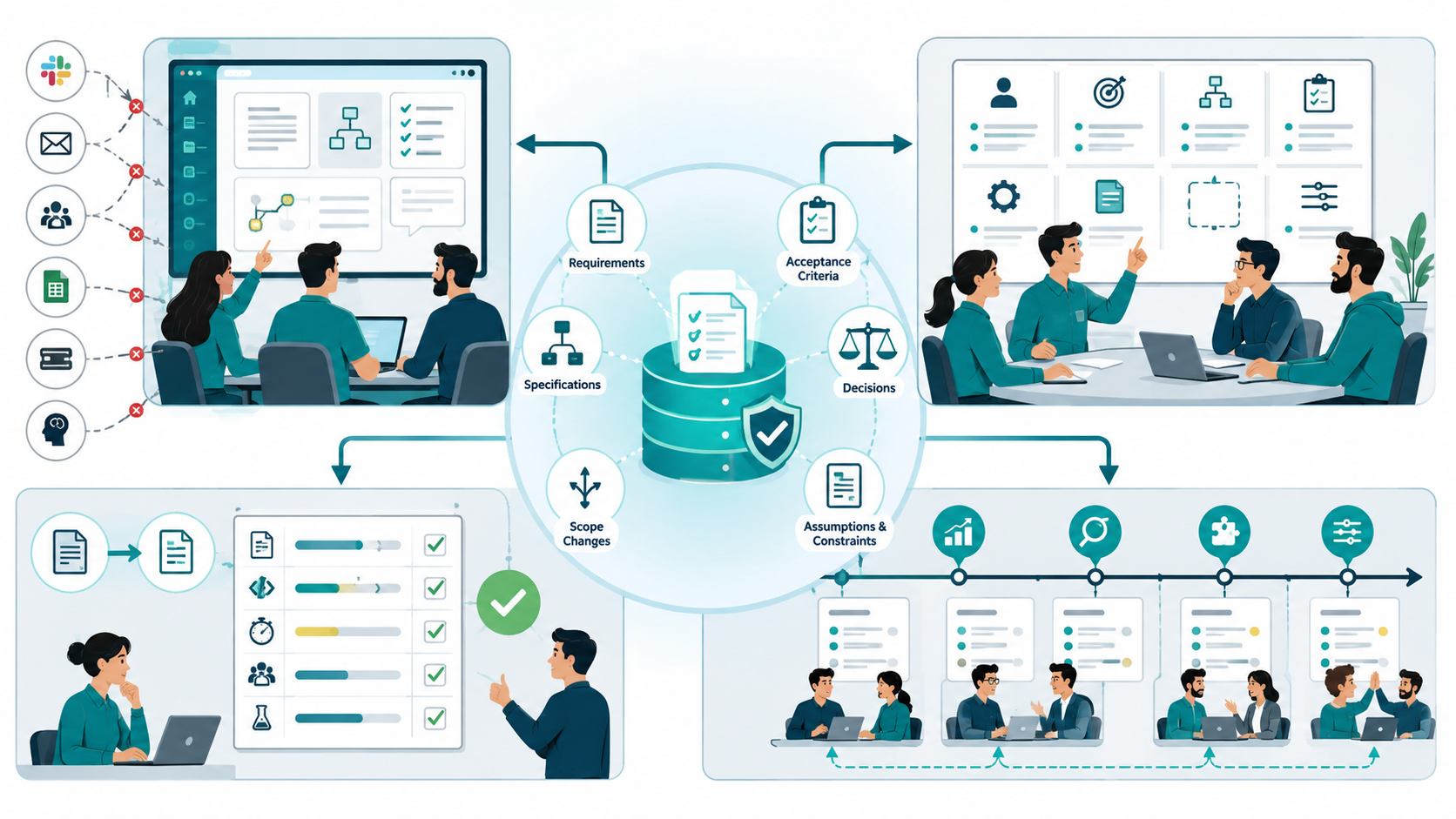
Sustainable Practices for Small Engineering Teams
Small teams don't need heavy project-management processes to maintain healthy scope.
They need consistency.
Keep One Source of Truth
Requirements should not exist simultaneously in Slack, email, meetings, spreadsheets, tickets, and developer memory.
Choose a primary location for:
- Requirements
- Specifications
- Acceptance criteria
- Decisions
- Scope changes
Other conversations can provide context, but the approved decision should be recorded.
Review Scope Before Development Starts
A short scope review can prevent days of rework.
Before development begins, confirm:
- What are we building?
- Why are we building it?
- Who uses it?
- What are the major workflows?
- What are the acceptance criteria?
- What dependencies exist?
- What assumptions remain?
- What is explicitly outside the scope?
- What are the technical constraints?
If these questions cannot be answered, the feature probably isn't ready for implementation.
Treat Scope Changes as Engineering Decisions
A change request isn't automatically bad.
Sometimes the original scope was wrong.
The important thing is to understand its impact.
For each significant change, evaluate:
Requirement change → Technical impact → Timeline impact → Resource impact → Testing impact → Approval
This keeps change management practical rather than bureaucratic.
Don't Validate Only at the Beginning
Scope validation should continue throughout the project.
Requirements evolve. Business priorities change. Technical discoveries happen. New dependencies appear.
Regular milestone reviews allow the team to catch deviations before they become expensive.
The objective isn't to freeze the project forever.
It's to make changes visible and deliberate.
Conclusion
The biggest mistake in software development scope validation is assuming that a signed requirements document means everyone understands the same product.
It doesn't.
A reliable scope comes from connecting business needs with actual functionality, user stories, workflows, technical requirements, dependencies, acceptance criteria, constraints, and project boundaries.
For small engineering teams, the process doesn't need to be complicated. A few focused validation sessions, explicit assumptions, realistic acceptance criteria, and clear scope boundaries can prevent a significant amount of rework.
The practical lesson is simple:
Don't ask only, “Has the scope been approved?” Ask, “Can the development team explain exactly what will be built, what won't be built, how it will work, and how we'll know it's finished?”
If the answer is yes, your scope is much more likely to survive contact with real development.
Software Development Scope Validation: FAQs
Software development scope validation is the process of confirming that project requirements, functionality, deliverables, constraints, assumptions, dependencies, and acceptance criteria are clearly understood and feasible before and during development.
Scope commonly changes because of unclear requirements, hidden dependencies, new business needs, technical discoveries, stakeholder expectations, or assumptions that were never validated.
Define clear project boundaries, document assumptions, establish acceptance criteria, prioritize requirements, and evaluate the technical and timeline impact of significant changes before approving them.
Scope approval means stakeholders agree to the proposed scope. Scope validation goes deeper by confirming that the requirements are understood, technically feasible, testable, and aligned with the intended business outcome.
Scope should be validated before development begins and reviewed again at important milestones. Continuous validation is particularly useful when requirements, priorities, or technical constraints are changing.
Reference
Written by

Paras Dabhi
VerifiedFull-Stack Developer (Python/Django, React, Node.js)
I build scalable web apps and SaaS products with Django REST, React/Next.js, and Node.js — clean architecture, performance, and production-ready delivery.
LinkedIn