
Travel Software Development Services In Ahmedabad
A lot of travel startups outsource development expecting a ready-to-use booking platform. On paper, everything looks fine — timelines, features, API integrations.
But once development starts, gaps show up. APIs behave differently than expected, booking flows get complicated, and timelines start slipping.
This usually happens because the complexity of travel systems is underestimated from day one.
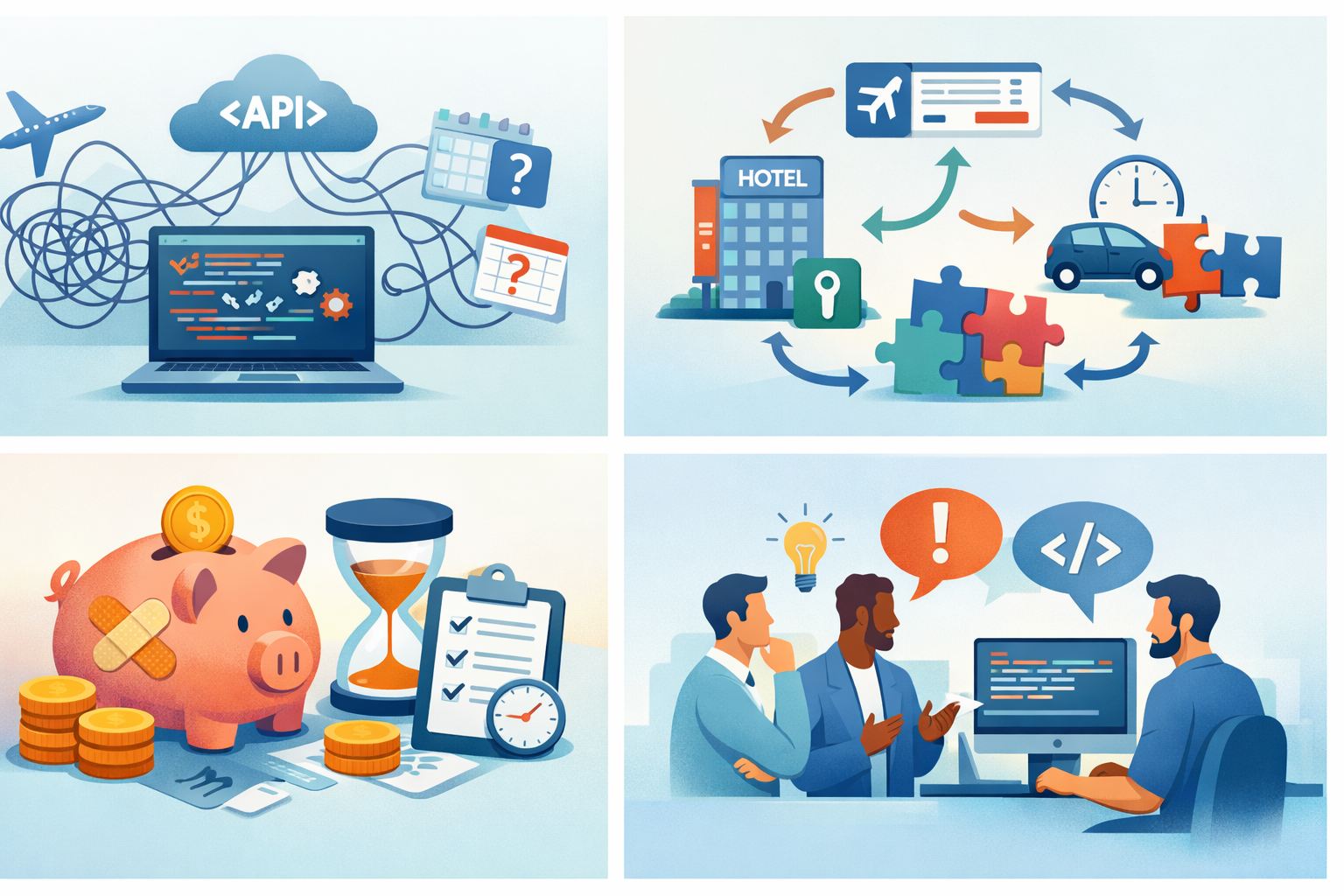
Why this problem actually happens
Travel APIs are not clean or predictable
Travel APIs rarely behave consistently in real-world usage. You'll see different response formats, sudden downtime, and pricing mismatches. What works in testing often fails under real traffic. You have to build systems assuming APIs will break or behave unexpectedly.
When founders hear "we'll integrate APIs," they assume it's plug-and-play. It's not. APIs often have:
- Inconsistent response formats
- Frequent downtime or latency
- Rate limits that break flows in production
- Edge cases like price changes mid-booking
Booking logic is far more complex than expected
Booking is not just a simple flow — it involves validations, re-checks, and handling partial failures. For example, payment can succeed while booking fails. These edge cases are common and need to be handled upfront. Most teams underestimate this complexity early.
A booking system is not just: search → select → pay → confirm. In reality, it includes:
- Availability re-checks
- Price validation
- Seat locking
- Partial failures
- Cancellation and refund workflows
Budget constraints force rushed decisions
Startups with limited budgets often skip proper planning and testing. They rush MVPs without handling edge cases or building scalable architecture, especially in products that may later expand into broader traveller, partner, or internal operational requirements. This works short-term but creates major issues later. Fixing these problems costs more than building correctly from the start.
In Ahmedabad, many startups try to build full platforms with limited budgets, so they:
- Skip proper architecture planning
- Avoid staging environments
- Don't test API edge cases
- Rush MVPs into production
Misalignment between founders and developers
Founders and developers often have different expectations of what "booking system" means. Without clear technical discussions, important parts like failure handling get ignored. This gap leads to delays and broken features. Clear alignment early saves a lot of rework.
Founders think: "We just need a booking system." Developers build what's defined. But no one defines:
- Failure handling
- Retry logic
- Data validation
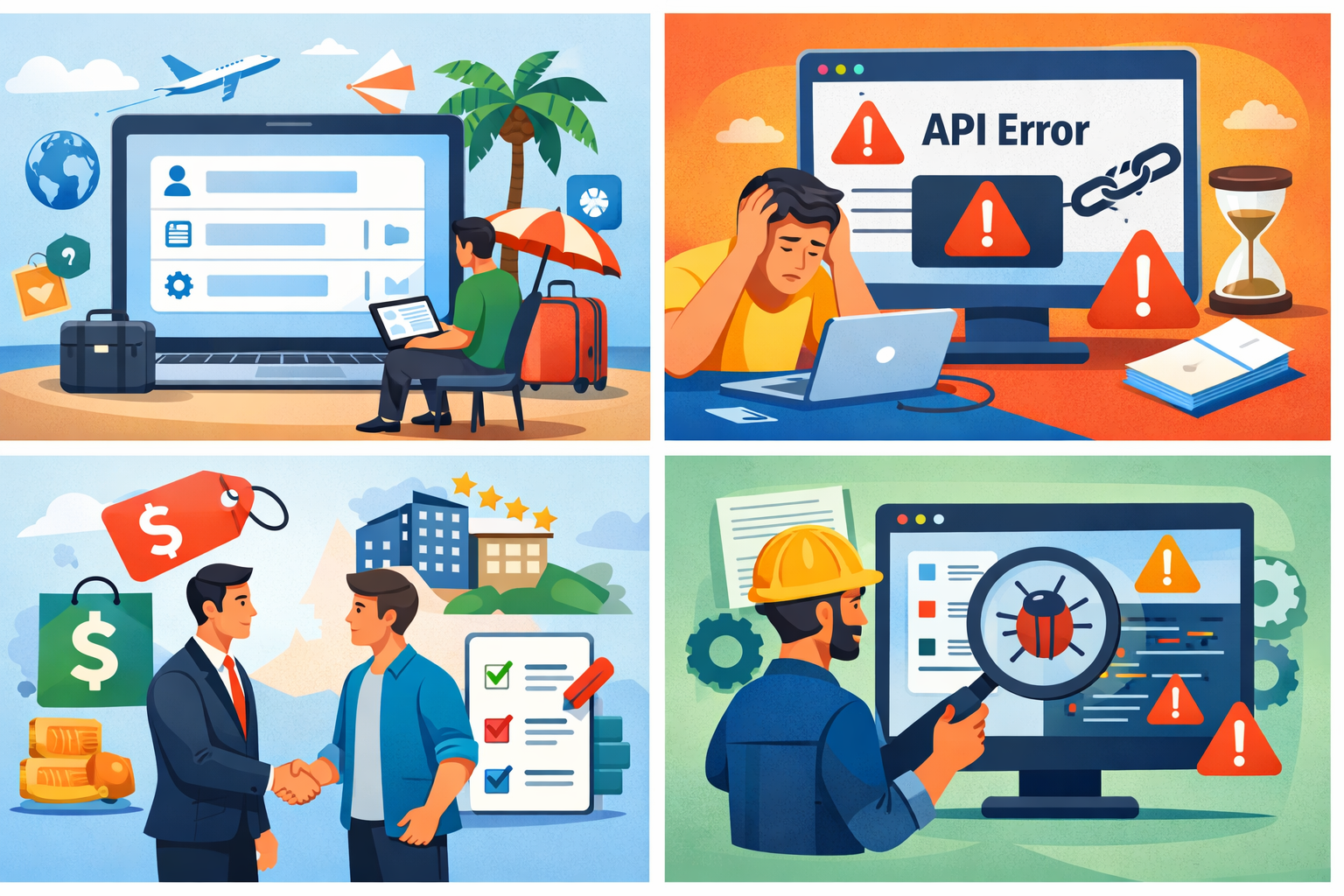
Where most developers or teams get this wrong
Treating travel platforms like CRUD apps
Many teams build travel systems like simple database applications. But booking systems are state-driven, not just create/read/update/delete. Each booking goes through multiple states that need proper handling. Ignoring this leads to inconsistent and unreliable behavior.
Travel systems have states:
- pending
- confirmed
- failed
- expired
Ignoring this leads to broken flows.
Ignoring API limitations during development
APIs work fine in ideal conditions but behave differently in production. Teams often ignore rate limits, timeouts, and inconsistent responses. Without handling these, systems fail under real usage. Proper error handling and retries are critical.
But in reality:
- APIs timeout under load
- Data mismatches happen
- Responses change between versions
Choosing vendors based only on cost
Selecting the cheapest development option usually leads to poor architecture and weak implementation. Important aspects like API validation and error handling get skipped, which is why stronger Custom Software Development matters once a travel platform depends on project-specific booking rules, supplier integrations, and operational workflows. This creates long-term issues that are expensive to fix. Cost should never be the only deciding factor.
- Weak architecture
- Poor error handling
- No API validation
Skipping technical validation early
Many teams start building without validating whether APIs or systems support their requirements. This leads to major roadblocks later in development. Early technical validation helps avoid wasted time and effort. It's one of the most overlooked steps.
Teams don't ask: Can this API handle our use case? What happens on failure?
Read More → Mobile App Development Cost In Ahmedabad
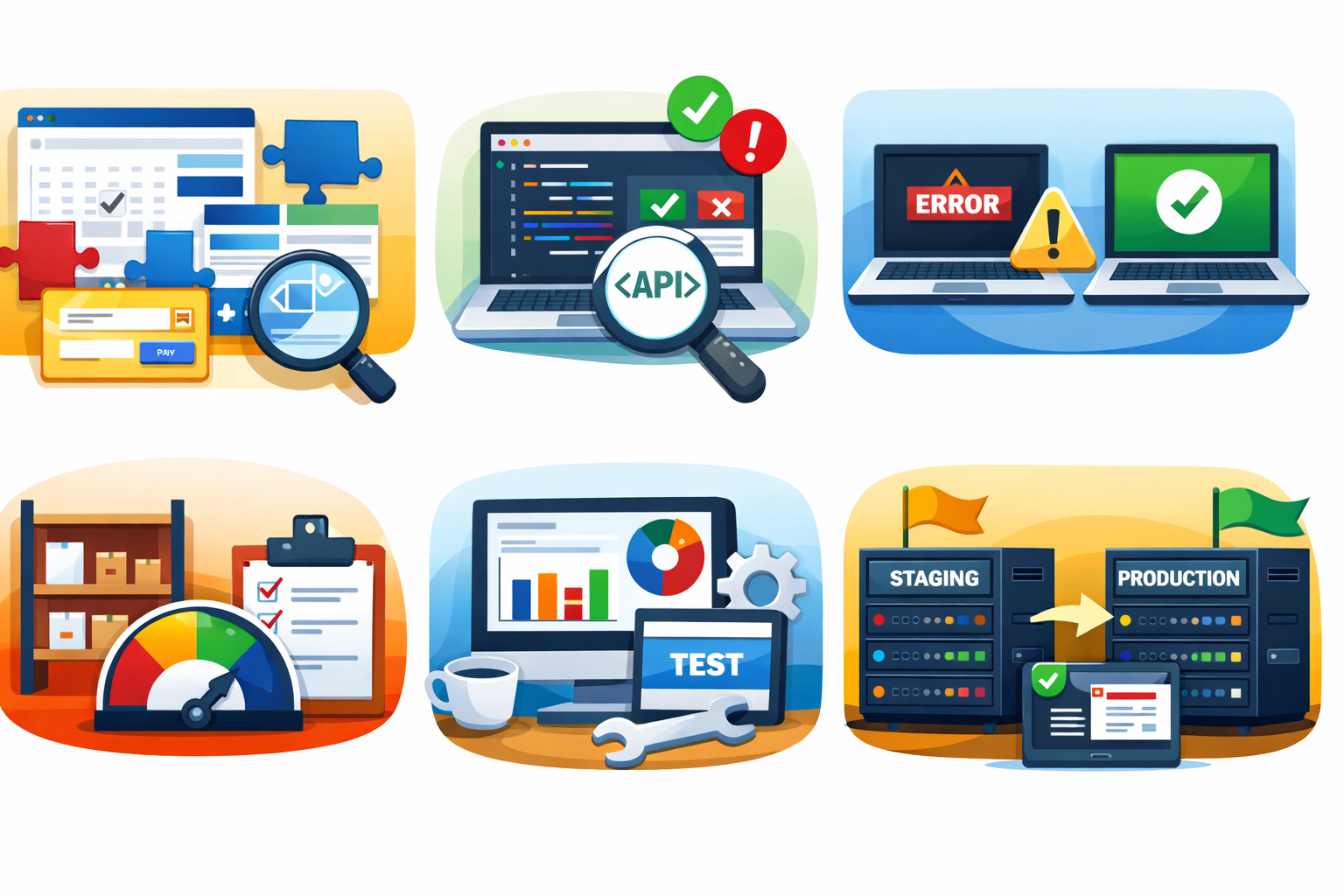
Practical solutions that work in real projects
Break booking flow into smaller components
Instead of building one large system, divide it into smaller services like search, booking, and payment. This makes debugging and scaling easier. It also helps isolate failures without breaking the entire system.
Split into:
- Search service
- Pricing validation
- Booking service
- Payment
- Confirmation
Validate APIs before committing
Before full development, test APIs with real scenarios and edge cases. Check how they behave under failures and limits. Strong validation becomes critical here, because travel systems fail more often on real-world conditions than on happy-path demos. A small validation effort early can save months of rework.
- Edge cases
- Rate limits
- Failure scenarios
Design for failure, not success
Most systems are designed assuming everything will work perfectly. In reality, failures are common in travel platforms. You need to handle scenarios like failed bookings after payment. Designing for failure makes the system more reliable.
Handle:
- Payment success + booking failure
- API timeout mid-flow
- Price changes between search and confirm
Start with limited inventory
Trying to build everything at once increases complexity and risk. Start with one category like flights or hotels. This helps you stabilise the system before expanding. A focused approach leads to better outcomes.
- Only flights first — OR
- Only hotels first
Build internal tools early
Internal dashboards for logs, failed bookings, and operational tracking are extremely useful. They help teams debug issues quickly, manage day-to-day processes better, and create digital software solutions for travel businesses that improve both internal efficiency and long-term system reliability.
- Failed bookings dashboard
- System logs
- Manual retry tools
Use staging environments properly
Testing directly in production is risky and leads to unexpected failures. A proper staging setup allows you to simulate real-world scenarios safely, and stronger Cloud Services planning makes those environments easier to manage as integrations, logs, and deployment complexity grow. It helps catch issues before users face them. Most teams skip this due to time pressure.
- Test failures in staging
- Test rate limits
- Test edge cases before production

When this approach does NOT work
Not ideal for high-scale platforms
Simple architectures work for small startups but not for large-scale systems. High traffic requires advanced infrastructure and optimisation. Without it, performance issues will appear quickly. Scaling needs a different approach altogether.
- Distributed architecture
- Advanced scaling strategies
Complex enterprise integrations
Enterprise travel systems often have strict requirements and complex APIs. They may require certifications, compliance, and custom workflows. Small teams usually struggle without prior experience. These integrations need careful planning.
- Certifications required
- Compliance standards
Real-time high-traffic scenarios
Handling real-time bookings at scale introduces performance challenges. Systems must manage concurrent users and fast-changing data. Without proper design, delays and failures increase. This requires more advanced engineering practices.

Best practices for small development teams
Keep scope under control
Trying to build too many features early leads to unstable systems. Focus on core functionality first and expand gradually. This keeps development manageable. Controlled scope leads to better quality.
- Focus on one feature
- Stabilise it
- Then expand
Avoid over-engineering early
Early-stage projects don't need complex architectures like microservices. Keeping things simple helps teams move faster. Over-engineering adds unnecessary complexity. Start simple and evolve when needed.
Track technical debt consciously
Quick fixes and shortcuts are common in startups. Over time, they create technical debt that slows development. Tracking and addressing it regularly is important. Ignoring it leads to bigger problems later.
- Maintain logging
- Keep code clean
- Regular refactoring
Communicate clearly with founders
Clear communication helps avoid misunderstandings and unrealistic expectations. Developers should explain technical limitations early. Founders should understand risks involved. This alignment improves project outcomes.
- Set expectations early
- Highlight technical risks
Plan for failures, not just features
A strong system is not one that never fails, but one that handles failures well. Planning for errors, retries, and fallbacks is critical, and this mindset becomes even more important in travel products that may later use smarter pricing, routing, or intelligent automation on top of already complex booking flows. This improves reliability and user trust. It's a mindset shift most teams need.
Conclusion
Travel booking systems don't fail because teams lack skills.
They fail because the problem is misunderstood.
The teams that succeed focus on reliability, not features.
FAQ
Because it depends on third-party APIs and real-time data that behave unpredictably in production.
Yes, but only with limited scope and proper planning.
Due to rate limits, inconsistent data, and poor error handling in the integration layer.
Yes, if requirements are clearly defined and API validation is done upfront.
Trying to build a full system too early without validating the APIs and core booking flow first.
References
Written by

Paras Dabhi
VerifiedFull-Stack Developer (Python/Django, React, Node.js)
I build scalable web apps and SaaS products with Django REST, React/Next.js, and Node.js — clean architecture, performance, and production-ready delivery.
LinkedIn