Ultimate Guide to Software Development Lifecycle (SDLC) in 2026

I’ve worked on teams where every release felt like a gamble.
Features half-done, bugs leaking into production, “hotfix Fridays,” and everyone quietly blaming the process.
We said we “followed SDLC,” but honestly, it was just tickets and hope.
If you’re in a 3–8 person team and wondering “why does our lifecycle keep breaking even though we’re working hard?” — this is probably your problem too.
Why this problem actually happens

Textbooks describe SDLC like a clean pipeline: plan → design → build → test → deploy.
That works on slides.
In small teams and startups, reality looks different:
Deadlines are client-driven, not engineering-driven
In small teams or agencies, timelines usually come from clients or sales commitments, not technical reality. So estimates get squeezed and corners get cut. The result is rushed builds, skipped testing, and fragile releases that break later.
Requirements change mid-sprint
Halfway through a task, someone says “just one small change,” and suddenly the scope doubles. This disrupts planning, invalidates previous work, and creates messy code patches. Over time, constant changes destroy focus and predictability.
The same dev writes code, reviews it, tests it, and deploys it
When one person handles everything, blind spots are unavoidable. You miss your own bugs because you already know how the code is “supposed” to work. Without a second pair of eyes, small issues quietly reach production.
There’s no dedicated QA or product manager
Without someone owning quality or clarity, features ship with unclear requirements and minimal validation. Developers end up guessing what “done” means. This leads to rework, back-and-forth, and frustrated clients later.
So phases collapse into each other.
- Planning happens while coding.
- Testing happens in production.
- Documentation never happens.
The lifecycle doesn’t fail because people are careless.
It fails because small teams don’t have the luxury of strict phases.
I’ve seen this over and over: teams try to copy “enterprise SDLC,” then feel guilty when it doesn’t work.
Where most developers or teams get this wrong

1. Treating SDLC like ceremony
I’ve seen small teams copy enterprise-style processes — long documentation, too many meetings, multiple approvals — thinking it will improve quality. Instead, it just slows everyone down and adds frustration.
Processes should reduce confusion, not create extra work. When SDLC becomes paperwork and rituals instead of clarity and ownership, teams spend more time managing tasks than actually building good software.
I’ve seen teams add:
- long spec docs
- 2-hour sprint planning
- heavy Jira workflows
- multiple approvals
But they still ship bugs.
Because they added process overhead, not clarity.
More steps don’t mean fewer mistakes.
2. Thinking “agile = no planning”
A lot of small teams hear “be agile” and assume it means skipping planning altogether. So tickets are vague, requirements live in someone’s head, and developers start building without a clear outcome.
This usually backfires fast. You don’t move faster — you just rewrite the same feature two or three times because nobody aligned on what “done” actually meant.
This is the other extreme.
“We’re agile” becomes:
- no written requirements
- vague tickets
- “we’ll figure it out while building”
This kills small teams faster than anything.
Half the bugs I’ve fixed weren’t coding mistakes — they were misunderstood requirements.
3. Mixing development and release
In many small teams, code goes live the moment it’s merged. There’s no gap between “finished coding” and “released to users,” which means testing happens in production.
This creates constant fire-fighting — quick fixes, rollbacks, and late-night deploys. Separating development from release, even by a day or two, adds breathing room and catches most issues before users see them.
Common startup pattern:
- merge to main
- deploy immediately
- pray nothing breaks
There’s no buffer between “done coding” and “live for users.”
So testing becomes user feedback.
That’s not SDLC. That’s gambling.
4. No ownership per phase
When everyone is responsible for everything, nothing is truly owned. Specs are half-written, testing is assumed someone else will do it, and releases happen without a final check.
In small teams, this lack of ownership quietly creates gaps in every phase. Even one clear person per step — planning, testing, release — brings more stability than adding more tools or meetings.
Everyone touches everything.
Which sounds collaborative, but actually means:
- nobody writes specs properly
- nobody owns testing
- nobody checks releases
“In most startups, this happens because we’re too small.”
But lack of ownership is what makes small teams chaotic.
Practical solutions that work in real projects

This is what finally worked for us in teams of 4–7 developers.
Nothing fancy. Just boring and predictable.
Step 1 — Freeze requirements before coding
Before touching the code, make sure the feature is clearly defined and agreed upon. A short problem statement, acceptance criteria, and edge cases are usually enough — nothing fancy, just clarity.
Starting development without this almost always leads to rework, scope creep, and messy patches. Spending 20–30 minutes aligning upfront saves days of fixing misunderstandings later.
Before writing a single line:
- short problem statement (5–10 lines max)
- acceptance criteria
- edge cases
No long docs.
If we can’t explain the feature in 10 minutes, it’s not ready to build.
Trade-off:
Slower start, faster finish. Less rework later.
Step 2 — Separate “build” from “release”
Don’t ship code the moment it’s written. Keep development and production releases as two separate steps, even if your team is small. Use a release branch or staging phase where features sit briefly before going live.
That small gap gives you time to test, review, and catch issues calmly. Without it, every deploy feels rushed and problems show up directly in front of users.
This changed everything.
We stopped deploying directly from active branches.
Instead:
- dev branch → daily work
- release branch → only tested features
- deploy only from release
Now there’s a gap where testing actually happens.
Result:
fewer emergency fixes.
Step 3 — Add a lightweight “QA day”
If you don’t have a dedicated QA, block one day each sprint for testing only. Rotate one developer to focus on validating features, checking edge cases, and trying to break things instead of writing new code.
It may feel like you’re slowing down, but it actually prevents production bugs and last-minute chaos. One focused testing day usually saves several days of emergency fixes later.
No dedicated QA? Fine.
We rotate.
Each sprint:
- one dev is “quality owner”
- not coding much
- testing others’ work
- verifying acceptance criteria
It feels expensive at first.
But one day of testing saves 3–4 days of production firefighting.
Step 4 — Define “done” strictly
In small teams, “done” often just means the code runs locally. That’s how half-finished work slips into production. You need a clear, shared checklist for what actually counts as complete.
For us, done means reviewed, tested, and documented — not just merged. A strict definition avoids hidden shortcuts and saves you from debugging the same feature again next week.
We changed our definition of done to:
- code merged
- tests pass
- reviewed
- manually tested
- documented
If one item is missing, it’s not done.
Before this, “done” meant “it works on my machine.”
Big difference.
Step 5 — Weekly release only
Instead of deploying randomly whenever something is ready, bundle changes and ship on a fixed weekly schedule. This creates a predictable rhythm for testing, reviews, and rollbacks if needed.
For small teams, fewer releases usually mean fewer surprises. It reduces context switching, late-night hotfixes, and the constant stress of “are we breaking production right now?”
No random deployments.
We ship once a week unless it’s critical.
Benefits:
- fewer interruptions
- predictable testing
- calmer team
Constant releases sound modern, but small teams don’t have the bandwidth for that chaos.
When this approach does NOT work
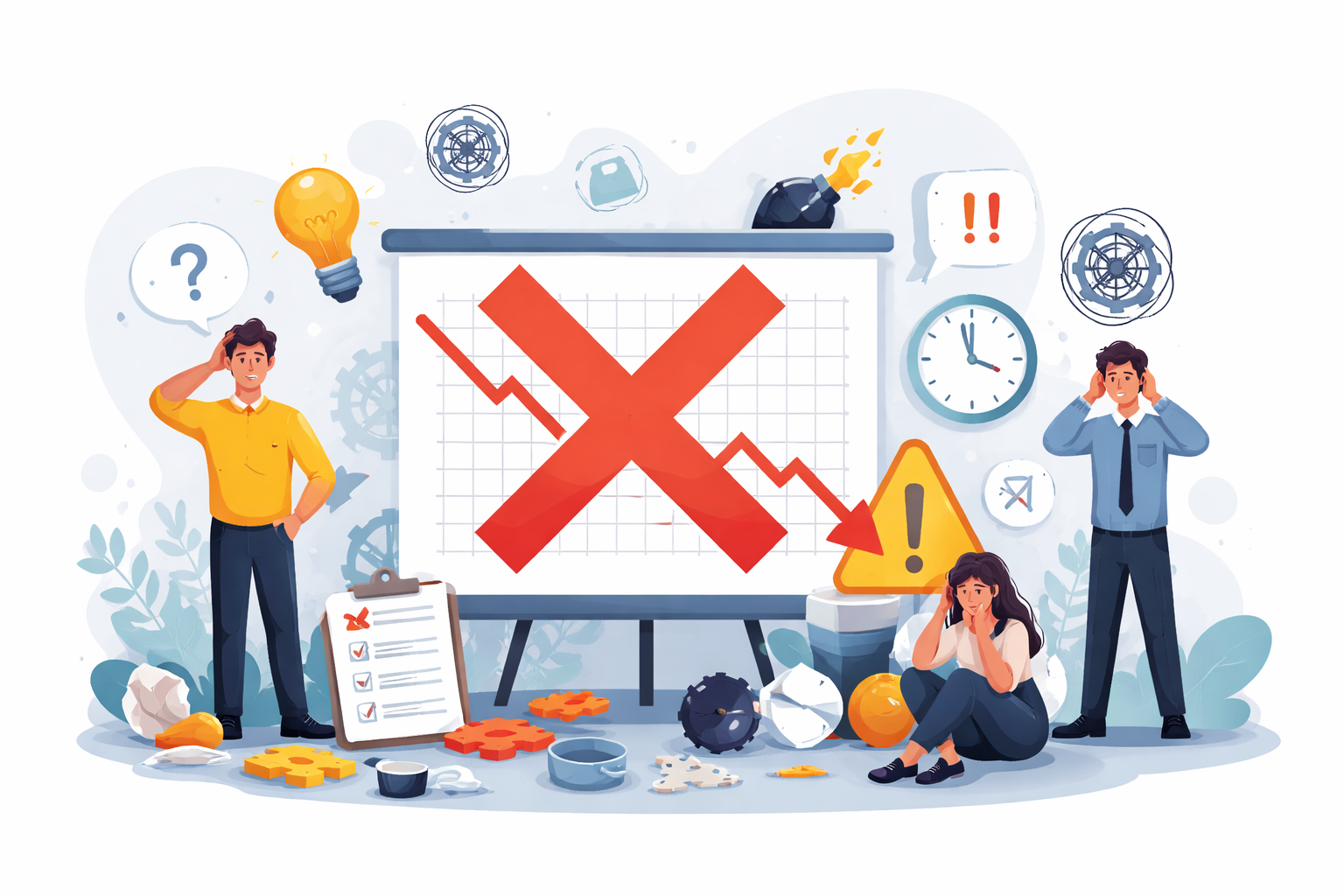
This setup isn’t magic.
It breaks in some cases.
Doesn’t work well if:
You need real-time deployments multiple times per day
If your product requires constant updates or instant fixes, a slow, staged release cycle becomes a bottleneck. Waiting days to ship small changes can block users and frustrate the team. In these cases, you need stronger automation, CI/CD, and faster validation — not manual checkpoints.
You have 20+ developers
Once the team grows past a dozen people, informal coordination stops working. Too many parallel changes create merge conflicts, miscommunication, and unstable builds. At this size, you need clearer processes, defined roles, and more structured workflows than a lightweight small-team setup.
Heavy compliance/regulation requirements
When you’re working in fintech, healthcare, or government projects, “lightweight” processes aren’t enough. Audits, documentation, and strict testing are mandatory, not optional. Skipping formal steps can lead to legal or security risks, not just bugs.
Multiple teams working on the same repo
When several teams touch the same codebase, simple branching and weekly releases quickly become messy. One team’s change can silently break another’s work. You need stronger coordination, release planning, and sometimes repo or service separation to avoid constant collisions.
At that scale, you need more formal processes and tooling.
This approach is for small, tight teams where simplicity beats sophistication.
Best practices for small development teams

After years of trial and error, these matter more than any framework:
1. Optimize for predictability, not speed
In small teams, chasing speed usually backfires. You rush features out, skip checks, and then spend the next few days fixing production issues. So you’re not actually faster — just busier.
Predictable delivery beats raw speed. Shipping smaller, stable updates on a consistent schedule keeps stress low and makes the whole team more reliable over time.
Consistent weekly releases beat random fast shipping.
2. Fewer tools, clearer rules
I’ve seen small teams stack five tools to “improve productivity” — multiple boards, chat apps, trackers, and dashboards. Instead of helping, it just spreads information everywhere and creates confusion about what’s actually the source of truth.
With fewer tools and simple, agreed-upon rules, everyone knows where work lives and how things move. Clarity beats complexity every time, especially when the team is small.
One board, one flow, one branching strategy.
Complex tooling creates invisible bugs.
3. Write less, but write clearly
Long documents usually don’t get read, especially in small teams moving fast. People skim, miss details, and then make assumptions while building. That’s how misunderstandings sneak into the code.
Short, focused notes work better — clear requirements, acceptance criteria, and edge cases. A few precise lines that everyone reads are far more useful than pages of documentation nobody touches.
Short specs > long docs nobody reads.
4. Make quality someone’s job each sprint
When everyone is “responsible for quality,” it usually means no one really is. Testing gets rushed, edge cases are skipped, and bugs slip through because people are focused on finishing their own tasks.
Assign one person each sprint to own testing and validation. Having a clear owner creates accountability and catches problems early, without needing a full-time QA hire.
If everyone owns testing, nobody owns it.
5. Reduce work in progress
Small teams often start too many things at once — three half-built features, two urgent bugs, and one “quick change.” Nothing actually finishes, and everything feels stuck. Context switching also kills focus and quality.
Limiting work in progress forces the team to finish tasks before picking up new ones. Fewer open items mean cleaner code, faster reviews, and a much more predictable release cycle.
Half-built features create hidden debt.
Finish first, start later.
6. Do small retrospectives
Most small teams skip retrospectives because they feel like a luxury or “process overhead.” But without stopping to reflect, the same mistakes keep repeating every sprint. Problems pile up quietly until they become bigger fires.
A simple 20–30 minute weekly chat is enough — what broke, why it happened, and what we’ll change next week. Small, regular fixes improve the workflow far more than big process changes later.
- 30 minutes weekly:
- What broke?
- Why?
- What do we change next week?
This alone improves your lifecycle more than any new tool.
Conclusion:
Small teams don’t fail at SDLC because they’re inexperienced.
They fail because they try to copy big-company processes or skip structure entirely.
What worked for us was simple:
- clear requirements
- separate build and release
- defined ownership
- predictable deployments
Nothing fancy. Just discipline.
Boring processes ship stable software.
Chaos ships bugs.
FAQs
Usually because coding, testing, and deploying happen at the same time with no buffer for verification.
Not formal, but you need clear steps and ownership. Otherwise everything blends together and quality drops.
Rotate a developer each sprint to focus mainly on testing and validation.
Often no. It creates constant interruptions and hidden bugs. Weekly releases are usually calmer and safer.
Starting development before requirements are clear, which leads to rework and missed deadlines.
About the Author
Paras Dabhi
VerifiedFull-Stack Developer (Python/Django, React, Node.js) · Stellar Code System
Hi, I’m Paras Dabhi. I build scalable web applications and SaaS products with Django REST, React/Next.js, and Node.js. I focus on clean architecture, performance, and production-ready delivery with modern UI/UX.

Paras Dabhi
Stellar Code System
Building scalable CRM & SaaS products
Clean architecture · Performance · UI/UX