
USA vs Offshore Software Development Cost Comparison
Many startup teams begin software projects assuming offshore development automatically reduces costs.
On paper, the math often looks convincing. Lower salaries, reduced payroll obligations, and larger talent pools appear to create immediate savings.
However, after working with US-based startups, European SaaS companies, and remote engineering teams across multiple countries, I've seen projects exceed their original budget despite choosing lower-cost development resources.
The problem is rarely developer rates alone. Most cost overruns come from planning assumptions, communication gaps, management overhead, and hidden operational expenses that teams fail to account for during forecasting.
Understanding where these costs actually emerge is more important than comparing hourly rates.
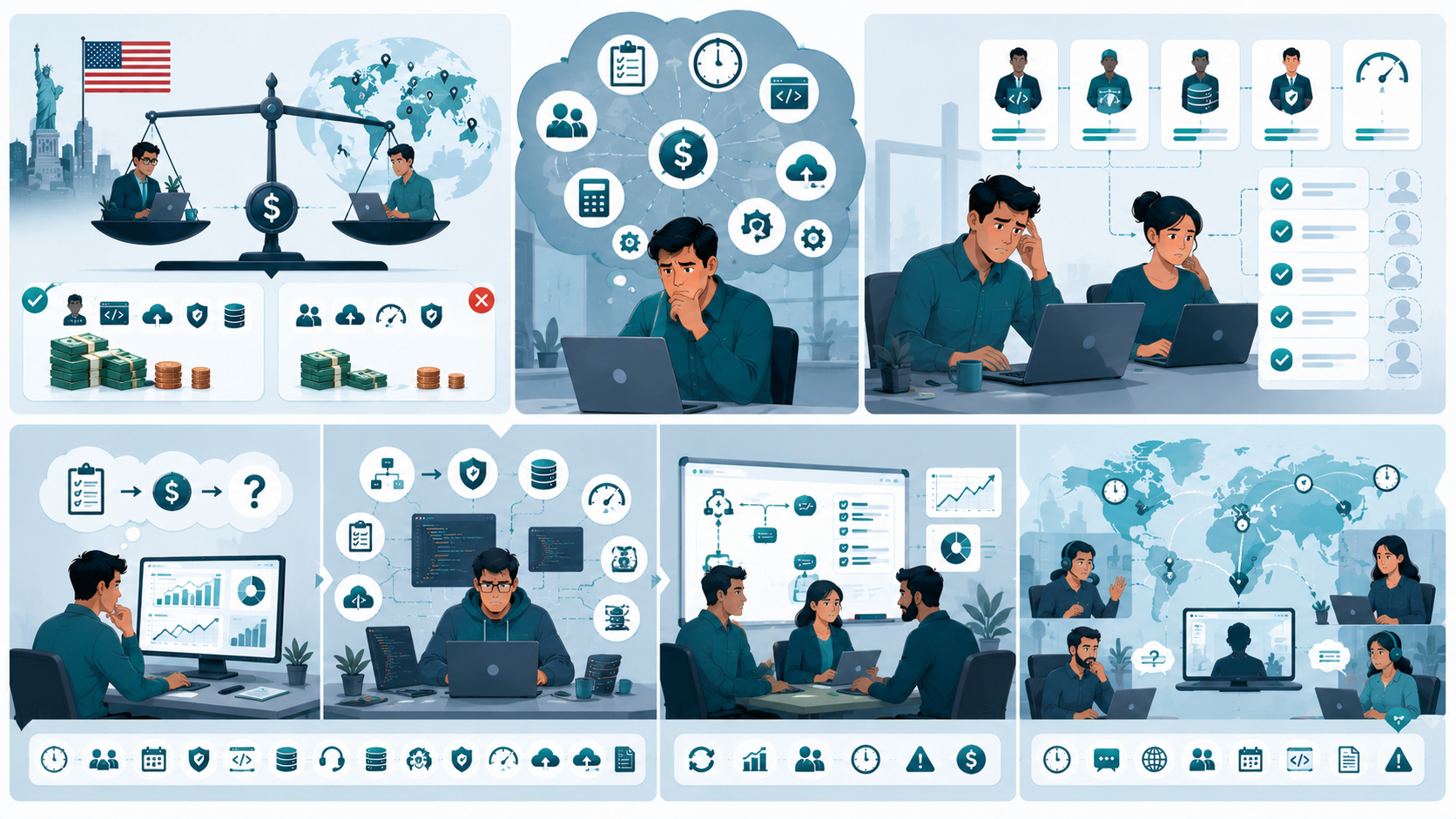
Why This Problem Happens in Real Teams
Cost Becomes the Primary Decision Factor
Many founders begin vendor evaluations with pricing rather than project requirements.
When budget pressure exists, the lowest proposal often receives immediate attention.
The challenge is that development expenditure extends far beyond coding hours.
Factors such as collaboration, project management, deployment workflows, quality assurance, support requirements, and technical governance significantly influence total investment.
Limited Engineering Capacity
Small engineering teams often have to balance feature development, maintenance, support, and deployment responsibilities at the same time. With limited resources, important activities such as architecture reviews, documentation, and technical planning may receive less attention. This can lead to slower delivery and increased long-term costs.
A team of four developers may not have dedicated specialists for:
- Architecture reviews
- Technical documentation
- Security compliance
- Performance optimization
- Deployment management
As a result, planning decisions focus on short-term affordability instead of long-term sustainability.
Early Forecasting Assumptions
Many startups estimate project costs based only on developer rates and initial feature requirements. They often overlook factors such as maintenance, infrastructure, communication, and future enhancements. As requirements evolve, original budget forecasts quickly become inaccurate.
Actual software delivery includes:
- Recruitment efforts
- Knowledge transfer
- Infrastructure expenses
- Maintenance obligations
- Communication overhead
- Product management time
These costs frequently remain invisible during initial planning.
Global Teams Introduce Coordination Costs
Distributed teams provide access to a broader talent pool, but they also require stronger communication and coordination. Differences in time zones, workflows, and decision-making processes can create delays if expectations are unclear. Effective collaboration practices are essential to maintain productivity and project momentum.
This directly impacts productivity and delivery timelines.

Where Most Teams Make the Wrong Decision
Comparing Hourly Rates Instead of Total Cost
Many teams focus on developer rates while ignoring the broader costs involved in software delivery. Factors such as project management, communication, maintenance, and quality assurance can significantly impact the overall investment. Evaluating total cost provides a more accurate picture of long-term value.
I've seen teams select lower-cost development partners only to spend months resolving integration issues and architectural inconsistencies.
Lower wages do not automatically create better ROI.
The important metric is cost-effectiveness across the entire development lifecycle.
Assuming Offshore Means Unlimited Scalability
Access to a larger talent pool can support growth, but scaling a team requires more than simply adding developers. Without clear processes and accountability, communication challenges and workflow inefficiencies can quickly emerge. Effective management is essential for sustainable scalability.
Adding developers without proper planning often introduces:
- Communication bottlenecks
- Duplicate work
- Reduced accountability
- Slower decision-making
Workforce growth alone rarely solves engineering problems.
Copying Enterprise Procurement Processes
Startups often adopt approval workflows and governance practices designed for much larger organizations. While these processes may improve control, they can also slow decision-making and increase operational overhead. Lean teams usually benefit from simpler and more flexible structures.
This creates:
- Excessive documentation
- Slower approvals
- Increased management overhead
- Reduced agility
Small product teams typically benefit from leaner operational structures.
Ignoring Retention Risks
Developer turnover can create hidden costs that are often overlooked during planning. When experienced team members leave, valuable product knowledge and technical context are lost. Maintaining strong retention helps reduce disruptions and protects long-term project stability.
When key contributors leave, teams lose:
- Product knowledge
- Architecture context
- Deployment expertise
- Historical decision-making rationale
Retention directly influences long-term development costs.

Practical Fixes That Actually Work
Evaluate Total Ownership Costs
Software development costs extend beyond developer rates. Choosing a software development company in USA for global delivery planning helps teams compare USA and offshore options based on infrastructure, maintenance, communication, support, recruitment, and long-term ownership costs.
Instead of comparing hourly pricing, assess:
- Development costs
- Infrastructure requirements
- Maintenance effort
- Support obligations
- Recruitment expenses
- Operational overhead
This creates a more accurate investment forecast.
Build Small Validation Projects First
Before committing to a long-term engagement, start with a small project or feature. This allows teams to assess communication, code quality, delivery reliability, and collaboration effectiveness. Early validation helps reduce risk and improves decision-making.
Before committing to a large engagement:
- Deliver a small feature
- Test collaboration processes
- Evaluate communication quality
- Review code quality
- Assess delivery reliability
This reduces risk significantly.
Invest in Documentation Early
Strong documentation reduces dependency on individual team members and improves long-term maintainability. Recording architecture decisions, API contracts, deployment processes, and security requirements helps teams work more efficiently. It also makes onboarding and knowledge transfer significantly easier.
At minimum, document:
- Architecture decisions
- API contracts
- Deployment workflows
- Security requirements
- Integration dependencies
This improves team availability and knowledge transfer.
Standardize Communication Processes
Consistent communication practices help distributed teams stay aligned and productive. Regular reviews, shared documentation, and clearly defined ownership reduce misunderstandings and delays. Structured workflows improve transparency and support smoother project execution.
Examples include:
- Weekly architecture reviews
- Daily engineering updates
- Shared technical documentation
- Clear ownership models
These practices improve coordination and transparency.
Measure Outcomes Instead of Activity
Successful teams focus on results rather than hours worked or tasks completed. Metrics such as delivery speed, software quality, deployment success, and customer impact provide better insights into team performance. Measuring outcomes helps organizations make smarter operational decisions.
Track metrics such as:
- Delivery predictability
- Defect rates
- Deployment frequency
- Maintenance effort
- Product performance
These indicators provide better insight than hours logged.

When This Approach Fails
Large Enterprise Platforms
As software platforms grow, they often require stronger governance, security controls, and operational oversight. Organizations operating across multiple regions must manage compliance, procurement processes, and accountability requirements. These additional responsibilities can make lean development practices more difficult to sustain.
Organizations operating across multiple regions often require:
- Compliance audits
- Security reviews
- Procurement controls
- Formal accountability structures
Lean processes become harder to maintain.
Highly Regulated Products
Products in industries such as finance, healthcare, and government must meet strict regulatory and security standards. Compliance requirements often increase development effort through audits, documentation, and risk management processes. As a result, project costs and delivery timelines can grow significantly.
Examples include:
- Financial systems
- Healthcare platforms
- Government software
In these environments, documentation and security obligations significantly influence expenditure.
Massive Engineering Organizations
As engineering teams expand, coordination becomes more challenging. Managing resources, maintaining architecture standards, and aligning multiple teams require additional planning and oversight. Larger organizations often experience increased operational complexity that can reduce cost predictability.
More effort is required for:
- Workforce planning
- Resource allocation
- Architecture governance
- Cross-team collaboration
Cost savings become less predictable.
Products Requiring Constant Real-Time Availability
Applications that must remain available around the clock demand higher levels of reliability and operational support. Teams need continuous monitoring, incident response processes, and infrastructure redundancy to minimize downtime. These requirements can substantially increase both development and maintenance costs.
High-traffic SaaS products often require:
- Advanced monitoring
- Reliability engineering
- Infrastructure optimization
- Dedicated support coverage
Operational costs can exceed development costs.

Sustainable Practices for Small Engineering Teams
Reduce Technical Debt Continuously
Technical debt can gradually slow development and make future changes more difficult. Regular refactoring, dependency updates, and code cleanup help maintain code quality and system stability. Consistent improvements prevent small issues from turning into costly rewrites.
Schedule regular time for:
- Refactoring
- Dependency updates
- Code cleanup
- Architecture improvements
Small improvements prevent expensive rewrites.
Maintain Strong Documentation
Well-maintained documentation helps teams work more efficiently and reduces knowledge gaps. Clear records of architecture decisions, deployment procedures, APIs, and security requirements make onboarding easier. Good documentation also supports smoother collaboration across distributed teams.
Focus on:
- Architecture diagrams
- Deployment procedures
- API documentation
- Security decisions
Good documentation increases team efficiency regardless of location.
Prioritize Sustainable Collaboration
Strong collaboration depends on clearly defined roles and responsibilities. Establishing ownership for technical decisions, deployments, reviews, and issue escalation reduces confusion and delays. A structured collaboration model helps teams maintain productivity as they grow.
Define:
- Technical leads
- Deployment responsibilities
- Review processes
- Escalation paths
This reduces management friction.
Keep Infrastructure Simple
Many startups invest in complex infrastructure before it is truly necessary. Focusing on solutions that meet current business needs helps reduce costs and operational complexity. Simpler systems are often easier to manage, maintain, and scale over time.
Choose solutions that support current capacity requirements rather than hypothetical future scale.
This improves affordability while maintaining flexibility.
Focus on Long-Term Value
The most effective development decisions prioritize long-term business outcomes rather than short-term savings. Reliability, maintainability, and software quality often deliver greater value over time. Teams that focus on sustainable growth typically achieve stronger returns on their investment.
The goal is maximizing value delivered relative to investment.
Teams that prioritize reliability, quality, and maintainability usually achieve better profitability over time.
Conclusion
The biggest mistake teams make when comparing USA and offshore software development costs is focusing entirely on pricing.
Real project costs emerge from communication, management, documentation, retention, infrastructure, and operational complexity.
Lower hourly rates can generate substantial savings, but only when supported by strong processes and clear accountability.
The most successful engineering teams evaluate total cost-effectiveness rather than developer rates alone.
Cost comparison should be viewed as a business planning exercise, not simply a staffing decision.
Frequently Asked Questions
Not necessarily. Lower compensation costs can be offset by communication challenges, management overhead, and reduced productivity if processes are weak.
Project complexity, team expertise, maintenance requirements, infrastructure needs, and delivery efficiency typically have a larger impact than hourly rates alone.
Both matter. The best outcomes usually come from balancing affordability with reliability and long-term maintainability.
Strong documentation, clear ownership, standardized workflows, and effective collaboration practices help reduce unnecessary expenditure.
In many cases, yes. Combining local product leadership with distributed engineering resources can improve flexibility while maintaining communication quality.
Reference
Written by

Paras Dabhi
VerifiedFull-Stack Developer (Python/Django, React, Node.js)
I build scalable web apps and SaaS products with Django REST, React/Next.js, and Node.js — clean architecture, performance, and production-ready delivery.
LinkedIn