What Should a Software Development Proposal Include?
A software project rarely goes wrong because the developers cannot write code. More often, problems start before development begins, when the client and engineering team have different assumptions about what is actually being built.
I have seen this happen in SaaS projects, internal platforms, and client products. A proposal may say “build a customer management system,” while the client imagines dashboards, automation, integrations, reporting, permissions, and mobile access. The development team may interpret the same sentence as a basic CRUD application.
Both sides think they agreed.
They didn't.
A good software development proposal exists to remove that ambiguity. It connects business objectives with technical requirements, deliverables, timeline, budget, responsibilities, and ownership before the team commits significant development resources.
The important part is not making the proposal long. It is making the right information explicit.

Why Software Development Proposals Cause Problems in Real Teams
The biggest mistake is treating a proposal as a formal document that exists mainly for approval.
In practice, it should become an early reference point for the project.
When important details are missing, teams eventually start making decisions during development that should have been made earlier.
1. Requirements are still unclear
A proposal might mention a feature without explaining its expected functionality.
For example:
Users can manage their accounts.
That sounds clear until development starts.
Does account management include:
- Profile editing?
- Password changes?
- Two-factor authentication?
- Social login?
- Email verification?
- Multiple user roles?
- Account deletion?
- Activity history?
Each additional requirement affects development, testing, architecture, timeline, and cost.
2. The scope keeps expanding
Small teams often start with a limited scope because they want to move quickly.
Then someone says:
Can we also add reporting?
A few days later:
Can users export those reports?
Then:
Can we connect the reports to our CRM?
None of these requests may be unreasonable. The problem is that the original scope was never precise enough to distinguish the agreed deliverables from future work.
3. Estimates are mistaken for commitments
A development estimate is based on assumptions.
If those assumptions change, the estimate can change too.
For example, a proposal may estimate a payment integration based on one provider and a standard checkout flow. If the business later requires multiple payment providers, subscriptions, refunds, regional tax handling, and complex webhooks, the original estimate is no longer applicable.
A good proposal makes those dependencies visible.
Where Most Teams Make the Wrong Decision
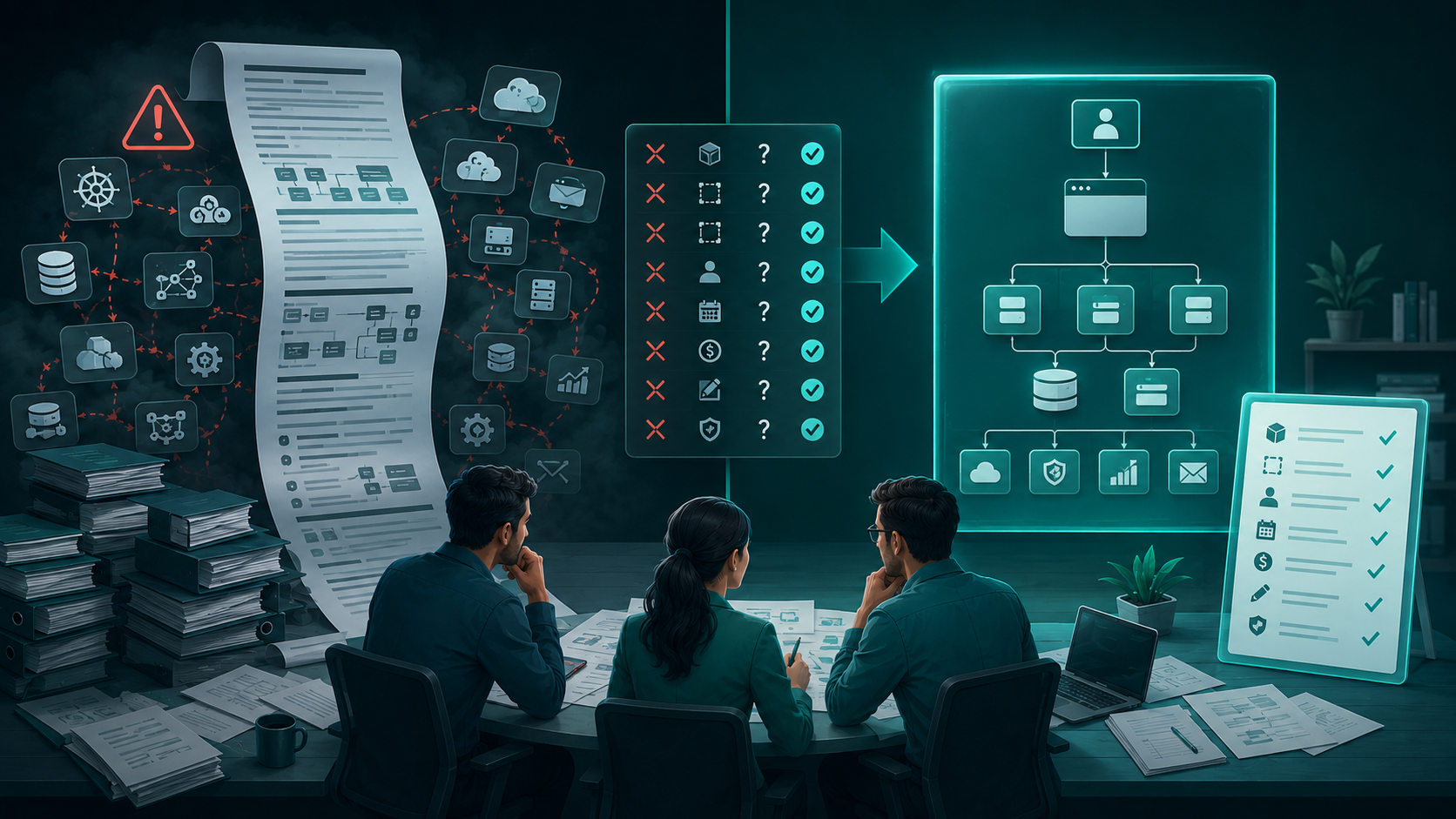
One common mistake is trying to make a software proposal sound impressive instead of making it useful.
I've reviewed proposals that contain pages of technical terminology but fail to answer basic questions:
- What exactly are we building?
- What is included?
- What is excluded?
- Who is responsible for what?
- When will major deliverables be completed?
- How was the cost estimate calculated?
- What happens when requirements change?
- Who owns the resulting software?
The proposal should not be a technical encyclopedia.
It should provide enough specification for both sides to understand the project without pretending that every implementation detail is already known.
Avoid copying enterprise architecture into a small project
Another common problem is unnecessary technical complexity.
A proposal for a small SaaS product might mention:
- Microservices
- Kubernetes
- Event-driven architecture
- Multiple databases
- Complex CI/CD infrastructure
- Several cloud services
None of these technologies are automatically wrong.
But technology should follow requirements, not the other way around.
For a small product, a modular monolith may provide better development speed, easier testing, simpler deployment, and lower operational overhead.
The proposal should explain the architectural reasoning rather than listing technologies to appear sophisticated.
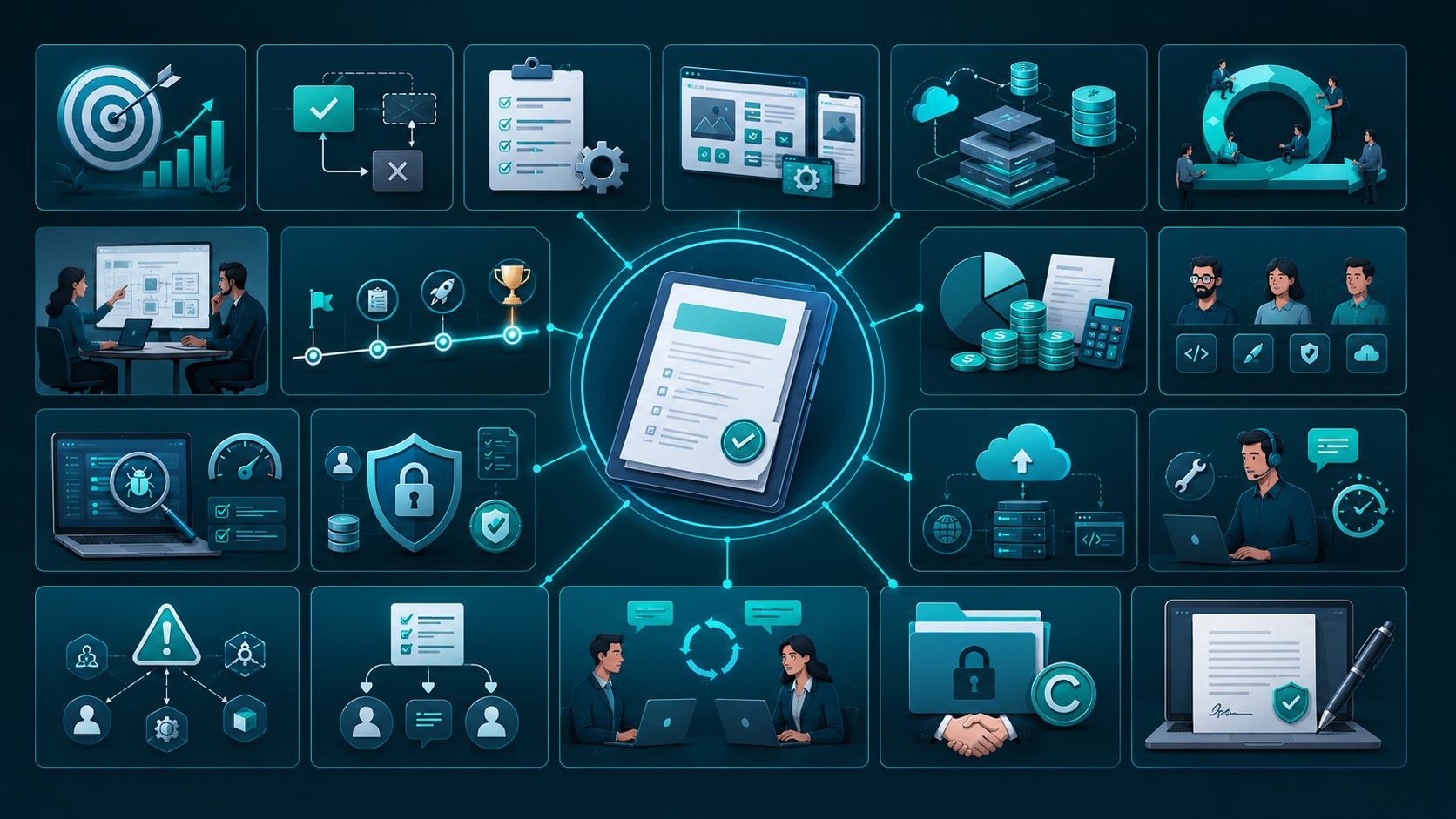
What Should a Software Development Proposal Include?
A practical proposal should cover the following areas. Working with a US software development partner for clear project scope helps teams define objectives, requirements, deliverables, architecture, timeline, budget, responsibilities, risks, assumptions, change management, and ownership before development begins.
1. Project Objectives and Goals
Start with why the software is being built.
The objective should describe the business problem or outcome rather than simply listing technical features.
For example:
Build a SaaS platform that allows property managers to centralize tenant communication, maintenance requests, and payment tracking.
This gives the engineering team context.
The goals can then become more measurable:
- Reduce manual administration
- Centralize customer information
- Improve response times
- Automate recurring tasks
- Provide reporting for managers
This distinction matters because technical decisions should support the actual project objectives.
2. Project Scope
The scope defines the boundaries of the work.
This is one of the most important sections of the proposal.
Clearly identify:
Included
What the development team will build.
Excluded
What is intentionally outside the current project.
Future considerations
Features that may be appropriate later but are not part of the current deliverables.
For example:
Phase 1
- User registration
- Authentication
- Customer management
- Dashboard
- Notifications
- Basic reporting
Future phase
- Advanced analytics
- Mobile application
- AI-based recommendations
- Third-party marketplace integrations
This prevents future ideas from silently becoming current requirements.
3. Requirements and Specifications
The proposal should describe the important functional and technical requirements.
Functional requirements explain what the system needs to do.
For example:
- Users can create accounts.
- Administrators can manage users.
- Customers can submit requests.
- Managers can assign requests.
- Users receive notifications.
Technical specifications can cover areas such as:
- Browser support
- Authentication
- API requirements
- Database requirements
- Integration requirements
- Hosting expectations
- Performance expectations
- Security requirements
The proposal does not need to specify every line of code.
It needs enough detail to establish a shared understanding.
4. Deliverables and Features
A proposal should clearly state what the client will actually receive.
Typical deliverables might include:
- UI/UX designs
- Frontend application
- Backend application
- Database
- APIs
- Third-party integrations
- Testing
- Deployment
- Technical documentation
Then connect those deliverables to specific features.
For example:
Customer Management
- Create customers
- Edit customer information
- Search customers
- Filter customers
- View customer history
- Export customer data
This is much easier to estimate than a vague statement such as “develop CRM functionality.”
5. Technology and Architecture
The proposal should explain the expected technology stack, architecture, framework, and platform where those decisions are relevant.
For example:
Why is this technology appropriate for this project?
For example, a particular framework might be selected because the team already has strong expertise with it, the ecosystem supports the required functionality, and it can handle the expected scale without unnecessary complexity.
- Frontend framework
- Backend technology
- Database
- Cloud platform
- API architecture
- Authentication approach
- Third-party services
But don't turn this section into a shopping list.
The important question is:
6. Development Methodology and Planning
Explain how the development process will work.
For an agile team, this could include:
- Requirements confirmation
- Architecture planning
- UI/UX design
- Development
- Testing
- Client review
- Deployment
- Iteration
The proposal can also explain how requirements will move through the workflow.
This becomes particularly important for remote teams working across different countries and time zones.
7. Timeline, Milestones, and Schedule
A project timeline should not simply say:
The project will take three months.
Break the work into meaningful milestones.
For example:
| Milestone | Main Work |
|---|---|
| Discovery | Requirements and planning |
| Design | Interface and architecture |
| Development | Core functionality |
| Integration | APIs and third-party systems |
| Testing | QA and bug fixing |
| Deployment | Production release |
This gives stakeholders a better understanding of project progress.
It also makes delays easier to identify.
If an external API is not available when expected, that dependency should be visible rather than becoming a surprise near launch.
8. Budget, Pricing, Cost, and Payment
A proposal should explain how the budget and pricing were determined.
Depending on the project, pricing might be:
- Fixed price
- Time and materials
- Milestone-based
- Retainer-based
- Hybrid
The proposal should make the cost estimate understandable.
For example:
Estimated effort
- Discovery: 60 hours
- UI/UX: 100 hours
- Frontend: 240 hours
- Backend: 300 hours
- Testing: 120 hours
- Deployment: 40 hours
- Payment schedule
- Deposit requirements
- Milestone payments
- Taxes where applicable
- Expenses
- Change-request pricing
The exact numbers depend on the project, but showing the reasoning behind the estimate is more useful than providing one unexplained total.
Also clarify:
9. Development Team and Responsibilities
A proposal should identify the expected team and their responsibilities.
Depending on project size, this could include:
- Product manager
- Technical lead
- Backend developer
- Frontend developer
- UI/UX designer
- QA engineer
- DevOps engineer
More importantly, clarify responsibilities.
For example, who provides:
- Product requirements?
- Design approvals?
- API credentials?
- Content?
- Infrastructure access?
- Third-party accounts?
- Testing feedback?
This becomes especially important with distributed teams.
A developer cannot complete a payment integration if nobody provides the required merchant credentials.
That is a project dependency, not a development failure.
10. Testing, Quality, and Performance
Testing should not appear as an afterthought.
The proposal should explain the expected quality process.
This might include:
- Unit testing
- Integration testing
- API testing
- Functional testing
- Regression testing
- Browser testing
- User acceptance testing
- Security testing
The required testing level depends on the product.
A simple internal tool does not necessarily require the same process as a financial platform handling sensitive transactions.
The proposal should match the testing strategy to the actual risk, functionality, performance, and compliance requirements.
11. Security, Privacy, and Compliance
Security requirements should be identified early.
Depending on the project, the proposal may need to address:
- Authentication
- Authorization
- Encryption
- Access control
- Data protection
- Backup
- Logging
- Monitoring
- Privacy requirements
- Regulatory compliance
This is particularly important when software handles personal, financial, healthcare, or business-sensitive information.
Security is not simply a feature added near deployment. It can influence the architecture, technology, development process, testing, and infrastructure from the beginning.
12. Deployment, Maintenance, and Support
The proposal should explain what happens after development.
Deployment may include:
- Production configuration
- Cloud setup
- Domain configuration
- Database deployment
- Environment variables
- CI/CD configuration
- Monitoring
Then define maintenance and support.
For example:
- Bug-fix period
- Maintenance responsibilities
- Support hours
- Response expectations
- Infrastructure responsibilities
- Future enhancement process
Without this section, clients may assume ongoing support is automatically included.
Developers may assume the opposite.
That is an avoidable disagreement.
13. Risks, Assumptions, and Dependencies
This is one of the most valuable sections in a serious proposal.
Every estimate contains assumptions.
For example:
- Client provides API documentation.
- Third-party services remain available.
- Requirements are approved within an agreed timeframe.
- No major architecture changes occur during development.
Then document potential risks.
Examples:
- Unstable third-party API
- Unclear requirements
- Legacy system integration
- Security constraints
- Delayed client feedback
- Performance requirements exceeding initial assumptions
Finally, identify dependencies.
If the project depends on an external payment provider, authentication service, data migration, or client infrastructure, make it explicit.
This makes the project easier to manage when something changes.
14. Change Management and Communication
Requirements will change.
The goal isn't to prevent every change. The goal is to manage changes without creating confusion.
Define a simple change-request process:
- Client submits the requested change.
- Team evaluates technical impact.
- Additional effort is estimated.
- Timeline and cost impact are communicated.
- Client approves or rejects the change.
- Development proceeds accordingly.
Also establish the communication process.
For remote teams, this might include:
- Weekly project meetings
- Written progress updates
- Task tracking
- Design reviews
- Sprint demonstrations
- Issue tracking
Good collaboration is not about having more meetings. It is about ensuring the right information reaches the right people at the right time.
15. Ownership, Confidentiality, and Agreement
The proposal should also address legal and commercial expectations.
Important areas may include:
- Intellectual property ownership
- Source-code ownership
- Confidentiality
- Third-party licenses
- Data ownership
- Documentation ownership
- Payment terms
- Termination conditions
- Acceptance criteria
- Agreement terms
The exact legal language should be handled appropriately for the jurisdictions involved.
But the important thing is that both parties understand what happens to the software and its associated assets after the project is completed.
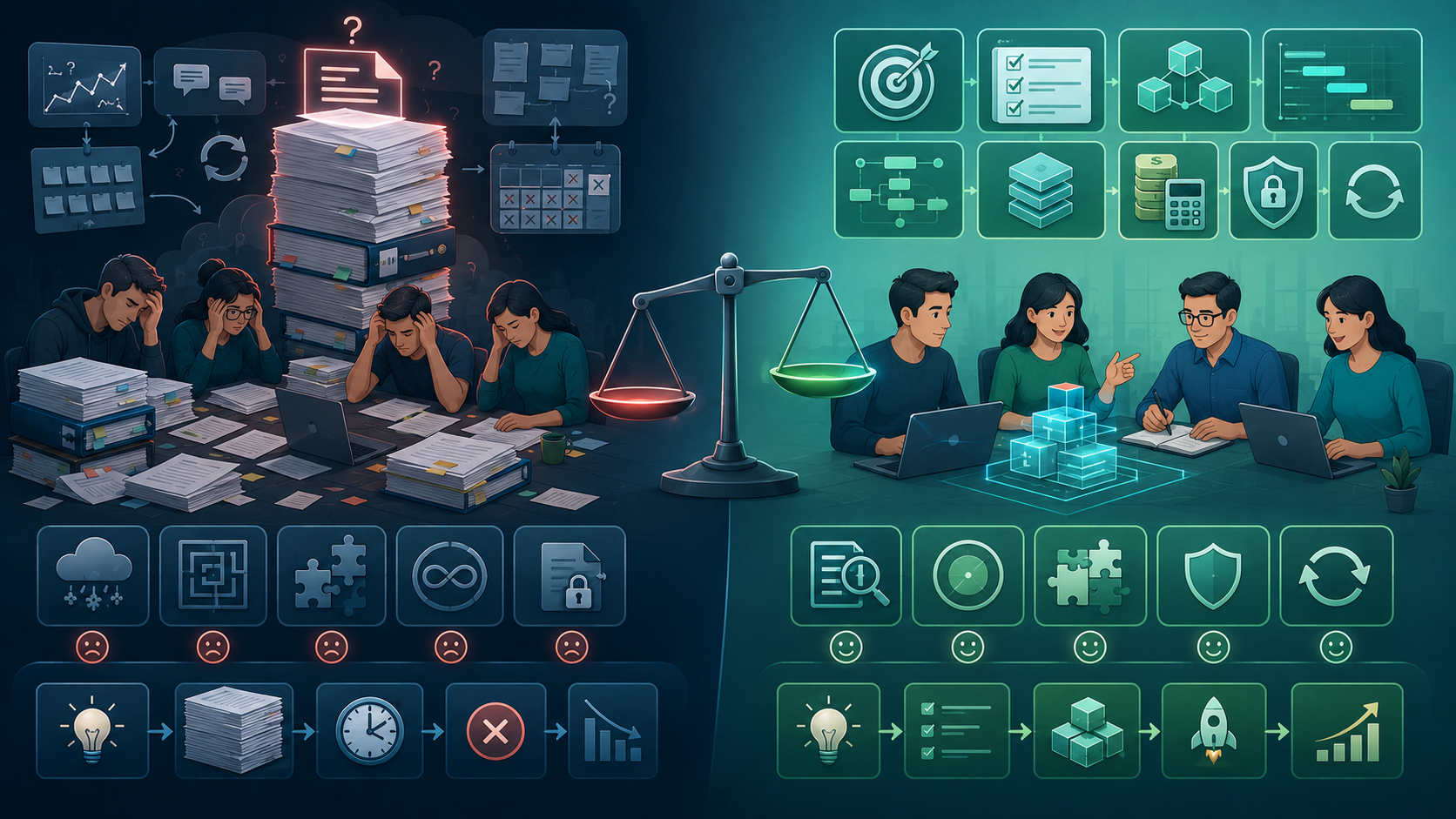
When a Detailed Proposal Can Become a Problem
More detail is not always better.
I've seen teams spend so much time creating a proposal that they effectively design the entire product before validating whether the product itself is viable.
A proposal can become counterproductive when:
- Requirements are still changing daily.
- The MVP has not been defined.
- Technical feasibility is unknown.
- The client expects unlimited revisions.
- The document becomes hundreds of pages long.
- Implementation details are treated as permanent decisions.
For an early-stage startup, a lightweight proposal may be more appropriate.
The goal is to create enough clarity to start the project—not to predict every decision that will be made six months later.
Sustainable Practices for Better Software Proposals
A good proposal should make future development easier, not create more administrative work.
For small engineering teams, I recommend a few practical habits.
Keep scope measurable
Instead of:
Build an admin panel.
Define what the administrator can actually do.
Record assumptions
If an estimate depends on an assumption, write it down.
Separate phases
Don't force every possible feature into the initial release.
Connect cost to effort
Explain why the estimate exists.
Keep technical decisions flexible
Choose architecture based on current requirements while leaving room for future evolution.
Define ownership early
Don't wait until launch to discuss source code and intellectual property.
Treat the proposal as a living reference
Once development begins, approved changes should be reflected in the project documentation.
This reduces the classic:
I thought that was included.
problem.

The Core Lesson
A software development proposal is not just a document used to win a project.
It is an agreement about expectations.
The strongest proposals connect:
Objectives → Scope → Requirements → Deliverables → Technology → Development → Testing → Timeline → Cost → Responsibilities → Support → Ownership
When those relationships are clear, developers can estimate more realistically, clients can make better decisions, and project teams have fewer arguments about what was supposedly agreed.
The proposal does not need to predict everything.
It needs to make the important things explicit.
Conclusion
A strong software development proposal is not about making a document as detailed as possible. It is about creating clarity before development begins. The proposal should clearly connect the project’s objectives, scope, requirements, features, deliverables, technology, development methodology, timeline, budget, responsibilities, testing, security, deployment, maintenance, and ownership.
From a practical engineering perspective, the best proposals also document assumptions, risks, dependencies, and change-management processes. These details may seem minor at the beginning, but they often prevent major disagreements once development is underway.
The goal is simple: both the client and development team should finish reading the proposal with the same understanding of what will be built, how it will be delivered, what it will cost, and where the project boundaries are. When that clarity exists from day one, teams can make better technical decisions, manage expectations, and build software with far fewer surprises.
What Should a Software Development Proposal Include?: FAQs
The scope and requirements are usually the most important. They establish what the team is expected to build and provide the foundation for estimating deliverables, timeline, resources, and cost.
Yes, when architecture affects cost, performance, security, scalability, or implementation. However, avoid unnecessary technical detail when the project is still in an early discovery stage.
Yes. The proposal should clearly explain the estimated cost, pricing model, payment schedule, and assumptions behind the estimate.
Yes. Clearly define what happens after deployment, including bug fixes, maintenance, support responsibilities, response expectations, and future development.
Use a defined change-request process. The team should evaluate the effect on scope, cost, timeline, resources, and technical architecture before the change is approved.
Reference
Written by

Paras Dabhi
VerifiedFull-Stack Developer (Python/Django, React, Node.js)
I build scalable web apps and SaaS products with Django REST, React/Next.js, and Node.js — clean architecture, performance, and production-ready delivery.
LinkedIn