Who Should Own The Source Code After Development
One of the most expensive problems in software projects often appears after the software has already been built.
The application is running. The MVP has launched. Users are signing up. Then the original developer, agency, contractor, or technical co-founder leaves.
Suddenly, the product team discovers that nobody is completely sure who owns the source code, who controls the repository, or whether the business can legally modify and reuse the software.
I have seen versions of this problem in startup teams, SaaS products, and remote development projects. The technical issue is usually manageable. The ownership issue is much harder because it affects every future engineering decision.
The practical answer is simple in most cases: the business paying for and operating the product should have clear ownership and control of the source code, unless the agreement explicitly defines a different ownership model.
However, ownership is more complicated than simply having access to a Git repository.
Why Source Code Ownership Becomes a Problem in Real Teams
Most teams do not intentionally create an ownership problem.
It usually happens because everyone is focused on shipping.
A founder wants an MVP released before funding runs out. A small engineering team is trying to meet a launch deadline. A contractor is hired quickly because the company does not yet have internal developers.
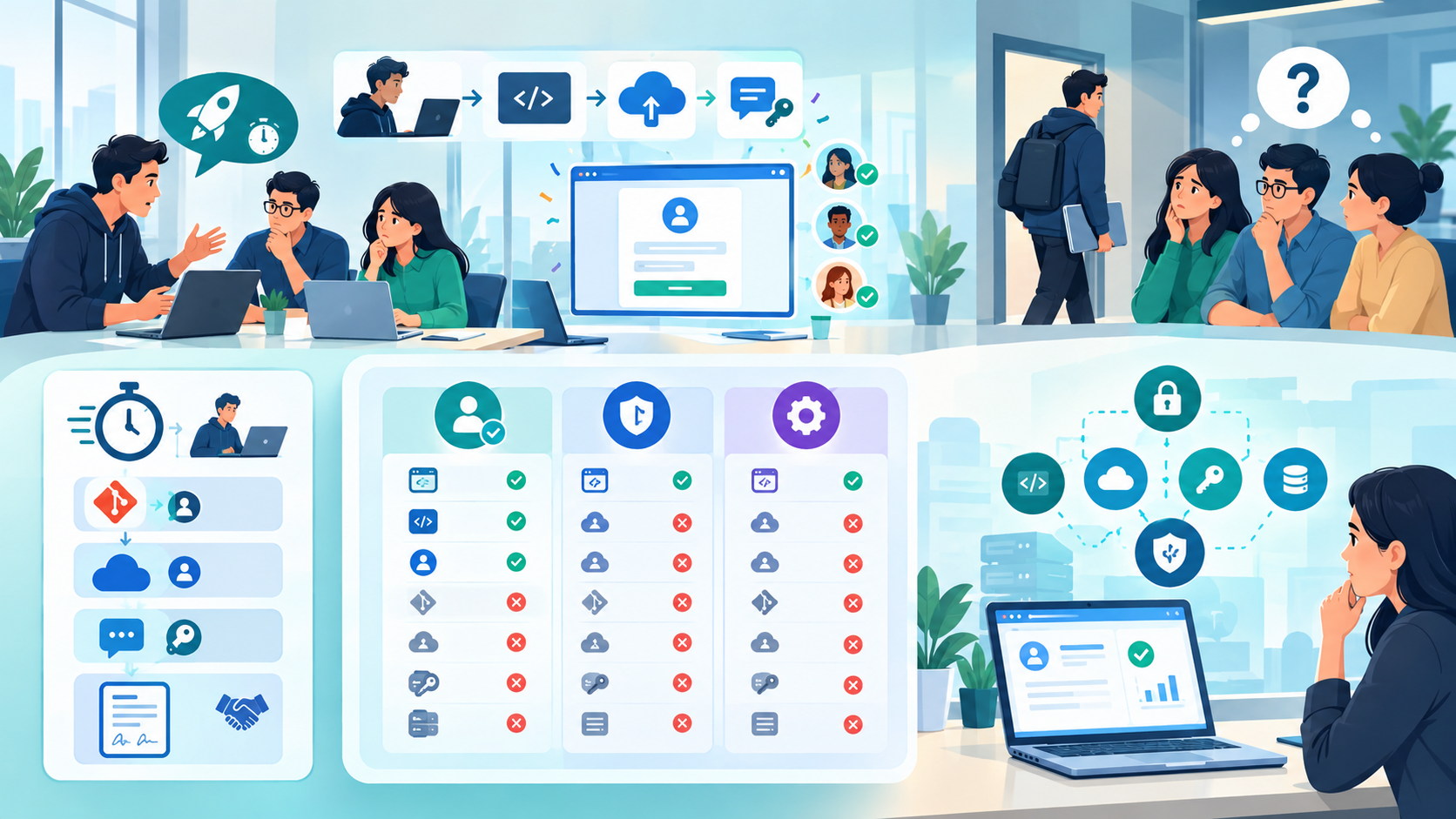
During that phase, questions such as these are often ignored:
- Who owns the intellectual property?
- Who controls the source code repository?
- Who owns deployment infrastructure?
- Can the business continue development without the original developers?
- Who owns reusable libraries and shared components?
- What happens if a contractor leaves?
- Who has access to production credentials?
These questions may feel administrative during development. They become engineering problems later.
For example, I have seen projects where the client technically believed they owned the application but the repository remained inside a developer's personal account. The company could access the deployed application, but not the complete development history, branches, automation scripts, or infrastructure configuration.
That creates a dangerous dependency.
The software may exist, but the business does not fully control the software system.
Time pressure creates bad ownership decisions
Early-stage startup teams are especially vulnerable because development often starts before the company has mature processes.
Typical situations include:
- A founder hires a freelance developer informally.
- A technical co-founder creates the repository under a personal account.
- An agency uses its own organization for source control.
- Developers deploy infrastructure using personal cloud accounts.
- Credentials are shared through chat messages.
- Contracts describe deliverables but not intellectual property ownership.
None of these decisions necessarily cause problems immediately.
The problem appears when the relationship changes.
A developer leaves. The agency contract ends. The company raises funding and needs a security review. Another engineering team needs to take over.
At that point, teams discover that access is not the same thing as ownership, and ownership is not the same thing as operational control.
Where Most Teams Make the Wrong Decision
The biggest mistake is treating source code ownership as a simple legal checkbox.
In practice, ownership has several layers.
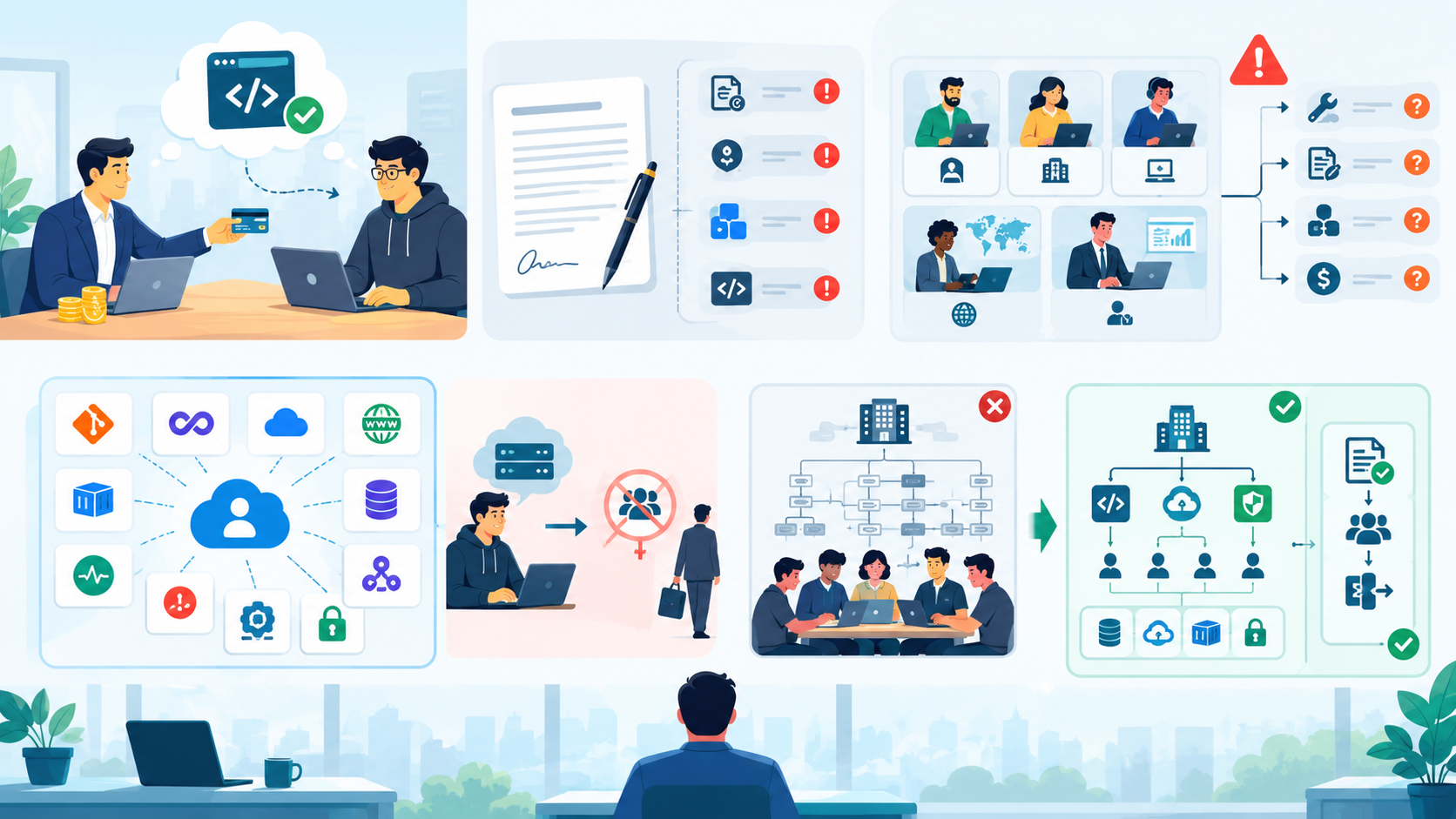
Mistake 1: Assuming that paying for development automatically means owning everything
This is probably the most common assumption.
A company pays someone to build software and assumes that the resulting code automatically belongs to the company.
Depending on the employment relationship and contract, that may not be enough.
The agreement should clearly define ownership or assignment of intellectual property.
This becomes especially important when working with:
- Independent contractors
- Development agencies
- Freelancers
- Remote developers
- International development teams
- External consultants
From an engineering perspective, unclear ownership creates future maintenance risk.
A new engineering team should never have to guess whether it can modify, rewrite, reuse, or commercially distribute the codebase it has been hired to maintain.
Mistake 2: Letting the development vendor own all operational accounts
I have seen teams focus heavily on the source code repository while forgetting everything around it.
Modern software products depend on much more than application code.
A working SaaS product may include:
- Source repositories
- CI/CD pipelines
- Cloud infrastructure
- Domain management
- Container registries
- Databases
- Monitoring systems
- Error tracking
- Third-party API accounts
- Environment configuration
- Deployment secrets
If an agency owns the repository but the startup owns everything else, the transition may still be manageable.
If the agency owns all of it, moving development internally becomes significantly harder.
The practical principle I recommend is straightforward:
Business-critical accounts should be controlled by the business, even when external developers are responsible for managing them.
Developers can receive appropriate access without being the permanent owners of the accounts.
Mistake 3: Copying the ownership model from big companies
Small teams sometimes create unnecessary complexity because they read about how large technology companies manage intellectual property and engineering infrastructure.
A team of five developers does not need a complicated internal ownership bureaucracy.
But it does need clarity.
For most small product teams, a simple model works better:
- The company owns the primary repositories.
- The company controls the organization that contains them.
- Developers receive role-based access.
- Infrastructure accounts belong to the company.
- Contracts clearly address intellectual property ownership.
- Offboarding includes removing access and transferring knowledge.
That is usually enough.
The goal is not to create processes for the sake of process. The goal is to prevent a single person or vendor from becoming an unavoidable dependency.
Practical Fixes That Actually Work
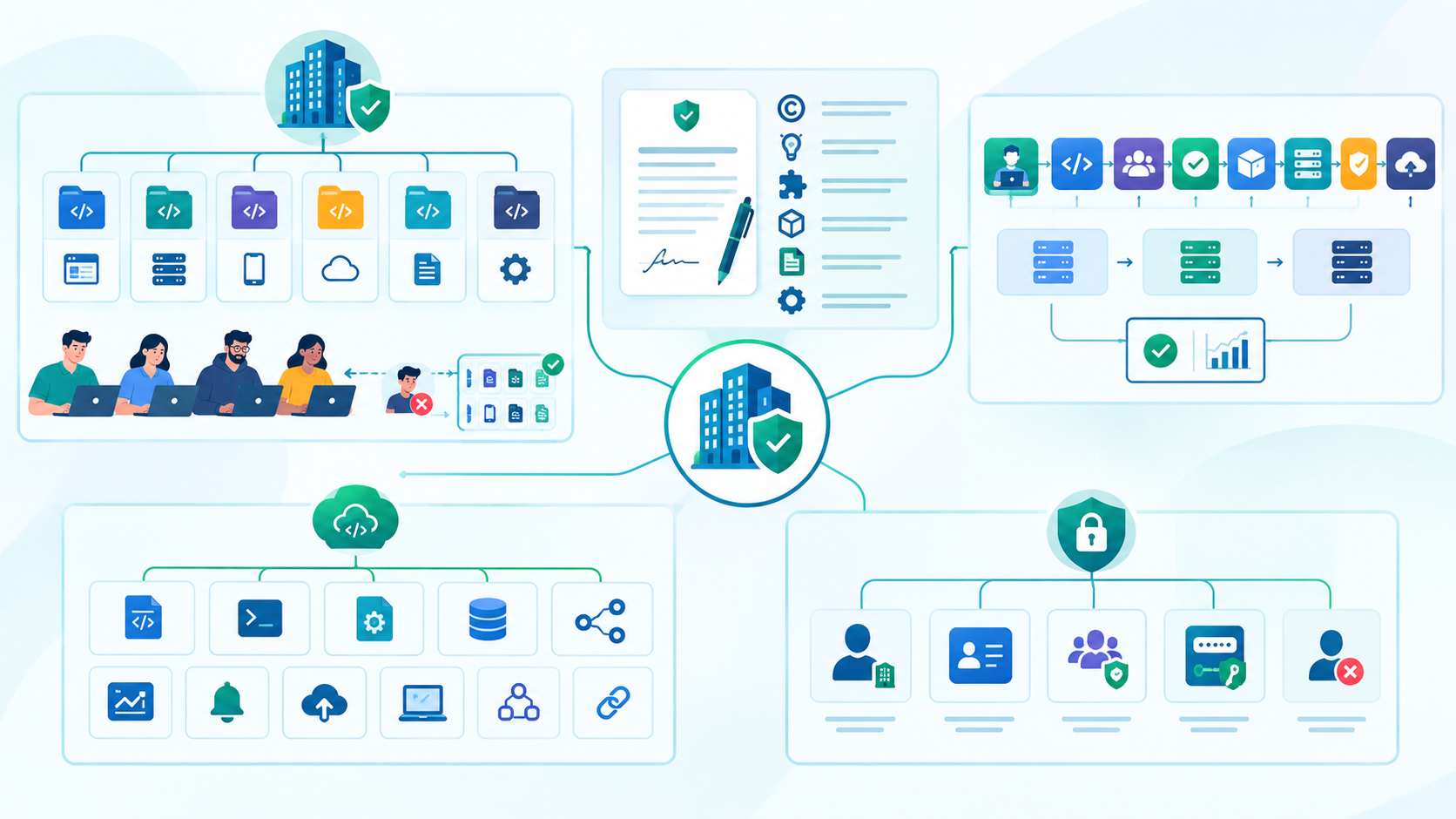
The best approach is to separate legal ownership, repository ownership, and technical control. Working with a US software team for company-controlled codebases helps businesses organize repository ownership, IP rights, deployment access, infrastructure control, credentials, documentation, reusable components, offboarding, and handover responsibilities before one developer or vendor becomes a long-term dependency.
These are related, but they are not the same thing.
1. Put repositories under a company-controlled organization
Do not build a business-critical product entirely inside an individual developer's personal repository.
The repository organization should ideally be controlled by the company.
A simple structure might look like this:
Company Organization
│
├── frontend
├── backend
├── mobile-app
├── infrastructure
├── documentation
└── internal-tools
The important part is not the structure itself.
The important part is that the business can continue accessing the repositories if any individual developer leaves.
2. Define ownership in the development agreement
The technical team should not try to solve legal questions through Git permissions.
Contracts should clearly address:
- Source code ownership
- Intellectual property assignment
- Custom-developed components
- Reusable pre-existing components
- Third-party dependencies
- Open-source software
- Documentation
- Infrastructure configuration
One area that often causes confusion is reusable code.
A development team may already have internal utilities, templates, or generic libraries developed before the project.
Those should be distinguished from custom code specifically created for the client's product.
Without that distinction, ownership discussions can become unnecessarily complicated.
The goal is clarity before the project ends, not negotiation after the relationship breaks down.
3. Make sure the company controls the deployment path
A business should not depend on one developer manually deploying every production release.
Even a small engineering team should gradually move toward a documented deployment workflow.
For example:
Developer
   ↓
Pull Request
   ↓
Code Review
   ↓
Automated Tests
   ↓
CI Pipeline
   ↓
Staging
   ↓
Production Approval
   ↓
Production Deployment
The specific tooling is less important than the ownership model.
The company should be able to continue deploying the product when a developer leaves.
If only one contractor knows how production deployments work, that contractor effectively controls part of the product.
4. Treat infrastructure configuration as part of the software asset
This is frequently missed.
Infrastructure-as-code files, deployment scripts, environment configuration, database migration history, and CI workflows are all important parts of maintaining a product.
A team might technically receive the application source code but still struggle to rebuild the system because the deployment knowledge disappeared.
When handing over a project, I would expect documentation covering at least:
- Application architecture
- Repository structure
- Local development setup
- Environment variables
- Deployment process
- Database migrations
- External integrations
- Monitoring and alerting
- Backup procedures
The documentation does not need to be perfect.
It needs to be sufficient for another competent engineering team to take over without reverse-engineering everything.
5. Avoid shared personal credentials
Small remote teams often take shortcuts with credentials.
Someone creates a cloud account. Someone else creates a database. API keys get stored in a password manager or chat thread.
This works until someone leaves.
A better model is:
- Company-owned accounts
- Individual developer access
- Role-based permissions
- Central credential management
- Access removed during offboarding
This reduces the risk that the business loses control over critical systems.
When Company Ownership Alone Does Not Solve the Problem
Clear ownership is essential, but it does not automatically make a codebase maintainable.
I have seen companies fully own repositories containing software that nobody wants to touch.
The original team may have left behind:
- No documentation
- No automated tests
- No deployment process
- Hardcoded configuration
- Outdated dependencies
- Undocumented integrations
- No architectural explanation
Legally owning that code does not make it easy to maintain.
This approach also becomes more complicated when products contain components from multiple sources.
For example:
- Open-source libraries have their own licenses.
- Third-party APIs remain owned by their providers.
- Commercial software may have license restrictions.
- A vendor may retain ownership of pre-existing frameworks.
- Developers may contribute independently created tools.
That is why source code ownership should not be treated as a single sentence in a contract.
The product needs an inventory of what the engineering team actually owns and controls.
For larger organizations, ownership can also become distributed across teams. A company may own the entire platform while individual teams maintain different services.
At that stage, the challenge becomes governance and operational responsibility rather than basic ownership.

Sustainable Practices for Small Engineering Teams
For a team of two to fifteen developers, I would focus less on formal governance and more on eliminating single points of failure.
Keep critical assets company-controlled
This should include:
- Source repositories
- Domains
- Cloud accounts
- Production environments
- CI/CD systems
- Monitoring platforms
- Database accounts
External developers can still manage these systems without owning them.
Document the things people usually keep in their heads
Small teams often depend heavily on tribal knowledge.
Someone knows how releases work.
Someone else knows why a particular backend system was designed in a specific way.
Another developer understands the payment integration.
That works while the same people remain on the team.
Document the decisions that would slow down a new engineer.
Short architecture notes are often more valuable than long documentation nobody reads.
For example:
Why do we use a modular monolith? Because the team has six engineers and the product does not currently require independent service deployment. Modules are separated by domain so services can be extracted later if scaling requirements change.
That kind of note can prevent future developers from repeating old architecture debates.
Build handover into normal engineering work
A project handover should not begin during the final week of a contract.
The team should be able to transfer knowledge continuously.
Useful habits include:
- Keeping README files current
- Documenting major architecture decisions
- Reviewing pull requests
- Avoiding single-developer deployment knowledge
- Maintaining basic onboarding instructions
- Recording important infrastructure decisions
This reduces technical debt and also reduces ownership risk.
Plan for people leaving
Developers leave. Agencies change priorities. Contractors move to other projects.
That is normal.
The engineering system should be designed so that one departure creates inconvenience rather than a crisis.
A practical question I ask small teams is:
If our most experienced developer disappeared tomorrow, could another engineer deploy and maintain the product within a reasonable amount of time?
If the answer is no, the problem is not simply staffing.
It is an engineering resilience problem.
Conclusion
After development, the source code should generally be clearly owned and controlled by the business responsible for operating the product.
But the biggest mistake teams make is stopping the discussion at the source code repository.
A modern software product also depends on infrastructure, deployment workflows, credentials, documentation, databases, integrations, and operational knowledge.
The most practical approach for startup teams is simple: keep business-critical assets under company control, give developers the access they need, document important technical decisions, and avoid building systems that depend on one person or vendor.
Ownership matters because software changes.
The team that builds version one is rarely the exact same team that maintains version five.
A healthy engineering setup assumes that people will change while the product continues.
Who Should Own The Source Code After Development: FAQs
In most product development arrangements, the business operating and paying for the custom product should have clearly defined ownership or rights to use and modify the source code. The exact legal arrangement should be defined in the relevant agreement.
No. Business-critical repositories should generally be under a company-controlled organization so the product remains accessible if an individual developer leaves.
No. The product may also depend on cloud infrastructure, databases, third-party services, domains, CI/CD workflows, credentials, and open-source dependencies. These should be reviewed separately.
At minimum, include repository access, architecture documentation, deployment instructions, environment configuration guidance, database migration information, third-party integration details, and access transfer procedures.
Use company-controlled accounts, shared repositories, documented deployment workflows, code reviews, basic technical documentation, and a clear offboarding process.
Reference
Written by

Paras Dabhi
VerifiedFull-Stack Developer (Python/Django, React, Node.js)
I build scalable web apps and SaaS products with Django REST, React/Next.js, and Node.js — clean architecture, performance, and production-ready delivery.
LinkedIn