Overview
What we delivered
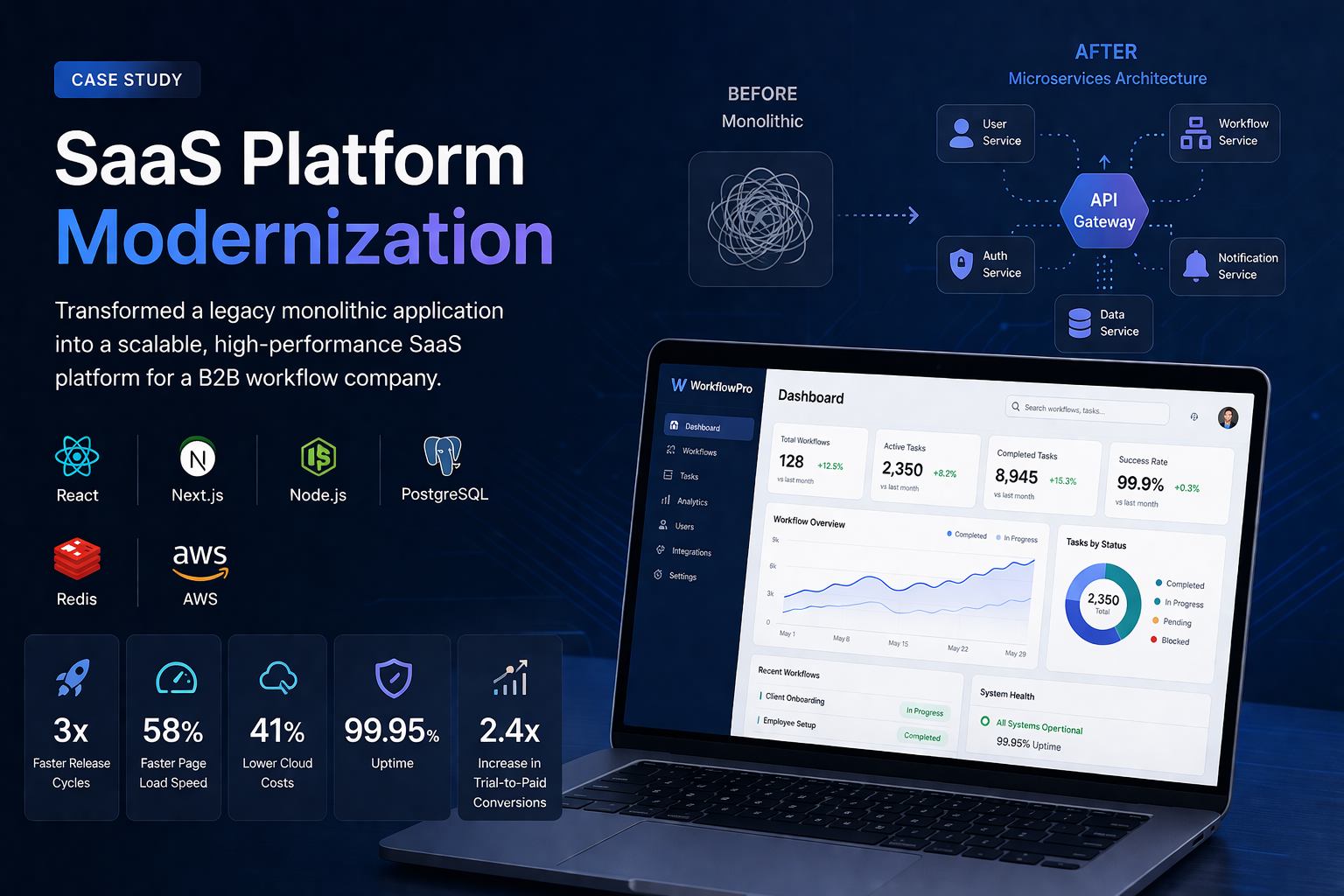
A B2B workflow company was struggling with the limits of its legacy monolithic SaaS platform. Slow releases, unstable APIs, poor performance, and rising infrastructure costs were holding the product back. Stellar Code System modernized the platform into a scalable full stack architecture using React, Next.js, Node.js, PostgreSQL, Redis, and AWS microservices—resulting in faster releases, lower cloud costs, stronger reliability, and improved trial-to-paid conversions.
Client
A B2B workflow software company running a legacy monolithic SaaS platform that supported multiple customer teams, business processes, and operational dashboards.
Challenge
The existing product had become difficult to maintain and scale. Engineering teams were slowed down by tightly coupled services, fragile deployments, and aging APIs that made new feature delivery increasingly risky.
Slow release cycles caused by monolithic deployment dependencies
Poor Core Web Vitals affecting product experience and organic visibility
Difficult feature rollouts due to tightly coupled legacy code
Rising infrastructure costs from inefficient scaling patterns
Unstable legacy APIs creating reliability and integration issues
Solution
Stellar Code System re-architected the SaaS product into a modular full stack platform with a modern frontend, scalable service design, optimized data access, and automated deployment pipelines.
1. Modular Platform Architecture
Migrated the monolith into a modular service-oriented architecture
Separated core business domains for cleaner release and scaling workflows
Introduced AWS-based microservices for better workload isolation
Reduced deployment risk by limiting cross-module dependency impact
2. Frontend Modernization
Rebuilt the frontend with React and SEO-friendly Next.js
Improved rendering performance and user-perceived speed
Addressed Core Web Vitals bottlenecks across key product screens
Created a more maintainable UI architecture for future feature expansion
3. API and Backend Improvement
Introduced a scalable API gateway layer
Stabilized legacy API behavior through controlled service boundaries
Improved backend maintainability with cleaner service contracts
Prepared the system for future integration and multi-team development
4. Data and Performance Optimization
Optimized PostgreSQL queries for high-traffic workflows
Added Redis caching for faster repeated data access
Reduced backend response bottlenecks across dashboard-heavy modules
Improved platform efficiency without overprovisioning infrastructure
5. DevOps, Observability, and Rollback Safety
Automated CI/CD using GitHub Actions
Added observability tooling for production monitoring
Introduced rollback-ready deployment pipelines
Improved release confidence and recovery speed during production changes
Technology Stack
Frontend: React.js and Next.js for modern SaaS interface architecture
Backend: Node.js services and API gateway-based architecture
Database: PostgreSQL for transactional and product data workloads
Caching: Redis for performance optimization and fast-access workflows
Cloud: AWS microservices and scalable infrastructure patterns
DevOps: GitHub Actions for CI/CD automation, observability, and rollback support
Implementation Timeline
Phase 1 (Weeks 1-2): Legacy platform audit, dependency mapping, modernization planning
Phase 2 (Weeks 3-6): Service decomposition, API gateway setup, backend restructuring
Phase 3 (Weeks 7-10): React and Next.js frontend rebuild, UX and performance improvements
Phase 4 (Weeks 11-12): PostgreSQL query optimization, Redis caching, API stabilization
Phase 5 (Weeks 13-14): CI/CD automation, observability, rollback pipeline hardening
Phase 6 (Post-launch): Monitoring, release support, iterative feature rollout acceleration
Results
The modernization effort delivered major technical and business improvements across release velocity, performance, cloud efficiency, and commercial outcomes.
Key Metrics:
3x faster release cycles
58% faster page load speed
41% lower cloud costs
99.95% uptime
2.4x increase in trial-to-paid conversions
Business Impact:
Faster product delivery with lower engineering friction
Improved user experience across customer workflows
Reduced production instability during new releases
Lower infrastructure waste through better service design
Stronger product growth through better performance and conversion flow
Client Testimonial
Words from the client
Stellar Code System helped us turn a fragile legacy product into a modern SaaS platform we can confidently scale. Their team improved our frontend, backend, release process, and infrastructure efficiency in a way that had measurable business impact almost immediately.
Technical Highlights
Legacy monolith decomposition into modular services
SEO-friendly Next.js frontend modernization
Scalable API gateway introduction
PostgreSQL and Redis performance tuning
Automated CI/CD with rollback readiness
Production observability for modern SaaS operations
Future Enhancements
The platform is now positioned for continued SaaS growth and operational maturity.
More granular service autoscaling based on workload type
Advanced feature flagging for staged rollouts
Tenant-level analytics and performance tracking
Further cost optimization through workload right-sizing
Extended observability for product and engineering analytics
Previous case study
Improving Cloud Governance, Cost Visibility, and Scalability for a Growing Organization
Cloud Consulting
Next case study
Enterprise Dashboard for Multi-Location Operations
Enterprise Software
Let’s build yours
Want similar results for your business?
Share your requirements—we’ll propose a premium, scalable solution.