AI Agent Development Company In USA
The excitement around AI agents has led many startups to believe they can replace repetitive business tasks with autonomous software in just a few weeks. On paper, the idea sounds straightforward. Connect a large language model, add a few APIs, and let the agent make decisions independently.
In practice, that's rarely how things unfold.
I've worked with product teams building AI-powered platforms across SaaS, fintech, healthcare, logistics, and internal enterprise operations. One pattern appears consistently: the first version of an AI agent usually performs well during demonstrations but struggles once real users introduce unpredictable requests, incomplete information, and changing business rules.
The problem isn't the Artificial Intelligence model itself. It's the surrounding architecture, context, memory, integration, and operational design that determine whether an agent becomes a reliable business asset or another abandoned experiment.
If you're evaluating an AI Agent Development Company in USA, the most valuable engineering capability isn't building an impressive prototype. It's designing an agent that continues making reliable decisions after deployment, handles uncertainty gracefully, and fits naturally into existing business workflows.

Why This Problem Happens in Real Teams
Most engineering teams don't begin an AI project with poor intentions. They simply underestimate how many moving pieces exist outside the language model.
Early deadlines encourage teams to focus on quick demonstrations rather than long-term system reliability. A simple conversational assistant often evolves into an autonomous Agent expected to retrieve data, execute business actions, communicate with multiple services, and adapt to changing situations.
That transition introduces significant technical complexity.
The AI model becomes only one component
Many founders initially believe the language model is the product.
In reality, it's only one service within a much larger system that includes:
- API connections
- Business logic
- Backend services
- External databases
- Knowledge retrieval
- Security validation
- Monitoring pipelines
- User permissions
- Deployment infrastructure
Once these pieces begin interacting, reliability depends less on the model and more on overall system design.
Context grows faster than expected
During development, agents usually receive clean inputs.
Production environments are different.
Users interrupt conversations, skip important information, change topics, or provide conflicting requests. Without proper Context management, the model starts producing inconsistent responses.
I've seen customer support agents answer perfectly for the first three messages before completely forgetting critical business rules because conversation history wasn't managed correctly.
Good AI systems deliberately manage:
- conversation history
- session state
- user preferences
- previous actions
- business policies
Instead of assuming the model remembers everything.
Memory isn't just conversation history
Many development teams misunderstand Memory.
Storing previous messages is rarely enough.
Reliable AI agents separate several types of memory:
- short-term conversation memory
- long-term customer information
- business knowledge
- operational history
- previous decisions
Mixing all of these together often creates inaccurate responses and unpredictable behavior.
Proper memory architecture significantly improves consistency.
Poor retrieval produces confident mistakes
One of the biggest production issues comes from weak Retrieval strategies.
Many teams expect the model to "know" company documentation.
It doesn't.
Successful AI systems retrieve relevant information before generating responses.
That often involves:
- document indexing
- Embedding generation
- Vector search
- ranking relevant documents
- filtering outdated information
Without this layer, agents begin inventing answers instead of using verified company knowledge.
Workflow automation becomes more complicated over time
An AI agent rarely performs only one task.
As products mature, the workflow expands.
A single customer request may involve:
- identity verification
- CRM lookup
- inventory validation
- payment processing
- notification services
- approval logic
The original automation suddenly becomes a chain of interconnected services.
This requires reliable Workflow management, careful Orchestration, and clearly defined failure handling rather than relying on one model response.
Autonomous decisions introduce new engineering risks
Making an Autonomous system doesn't simply mean removing human involvement.
It means deciding:
- when the agent should act independently
- when approval is required
- when uncertainty becomes too high
- when escalation is safer than automation
Experienced teams spend more time defining these decision boundaries than selecting AI models.
That's because incorrect automation often costs more than slower automation.
Infrastructure matters earlier than many teams expect
AI workloads behave differently from traditional applications.
Inference requests fluctuate.
Latency changes.
Token usage varies.
External services occasionally fail.
Without scalable Cloud Infrastructure, performance quickly becomes inconsistent.
Teams also need:
- request queuing
- retry mechanisms
- rate limiting
- load balancing
- logging
- failover strategies
These concerns rarely appear in early prototypes but become essential after production deployment.
Security cannot be an afterthought
AI agents frequently access internal systems.
That means they're interacting with customer records, financial information, internal documents, and business processes.
Without proper Security controls, agents may expose information they should never access.
Production systems require:
- authentication
- authorization
- encrypted communication
- audit logs
- permission validation
- secure API access
Compliance requirements become even more important for industries handling regulated information.
Scaling introduces operational challenges
As usage increases, engineering teams begin optimizing:
- Performance
- Reliability
- Scalability
- response latency
- infrastructure cost
- monitoring coverage
Interestingly, model quality often isn't the biggest bottleneck anymore.
Operational complexity becomes the limiting factor.
I've seen systems with excellent language models struggle simply because their monitoring couldn't detect failed API calls quickly enough.

Where Most Teams Make the Wrong Decision
One misconception has become increasingly common as AI agents gain popularity.
Many teams assume that building an AI agent is mostly about choosing the right language model. They spend weeks comparing benchmarks, experimenting with prompts, or switching providers, expecting each change to dramatically improve the product.
From my experience, model selection is rarely the reason a production AI agent succeeds or fails.
Most failures come from engineering decisions made long before the first user starts a conversation.
Treating the Model as the Entire Product
I've reviewed projects where months of development focused almost entirely on prompt engineering.
The prompts became increasingly complex, but the surrounding system remained fragile.
The Model generated reasonable responses, yet the application struggled because it lacked proper Architecture, reliable Integration, and structured business logic.
An AI agent should never become the place where every business rule lives.
Instead, experienced teams keep responsibilities separate:
- The model interprets language.
- The backend validates requests.
- APIs execute business actions.
- Business rules remain outside prompts.
- Monitoring tracks operational health.
This separation makes systems easier to maintain as products evolve.
Expecting One Prompt to Solve Every Situation
Early prototypes often rely on a single massive prompt.
It usually contains:
- company policies
- product documentation
- formatting instructions
- customer guidelines
- response rules
- workflow definitions
Initially, everything appears to work.
As new features arrive, that prompt becomes hundreds or even thousands of lines long.
Eventually nobody understands which instruction influences which behavior.
Instead of continuously expanding prompts, successful engineering teams improve:
- Context management
- Memory
- Retrieval
- business services
- decision boundaries
The prompt stays relatively simple while the surrounding platform becomes smarter.
Building Autonomous Agents Too Early
One mistake I continue seeing is trying to make every agent fully Autonomous from the beginning.
It sounds impressive.
In production, it creates unnecessary risk.
Imagine an AI agent responsible for:
- approving refunds
- modifying subscriptions
- processing invoices
- updating contracts
Without human verification, a small reasoning mistake may affect hundreds of customers before anyone notices.
A better approach is gradual autonomy.
Stage 1
- The agent recommends actions.
Stage 2
- A human reviews recommendations.
Stage 3
- The agent performs low-risk actions automatically.
Stage 4
- Higher-risk operations still require approval.
This progression produces far more reliable systems than immediate full automation.
Copying Big-Tech Architecture
One trend has become particularly common.
Small startup teams copy architectures used by companies employing hundreds of engineers.
They introduce:
- dozens of microservices
- event streaming platforms
- distributed messaging
- complex orchestration engines
- multiple AI services
- several databases
The result is usually slower development rather than better software.
I've seen engineering teams of six developers maintaining infrastructure originally designed for organizations with thousands of employees.
That imbalance creates unnecessary operational overhead.
For many SaaS products, a well-designed modular backend is significantly easier to maintain than an ecosystem of loosely connected services.
Complexity should solve real business problems—not future possibilities that may never happen.
Ignoring Data Quality
An AI system can only reason about the information it receives.
If the Dataset contains duplicate records, outdated documentation, inconsistent terminology, or missing fields, no prompt can compensate for those weaknesses.
I've watched teams spend weeks tuning prompts when the actual issue was inaccurate business data.
Before improving model behavior, verify:
- documentation accuracy
- structured business information
- customer records
- API responses
- internal knowledge sources
Reliable input produces far more consistent output.
Treating Retrieval as Search Instead of Reasoning
Many developers think Retrieval simply means searching documents.
Production AI agents require something much more precise.
Relevant information must be:
- indexed correctly
- converted into high-quality Embeddings
- stored inside a Vector database
- ranked according to relevance
- filtered for permissions
- validated before being returned
Poor retrieval often leads to confident but incorrect responses.
Strong retrieval significantly reduces hallucinations because the model reasons over trusted business information rather than relying entirely on prior training.
Forgetting That APIs Fail
Early demonstrations usually assume every API responds instantly.
Production environments don't behave that way.
External systems experience:
- downtime
- rate limits
- authentication failures
- expired credentials
- slow responses
- incomplete data
Experienced engineering teams expect these situations.
Instead of assuming success, they build:
- retries
- timeout handling
- fallback responses
- request validation
- graceful degradation
- detailed logging
An AI agent should continue functioning even when connected services temporarily fail.
Measuring Intelligence Instead of Reliability
One surprising observation from real deployments is that users rarely judge an AI agent by how "intelligent" it sounds.
They judge it by whether it consistently completes their task.
An agent that accurately finishes 95% of requests is usually more valuable than one that sounds brilliant but succeeds only half the time.
Because of that, mature engineering teams measure:
- completion rate
- response consistency
- execution accuracy
- API success rate
- latency
- recovery from failure
- customer satisfaction
These operational metrics matter far more than benchmark scores.
Ignoring Continuous Monitoring
Many projects invest heavily in development and almost nothing in Monitoring.
Once the agent reaches production, teams assume everything will continue working.
Reality changes quickly.
Business policies evolve.
Models receive updates.
External APIs change.
Customer behavior shifts.
Without continuous monitoring, these changes remain invisible until users begin reporting problems.
Every production AI platform should monitor:
- failed conversations
- response latency
- infrastructure usage
- API errors
- token consumption
- execution failures
- unusual behavioral patterns
Observability is just as important as development.
Read More:
AI Software Development Company In USA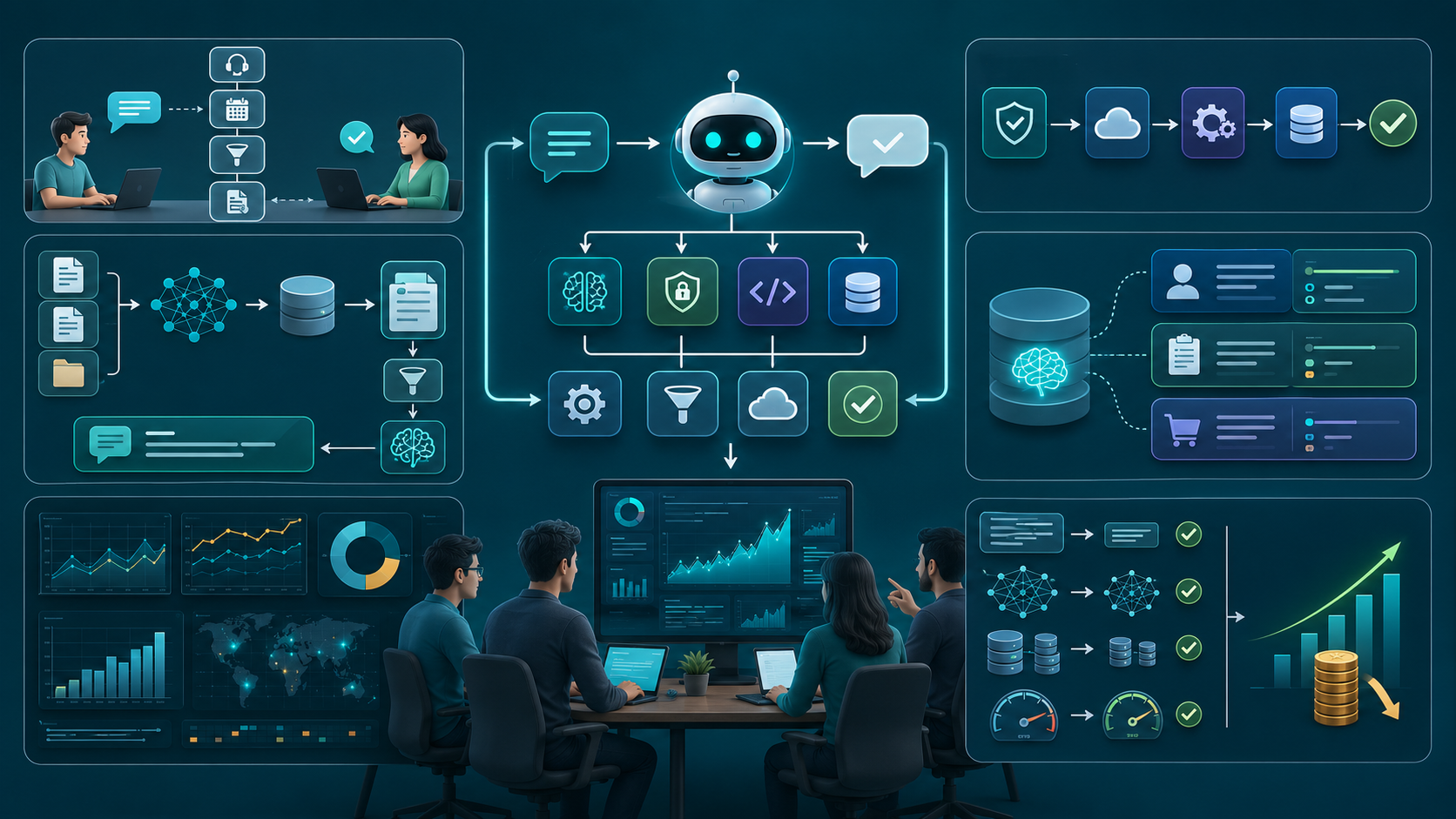
Practical Fixes That Actually Work
After working on multiple AI-driven products, I've found that successful AI agents share one characteristic: they are engineered like reliable software systems rather than intelligent chat interfaces. Working with a US AI software team for production agent systems helps businesses design reliable agent workflows, API integrations, context management, memory, retrieval, security controls, monitoring, and scalable infrastructure for real production use.
Here are the practices that have delivered the most reliable results.
Start with One Business Workflow
Avoid building a general-purpose assistant that attempts to solve every problem.
Instead, define one measurable workflow.
Examples include:
- Processing customer support tickets
- Scheduling appointments
- Qualifying sales inquiries
- Generating internal reports
- Answering documentation questions
A focused scope allows you to improve Performance, validate Decision quality, and optimize the Workflow before expanding responsibilities.
Separate Reasoning from Business Logic
One architectural mistake is embedding business rules inside prompts.
A better approach is:
- The AI interprets user intent.
- The backend validates permissions.
- APIs perform business actions.
- The system verifies outcomes.
- The AI explains the result.
This approach keeps your Backend, API, and Architecture easier to maintain as requirements evolve.
Build Reliable Knowledge Retrieval
Instead of asking the model to "remember everything," create a structured knowledge layer.
An effective pipeline usually looks like this:
- Collect verified business documentation.
- Generate Embedding vectors.
- Store them in a Vector database.
- Retrieve relevant documents.
- Supply only the necessary Context.
- Generate the final response.
This improves answer quality while reducing hallucinations and unnecessary token usage.
Design Memory Intentionally
Not every piece of information should remain in the agent's memory.
Separate information into categories such as:
- Session Memory
- Customer profile
- Previous actions
- Business preferences
- Historical transactions
This organization helps the model maintain consistency without overwhelming the available context window.
Monitor Every Production Deployment
Once an AI agent reaches production, monitoring becomes part of the product.
Track metrics such as:
- API failures
- Average response time
- Task completion rate
- Token consumption
- Infrastructure utilization
- Failed workflows
- Escalation frequency
Good Monitoring often identifies operational issues before customers notice them.
Optimize Before You Scale
Many startups attempt to improve scalability by adding more infrastructure.
Often, the better solution is optimization.
Review:
- Prompt length
- Retrieval quality
- Database queries
- API latency
- Workflow efficiency
- Response caching
Better Optimization usually lowers operating costs while improving the overall user experience.
When This Approach Fails
No architecture works forever.
As products mature, the same design decisions that accelerated early development can eventually become limitations.
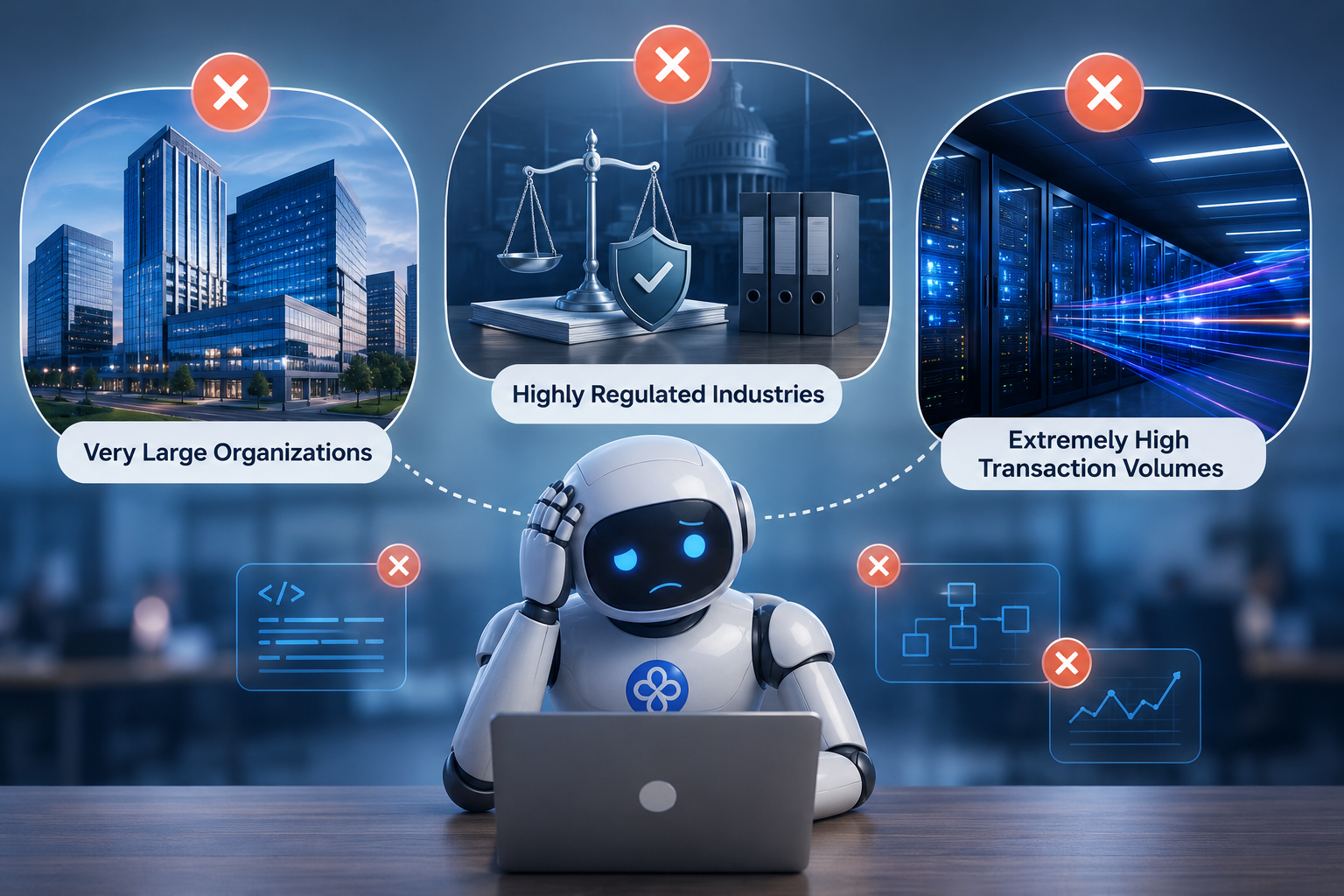
Very Large Organizations
Large enterprises often require:
- Multiple compliance frameworks
- Regional deployments
- Separate security boundaries
- Dedicated AI governance
- Independent engineering teams
A startup-oriented architecture may eventually require restructuring.
Highly Regulated Industries
Healthcare, finance, insurance, and legal applications frequently demand:
- Extensive Compliance
- Human approval workflows
- Detailed audit trails
- Data residency controls
- Additional security validation
AI agents can still provide value, but autonomous decision-making should remain carefully limited.
Extremely High Transaction Volumes
As traffic increases dramatically, new challenges appear:
- Infrastructure bottlenecks
- Queue management
- Distributed processing
- Failover planning
- Cost optimization
At this stage, improving Scalability becomes an engineering priority rather than simply increasing server capacity.
Sustainable Practices for Small Engineering Teams
One lesson I've learned is that long-term success rarely comes from building the smartest AI.
It comes from building software that teams can confidently maintain six months later.
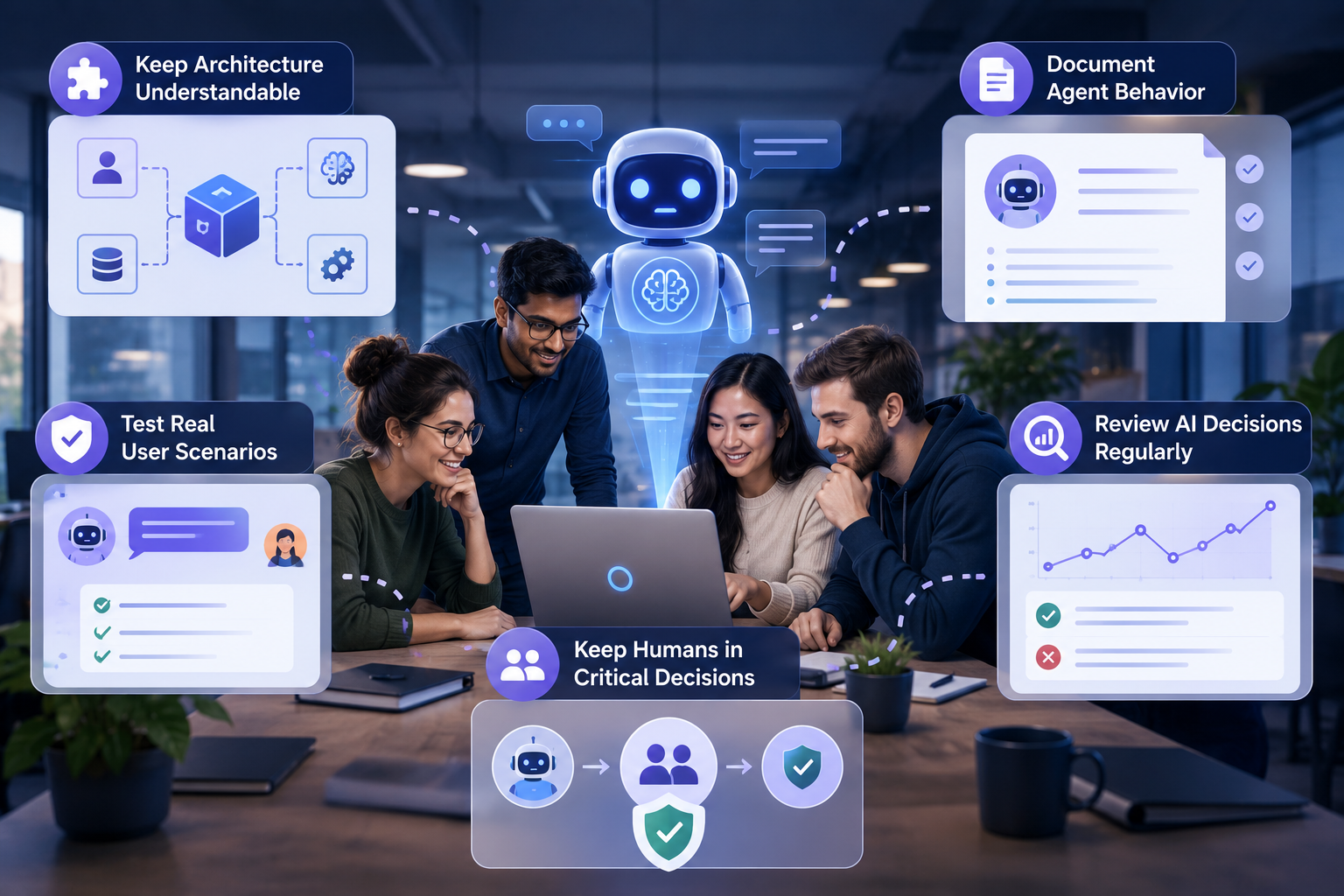
Keep Architecture Understandable
Choose designs your entire engineering team can understand.
If every change requires a senior engineer to explain the system, the architecture has probably become too complicated.
Document Agent Behavior
Maintain documentation for:
- Business rules
- Prompt strategy
- API integrations
- Failure scenarios
- Escalation paths
- Deployment procedures
Clear documentation reduces onboarding time and improves collaboration across remote teams.
Test Real User Scenarios
Synthetic examples rarely expose production problems.
Test using:
- incomplete customer requests
- unexpected user behavior
- conflicting instructions
- invalid inputs
- unavailable services
These situations reveal weaknesses much earlier than laboratory-style testing.
Review AI Decisions Regularly
Even reliable AI agents benefit from periodic review.
Analyze:
- Incorrect responses
- Escalated conversations
- Failed automations
- New business requirements
Continuous improvement is more sustainable than large redesigns every few months.
Keep Humans in Critical Decisions
AI should accelerate work, not remove accountability.
For actions involving contracts, payments, legal approvals, or customer risk, human oversight remains essential.
That balance creates trust while allowing automation to improve Productivity.
Conclusion
Building an AI agent isn't primarily an AI challenge—it's an engineering challenge.
The strongest AI agent platforms combine Artificial Intelligence, structured Knowledge, reliable Integration, scalable Infrastructure, thoughtful Architecture, and disciplined operational practices.
When evaluating an AI Agent Development Company in USA, don't focus solely on model expertise. Look for teams that understand how AI fits into real software systems, how to manage context and memory, how to design resilient workflows, and how to maintain performance as products grow.
The companies that succeed with AI agents aren't necessarily using the newest model. They're building systems that remain reliable, secure, and maintainable long after the initial launch.
AI Agent Development Company In USA: FAQs
An AI agent development company builds autonomous software that can understand user requests, retrieve information, integrate with business systems, automate workflows, and perform tasks with minimal human intervention.
A chatbot mainly responds to conversations, while an AI agent can reason, access external APIs, retrieve knowledge, make decisions, and execute multi-step workflows based on business rules.
Most failures occur because of weak system architecture, poor context management, unreliable integrations, inadequate monitoring, and insufficient operational planning rather than limitations of the AI model itself.
Usually not. A phased approach—starting with recommendations, adding human review, and gradually increasing autonomy—reduces risk and improves long-term reliability.
Look for engineering expertise in AI architecture, API integration, retrieval-augmented generation (RAG), cloud deployment, security, scalability, monitoring, and long-term maintenance rather than only experience with language models.
Reference
Written by

Paras Dabhi
VerifiedFull-Stack Developer (Python/Django, React, Node.js)
I build scalable web apps and SaaS products with Django REST, React/Next.js, and Node.js — clean architecture, performance, and production-ready delivery.
LinkedIn