AI Software Development Company In USA
Artificial intelligence has become part of almost every product conversation. Founders want intelligent features, product teams want automation, and engineering teams are expected to deliver AI-powered capabilities without slowing down existing development. On paper, it sounds straightforward. In practice, it rarely is.
One pattern I've noticed across startup projects is that many teams begin with impressive demonstrations but struggle once the product reaches real users. An AI feature that performs well in a controlled environment often behaves differently when it encounters inconsistent data, changing business requirements, or higher traffic. At that point, the challenge is no longer building an AI model—it's maintaining a reliable software product around it.
This is where choosing an experienced AI Software Development Company in USA becomes more important than simply hiring developers who know machine learning. Building production-ready AI software requires careful planning across architecture, infrastructure, deployment, security, governance, and long-term maintenance. These engineering decisions have a greater impact on project success than the choice of a particular framework or model.
Having worked with startup teams, SaaS products, and remote engineering teams across different markets, I've seen projects succeed not because they adopted the newest AI technology, but because they focused on practical software engineering from the beginning. The teams that treated AI as one component of a larger software system consistently delivered more reliable products than those chasing the latest trends.
Why Building AI Software Is More Than Training an AI Model
One misconception I frequently encounter is the assumption that AI development begins and ends with training a model. In reality, the model represents only a fraction of the overall engineering effort.
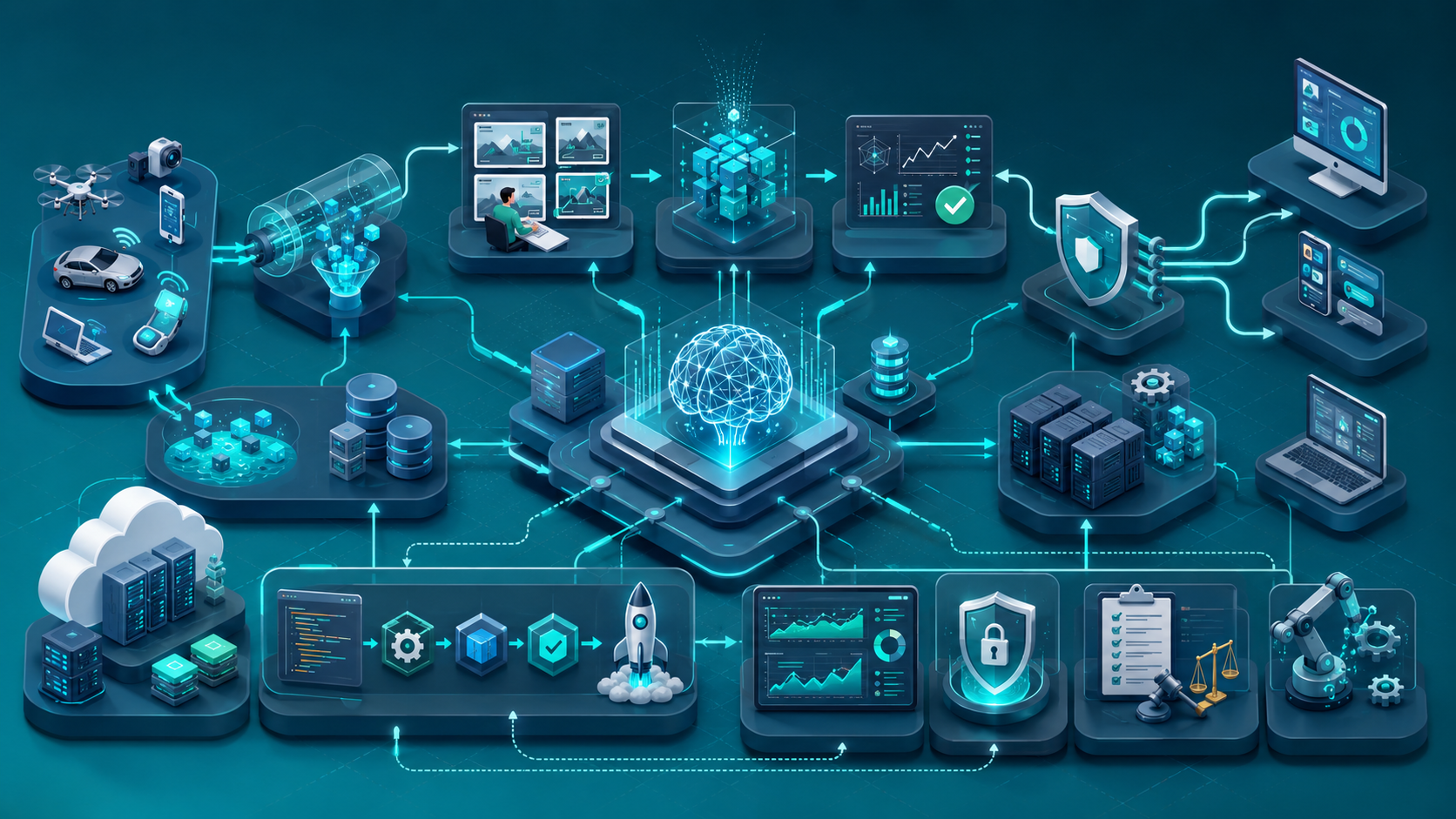
An AI application depends on multiple interconnected systems working together. Every stage, from collecting a dataset to monitoring production performance, influences the final user experience.
A production-ready AI system typically includes:
- Data collection pipelines
- Data annotation workflows
- Model training
- Continuous analytics
- Secure APIs
- Cloud infrastructure
- Backend services
- Deployment automation
- Monitoring systems
- Governance policies
If any of these components are overlooked, the application becomes increasingly difficult to maintain.
For example, an accurate prediction model loses value if outdated data continues feeding into the system. Likewise, an advanced neural network cannot compensate for unreliable backend services or poor deployment practices.
Successful engineering teams understand that AI software is an ecosystem rather than a standalone algorithm.
Why This Problem Happens in Real Engineering Teams
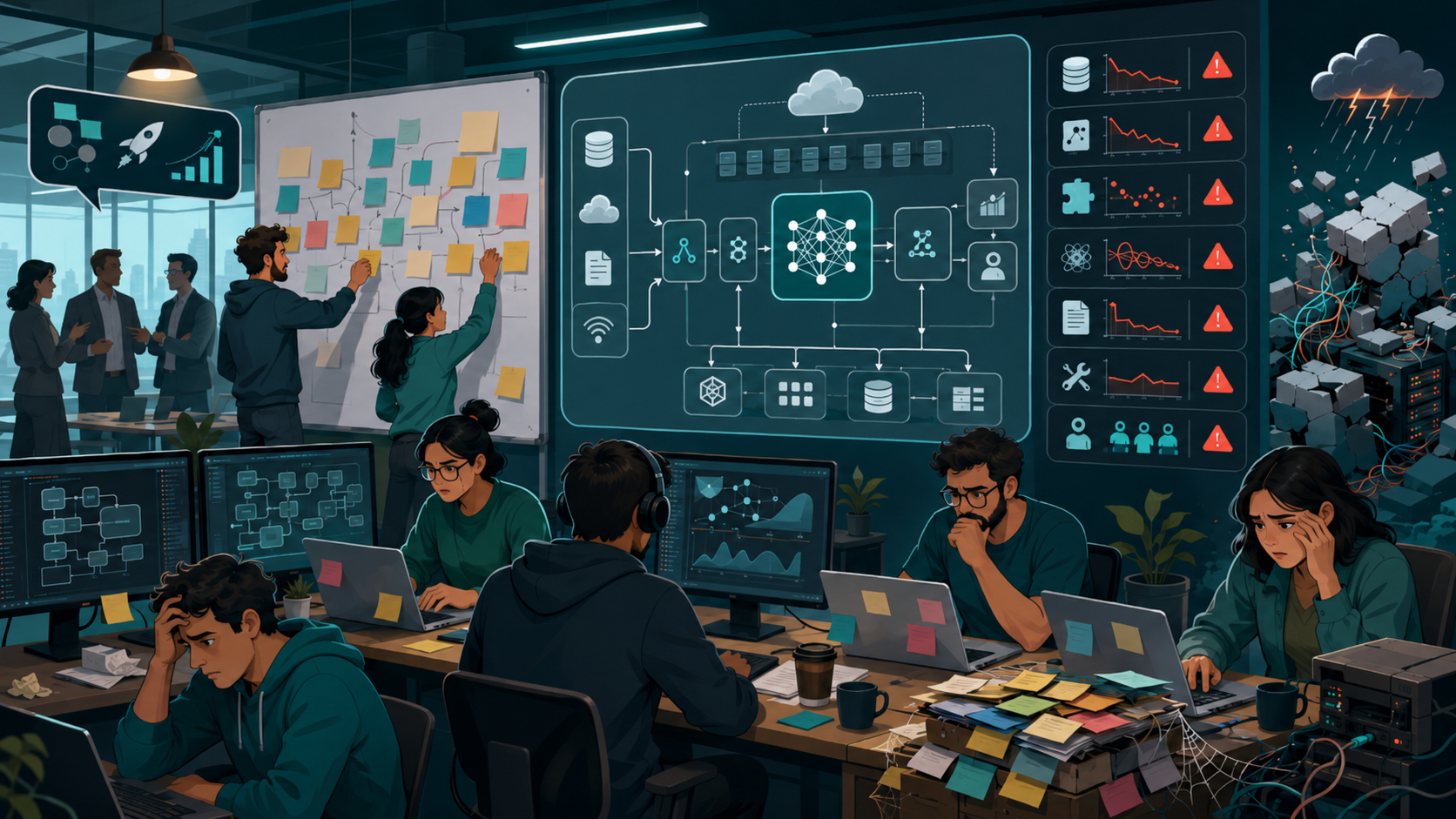
Most AI software challenges are not caused by poor developers. They're usually the result of business pressure and engineering compromises.
In startup environments, deadlines often take priority over long-term architecture.
Typical situations include:
- Investors requesting rapid demonstrations
- Product launches with aggressive timelines
- Small engineering teams handling multiple responsibilities
- Limited budgets for infrastructure
- Constant changes in product requirements
These pressures encourage shortcuts.
Instead of designing flexible workflows, teams focus on delivering visible features as quickly as possible.
Initially, this approach seems effective.
However, several months later, technical debt begins accumulating.
Common symptoms include:
- Increasing deployment failures
- Slower feature releases
- Growing maintenance costs
- Model accuracy degradation
- API inconsistencies
- Poor documentation
- Complex integration issues
At this stage, engineering velocity drops significantly.
Read More:
Custom Software Development Cost In USA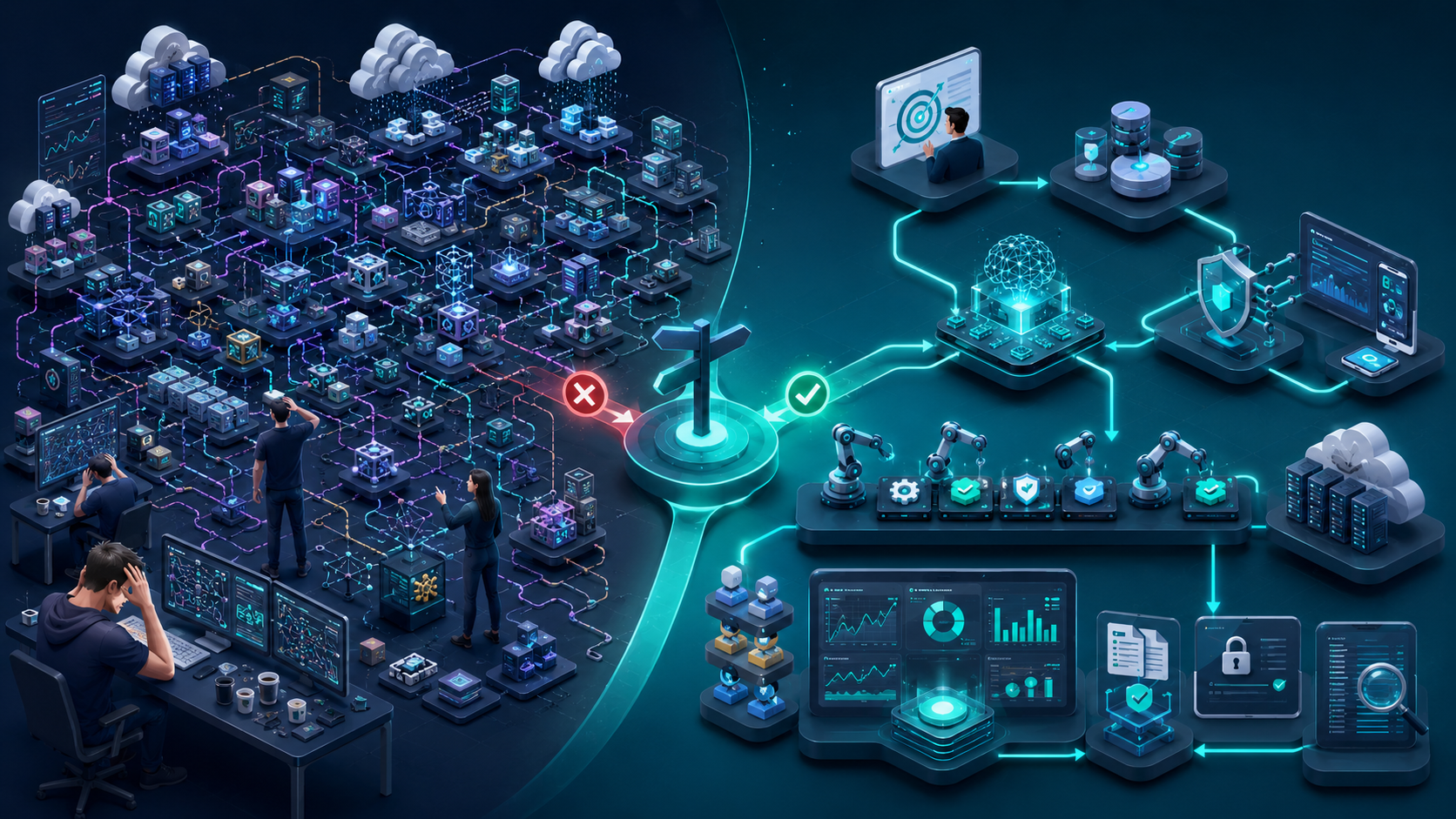
The Hidden Complexity Behind AI Software
Artificial intelligence introduces several layers of complexity that traditional applications may never encounter. Working with a US AI engineering team for production-ready software systems helps businesses plan model versioning, data pipelines, secure APIs, monitoring, governance, and scalable architecture before AI features reach real users.
Unlike conventional business logic, AI systems continuously evolve.
Data changes.
Customer behavior changes.
Business objectives change.
Regulations change.
Consequently, software architecture must support continuous improvement rather than one-time delivery.
This requires engineering teams to think carefully about:
- Model versioning
- Dataset management
- Privacy controls
- Compliance requirements
- Monitoring pipelines
- Performance optimization
- Scalability planning
- Workflow automation
Ignoring these areas creates operational risk.
I've worked on projects where changing a single machine learning model unexpectedly affected recommendation engines, reporting dashboards, and customer-facing APIs because dependencies were poorly documented.
The problem wasn't artificial intelligence itself.
It was software architecture.
Where Most Teams Make the Wrong Decision
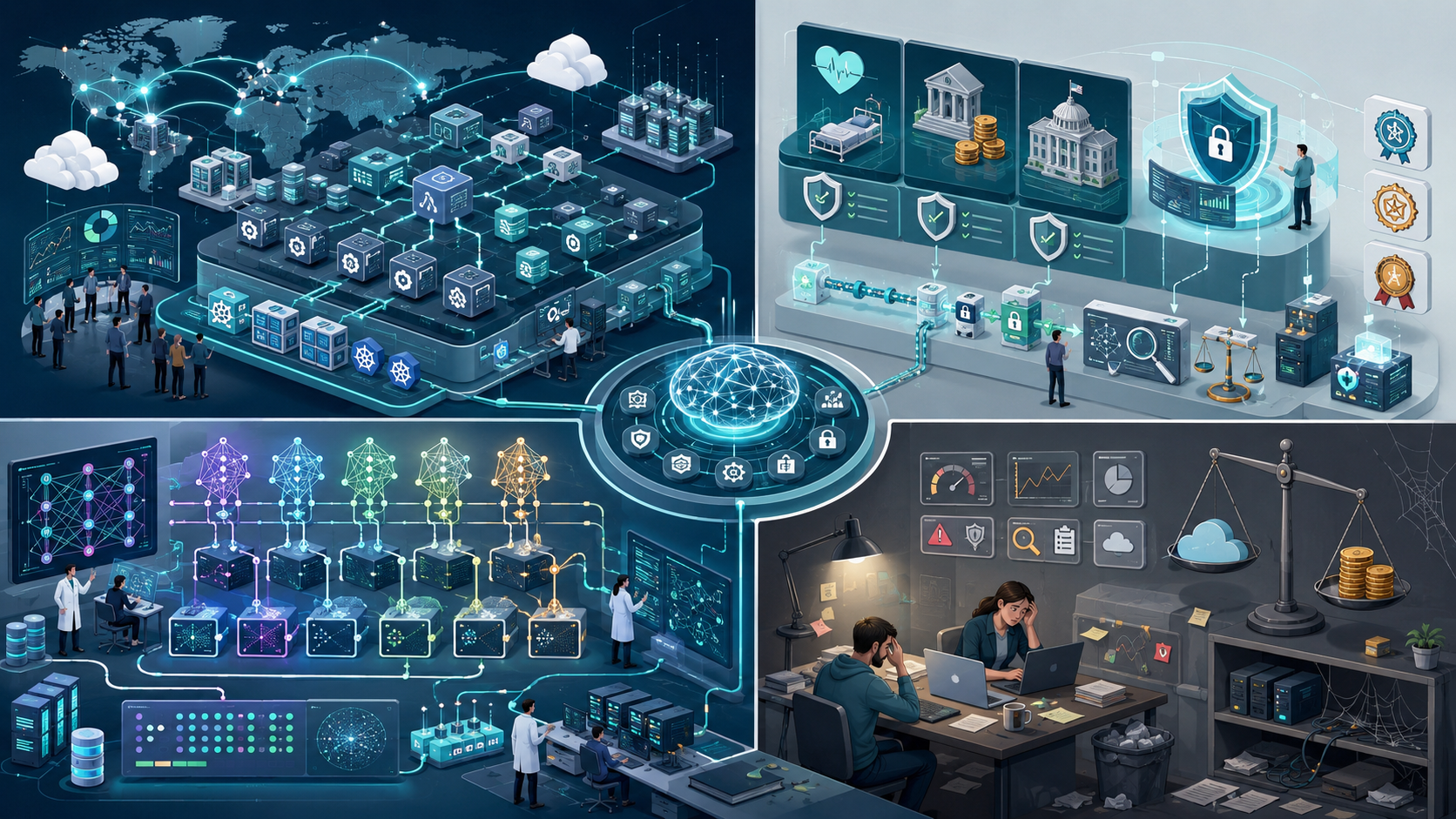
One of the biggest mistakes I see is copying the architecture of large technology companies.
It's easy to find articles describing microservices, event-driven systems, Kubernetes clusters, distributed databases, and complex orchestration platforms.
Many founders assume this is the standard for successful AI products.
In reality, those architectures evolved after years of scaling.
Small engineering teams rarely need that level of complexity.
I've seen startups introduce:
- Multiple microservices
- Separate inference servers
- Independent analytics pipelines
- Distributed message queues
- Several cloud providers
- Overly complex deployment workflows
before they had even reached their first thousand active users.
The result?
More infrastructure to maintain.
More security configurations.
More monitoring dashboards.
More operational overhead.
Instead of increasing productivity, complexity reduced engineering efficiency.
Tool Obsession Instead of Problem Solving
Many teams adopt new AI tools simply because they're popular, not because they solve a real business problem. This often increases complexity without improving outcomes. Focus on choosing technologies that support your product goals rather than following industry trends.
Every few months a new AI framework becomes popular.
Suddenly teams want to adopt:
- New transformer architectures
- Experimental embeddings
- Alternative tokenization methods
- Emerging orchestration frameworks
without evaluating whether the existing solution actually needs replacing.
Technology should serve the product—not the other way around.
A reliable recommendation engine delivering consistent predictions is usually more valuable than adopting the newest research model that increases infrastructure costs without improving customer outcomes.
Ignoring Software Engineering Fundamentals
Advanced AI models cannot compensate for poor software engineering practices. Clean architecture, reliable APIs, secure backend systems, testing, and documentation remain essential for building maintainable AI applications. Strong fundamentals create a stable foundation for long-term growth.
However, successful AI products are usually built on ordinary engineering disciplines.
I've seen AI initiatives delayed not because the algorithms failed but because teams overlooked basic software engineering practices such as:
- Consistent API design
- Reliable database management
- Secure authentication
- Proper backend architecture
- Automated testing
- Continuous integration
- Documentation
- Version control
These practices may not appear exciting, but they determine whether an AI application remains maintainable after deployment.
Assuming AI Eliminates Engineering Work
AI can automate certain tasks, but it doesn't reduce the need for experienced engineers. Teams still need to manage infrastructure, monitoring, security, deployment, and ongoing model maintenance. Successful AI projects require continuous engineering effort after launch.
In practice, AI introduces additional responsibilities.
Teams now manage:
- Model retraining
- Prediction validation
- Inference monitoring
- Data quality
- Governance
- Compliance audits
- Privacy controls
- Performance optimization
- Reliability testing
Instead of replacing software engineering, AI expands it.
The companies that succeed recognize this early and invest accordingly.

Practical Fixes That Actually Work
Over the years, I've found that successful AI projects rarely succeed because of a breakthrough model. They succeed because engineering teams make practical decisions early and continue refining them as the product evolves.
An experienced AI software development company in the USA focuses less on chasing trends and more on creating systems that remain stable after months or even years of continuous development.
Here are the practices that have consistently worked across startup and SaaS projects.
Start with the Business Problem, Not the Model
Before selecting an AI model, clearly define the business challenge you're trying to solve. Understanding the problem helps teams choose the right solution instead of overcomplicating development. Business goals should always guide technical decisions.
Many projects begin by asking, "Which AI model should we use?"
A better question is, "What business decision are we trying to improve?"
When the objective is clearly defined, choosing an algorithm, neural architecture, or transformer model becomes much easier. The engineering team can evaluate trade-offs based on measurable outcomes instead of industry hype.
For example, if the goal is document classification, the focus should be on prediction accuracy, processing time, and user experience rather than implementing the most complex architecture available.
Build a Reliable Data Pipeline First
High-quality AI depends on consistent and well-managed data. Establish reliable processes for collecting, validating, and updating datasets before focusing on model improvements. A strong data pipeline improves both accuracy and long-term maintainability.
Before investing time in model optimization, establish a dependable workflow for handling data.
A practical pipeline usually includes:
- Data collection standards
- Validation rules
- Dataset version control
- Annotation guidelines
- Automated quality checks
- Backup procedures
- Access permissions
When these processes are in place, retraining models becomes predictable instead of disruptive.
Keep the Architecture Simple
Simple architectures are easier to develop, understand, and maintain than overly complex systems. Modular designs with clear responsibilities help teams scale applications gradually without introducing unnecessary operational overhead. Complexity should grow only when required.
For many early-stage products, a well-designed modular application with clearly separated services is easier to maintain than dozens of microservices.
A maintainable architecture should provide:
- Clear API boundaries
- Independent business modules
- Reusable components
- Consistent database design
- Well-defined integration points
- Scalable infrastructure
As traffic increases, individual components can be optimized without rebuilding the entire system.
Automate Repetitive Engineering Tasks
Automation reduces manual work and improves consistency across development workflows. Tasks like testing, deployment, monitoring, and infrastructure provisioning can be automated to minimize errors. This allows engineering teams to focus on solving higher-value problems.
Automation improves consistency while reducing deployment mistakes.
Areas worth automating include:
- Model training pipelines
- Testing
- Deployment workflows
- Infrastructure provisioning
- Monitoring alerts
- Performance reporting
- Security scanning
- Compliance verification
Automation doesn't eliminate engineering effort—it allows developers to spend more time solving product problems instead of repeating operational tasks.
Design for Continuous Monitoring
Monitoring should begin as soon as an AI application enters production. Tracking performance, prediction quality, system health, and resource usage helps teams identify issues before they impact users. Continuous monitoring supports long-term system reliability.
Once AI features reach production, continuous monitoring becomes essential.
Engineering teams should observe:
- Model performance
- Prediction accuracy
- API response times
- Backend resource usage
- Infrastructure utilization
- Error rates
- Workflow failures
- Customer behavior changes
These metrics help identify issues long before users begin reporting them.
Prioritize Security and Governance Early
Security and governance should be part of the initial architecture rather than an afterthought. Implementing access controls, privacy measures, compliance policies, and audit logging early reduces future risks. Proactive planning creates more secure and trustworthy AI systems.
Rather than adding protections later, include them during initial design.
Good engineering practices include:
- Role-based access control
- API authentication
- Encryption
- Audit logging
- Privacy controls
- Governance policies
- Compliance documentation
Building these capabilities early reduces future development effort and simplifies regulatory reviews.
When This Approach Doesn't Work
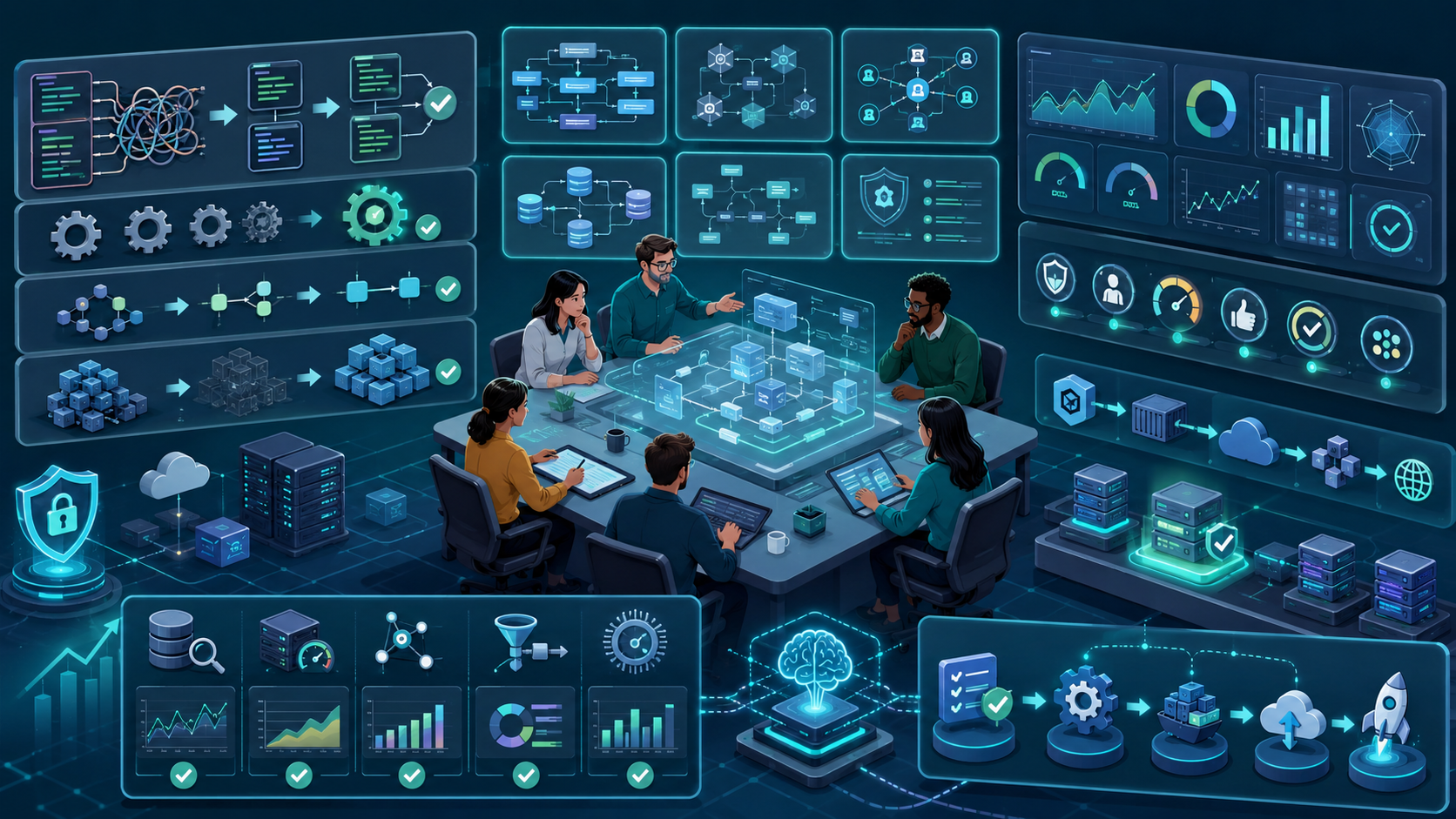
Although these recommendations work well for many organizations, they're not universal.
Every engineering decision has trade-offs.
Extremely Large AI Platforms
Large organizations with global operations often require distributed systems and specialized infrastructure to support thousands of users and complex workloads. As engineering teams grow, platform-specific solutions become necessary to maintain performance and operational efficiency.
At that scale, simpler architectures may no longer provide sufficient flexibility.
Dedicated platform engineering teams become necessary.
Highly Regulated Industries
Industries such as healthcare, finance, and government operate under strict regulatory requirements. AI systems in these sectors must meet standards for privacy, security, compliance, and explainability. These additional responsibilities naturally increase project complexity and development effort.
Engineering teams must account for:
- Data retention policies
- Model explainability
- Security certifications
- Privacy regulations
- Governance audits
These requirements naturally increase project complexity.
Research-Oriented AI Products
AI products focused on research require continuous experimentation with new models, algorithms, and techniques. This environment often demands flexible infrastructure that supports rapid testing without disrupting ongoing development. Innovation becomes a core part of the engineering process.
Research teams frequently test:
- Multiple algorithms
- New transformer architectures
- Alternative embeddings
- Experimental tokenization methods
In these situations, additional infrastructure may be justified because rapid experimentation is part of the business model.
Very Small Budgets
Limited budgets often force teams to balance feature development with long-term maintainability. Cutting essential investments in infrastructure, testing, or security may reduce short-term costs but usually creates larger technical challenges later. Careful planning helps maximize available resources.
Building production-quality AI software requires investment in:
- Engineering talent
- Cloud infrastructure
- Monitoring
- Security
- Testing
- Documentation
- Long-term maintenance
Trying to minimize every cost usually creates larger expenses later through technical debt and expensive system rewrites.
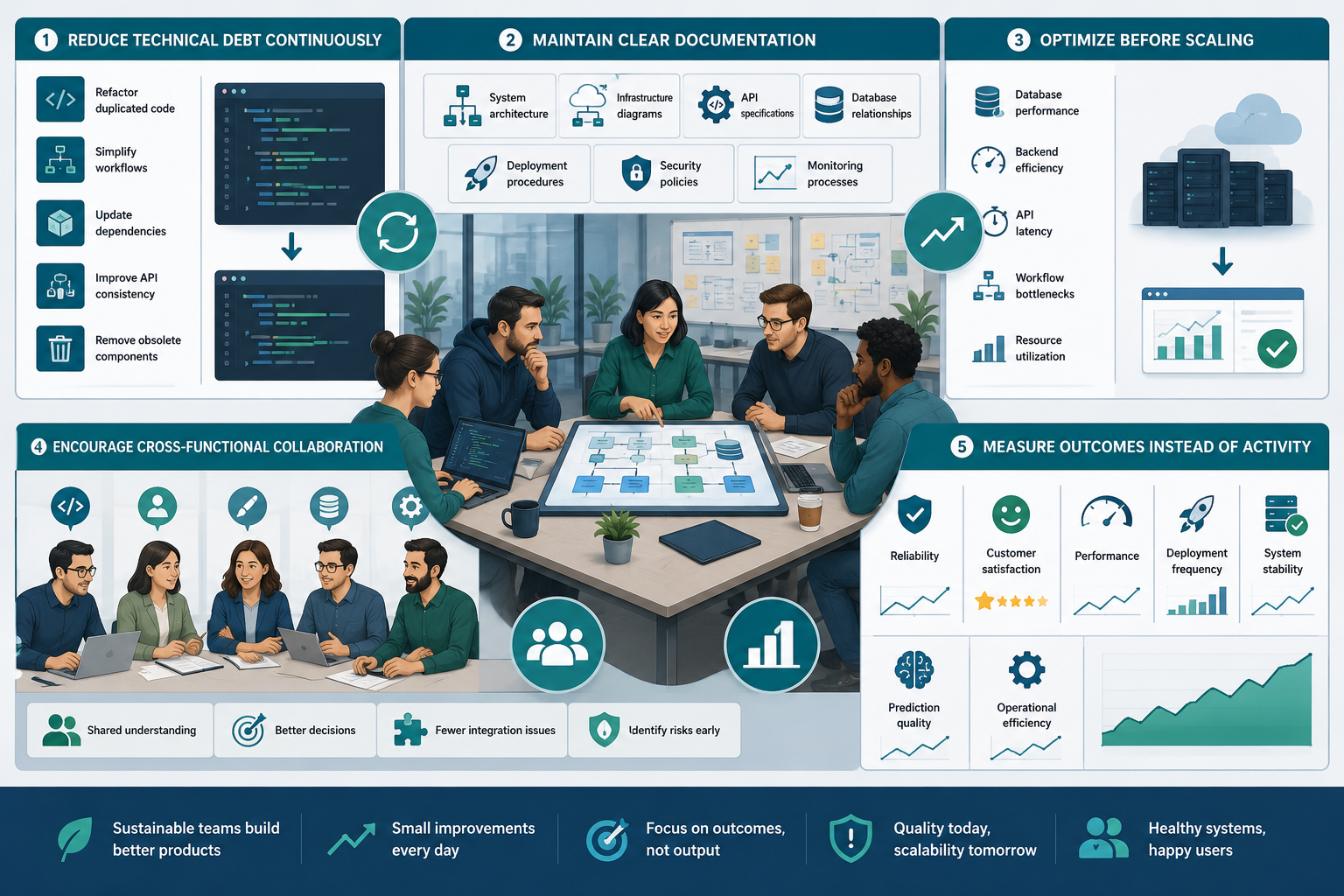
Sustainable Practices for Small Engineering Teams
Most startup engineering teams consist of fewer than fifteen developers.
In these environments, sustainability matters more than architectural perfection.
Reduce Technical Debt Continuously
Technical debt grows over time if small issues are ignored. Regular refactoring, dependency updates, and code improvements help maintain software quality without requiring large-scale rewrites. Consistent maintenance keeps development moving efficiently.
Instead of waiting for major refactoring projects, schedule regular improvements.
Examples include:
- Refactoring duplicated code
- Simplifying workflows
- Updating dependencies
- Improving API consistency
- Removing obsolete components
Small improvements are easier to manage than complete rebuilds.
Maintain Clear Documentation
Comprehensive documentation helps engineering teams understand systems, onboard new developers, and troubleshoot issues faster. Recording architecture decisions, deployment procedures, and API specifications improves collaboration and reduces long-term maintenance challenges.
Useful documentation includes:
- System architecture
- Infrastructure diagrams
- API specifications
- Database relationships
- Deployment procedures
- Security policies
- Monitoring processes
Good documentation reduces onboarding time and helps remote engineering teams collaborate more effectively.
Optimize Before Scaling
Scaling infrastructure too early often leads to unnecessary complexity and higher costs. Before expanding systems, evaluate current performance and identify existing bottlenecks. Optimizing available resources usually delivers better results than introducing new technologies prematurely.
Before adding new infrastructure, evaluate:
- Database performance
- Backend efficiency
- API latency
- Workflow bottlenecks
- Resource utilization
Often, optimizing existing systems provides greater value than introducing additional complexity.
Encourage Cross-Functional Collaboration
Successful AI projects depend on collaboration between developers, product managers, designers, data specialists, and operations teams. Involving multiple perspectives improves planning, reduces communication gaps, and leads to stronger technical decisions throughout development.
Successful AI projects require collaboration between multiple disciplines.
Developers, product managers, designers, data specialists, and operations engineers should review major architectural decisions together.
This reduces integration problems and helps identify risks before development begins.
Measure Outcomes Instead of Activity
The success of an AI project should be measured by business outcomes rather than the number of completed tasks. Metrics such as reliability, system performance, prediction quality, and customer satisfaction provide a more accurate picture of long-term product success.
Instead, they evaluate:
- Reliability
- Customer satisfaction
- Performance
- Deployment frequency
- System stability
- Prediction quality
- Operational efficiency
These indicators provide a more accurate picture of product health than development speed alone.
Conclusion
Building AI software that survives beyond an impressive demonstration requires much more than selecting the latest model or framework. Long-term success depends on thoughtful architecture, reliable infrastructure, disciplined engineering workflows, continuous monitoring, and a commitment to reducing technical debt over time.
An experienced AI software development company in the USA understands that artificial intelligence is only one part of a much larger software ecosystem. Every decision—from data preparation and API design to deployment, security, governance, and ongoing maintenance—affects the stability, scalability, and reliability of the final product.
The strongest AI products are rarely the ones with the most complex algorithms. They are the ones built with clear engineering principles, realistic planning, and continuous improvement. Teams that prioritize maintainability over unnecessary complexity are better positioned to adapt as user expectations, data, and business requirements evolve.
AI Software Development Company USA: FAQs
Look beyond AI expertise alone. Evaluate the company's experience with software architecture, cloud infrastructure, security, API integration, deployment workflows, monitoring, and long-term maintenance. A reliable partner should demonstrate how they manage complete software lifecycles rather than focusing only on model development.
Most challenges arise from poor data quality, weak architecture, limited monitoring, growing technical debt, and rushed engineering decisions. AI models need continuous maintenance, retraining, and operational support to remain effective in production.
Usually not. Small engineering teams benefit from simple, modular architectures that are easier to maintain. Infrastructure should evolve alongside product growth instead of being designed for hypothetical future scale.
Data quality is fundamental. Even advanced models cannot consistently produce accurate predictions if datasets are incomplete, outdated, or poorly annotated. Investing in reliable data collection and validation often delivers greater value than experimenting with increasingly complex models.
Focus on automation, clear documentation, regular refactoring, continuous monitoring, secure deployment workflows, and collaborative engineering practices. These habits help teams reduce technical debt, improve reliability, and maintain steady development velocity as products grow.
Reference
Written by

Paras Dabhi
VerifiedFull-Stack Developer (Python/Django, React, Node.js)
I build scalable web apps and SaaS products with Django REST, React/Next.js, and Node.js — clean architecture, performance, and production-ready delivery.
LinkedIn