AI In Software Development: Complete Business Guide
Many startup founders assume adding AI to a product is similar to adding any other feature.
The logic seems straightforward. Connect an AI model, build a user interface, send prompts, and ship the feature.
In reality, most engineering teams discover a different problem within a few months.
The first version works. Users like it. Early demos impress investors and stakeholders. Then the maintenance burden starts growing faster than expected.
Prompt changes break workflows. AI responses become inconsistent. Costs become difficult to predict. Product teams keep adding exceptions and workarounds. Suddenly, a feature that took three weeks to launch becomes one of the hardest parts of the platform to maintain.
I've seen this happen repeatedly in SaaS products, internal business tools, customer support platforms, and workflow automation systems. The issue is rarely the AI model itself. The problem is how teams integrate AI into existing software architecture.
This is where AI in software development becomes less about machine learning and more about engineering discipline. Choosing a software development company in USA for AI-powered business platforms helps businesses connect AI features with architecture, validation, monitoring, and long-term maintainability.

Why This Problem Happens in Real Teams
Most startups build AI features under pressure.
There is pressure from competitors releasing AI capabilities.
There is pressure from customers asking for automation.
There is pressure from leadership wanting AI included in product roadmaps.
As a result, engineering teams often optimize for speed rather than maintainability.
Common patterns include:
- Hardcoded prompts throughout the codebase
- AI business logic mixed directly into application logic
- No version control for prompts
- Lack of response validation
- No monitoring of AI outputs
- Multiple teams modifying prompts independently
The underlying issue is that many developers treat AI outputs as deterministic software behavior.
Traditional backend systems usually produce predictable outputs.
AI systems do not.
The same request can generate different responses depending on model updates, prompt changes, context windows, temperature settings, and provider modifications.
When teams ignore this reality, technical debt accumulates rapidly.
Another factor is resource limitations.
Small engineering teams rarely have dedicated AI specialists. Backend developers, frontend developers, and product engineers are often responsible for AI implementation while simultaneously maintaining the rest of the platform.
This creates shortcuts that feel reasonable initially but become expensive later.

Where Most Teams Make the Wrong Decision
The biggest mistake I see is copying architectures designed for companies operating at a completely different scale.
A startup with five developers does not have the same problems as a company with hundreds of engineers.
Yet many teams immediately introduce:
- Multiple AI services
- Complex orchestration layers
- Agent frameworks
- Vector databases
- Microservice-based AI pipelines
- Advanced retrieval systems
before validating whether any of those components are actually necessary.
I've seen startups spend months building sophisticated AI infrastructure for products that had fewer than 100 active users.
The result is predictable.
The architecture becomes harder to maintain than the feature itself.
Another common mistake is treating prompts as temporary implementation details.
In practice, prompts become business logic.
For example:
A customer support platform may depend on prompts for:
- Ticket classification
- Priority detection
- Escalation recommendations
- Sentiment analysis
- Response generation
Those prompts directly affect customer outcomes.
Yet many teams leave them scattered across backend files, frontend applications, configuration files, and deployment scripts.
Six months later nobody knows which prompt version is responsible for which behavior.
Remote development teams encounter this issue even more frequently because multiple engineers often modify AI behavior simultaneously without centralized governance.
The result is inconsistency, confusion, and difficult debugging sessions.

Practical Fixes That Actually Work
After working on multiple AI-powered products, I've found that simplicity usually wins.
1. Treat Prompts Like Source Code
Prompts directly influence how AI features behave, so they should be managed with the same discipline as application code. Storing prompts in dedicated files and tracking changes through version control helps teams maintain consistency, simplify debugging, and roll back problematic updates when needed.
Track prompt revisions alongside application releases.
Instead of:
This makes changes traceable and reversible.
prompt = "Analyze customer sentiment..."/prompts/
sentiment_v1.txt
sentiment_v2.txt2. Create an AI Service Layer
Prompts directly influence how AI features behave, so they should be managed with the same discipline as application code. Storing prompts in dedicated files and tracking changes through version control helps teams maintain consistency, simplify debugging, and roll back problematic updates when needed.
Create a dedicated abstraction layer.
For example:
- Easier provider switching
- Centralized logging
- Cost monitoring
- Consistent error handling
- Better testing
Benefits include:
This approach prevents AI integrations from spreading throughout the entire system.
Frontend
     ↓
Application Logic
     ↓
AI Service Layer
     ↓
AI Provider
3. Validate Every AI Response
Prompts directly influence how AI features behave, so they should be managed with the same discipline as application code. Storing prompts in dedicated files and tracking changes through version control helps teams maintain consistency, simplify debugging, and roll back problematic updates when needed.
Implement validation rules.
Examples:
- Required fields
- Output schemas
- Character limits
- Confidence thresholds
- Business rule validation
Many production issues occur because teams trust AI outputs without verification.
A simple validation layer can eliminate a large percentage of failures.
4. Log More Than You Think You Need
Prompts directly influence how AI features behave, so they should be managed with the same discipline as application code. Storing prompts in dedicated files and tracking changes through version control helps teams maintain consistency, simplify debugging, and roll back problematic updates when needed.
Track:
- Prompt versions
- Response times
- Model versions
- User inputs
- Generated outputs
- Failure rates
When users report incorrect behavior weeks later, these logs become invaluable.
Without them, troubleshooting becomes guesswork.
5. Measure Business Outcomes Instead of AI Metrics
Success should be measured by the business value AI creates rather than technical metrics alone. Focus on outcomes such as increased productivity, reduced manual work, improved customer experience, and operational efficiency to determine whether AI investments are delivering meaningful results.
Many teams focus on:
- Token usage
- Model accuracy
- Latency
Those metrics matter.
However, business metrics matter more.
Ask questions like:
- Did support tickets decrease?
- Did onboarding improve?
- Did manual work reduce?
- Did customer satisfaction improve?
AI features that look impressive technically often deliver little business value.
The opposite is also true.
Simple AI automations frequently outperform complex AI systems when measured against actual business outcomes.

When This Approach Fails
No architecture remains effective forever.
The simplified approach described above works well for:
- Early-stage startups
- SaaS products
- Teams with 2–15 developers
- Initial AI feature rollouts
Eventually, limitations appear.
Common breaking points include:
High-Volume AI Workloads
As AI usage grows, centralized services can struggle to handle large volumes of requests efficiently. Higher traffic often requires specialized infrastructure, performance optimization, and scalable architectures to maintain reliability, speed, and cost control.
Multiple AI Products
Managing several AI-powered products introduces challenges around consistency, governance, and maintenance. Organizations often need shared AI platforms, standardized processes, and centralized oversight to avoid duplication and operational complexity.
Heavy Compliance Requirements
Industries with strict regulations must implement additional controls around AI systems. Requirements such as audit trails, data governance, security measures, and compliance monitoring help ensure regulatory obligations are met while reducing operational risks.
Industries with strict regulatory requirements may need:
- Enhanced audit trails
- Model governance
- Data residency controls
- Advanced security controls
Large Engineering Organizations
As engineering teams expand, coordinating AI development becomes more difficult. Clear ownership, documented processes, and structured governance models help maintain consistency and prevent confusion across multiple teams working on AI initiatives.
More structured ownership models become necessary.
The important point is timing.
Most startups encounter these challenges much later than they expect.
Prematurely solving future scaling problems often creates more complexity than it removes.
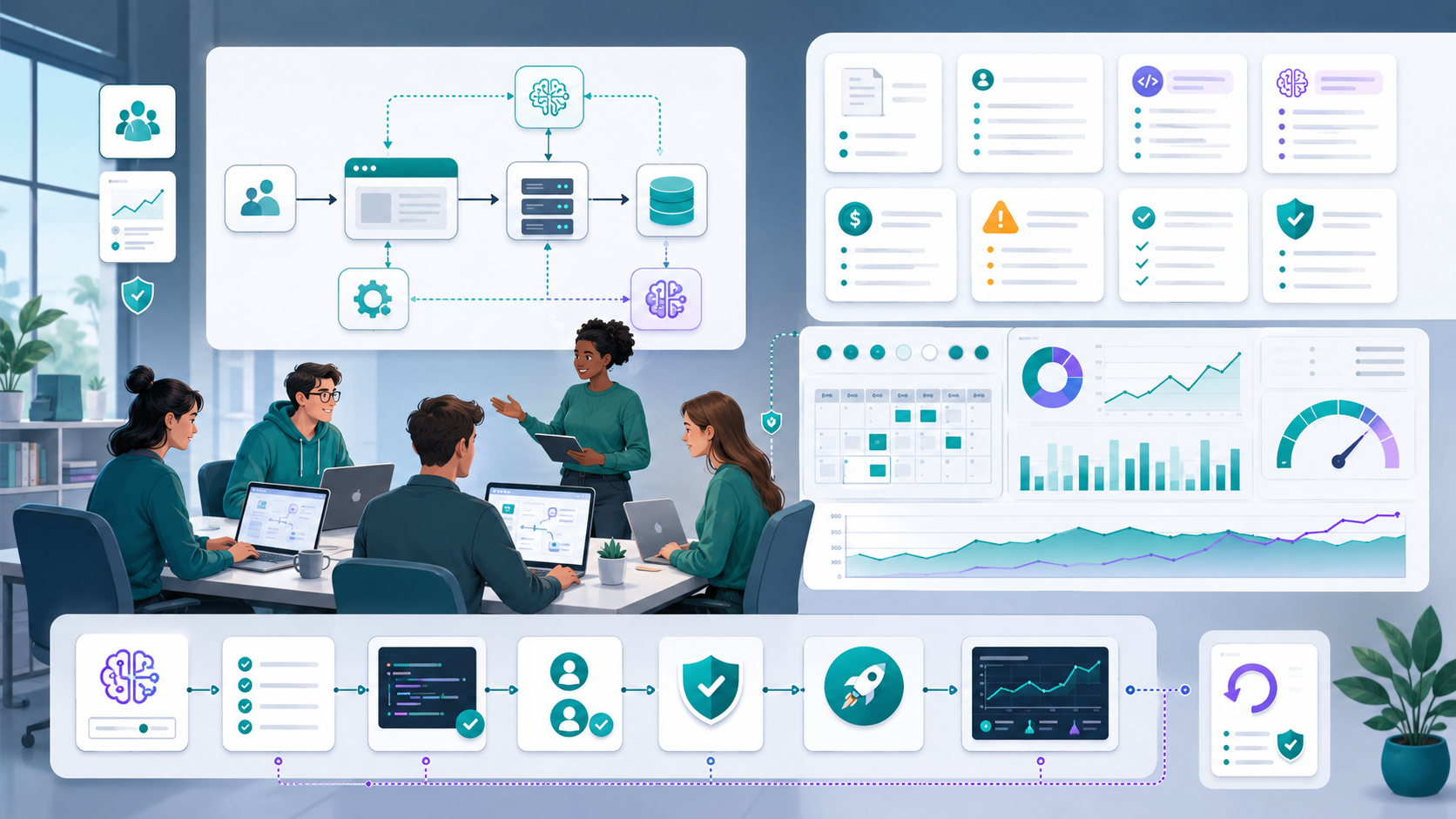
Sustainable Practices for Small Engineering Teams
The goal is not building the most advanced AI system.
The goal is building maintainable software that delivers consistent business value.
Several practices consistently help.
Keep Architecture Boring
Simple architectures are easier to maintain, troubleshoot, and scale as products evolve. Small engineering teams benefit from reducing unnecessary complexity and introducing new architectural patterns only when there is a clear business or technical need.
Limit AI Surface Area
AI should be used selectively where it adds genuine value and helps solve uncertain or complex problems. Relying on traditional software for predictable workflows reduces operational risks and improves overall system reliability.
Not every workflow needs AI.
Use AI where uncertainty exists.
Use traditional software where deterministic behavior is preferable.
This reduces operational risk significantly.
Document Decisions
Maintaining lightweight documentation helps teams understand why technical decisions were made. Recording prompt ownership, model choices, limitations, and validation strategies makes future maintenance and onboarding significantly easier.
Maintain lightweight documentation for:
- Prompt ownership
- Model selection
- Cost assumptions
- Known limitations
- Validation strategies
Future team members will thank you.
Review AI Costs Monthly
AI expenses can grow gradually as usage increases, making them easy to overlook. Regular cost reviews help teams identify trends early, optimize spending, and ensure AI investments remain aligned with business goals.
Monthly reviews prevent unpleasant surprises.
Track cost growth alongside user growth.
Build Deployment Discipline
Prompt updates should follow the same review and testing process as software releases. Structured deployment practices reduce the risk of unexpected behavior and make it easier to identify and reverse problematic changes.
Test them.
Review them.
Monitor them.
Rollback when necessary.
Many production incidents stem from prompt modifications rather than code changes.
Protect Engineering Velocity
Successful teams focus on building AI systems that remain manageable over time. When AI features require constant intervention and maintenance, they can slow overall product development and create unnecessary engineering overhead.
The objective is sustainable delivery, not endless experimentation.
When AI features become operational burdens, overall product development slows down.
That is usually a sign the architecture needs simplification.
Conclusion
The biggest misconception around AI in software development is that AI itself creates complexity.
In my experience, the real complexity comes from how teams integrate AI into their products.
Most technical debt appears because startups move too quickly, treat prompts as temporary assets, skip validation layers, and copy architectures designed for much larger organizations.
The teams that succeed long-term usually take the opposite approach.
They keep systems simple.
They isolate AI logic.
They monitor outcomes carefully.
And they resist the temptation to overengineer before genuine scaling requirements appear.
AI can create enormous business value, but only when it remains manageable for the engineering team responsible for maintaining it.
Frequently Asked Questions
Only if it solves a specific customer problem. AI should support product value, not serve as a marketing feature.
Most teams mix AI logic directly into application code, making updates, debugging, and monitoring increasingly difficult over time.
Usually not. Most small engineering teams benefit from a well-structured monolith until usage patterns justify additional complexity.
Version prompts, require code reviews for prompt changes, and maintain centralized logging for all AI interactions.
Prematurely building complex AI infrastructure before validating user demand and real business outcomes.
Reference
Written by

Paras Dabhi
VerifiedFull-Stack Developer (Python/Django, React, Node.js)
I build scalable web apps and SaaS products with Django REST, React/Next.js, and Node.js — clean architecture, performance, and production-ready delivery.
LinkedIn