AI software development services in India for startups
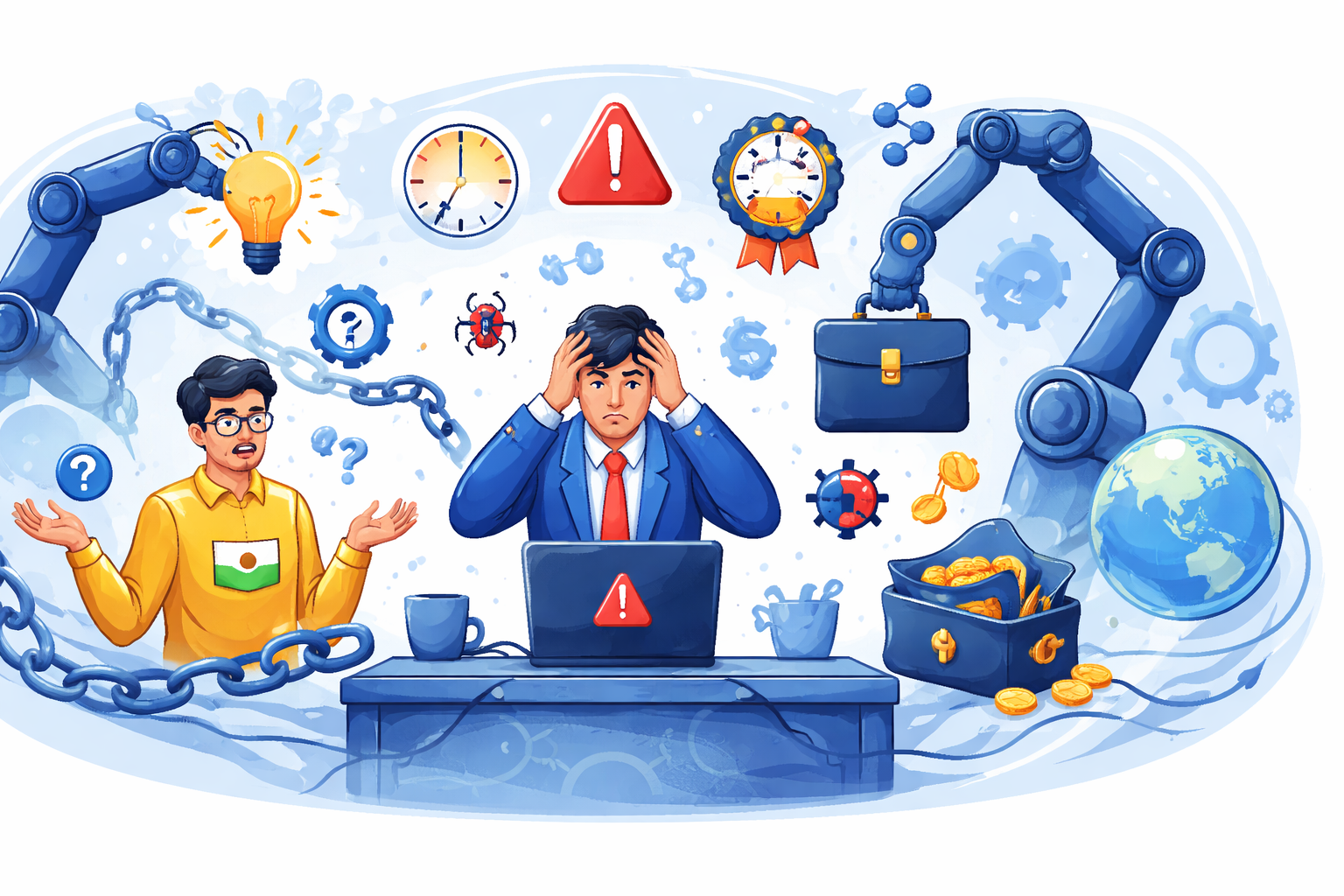
Most startup founders don’t struggle with the idea of using AI. They struggle with the first 90 days of execution.
The pressure usually starts when the MVP budget begins expanding faster than expected—API bills rise, delivery slips, and the outsourced team keeps suggesting future-proof architecture before the product is even validated.
I’ve seen this happen repeatedly with early-stage teams. The issue is rarely India as a delivery destination. It’s usually how the AI work gets scoped, validated, and controlled from day one.

Why Startups Struggle to Choose AI Development Teams in India
The real challenge is not finding AI developers in India. There are plenty of capable teams.
The hard part is knowing whether the team understands startup constraints, not just AI engineering.
In early-stage projects, founders often come with a rough vision:
- AI chatbot for support
- internal sales copilot
- document automation workflow
- AI-based recommendation engine
But the actual product questions are still unclear.
The most common reasons projects drift:
Unclear AI scope
Most early AI MVP delays start because the problem is defined too broadly. We need AI is not a technical scope—it could mean retrieval, automation, prediction, or workflow intelligence, and each requires a different architecture path.
Many founders say we need AI when the real need is:
- search over documents
- smart workflow routing
- prediction on structured data
- summarization layer
- decision support UI
These are different engineering problems.
A team that doesn’t force scope clarity early will burn time fast.
Full-stack teams with weak ML delivery experience
A strong SaaS engineering team can still struggle with production AI systems. The real complexity starts with prompt stability, retrieval accuracy, fallback handling, and monitoring output quality after launch.
I’ve seen good product teams fail because they were excellent at SaaS dashboards but weak in:
- prompt reliability
- retrieval pipelines
- vector search quality
- fallback logic
- observability for hallucinations
That gap becomes expensive during iteration.
Hidden infrastructure costs
The biggest budget surprise usually comes after the MVP starts getting usage. Token consumption, vector database scaling, background jobs, and repeated inference calls can quietly increase monthly burn if not planned early.
The biggest shock for startups is rarely development cost. It’s post-launch inference cost.
A cheap build can become a very expensive product if:
- prompts are too large
- token usage is uncontrolled
- async tasks are missing
- every user action hits a model unnecessarily
This is where AI MVP development in India either becomes cost effective—or painful.

Where Founders and Small Teams Usually Make the Wrong Call
The biggest mistake is optimizing for hourly rate instead of delivery judgment.
A lower-cost agency may look attractive, but I’ve seen startups lose 2–3 months because the team started with the wrong assumptions.
Choosing the cheapest team
The lowest-cost team often looks efficient during discovery but misses the operational details that matter later. Weak milestone planning, unclear ownership, and no AI QA process usually turn early speed into delivery chaos within a few sprints.
Low-cost teams often overcommit during discovery.
The result:
- under-scoped milestones
- vague ownership
- missing AI testing workflows
- no clarity on production monitoring
This looks fast in week one and becomes chaos by week six.
Building custom models too early
Early-stage startups rarely need custom model training before validating the product workflow. In most MVPs, API-first AI integration gives faster learning, lower infrastructure risk, and far better budget control before PMF.
Most AI SaaS MVPs do not need custom training initially.
Yet founders are often convinced they need:
- fine-tuning
- custom ML pipelines
- private model hosting
- GPU-heavy infra
Before PMF, this is usually a waste.
API-first LLM app development for startups is often the smarter path.
Ignoring inference economics
A demo can look impressive while still hiding serious long-term cost issues. If token usage, retries, and workflow-level inference costs are not modeled early, the product can become expensive to scale even with good user adoption.
Most AI MVPs fail at this stage because nobody models:
- cost per user workflow
- daily token ceiling
- retry failure cost
- latency under load
A demo that works for 20 users may collapse at 2,000.

Practical AI Development Approach That Works for Startup MVPs
The workflow that consistently works is simple: validate problem → reduce model risk → control usage cost.
Phase 1: Problem Validation
The fastest way to reduce AI MVP risk is to start with one measurable user workflow. Instead of building broad features, validate where AI directly saves time, improves accuracy, or removes manual effort. Early checks around data quality, prompt reliability, and latency help avoid expensive rework later.
Before writing production code, map one real user workflow.
For example:
- support teams need 5 minutes to summarize each ticket thread
Now AI has a measurable job.
Start with:
Phase 2: MVP Architecture
A safe MVP architecture should prioritize fast iteration without locking the startup into unnecessary complexity. API-first integrations, retrieval layers, fallback workflows, and strong observability create enough structure to scale while keeping the system easy to improve after real user feedback.
For most startup AI product development, the safest architecture is:
- API-first model integration
- retrieval layer for domain knowledge
- prompt templates with versioning
- human-review fallback
- structured output validation
- event logging
This avoids overengineering while keeping room for scale.
A practical stack often includes:
Phase 3: Cost Control
Once the MVP starts getting real usage, cost discipline becomes as important as model quality. Token limits, async workflows, caching, and model routing decisions help keep inference spend predictable while protecting the startup’s monthly burn rate.
This is where working with an AI software development company in India becomes valuable for startups that need stronger cost control, better architecture decisions, and faster iteration without increasing delivery risk.
Focus on:
- token caps per action
- cached retrieval results
- prompt compression
- async background jobs
- batching non-urgent tasks
- smaller models for low-risk actions
For one internal copilot MVP, moving non-critical enrichment jobs async reduced model cost by nearly half without changing UX.
That kind of architectural decision matters more than hourly pricing.
When Hiring AI Software Development Services in India Does NOT Work
This approach is not universal.
There are clear cases where outsourcing AI work becomes risky.
No founder clarity
An external AI team can only move as clearly as the founder’s product direction. If the core workflow, success metric, or business constraint is undefined, the team ends up making product decisions by assumption, which usually leads to wasted sprints.
If the founder cannot define:
- user problem
- success metric
- first workflow
- business constraint
the external team will end up guessing product direction.
That rarely ends well.
Poor or unstable data
Even a strong AI architecture cannot compensate for weak workflow data. When datasets are inconsistent, incomplete, or hard to access, delivery slows because the team spends more time cleaning assumptions than improving model outcomes.
AI systems are only as useful as the workflow data they operate on.
If data is:
- inconsistent
- unstructured beyond recovery
- incomplete
- access-restricted
delivery slows dramatically.
Highly regulated workloads
In legal, healthcare, or finance workflows, delivery speed alone is not enough. Compliance checks, traceability, approval layers, and deployment controls add architectural complexity that many fast-moving outsourcing models are not built to handle well.
For legal-tech, healthcare, or finance-heavy workflows, compliance and auditability may require:
- stricter architecture reviews
- deployment restrictions
- human approvals
- traceability layers
In those cases, speed-first outsourcing models may not fit.
Best Practices for Startups Hiring AI Developers in India
For 3–8 member teams, sustainability matters more than raw speed.
These practices consistently reduce long-term technical debt:
Keep MVP-first milestones
The most reliable milestones are tied to measurable business improvements, not technical complexity. When teams align delivery with workflow outcomes like time saved or automation gains, the MVP stays focused on product validation instead of engineering vanity.
Define milestones around business outcomes:
- reduce support time
- improve lead qualification
- automate document extraction
- shorten analyst workflows
Not technical vanity goals.
Plan inference budgets early
AI MVP costs become predictable only when founders understand usage economics from the beginning. Tracking cost per workflow, burn ceilings, and scale thresholds prevents the product from becoming financially difficult to grow after early traction.
Every founder should know:
- cost per user
- cost per workflow
- monthly burn ceiling
- scale breakpoints
This prevents surprise burn.
Document ownership
Ownership gaps create some of the most expensive AI maintenance issues after launch. Clear responsibility for prompts, pipelines, evaluation logic, and tuning workflows ensures the product can evolve without slowing every future release.
Clarify who owns:
- prompts
- evaluation logic
- data pipelines
- infra dashboards
- post-launch tuning
Missing ownership creates silent technical debt.
Monitor after launch
AI systems rarely fail in obvious ways—they drift gradually through quality drops, latency spikes, or rising inference costs. Continuous monitoring helps teams catch regressions early before they impact user trust or startup burn.
AI systems degrade in subtle ways.
Track:
- output quality drift
- retrieval miss rate
- prompt regressions
- rising latency
- cost spikes
The Indian AI development team for startups should not disappear after deployment.
Conclusion
The best AI software development services decision in India is rarely about finding the lowest quote.
It’s about choosing a team that understands MVP risk, inference economics, workflow validation, and startup burn pressure.
The teams that help startups win are the ones that validate fast, avoid unnecessary custom ML work, and keep infrastructure costs predictable until product-market fit becomes real.
That discipline matters far more than team size or hourly rate.
FAQ
Yes, if the team has real LLM workflow and production AI experience, India can offer strong delivery speed and cost efficiency for MVPs.
It depends on scope, but most startup AI MVPs stay efficient when built API-first before moving to custom ML pipelines.
Usually no. Early-stage teams should validate workflows with APIs first unless proprietary data creates a strong model advantage.
Check their experience with retrieval pipelines, observability, token cost control, and post-launch AI monitoring—not just frontend SaaS delivery.
Usually after PMF, when recurring usage cost, latency, privacy, or domain-specific performance justifies the extra engineering complexity.
Reference
Written by

Paras Dabhi
VerifiedFull-Stack Developer (Python/Django, React, Node.js)
I build scalable web apps and SaaS products with Django REST, React/Next.js, and Node.js — clean architecture, performance, and production-ready delivery.
LinkedIn