Azure Cloud Migration Services India for Enterprises | Trusted Experts
Most enterprise Azure migrations do not fail because Azure is difficult.
They fail because the existing environment is poorly understood before the first replication starts.
In Indian enterprises, the same pressure points show up repeatedly: aging VMware clusters, rising DR costs, SAP slowdowns, and leadership deadlines tied to data center renewal cycles. The migration itself is rarely the hard part.
The real risk is moving business-critical systems without dependency clarity, rollback logic, and cost controls built into the plan from day one.

Why enterprise Azure migrations become risky
The biggest hidden problem is application dependency blindness.
A server may look standalone in inventory, but in production it often depends on:
- file shares
- legacy AD paths
- scheduled SQL jobs
- internal APIs
- shared reporting databases
- hardcoded IP-based integrations
When teams migrate only the visible VM layer, latency and timeout issues appear after cutover.
ERP systems can look healthy in UAT and still fail in production because a batch processing server is still pointing to an on-prem file service over VPN.
Another major issue is lift-and-shift without right-sizing.
Blindly cloning on-prem VM sizes often creates unnecessary cost and poor performance.
Common risk multipliers include:
- incomplete rollback checkpoints
- no replication health validation
- underestimating database delta sync time
- WAN bandwidth assumptions
- rushed CIO deadlines before quarter close
- no security policy alignment for target VNets
These are execution mistakes, not platform issues.

Where most Indian enterprises get migration strategy wrong
The most common mistake is treating every workload as a VM migration problem.
Some systems belong on Azure VMs.
Many should move to:
- Azure App Service
- Azure SQL Database
- Azure Kubernetes Service
- Azure Files
Many Indian manufacturing and logistics companies move entire application estates as VMs, only to realize later they recreated the same operational burden in cloud.
Another major failure point is moving databases before application dependency testing.
The database cutover succeeds, but:
- app connection pools are misconfigured
- firewall rules are incomplete
- ETL jobs still hit old endpoints
- reporting tools cache legacy DNS entries
Other frequent mistakes include:
- no pilot migration wave
- overprovisioned target VMs
- no cost tagging standards
- missing Azure Monitor alerts
- ignoring Defender baselines
- no DR simulation before production switch
Read More → Top Software Development Companies In India
A phased Azure migration framework that works
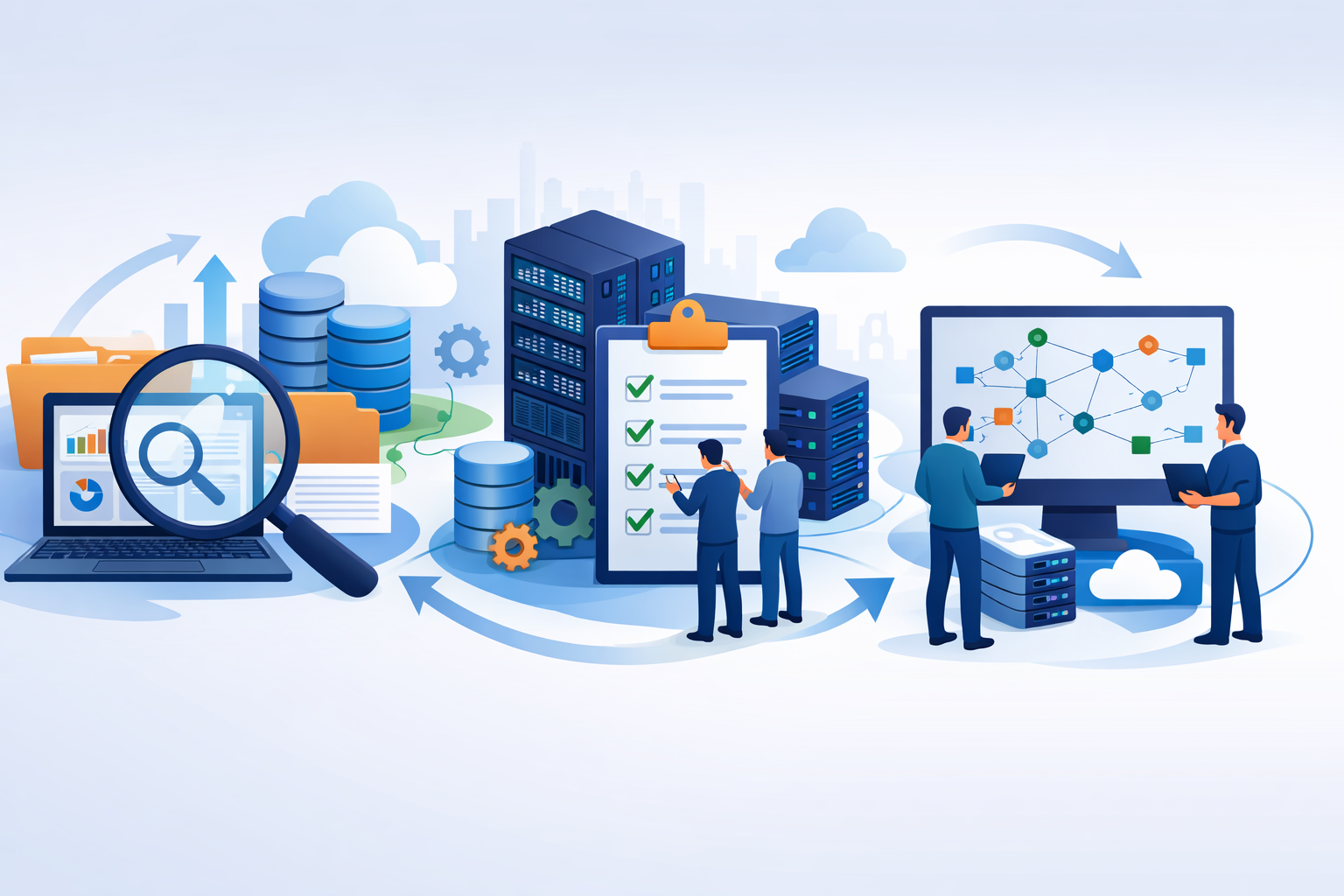
The safest Azure migration model for enterprises is a wave-based rollout, not a one-time infrastructure move. Breaking workloads into controlled phases reduces downtime risk, improves rollback confidence, and makes cost optimization easier after production cutover.
The only migration approach that consistently works is wave-based execution.
Phase 1 — Discovery
This phase builds the migration blueprint. Accurate inventory, dependency mapping, SQL profiling, and network validation help teams avoid the hidden failures that usually appear only after production traffic moves.
This phase decides success.
Focus on:
- server inventory
- dependency mapping
- SQL workload profiling
- authentication paths
- network flow validation
- bandwidth and replication estimates
- compliance classification
Azure Migrate’s dependency mapping and phased planning are built exactly for this.
Phase 2 — Pilot migration
A pilot wave helps validate whether the Azure landing zone, access policies, backups, and monitoring behave correctly under real workloads. Moving low-risk internal systems first exposes design gaps before critical business applications are affected.
Move low-risk workloads first:
- internal portals
- reporting apps
- QA environments
- non-critical APIs
This validates:
Phase 3 — Critical workload migration
Once the pilot is stable, critical systems like ERP, CRM, APIs, and databases can move with far lower risk. This is where an enterprise cloud solutions company in India becomes valuable, because controlled cutover timing, delta replication, and tested rollback snapshots are what keep downtime close to zero.
Only after pilot stability:
- ERP
- CRM
- customer APIs
- identity services
- primary databases
- file services
For databases, near-zero downtime is realistic only with delta sync, cutover windows, and rollback snapshots.
Phase 4 — Optimization
This is where Azure starts delivering measurable ROI beyond infrastructure hosting. Rightsizing, reserved capacity, monitoring baselines, and storage tier optimization usually unlock the biggest long-term savings after migration.
This is where cloud ROI actually appears.
Focus on:
- reserved instances
- autoscaling
- cost tagging
- log retention policies
- Defender hardening
- Azure Monitor baselines
- storage tier optimization
Most enterprises stop too early and miss the savings layer.

When Azure migration is NOT the right move
Not every enterprise workload should move immediately.
Azure is usually the wrong first step when systems depend on:
- hardcoded LAN broadcast discovery
- proprietary license dongles
- factory-floor ultra-low latency control systems
- unsupported Windows legacy stacks
- unstable monoliths with unknown dependencies
- broken database indexing and hygiene
In these cases, hybrid retention using Azure Arc or partial modernization is usually safer than a full cutover.
Many migrations get delayed because the team tries to cloud-fix an application that first needs architecture cleanup.

Best practices for enterprise Azure migration in India
For Indian enterprises, migration planning must go beyond pure infrastructure.
The best results come from including:
- DPDP and internal data governance review
- RBI-aligned controls for BFSI workloads
- India region DR planning (Central India / South India)
- hybrid identity validation
- phased database cutover approvals
- DR drills before final production switch
- reserved capacity ownership
- FinOps tagging rules
- SLA monitoring dashboards
Azure Migrate supports phased movement across regions and workloads, which is especially useful for Indian enterprises with multi-city branches and DR requirements.
The most overlooked best practice is business rollback ownership.
Technical rollback is easy compared to operational rollback across finance, HR, ERP, and vendor workflows.
That must be tested before the real switch.
Conclusion
Successful Azure cloud migration services India for enterprises are rarely about speed alone. The migrations that go smoothly are the ones built on clear discovery, dependency visibility, phased execution waves, and tested rollback ownership before production cutover.
In real enterprise environments, Azure itself is usually not the reason projects fail. The bigger risks come from poor workload sequencing, limited observability, rushed deadlines, and moving critical databases without validating application dependencies first.
The teams that get long-term value from Azure treat migration as a business continuity project, not just an infrastructure move. When cutover planning, cost governance, security baselines, and post-migration optimization are included from the beginning, downtime drops and cloud ROI becomes much easier to achieve.
Azure cloud migration services India for enterprises: FAQs
For mid-size enterprises, 6–16 weeks is realistic, depending on application dependencies, database size, and rollback testing depth.
Only for low-risk workloads. Critical ERP, CRM, and API systems usually need right-sizing or partial modernization for long-term savings.
Use pilot waves, continuous replication, delta sync, cutover checkpoints, and tested rollback snapshots before production traffic switch.
Moving databases before validating application dependencies causes the most expensive failures.
Where possible, yes. Managed services reduce long-term patching, backup, and observability overhead compared to recreating legacy VM estates.
Reference
Written by

Paras Dabhi
VerifiedFull-Stack Developer (Python/Django, React, Node.js)
I build scalable web apps and SaaS products with Django REST, React/Next.js, and Node.js — clean architecture, performance, and production-ready delivery.
LinkedIn