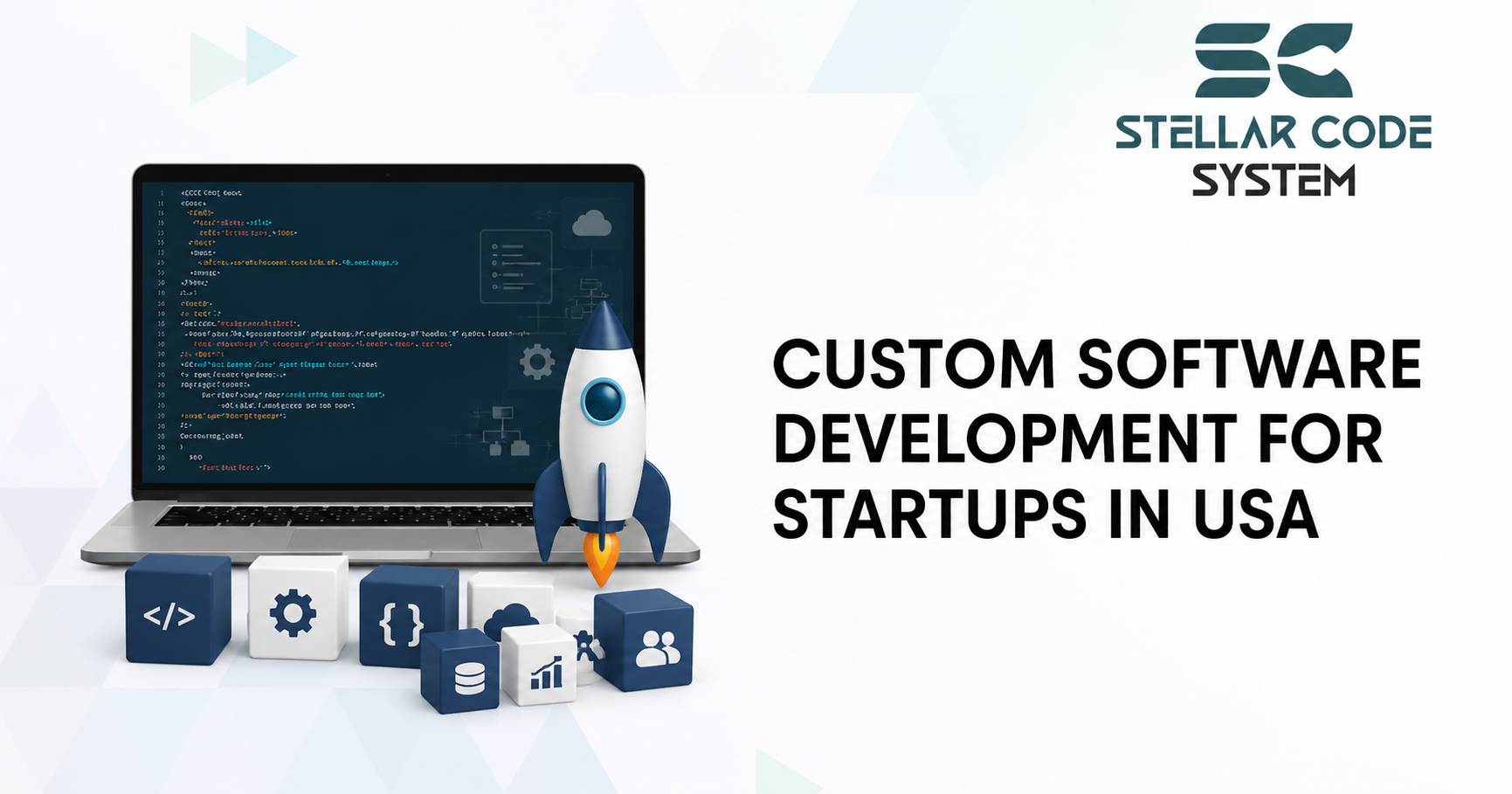
Custom Software Development For Startups In Usa
Every startup begins with optimism. The product roadmap looks manageable, the engineering team is small, and everyone believes the first version of the software can evolve naturally as the business grows. In reality, that rarely happens.
I've worked with startup teams building SaaS products across the USA and collaborating with distributed engineering teams in Europe, Australia, and Canada. The same pattern appears again and again. Teams invest months building a sophisticated platform before they've validated whether customers actually need half of the planned features.
The biggest challenge isn't writing code. It's making technical decisions that still make sense six, twelve, or twenty-four months later. Early choices around architecture, database design, API structure, and deployment often determine whether a product continues moving quickly or becomes difficult to maintain.
Many founders assume custom software development means building every possible feature from day one. In practice, successful startups treat software as a product that evolves continuously. They focus on solving today's business problem while leaving enough flexibility to adapt tomorrow.
The teams that succeed aren't necessarily using the newest technology, the most advanced framework, or the latest cloud service. They build reliable systems that prioritize simplicity, maintainability, and sustainable growth over unnecessary complexity.
Why This Problem Happens in Real Teams
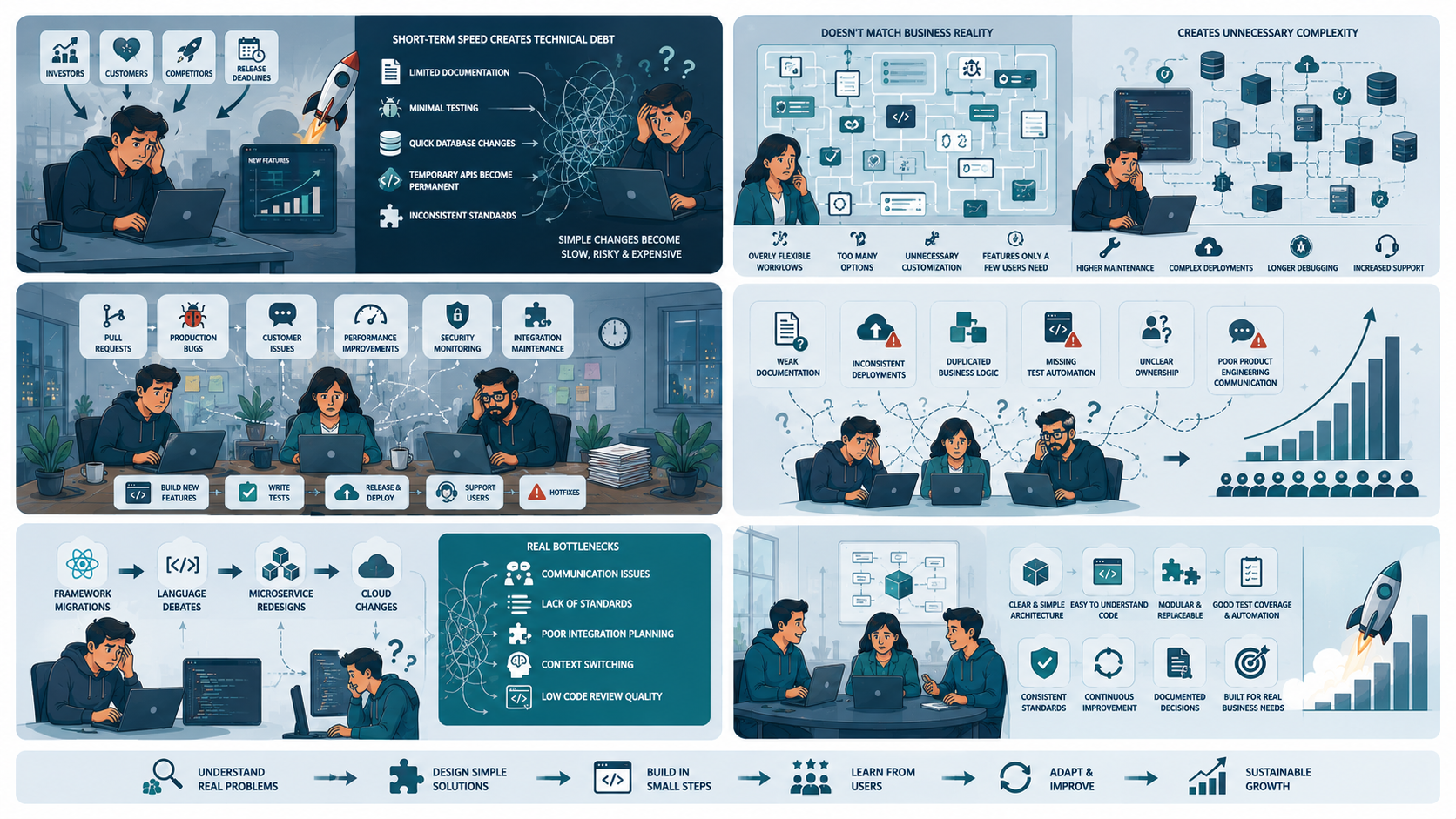
The pressure on early-stage startups is unlike that of established companies. Investors expect progress, customers expect new capabilities, and competitors continue releasing features. Under these conditions, engineering decisions often become reactive instead of deliberate.
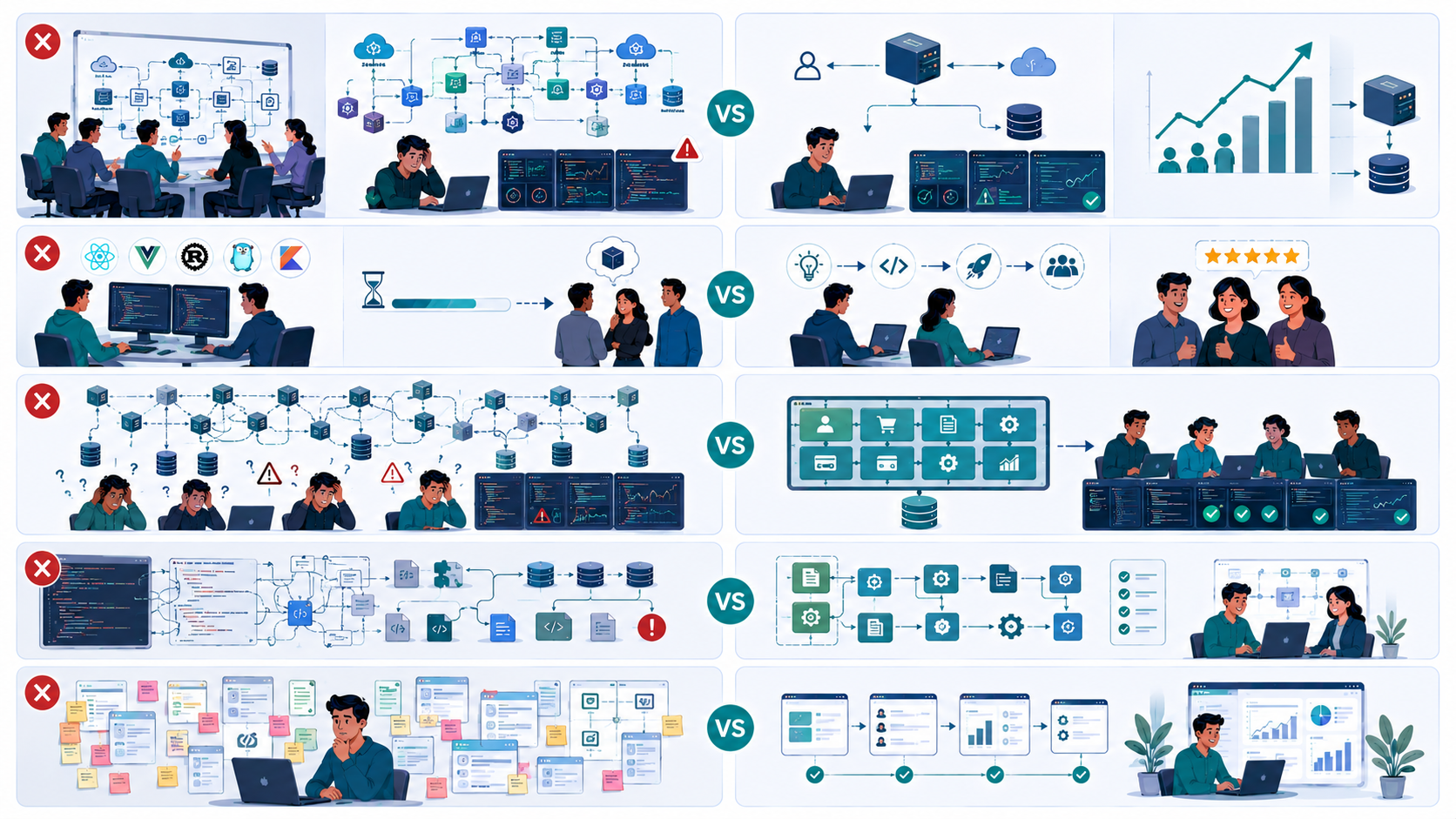
One common mistake is trying to build an enterprise-grade platform before the business has reached enterprise-level requirements.
A team of five developers rarely benefits from the same infrastructure used by organizations with hundreds of engineers. Yet many startups copy architectural patterns from large technology companies because they appear modern or scalable.
The result is additional complexity without solving an immediate business need.
Development Speed Often Wins Over Long-Term Thinking
During the first year, engineering teams are measured by how quickly they can deliver new functionality.
That naturally encourages shortcuts:
- Limited documentation
- Minimal testing
- Quick database changes
- Temporary API endpoints that become permanent
- Inconsistent coding standards
None of these decisions seem dangerous individually.
Combined over several months, they introduce technical debt that slows every future release.
I've seen startups spend three weeks building a new feature that should have taken three days—not because the feature was difficult, but because nobody fully understood the existing system anymore.
Custom Software Should Match Business Reality
Successful customization isn't about building more software.
It's about building software that reflects how the business actually operates.
For example, many startup founders request flexible workflows before they understand their own operational process.
Developers respond by creating configurable systems with dozens of options.
Months later, everyone realizes only two workflows are actually being used.
That additional engineering effort increases:
- Maintenance
- Deployment complexity
- Debugging time
- Product support effort
without creating meaningful customer value.
Small Teams Have Limited Engineering Capacity
A startup with six developers doesn't have six people building new features.
Someone is reviewing pull requests.
Someone is fixing production bugs.
Someone is answering customer issues.
Someone is improving performance.
Someone is monitoring security.
Someone is maintaining existing integrations.
Actual development capacity is usually much smaller than founders expect.
This is why every architectural decision matters.
The more complicated the system becomes, the less time remains for actual product innovation.
Growth Creates Different Problems Than Teams Expect
Many founders assume growth means adding more servers or moving to a larger cloud environment.
In reality, scaling usually exposes process issues before it exposes infrastructure limitations.
Typical examples include:
- Poor workflow between product and engineering
- Weak documentation
- Inconsistent deployment practices
- Duplicate business logic
- Missing automated testing
- Unclear ownership of services
These issues slow product delivery long before CPU or memory becomes a concern.
I've seen products handling hundreds of thousands of users on relatively simple backend systems because the underlying architecture remained clean and predictable.
I've also seen startups struggle with only a few thousand active users because years of rushed decisions created fragile dependencies across the application.
Technology Isn't Usually the Real Bottleneck
Startups frequently debate whether they should migrate to another programming language, adopt a different frontend framework, or redesign their backend using microservices.
Most of the time, those changes solve the wrong problem.
The actual bottlenecks usually involve:
- Poor communication between product and engineering
- Lack of shared technical standards
- Weak integration planning
- Overcomplicated application design
- Constant context switching
- Insufficient code reviews
Changing the technology stack rarely fixes these underlying issues.
Instead, it often introduces another migration project that consumes months of valuable engineering time.
The Pressure to Build for Every Future Scenario
Another recurring issue is designing software around assumptions instead of evidence.
Founders often ask developers to prepare for:
- International expansion
- Multi-tenant support
- Enterprise customers
- Complex permissions
- Multiple payment providers
- Extensive reporting and analytics
These capabilities may eventually become important.
But implementing them too early often delays the launch of a usable product.
Good software architecture allows change.
It doesn't require building every possible future requirement before the first customer signs up.
The startups I've seen succeed most consistently focused on one principle:
Build systems that are easy to understand, easy to improve, and easy to replace when business requirements inevitably change.
That mindset creates better quality, higher reliability, improved efficiency, and sustainable growth without sacrificing the flexibility every startup eventually needs.
Where Most Teams Make the Wrong Decision
After working with startup engineering teams for more than a decade, I've noticed that most technical problems don't begin with bad code. They begin with good intentions.
A founder reads how a unicorn built its infrastructure. An engineer watches a conference talk about distributed systems. Another developer wants to experiment with a new framework. None of these ideas are inherently wrong, but they often solve problems the startup doesn't actually have.
The result is a product that becomes harder to build, harder to maintain, and slower to evolve.
Mistaking Scalability for Complexity
One of the most common assumptions is that a startup must prepare for millions of users before acquiring its first thousand.
I've seen teams spend months designing highly scalable systems that never reached the traffic levels they were built for.
Instead of focusing on customer feedback, they invested time in:
- Multiple backend services
- Event-driven messaging
- Advanced caching layers
- Complex deployment pipelines
- Distributed databases
The irony is that a well-designed monolithic application often handles far more traffic than early-stage startups expect.
Real scalability comes from understanding bottlenecks, not from adding architectural layers.
Chasing New Technology Instead of Solving Business Problems
The software industry evolves quickly. Every year introduces another language, library, or platform that promises better performance or developer productivity.
That creates a temptation to rebuild existing systems.
I've seen startups pause feature development for months because they wanted to migrate everything to a newer stack.
Customers didn't notice the rewritten code.
They noticed the missing features.
Technology should support the business, not become the business.
Before introducing a new framework, ask one simple question:
Does this change solve a problem our customers actually experience?
If the answer is no, the migration probably isn't worth the engineering effort.
Building Too Many Services Too Early
Microservices have become almost synonymous with modern software engineering.
They offer clear benefits for large organizations with dozens of independent teams.
Small startups rarely operate under those conditions.
I've seen engineering teams with four developers maintaining twelve microservices.
Every release required coordinating multiple repositories, updating APIs, managing deployments, and troubleshooting communication failures.
Instead of increasing productivity, the architecture reduced it.
For most startups, a modular monolith provides:
- Easier maintenance
- Faster debugging
- Simpler deployments
- Better collaboration
- Lower operational overhead
Services should emerge from proven business boundaries—not from architectural trends.
Ignoring Long-Term Maintainability
Early development often prioritizes speed.
That's understandable.
The problem begins when temporary solutions become permanent.
Examples include:
- Duplicate business logic
- Hard-coded configuration values
- Shared utility functions with dozens of responsibilities
- Unclear API contracts
- Inconsistent naming conventions
None of these issues break the application immediately.
Over time, however, they reduce developer confidence.
Every new feature feels risky because no one fully understands the impact of changing existing code.
Maintainability isn't something you add later.
It's something you preserve through small, consistent decisions.
Treating Custom Software Like a Collection of Features
Many startups think of software as a growing list of functionality.
Every customer request becomes another feature.
Every investor suggestion becomes another dashboard.
Every sales opportunity introduces another workflow.
Eventually the application becomes difficult to navigate.
The interface grows more complicated.
Business rules become inconsistent.
Performance starts to decline.
Successful custom software development focuses on solving business problems instead of accumulating features.
Sometimes the best engineering decision is saying no.
Removing unnecessary functionality often improves usability, simplifies the interface, and reduces future maintenance.
Practical Fixes That Actually Work
The startups that maintain development velocity over several years rarely have perfect architecture. Working with a startup-focused software development partner in the USA helps founders build simple architecture, maintainable APIs, reliable testing, predictable deployments, and disciplined engineering workflows without adding unnecessary complexity too early.
They have disciplined engineering habits.
These practices consistently produce better outcomes without requiring larger teams or bigger budgets.
Start With the Simplest Architecture
Choose an architecture that your entire team understands.
That usually means:
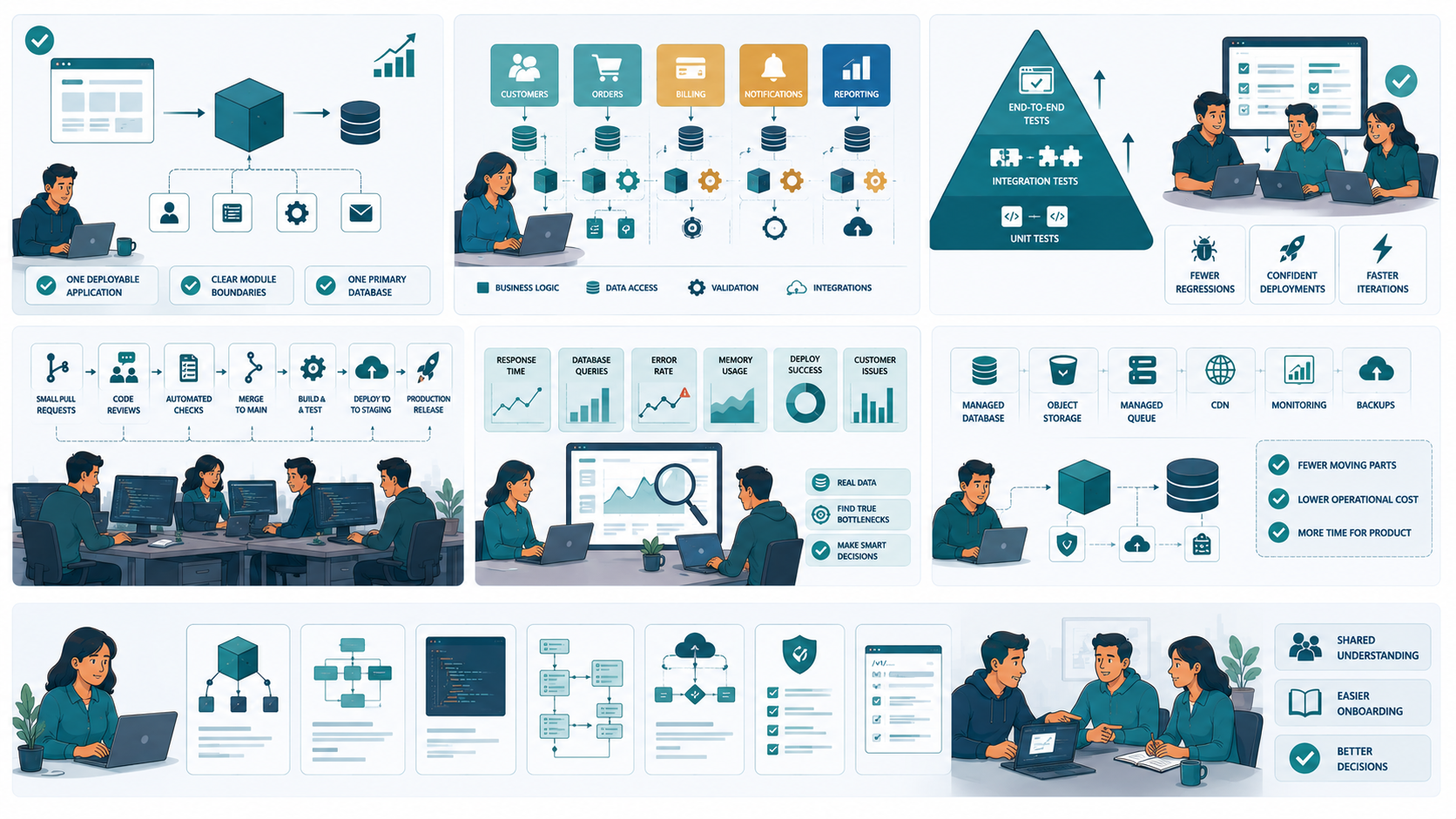
- A single deployable application
- Clear module boundaries
- Shared coding standards
- One primary database
- Well-defined API endpoints
Simple systems are easier to test, debug, and improve.
Complexity should be introduced only when measurable business requirements justify it.
Build Around Business Domains
Instead of organizing code by technical layers alone, organize it around business capabilities.
For example:
- Customer
- Orders
- Billing
- Notifications
- Reporting
Each module owns its logic, data access, validation, and integrations.
This approach improves collaboration because developers understand where functionality belongs.
As the product grows, these modules can evolve independently without requiring a complete architectural redesign.
Invest in Automated Testing Early
Testing often feels expensive during the first few months.
Skipping it becomes much more expensive later.
A practical testing strategy includes:
- Unit tests for business logic
- Integration tests for APIs
- End-to-end tests for critical user journeys
The goal isn't perfect test coverage.
The goal is confidence.
Reliable testing allows engineering teams to deploy frequently without introducing unexpected regressions.
Standardize Development Workflows
Many startup teams lose time because every developer follows a different process.
A lightweight engineering workflow makes a significant difference.
For example:
- Small pull requests
- Mandatory code reviews
- Consistent branch naming
- Automated quality checks
- Continuous deployment to staging
- Production releases on a predictable schedule
Consistency reduces confusion more effectively than introducing additional project management tools.
Measure Before You Optimize
Developers naturally enjoy optimization.
Customers usually care more about reliability.
Before improving performance, collect data.
Monitor:
- API response times
- Database queries
- Memory usage
- Application errors
- Deployment success rates
- Customer-reported issues
Real metrics reveal genuine bottlenecks.
Assumptions often don't.
Keep Infrastructure Boring
This advice surprises many founders.
Stable infrastructure is usually invisible.
Whenever possible, prefer managed services over maintaining unnecessary operational complexity.
Reduce the number of moving parts.
Avoid introducing another service simply because it's popular.
The fewer systems engineers must manage, the more time they can spend improving the product.
Document Engineering Decisions
Documentation doesn't need to become a lengthy technical manual.
Simple records explaining why important decisions were made are often enough.
Document topics such as:
- Architecture choices
- Integration patterns
- Deployment procedures
- Security requirements
- Database conventions
- API versioning
When new developers join the team, this documentation dramatically reduces onboarding time.
More importantly, it prevents the same technical debates from happening every few months.
When This Approach Fails
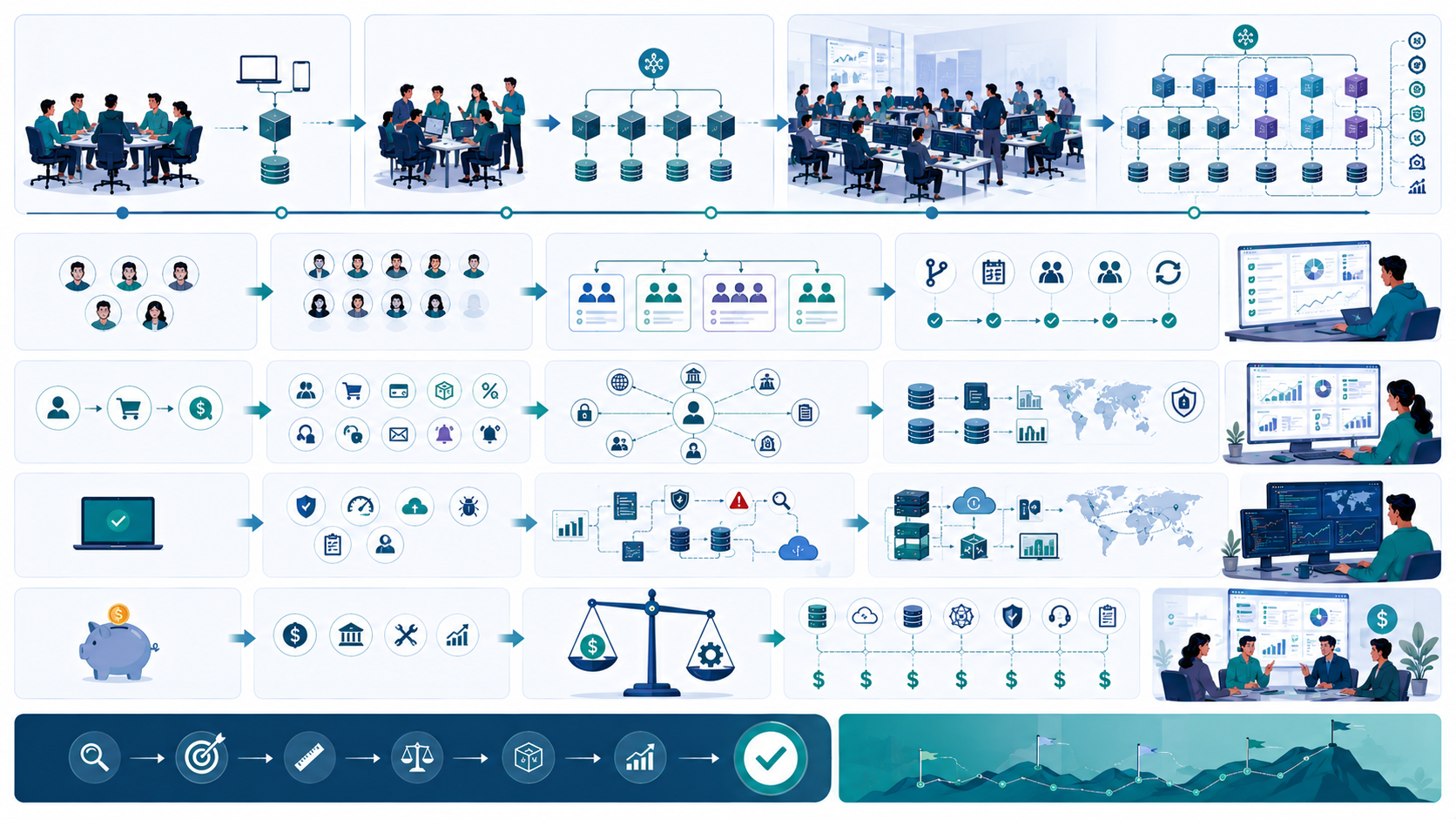
Simple architecture is a strong starting point, but it isn't a permanent strategy.
I've seen founders interpret "keep it simple" as "never change anything." That's just as risky as overengineering from the beginning.
There comes a point where a startup outgrows the decisions that helped it move quickly in its early stages.
The challenge is recognizing when that moment has actually arrived.
Your Engineering Team Has Grown Significantly
A modular application works well when a small engineering team shares the same understanding of the codebase.
As the team grows from five developers to twenty or more, coordination becomes more difficult.
Different teams begin working on separate parts of the product.
Independent release schedules become necessary.
Ownership of services becomes clearer.
At that stage, introducing additional architectural boundaries may improve productivity instead of slowing it down.
The important distinction is that the business has created the need—not industry trends.
Product Complexity Has Changed
A startup often launches with one primary workflow.
Over time, that product may expand into:
- Multiple customer types
- Advanced permission models
- Third-party integration requirements
- Separate billing systems
- Regional compliance requirements
- Large reporting and analytics workloads
The original architecture may no longer provide enough flexibility.
This is a good reason to evolve the system—not rewrite everything.
Incremental modernization is almost always safer than a complete rebuild.
Operational Requirements Become More Demanding
As products mature, expectations change.
Customers begin expecting:
- Higher availability
- Better security
- Faster response times
- Predictable deployments
- Improved monitoring
- Stronger disaster recovery
Meeting these expectations may require additional investment in infrastructure, deployment automation, and operational processes.
Those changes are worthwhile because they solve real operational problems.
Budget Still Matters
Even successful startups operate with constraints.
Every engineering decision carries an investment.
More services mean:
- More monitoring
- More maintenance
- More documentation
- More testing
- More deployment coordination
If a new architectural decision doesn't create measurable business value, it's probably an unnecessary expense.
Good engineering balances technical quality with financial reality.

Sustainable Practices for Small Engineering Teams
Long-term success rarely comes from one brilliant technical decision.
It comes from dozens of small habits repeated consistently.
These practices have helped the startup teams I've worked with maintain development velocity without accumulating unmanageable technical debt.
Prioritize Code Clarity Over Cleverness
Readable code scales better than clever code.
Every engineer should be able to understand:
- Business logic
- API behavior
- Database relationships
- Deployment process
If developers constantly need explanations before making changes, the codebase is becoming too complicated.
Simple solutions usually outperform clever ones over the lifetime of a product.
Treat Technical Debt Like Product Debt
Technical debt isn't inherently bad.
Sometimes it's the correct business decision.
The mistake is ignoring it indefinitely.
Schedule regular improvements alongside feature development.
Examples include:
- Refactoring duplicated logic
- Improving test coverage
- Updating dependencies
- Removing unused features
- Simplifying workflows
- Improving documentation
Small improvements made consistently prevent large and expensive rewrites later.
Improve Collaboration Before Adding More Tools
Many startups assume productivity problems require another platform.
In practice, most issues come from unclear communication.
Good collaboration usually depends on:
- Shared engineering standards
- Consistent pull request reviews
- Clear ownership
- Well-defined priorities
- Simple documentation
Adding more software rarely fixes process problems.
Better communication usually does.
Make Deployment Predictable
Releasing software should become routine.
A healthy deployment workflow includes:
- Automated testing before release
- Consistent deployment procedures
- Rollback capability
- Production monitoring
- Post-release verification
Developers should feel confident deploying on any working day—not only during late-night maintenance windows.
Predictability reduces stress across the entire engineering team.
Optimize for Sustainable Growth
Many founders focus on shipping as many features as possible.
Experienced teams optimize differently.
They ask:
- Can new developers understand this system quickly?
- Can we safely modify existing functionality?
- Will this decision still make sense next year?
- Are we improving quality while maintaining efficiency?
- Does this architecture support future growth?
Those questions produce healthier software than constantly chasing development speed alone.
Sustainable engineering is about maintaining momentum without sacrificing reliability or burning out the team.
Conclusion
Custom software development for startups isn't about building the most sophisticated platform.
It's about making engineering decisions that fit the current stage of the business while leaving enough room to adapt as the product evolves.
The biggest mistake I continue to see isn't choosing the wrong programming language, cloud provider, or framework.
It's introducing complexity long before the business requires it.
Successful startup teams focus on building software that is understandable, maintainable, and reliable. They improve architecture gradually, invest in clean engineering practices, and let real customer needs—not assumptions—drive technical decisions.
Simple systems aren't a limitation.
They're often the reason startups can continue delivering value while competitors become trapped maintaining unnecessarily complicated platforms.
Custom Software Development For Startups In Usa: FAQs
Yes, when your product solves a unique business problem that off-the-shelf software cannot address. The key is building only what supports your current business goals instead of trying to anticipate every future requirement.
Usually not. Most startups benefit more from a modular monolithic architecture because it's easier to maintain, deploy, test, and understand with a small engineering team. Microservices become valuable once organizational and product complexity justify the additional operational overhead.
Focus on continuous improvement rather than periodic rewrites. Regular refactoring, automated testing, code reviews, documentation, and consistent development standards help prevent technical debt from becoming difficult to manage.
Many successful MVPs are built and maintained by teams of 2–6 developers, depending on product complexity. Clear priorities, simple architecture, and disciplined workflows usually have a greater impact than increasing team size.
The most common mistake is optimizing for future scale instead of current business needs. Overengineering architecture, introducing unnecessary technologies, and adding features before validating customer demand often slow product development more than they help future growth.
Reference
Written by

Paras Dabhi
VerifiedFull-Stack Developer (Python/Django, React, Node.js)
I build scalable web apps and SaaS products with Django REST, React/Next.js, and Node.js — clean architecture, performance, and production-ready delivery.
LinkedIn