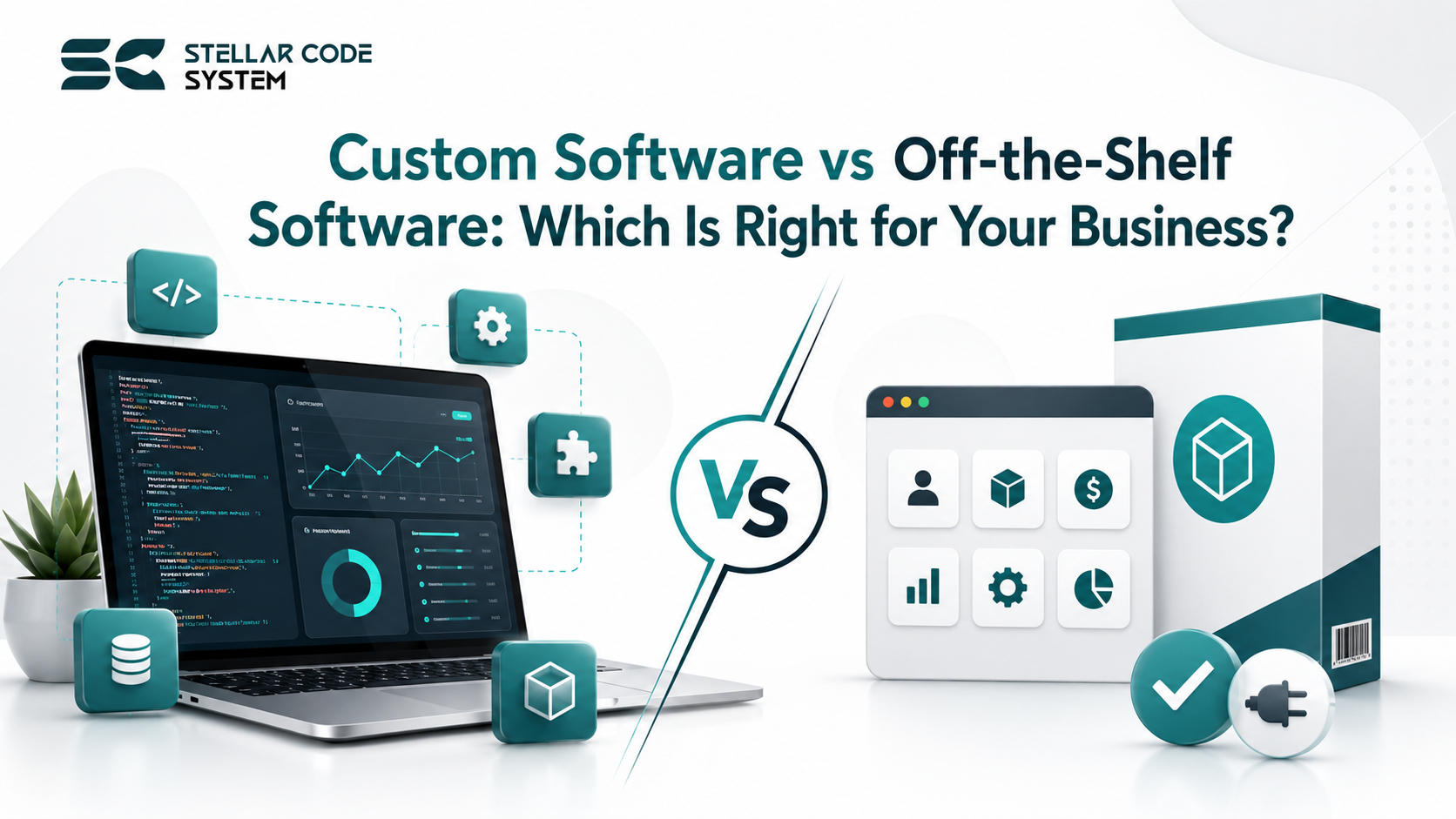
Custom Software vs Off-the-Shelf Software: Which Is Right for Your Business?
Choosing between custom software and off-the-shelf software seems straightforward at first.
Most businesses start by comparing features, pricing, and implementation timelines. On paper, a ready-made solution often appears to be the faster and safer choice. It promises quick deployment, lower upfront costs, and vendor-supported updates.
However, the decision becomes more complicated as business operations grow. What works well for a small team today may create limitations six months later when workflows become more complex, departments expand, and integration requirements increase.
I've worked with startup teams, SaaS products, and growing businesses that initially selected a commercial software platform to save time, only to discover later that their processes no longer fit the software. I've also seen companies invest heavily in custom application development before fully understanding their actual business requirements.
The real challenge isn't choosing the cheapest option or the most feature-rich platform. The challenge is understanding which software solution aligns with your long-term technology strategy and operational goals.

Why This Decision Becomes Difficult for Real Businesses
Most businesses do not struggle because they lack software options.
They struggle because software decisions are often made under pressure.
Common situations include:
- Rapid business growth
- Manual processes consuming too much time
- Expanding customer requirements
- Legacy systems becoming difficult to maintain
- Increasing demands for workflow optimization
At this stage, leadership teams usually want faster results.
A ready-made software product may seem attractive because it offers:
- Faster software implementation
- Lower initial investment
- Immediate functionality
- Vendor-supported software maintenance
Meanwhile, custom-built platforms require:
- Discovery and planning
- Software architecture design
- Development and testing
- Software deployment planning
- Ongoing ownership responsibilities
The difficulty arises because businesses often underestimate future scalability requirements.
A system that supports current workflows may not support future business process automation, system integration needs, or operational scalability goals.
As a result, organizations frequently make software selection decisions based on today's problems instead of tomorrow's challenges.

Where Most Teams Make the Wrong Decision
One of the most common mistakes I see is treating software evaluation as a feature comparison exercise.
Businesses compare feature lists and pricing tables while ignoring how the software fits into their broader technology investment strategy.
Assuming Off-the-Shelf Software Solves Every Problem
Many companies choose a packaged software solution because it appears cost-effective.
The advantages seem obvious:
- Lower development costs
- Faster setup
- Established technical support
- Regular software upgrades
These benefits are real.
However, standardized software is designed for the average customer.
The moment a business requires specialized workflows, industry-specific rules, or unique customer experiences, limitations begin to appear.
Common challenges include:
- Limited customization options
- Vendor dependency
- Restricted ownership and control
- Complicated third-party integrations
- Difficult legacy system integration
What initially looked like a turnkey solution gradually becomes a collection of workarounds.
Building Custom Software Too Early
The opposite mistake is equally common.
Some organizations decide that every business process requires a tailor-made software solution.
This often happens after hearing success stories from large technology companies.
The result is unnecessary complexity.
A personalized solution can deliver business-specific functionality and complete flexibility, but only if the organization has:
- Clear feature requirements
- Stable workflows
- Internal technical expertise
- Long-term maintenance plans
Without those foundations, businesses risk spending significant resources building features that may never provide meaningful return on investment (ROI).
Ignoring Total Cost of Ownership
Many software comparisons focus only on acquisition costs.
In reality, total cost of ownership (TCO) matters far more.
Costs typically include:
- Licensing fees
- Development expenses
- Software maintenance
- Security updates
- Infrastructure
- Training
- Technical support
- Future enhancements
The cheapest option today may become the most expensive option over the next several years.

Practical Framework for Choosing the Right Option
After working with numerous startup teams and product organizations, I've found that the decision becomes much easier when evaluated through four practical questions. For companies comparing long-term software options, working with a software development partner for US businesses can make the evaluation more practical around scalability, integrations, ownership, and operational goals.
How Unique Are Your Business Processes?
If your workflows closely resemble industry standards, a SaaS platform or commercial software solution may be sufficient.
Examples include:
- Accounting systems
- HR management
- CRM platforms
- Basic project management
These areas rarely justify custom development.
However, if your competitive advantage depends on unique workflows, custom software becomes more attractive.
Examples include:
- Proprietary operational processes
- Specialized customer experiences
- Complex internal automation
- Industry-specific compliance requirements
How Important Is Customization?
Ask whether your business adapts to the software or the software adapts to your business.
Off-the-shelf software generally offers:
- Configuration options
- Plugins
- Extensions
- Limited customization
Custom software offers:
- Complete software customization
- Flexible software architecture
- Full ownership
- Tailored user experience (UX)
The more unique your requirements become, the more valuable customization becomes.
What Are Your Integration Requirements?
Modern businesses rarely operate with a single application.
Most environments include:
- CRM systems
- Finance platforms
- Analytics tools
- Customer support software
- Marketing systems
As integration requirements increase, API connectivity and system integration become critical.
I've seen businesses spend more effort connecting multiple ready-made applications than they would have spent developing a focused custom-built platform.
What Does Growth Look Like?
Growth affects software decisions significantly.
Ask:
- Will transaction volume increase substantially?
- Will multiple departments use the platform?
- Will customer requirements evolve quickly?
- Will new services be introduced?
If the answer is yes, scalability requirements should play a major role in the decision.
Scalable software often provides better long-term value than solutions designed only for immediate needs.

When Custom Software or Off-the-Shelf Software Fails
Neither approach is perfect.
Understanding the disadvantages is essential.
When Custom Software Fails
Custom software becomes problematic when:
- Requirements constantly change
- Budgets are limited
- Internal technical leadership is missing
- Documentation is neglected
- Software maintenance is underfunded
In these situations, development can become expensive and difficult to sustain.
When Off-the-Shelf Software Fails
Ready-made software typically struggles when:
- Business workflows become highly specialized
- Integration complexity increases
- Vendor roadmaps conflict with business needs
- Data management requirements become unique
- Performance enhancement demands exceed platform capabilities
Eventually, businesses encounter restrictions that cannot be solved through configuration alone.

Sustainable Practices for Making Better Software Decisions
The healthiest software decisions focus on long-term business outcomes rather than short-term convenience.
Document Business Requirements Before Evaluating Software
Many organizations evaluate products before fully understanding their own requirements.
Instead:
- Document workflows
- Identify bottlenecks
- Define success metrics
- Prioritize critical features
This creates a more accurate software comparison process.
Start Simple but Plan Ahead
Avoid overengineering.
A small business does not need enterprise-level complexity on day one.
However, teams should understand:
- Future scalability requirements
- Potential integration needs
- Security expectations
- Growth projections
Good planning reduces expensive migrations later.
Measure Long-Term Value
Technology decisions should support:
- Productivity improvement
- Process efficiency
- Resource management
- Customer experience
- Business growth
Evaluating software solely on acquisition cost often leads to poor outcomes.
Maintain Strong Documentation
Documentation improves:
- Software deployment consistency
- Knowledge sharing
- Maintenance efficiency
- Future development efforts
As teams grow, documentation becomes one of the most valuable assets for preserving operational knowledge.
Focus on Operational Efficiency
The goal of any business software investment should be operational efficiency.
Whether using a cloud-based software platform or a bespoke software solution, the software should simplify work rather than create additional complexity.
Conclusion
The debate between custom software and off-the-shelf software is rarely about which option is objectively better.
It's about which option better aligns with your business requirements, growth plans, and operational realities.
The biggest mistake organizations make is evaluating software based only on short-term costs or feature lists.
Custom software offers flexibility, ownership, and business-specific functionality, but it requires investment, planning, and ongoing responsibility.
Off-the-shelf software provides speed, convenience, and predictable implementation, but it can introduce vendor dependency and customization limitations over time.
The most successful teams evaluate software through the lens of long-term value, scalability, integration requirements, and business objectives rather than immediate convenience.
FAQ
No. Custom software is beneficial when businesses require unique workflows, specialized functionality, or complete ownership. Standard business processes are often served well by commercial software solutions.
Faster implementation. Most ready-made software products can be deployed quickly with lower upfront costs and vendor-supported maintenance.
Return on investment (ROI) should consider productivity improvement, process efficiency, reduced manual work, operational scalability, and long-term business growth rather than acquisition costs alone.
Typically when existing software solutions cannot support critical workflows, integration requirements, customer experiences, or competitive differentiation.
Poor software selection decisions, underestimated maintenance requirements, expensive integrations, and failing to account for total cost of ownership (TCO) often create the highest long-term expenses.
Reference
Written by

Paras Dabhi
VerifiedFull-Stack Developer (Python/Django, React, Node.js)
I build scalable web apps and SaaS products with Django REST, React/Next.js, and Node.js — clean architecture, performance, and production-ready delivery.
LinkedIn