
Custom Website Development For US Small Businesses
Most small business websites do not fail because of bad design or lack of traffic.
They become difficult to maintain.
I’ve worked with startup teams, SaaS founders, and remote engineering teams across the USA, UK, Germany, Canada, and Australia, and the pattern is usually the same. The website launches quickly, everyone is happy for a few months, and then small updates slowly become operational problems.
A pricing change breaks frontend consistency.
A plugin update causes deployment issues.
Marketing requests new landing pages, but the existing CMS architecture cannot support reusable templates cleanly.
The original developer is no longer available, documentation is missing, and suddenly even basic frontend changes feel risky.
Most teams assume custom website development services for small businesses end after launch.
In reality, long-term maintainability becomes the real engineering challenge.
For small engineering teams, sustainable architecture decisions matter far more than technical sophistication.

Why This Problem Happens in Real Teams
Most custom website projects begin under startup pressure.
Founders want faster launches. Product teams want flexibility. Marketing teams want editable content structures. Developers are expected to deliver quickly with limited engineering resources.
Under those conditions, teams naturally optimize for delivery speed instead of software maintainability.
That creates predictable architecture problems:
- Business logic tightly coupled with frontend templates
- Weak content modeling inside the CMS
- Poor component reuse
- No frontend system design standards
- Plugin-heavy website architecture
- Inconsistent CSS architecture
- Missing deployment workflows
- No staging environment
- Weak version control workflow
- No onboarding documentation
Initially, none of this seems dangerous.
The deployment pipeline works.
Pages load.
Forms connect correctly.
SEO traffic starts growing.
The real issues appear once the business evolves.
Small businesses rarely keep the same operational workflows for more than a year. When they work with a US software development company for custom website projects, the website should be planned for changing services, evolving content structures, CRM integrations, SEO page expansion, automation, and backend integration requirements.
If the website architecture was designed only for launch speed, the system starts resisting every change.
This is where technical debt compounds quietly.
I’ve seen remote engineering teams spend more time working around frontend maintainability problems than building actual product improvements.
In distributed teams, architecture consistency matters even more because multiple developers eventually touch the same codebase.
Without shared engineering standards, frontend scalability becomes difficult very quickly.

Where Most Teams Make the Wrong Decision
The biggest mistake small teams make is copying large-scale SaaS engineering patterns too early.
A small business website with 30 to 50 pages does not need enterprise-level infrastructure management.
But many teams still introduce:
- Multiple frontend rendering strategies
- Overengineered API architecture
- Separate frontend and backend repositories
- Complex deployment automation
- Heavy JavaScript frameworks
- Premature microservices
- Kubernetes-based deployment systems
- Excessive frontend abstraction
- Multiple CMS integrations
Most small teams underestimate operational complexity.
Building features is usually straightforward.
Maintaining scalable architecture over time is much harder.
I’ve inherited projects where simple content updates required:
- touching multiple repositories
- rebuilding frontend bundles
- debugging plugin conflicts
- fixing dependency management issues
- redeploying entire environments
That operational overhead eventually slows engineering velocity.
Another common problem is plugin dependency overload.
Especially in CMS-based projects, teams install plugins for every feature request:
- SEO management
- image optimization
- caching layers
- schema generation
- redirect handling
- analytics tracking
- security monitoring
- localization workflows
- form builders
- page builders
Individually, these decisions seem harmless.
Collectively, they create fragile systems with growing integration complexity.
Every additional dependency increases:
- maintenance risk
- deployment risk
- compatibility issues
- frontend performance problems
- operational instability
I’ve seen projects where developers no longer understood which plugins were actually required for production stability.
That is usually a sign that architecture planning stopped early in the project lifecycle.
Frontend architecture drift is another major issue.
This happens when teams skip frontend system design rules.
Over time, the codebase accumulates:
- duplicated layouts
- inconsistent typography
- conflicting spacing systems
- ad hoc CSS overrides
- multiple button variations
- inconsistent reusable components
At first, this feels manageable.
After a year, even small frontend updates become risky because nobody fully understands the component library anymore.
Practical Fixes That Actually Work
The most maintainable website projects I’ve worked on were intentionally simple from an engineering perspective.
Not simplistic.
Operationally predictable.
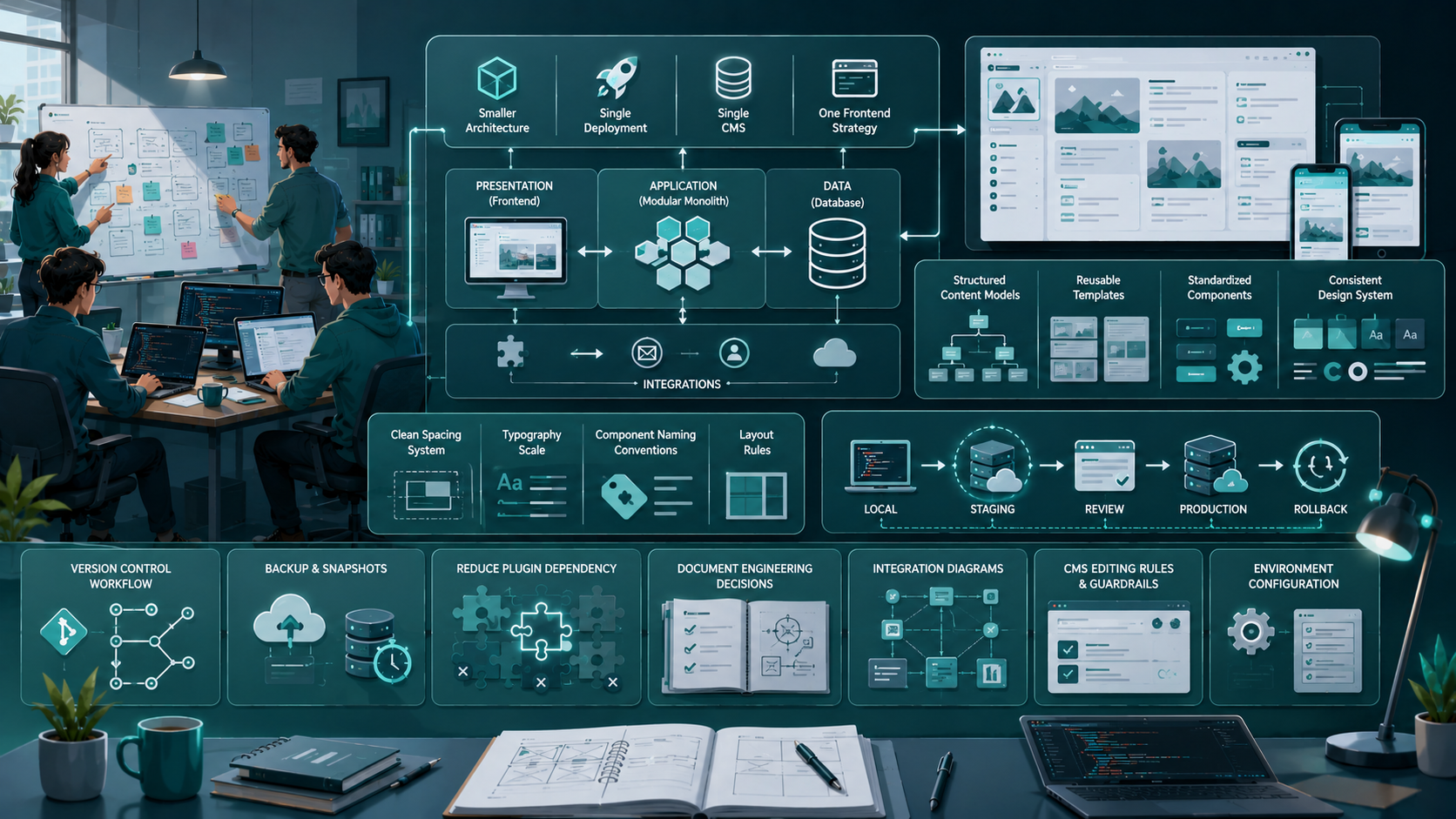
Keep the architecture smaller than you think you need
For most small business website projects:
- A modular monolith is usually enough
- One deployment pipeline is usually enough
- One CMS architecture is usually enough
- One frontend rendering strategy is usually enough
Small engineering teams benefit more from consistency than flexibility.
Simpler systems usually survive developer turnover better.
A lean software architecture reduces operational risk significantly.
Separate content structure from presentation early
This is one of the highest ROI architecture decisions for long-term maintainability.
Instead of building page-specific frontend logic everywhere:
- Create structured content models
- Define reusable templates
- Standardize reusable components
- Separate presentation layer concerns
- Avoid hardcoded page structures
That small architectural decision dramatically improves frontend maintainability.
Bad approach
Every service page uses custom frontend logic.
Better approach
A scalable content management structure where pages reuse standardized schemas.
Establish frontend consistency rules early
Most frontend scalability problems are actually consistency problems.
Define:
- spacing systems
- typography scales
- component naming conventions
- layout rules
- reusable UI patterns
- frontend workflow management standards
This is not about perfection.
It is about predictability.
Small engineering teams move faster when frontend systems are consistent.
Use staging environments even for small projects
I still see businesses updating production environments directly.
That becomes dangerous once:
- SEO traffic grows
- backend systems become integrated
- deployment reliability matters
- analytics workflows become important
- multiple contributors manage content
Even lightweight deployment discipline helps.
A stable deployment workflow should include:
- Version control workflow
- Staging deployment verification
- Backup snapshots
- Deployment testing
- Rollback strategy
- Release management discipline
Small teams often skip this because it feels too enterprise-focused.
In reality, it is basic operational safety.
Reduce plugin dependency aggressively
Plugin-heavy systems eventually become maintenance problems.
Every plugin increases:
- software operational risk
- security exposure
- dependency conflicts
- infrastructure overhead
- production instability
If a plugin solves a mission-critical workflow, keep it.
But avoid dependency accumulation for small convenience features.
I’ve seen CMS projects with over 60 active plugins where nobody understood the production environment anymore.
That is rarely sustainable.
Document engineering decisions, not just code
Most maintenance pain comes from missing context.
Future developers need to understand:
- Why specific architecture decisions were made
- Why backend integration works a certain way
- Why certain deployment workflows exist
- Which business constraints shaped the frontend architecture
Even lightweight engineering documentation helps:
- deployment notes
- infrastructure management steps
- onboarding documentation
- integration diagrams
- CMS editing rules
- component standards
- environment configuration instructions
In remote engineering teams, documentation discipline prevents repeated operational mistakes.

When This Approach Fails
Simple architecture is not always the correct solution.
There are situations where these recommendations stop scaling well.
For example:
- High-traffic SaaS products
- Real-time collaboration systems
- Large backend systems
- Multi-region applications
- Heavy API orchestration layers
- Large engineering organizations
- Complex multi-tenant platforms
At larger scale, teams eventually need:
- deployment isolation
- independent service scaling
- specialized infrastructure management
- advanced DevOps workflows
- distributed backend architecture
But most small business websites never reach that operational complexity.
Another limitation is engineering discipline.
A simple architecture still requires:
- code standardization
- software governance
- documentation discipline
- deployment safety
- sustainable code practices
Without structure, simple systems can still become fragile legacy codebases.
Budget constraints also create long-term problems.
Small businesses often postpone:
- code refactoring
- dependency updates
- frontend cleanup
- performance optimization
- testing strategy improvements
- deployment workflow improvements
Short term, this feels efficient.
Long term, technical debt accumulates until small changes become expensive.
Sustainable Practices for Small Engineering Teams
The healthiest startup engineering teams optimize for sustained delivery capacity instead of short-term development speed.
That changes technical decision making significantly.
Optimize for maintainability instead of engineering excitement
New frameworks rarely solve operational problems.
Before introducing new infrastructure, ask:
- Will this improve long-term maintainability?
- Can future developers onboard quickly?
- Does the product team actually need this complexity?
- Who will maintain this system six months from now?
Those questions prevent many poor architecture decisions.
Keep deployment workflows predictable
Reliable deployment workflows reduce operational stress dramatically.
Healthy deployment systems are usually:
- predictable
- documented
- reversible
- operationally stable
- automated where practical
Not overly complicated.
A boring deployment process is often a sign of strong engineering maturity.
Reduce hidden ownership inside the team
If only one developer understands:
- deployment automation
- backend systems
- infrastructure management
- CMS workflows
- frontend architecture
- production configuration
the project becomes operationally fragile.
Even small remote teams should intentionally spread system knowledge.
Treat frontend consistency as a maintenance strategy
Frontend inconsistency compounds faster than most teams expect.
A shared component library and reusable UI patterns dramatically improve:
- frontend scalability
- developer productivity
- code maintainability
- release stability
- engineering collaboration
This is not only a design decision.
It is a software sustainability decision.
Schedule technical debt cleanup continuously
Most startup teams postpone technical debt cleanup because feature pressure never stops.
That usually backfires.
Small recurring maintenance is far cheaper than major architectural rewrites later.
Even dedicating limited sprint capacity toward:
- dependency management
- frontend cleanup
- code refactoring
- deployment reliability
- documentation improvements
- performance optimization
can significantly extend the lifespan of a maintainable codebase.
Conclusion
Most custom website maintenance problems are not caused by bad developers.
They come from reasonable short-term decisions made under startup pressure.
The biggest mistake small teams make is assuming the website only needs to work at launch.
In reality, maintainability becomes the defining engineering challenge after the first year.
The most sustainable small engineering teams usually prioritize:
- architecture simplicity
- frontend consistency
- deployment discipline
- cleaner operational workflows
- structured content management
- reduced dependency complexity
- maintainable deployment workflows
The teams that avoid painful rebuilds are rarely using the most advanced infrastructure.
They are usually the teams that kept the system understandable as the business evolved.
FAQ
Because most early architecture decisions optimize for launch speed instead of long-term software maintainability. As business requirements evolve, technical debt and frontend inconsistencies compound.
In many cases, yes. Modular monolith architecture often provides better maintainability and lower operational complexity than premature microservices for small teams.
Usually because teams skip frontend system design rules early. Without reusable components and frontend consistency standards, duplicated patterns grow rapidly.
Most small business websites do not require Kubernetes. Simpler deployment workflows are usually easier to maintain and troubleshoot for lean engineering teams.
By using structured deployment workflows, staging environments, version control discipline, deployment testing, and clear engineering documentation.
Written by

Paras Dabhi
VerifiedFull-Stack Developer (Python/Django, React, Node.js)
I build scalable web apps and SaaS products with Django REST, React/Next.js, and Node.js — clean architecture, performance, and production-ready delivery.
LinkedIn