Enterprise Application Development Services In USA
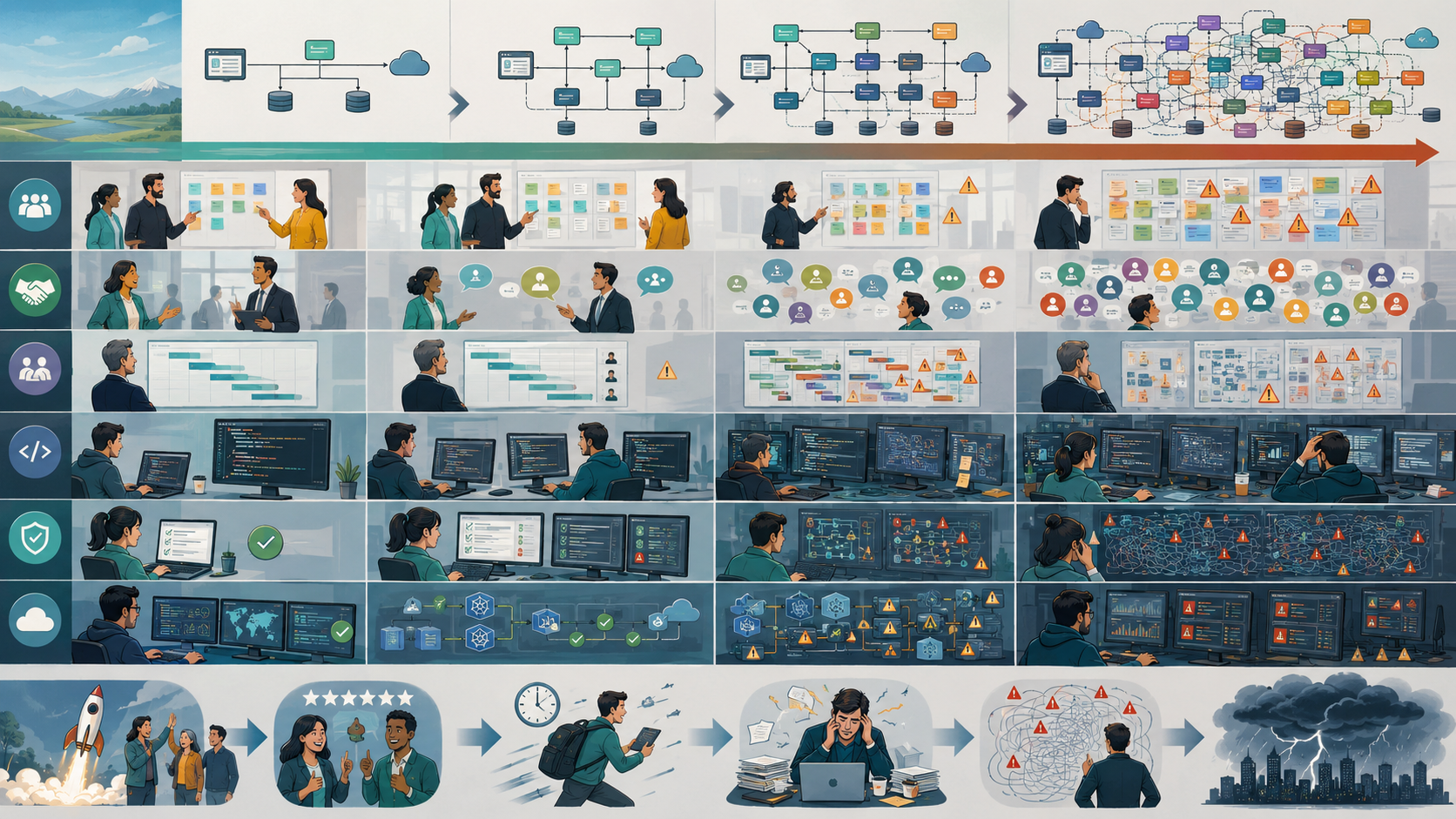
Enterprise application development rarely fails because of one major architectural mistake. In my experience, the problems usually start with dozens of small engineering decisions that seem reasonable at the time. A feature ships quickly, an API is added without much discussion, a new service is introduced to solve one urgent problem, and another deployment goes live before anyone has time to revisit the overall architecture.
I've seen this happen across startup teams building SaaS products as well as larger organizations modernizing long-running enterprise systems. The first version of the software often performs well. Users are happy, releases are frequent, and the engineering team moves quickly. But after several years of continuous development, even simple changes begin to take longer. Development slows down, maintenance costs increase, and reliability becomes harder to maintain.
Many teams assume that adding more developers or adopting newer technologies will solve the problem. Instead, the codebase becomes increasingly difficult to understand. Backend services become tightly coupled, frontend components duplicate business logic, and integrations grow into fragile dependencies that nobody wants to modify.
This is where experienced engineering teams realize that enterprise application development is not only about delivering features. It is about building software that remains maintainable, secure, scalable, and adaptable as business requirements evolve. Whether you're building Enterprise Application Development Services in USA for startups, healthcare providers, financial organizations, manufacturing companies, or global SaaS platforms, long-term sustainability matters far more than short-term delivery speed.
Why This Problem Happens in Real Teams
Most enterprise applications do not become difficult because developers lack technical skills. They become difficult because real projects operate under business pressure, changing priorities, and limited engineering resources.
During the first year of development, nearly every decision is optimized for speed.
The product team wants new functionality.
Sales teams request customer-specific features.
Management wants faster deployment cycles.
Engineering teams naturally focus on shipping software rather than refining architecture.
None of these decisions are wrong individually.
The challenge appears when hundreds of these decisions accumulate over multiple product releases.

Architecture Evolves Faster Than Documentation
One of the earliest warning signs is outdated documentation.
The original application architecture may have been carefully planned with clear workflows, clean interfaces, and well-defined responsibilities. Over time, however, the system evolves much faster than the documentation.
New APIs appear.
Additional database tables are introduced.
Authentication flows change.
Authorization rules become more complex.
Deployment pipelines expand.
Cloud infrastructure grows across multiple environments.
Without regular updates, documentation quickly loses value, forcing developers to understand the application directly from the source code.
Eventually, every onboarding engineer spends weeks tracing backend logic instead of delivering new functionality.
Business Requirements Never Stop Changing
Enterprise software is expected to support changing business operations.
That means applications continuously receive new modules for:
- Finance
- Accounting
- Human Resources
- Supply Chain
- Procurement
- Inventory
- Customer Relationship Management
- Enterprise Resource Planning
- Reporting
- Analytics
- Dashboard functionality
Each new business process introduces additional workflows, validation rules, database relationships, and integrations.
The application gradually becomes a collection of interconnected systems instead of a single software product.
Without careful architecture decisions, each new feature increases system complexity.
Integration Complexity Grows Faster Than Expected
Early enterprise applications often integrate with only a few external systems.
Over several years, those integrations expand considerably.
Typical enterprise projects eventually connect with:
- Payment systems
- Identity providers
- Analytics platforms
- Cloud storage
- Internal APIs
- Third-party services
- Legacy software
- Mobile applications
Every new integration increases dependency management.
One small API change can unexpectedly affect multiple business workflows.
I've worked on projects where a seemingly harmless update to an authentication provider caused reporting systems, customer dashboards, and background automation jobs to fail simultaneously.
The software itself wasn't broken.
The growing network of integrations had become too interconnected.
Infrastructure Becomes More Complicated Than the Product
Infrastructure usually begins with a relatively straightforward deployment.
A single application.
One database.
Basic networking.
Simple monitoring.
As traffic grows, teams introduce additional infrastructure to improve scalability and availability.
This often includes:
- Cloud hosting
- Virtualization
- Containers
- Docker
- Kubernetes
- Multi-cloud environments
- Hybrid infrastructure
- Load balancing
- Distributed storage
- Backup systems
- Disaster Recovery planning
- Monitoring
- Logging
- Observability
- Automated deployment workflows
These improvements are valuable when justified by business requirements.
The problem is that infrastructure complexity sometimes grows faster than the application itself.
I've seen engineering teams spend weeks improving Kubernetes configurations while unresolved database performance issues continued slowing every customer request.
The architecture looked modern.
The user experience did not improve.
Continuous Development Creates Hidden Technical Debt
Technical debt rarely comes from writing poor code intentionally.
It usually develops because engineering teams postpone improvements while focusing on immediate priorities.
Examples include:
- Duplicate business logic
- Temporary database structures
- Inconsistent API design
- Missing automated testing
- Weak versioning strategies
- Limited Quality Assurance
- Manual deployment processes
- Incomplete documentation
Each shortcut appears manageable.
Together, they significantly reduce long-term productivity.
Eventually, developers become hesitant to modify existing functionality because unexpected regressions become increasingly common.
Maintenance begins consuming more engineering time than innovation.
Enterprise Growth Demands More Than New Features
As organizations expand, expectations also change.
Applications must support:
- Higher performance
- Better scalability
- Stronger security
- Compliance requirements
- Encryption
- Authentication
- Authorization
- Governance
- Reliability
- Availability
- Fault Tolerance
- Resilience
Meeting these requirements often requires substantial architectural improvements rather than additional feature development.
Unfortunately, many teams continue building on top of aging foundations instead of modernizing critical areas of the platform.
Modernization is not simply migrating to the cloud or adopting newer frameworks.
It involves carefully evaluating architecture, improving interoperability, strengthening infrastructure, optimizing deployment pipelines, and simplifying business workflows.
Without deliberate optimization, enterprise applications eventually become difficult to customize, difficult to maintain, and expensive to evolve.
Small Engineering Decisions Shape the Entire Software Lifecycle
One lesson I've learned repeatedly is that enterprise software succeeds because of consistent engineering discipline rather than individual technical breakthroughs.
Good architecture isn't created by selecting fashionable frameworks.
It develops through thousands of practical decisions involving:
- Software design
- Database structure
- API consistency
- Deployment automation
- Security practices
- Performance optimization
- Collaboration across product teams
- Agile planning
- Scrum execution
- Continuous Improvement
- Lifecycle management
When those decisions remain aligned over several years, enterprise applications continue supporting business growth without constant rewrites.
When they don't, even experienced engineering teams spend most of their time maintaining existing systems instead of building new capabilities.
Where Most Teams Make the Wrong Decision
By the time an enterprise application starts showing signs of strain, most teams already know something is wrong. Releases take longer, deployment windows become stressful, and simple feature requests unexpectedly affect unrelated parts of the system.
The mistake isn't recognizing the problem too late. The mistake is choosing solutions that add more complexity instead of reducing it.
Over the years, I've noticed the same patterns appear in projects regardless of whether the team had five developers or fifty.
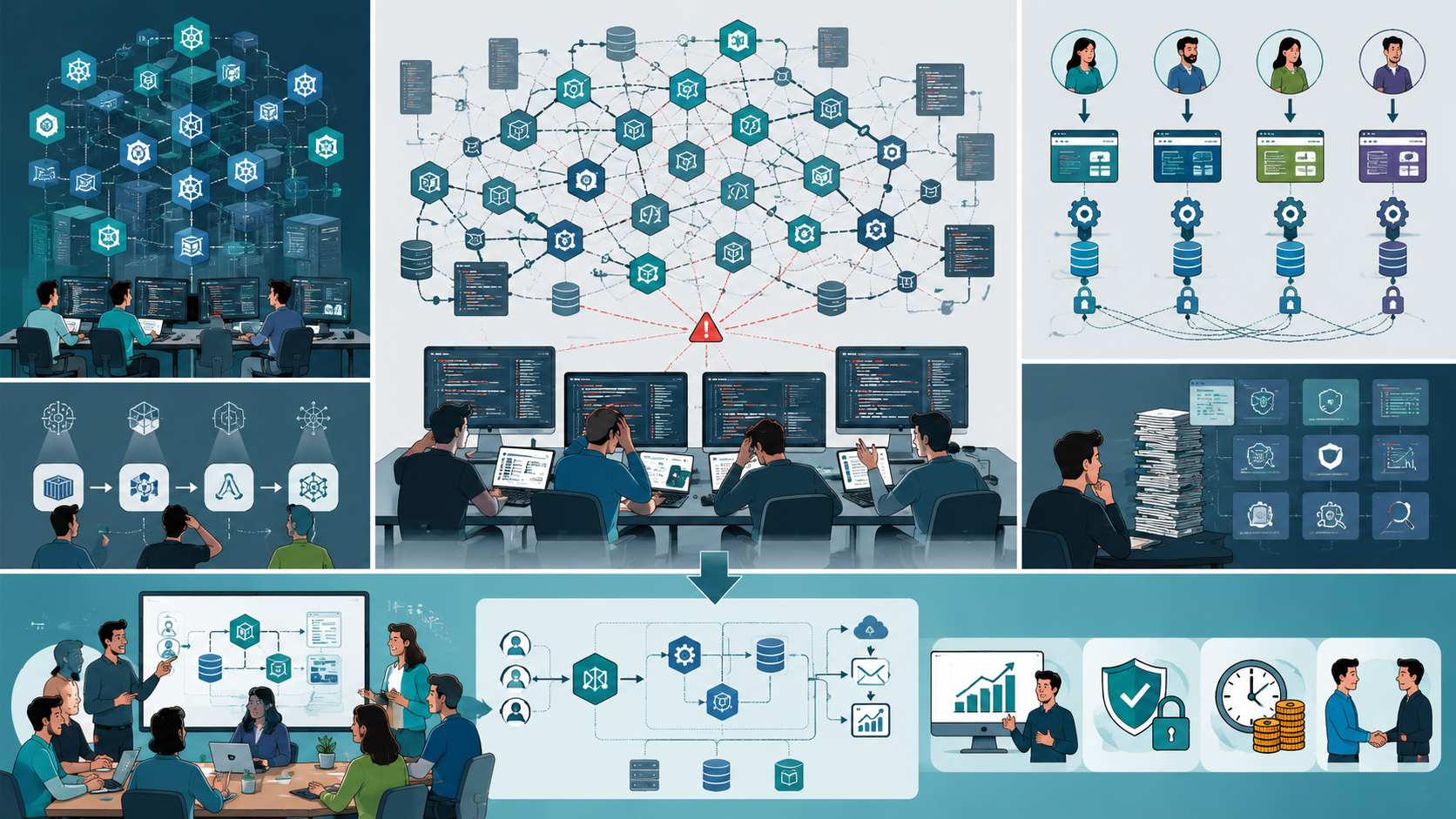
Mistake 1: Copying Large Technology Companies
One of the most common decisions is adopting the architecture used by companies operating at an entirely different scale.
A startup serving a few thousand users doesn't face the same challenges as a platform serving hundreds of millions.
Yet many engineering teams immediately introduce:
- Multiple microservices
- Complex service discovery
- Distributed messaging
- Kubernetes clusters
- Container orchestration
- Advanced networking layers
- Separate databases for every service
The result is rarely better scalability.
Instead, developers spend more time managing infrastructure than improving the product.
I've worked with teams where debugging a simple customer issue required checking six services, multiple logs, and several deployment environments before finding the root cause.
A well-structured modular application would have solved the same business problem with far less operational overhead.
Mistake 2: Treating Every New Requirement as a New System
Enterprise software naturally grows over time.
New departments request additional functionality.
Finance needs new reporting.
Operations wants workflow automation.
Customer support asks for internal dashboards.
Instead of extending existing modules, teams sometimes create entirely new applications for every requirement.
Initially this feels organized.
A year later, the organization owns:
- Multiple APIs
- Separate authentication systems
- Independent databases
- Duplicate business logic
- Inconsistent user interfaces
Every integration increases maintenance effort.
Synchronization between systems becomes unreliable, and interoperability gradually becomes one of the largest engineering challenges.
Mistake 3: Prioritizing Technology Over Business Problems
Technology evolves quickly.
Every year introduces new frameworks, deployment strategies, cloud services, and development practices.
There's nothing wrong with modernization when it solves an actual engineering problem.
The issue appears when teams adopt technology simply because it's popular.
I've seen organizations migrate from stable platforms to newer frameworks without measurable improvements in performance, productivity, or maintainability.
The migration consumed months of engineering effort while customers experienced no noticeable benefit.
A successful enterprise application should evolve because business requirements demand change—not because a technology trend becomes popular.
Mistake 4: Ignoring Operational Costs
Most architectural discussions focus on development effort.
Very few consider operational effort.
Every additional service introduces:
- Monitoring requirements
- Logging configuration
- Security updates
- Backup strategies
- Versioning
- Deployment automation
- Compliance reviews
- Maintenance responsibility
Each component looks manageable individually.
Together they create a significant operational burden.
Small engineering teams rarely have enough capacity to maintain unnecessary complexity without sacrificing delivery speed.
Practical Fixes That Actually Work
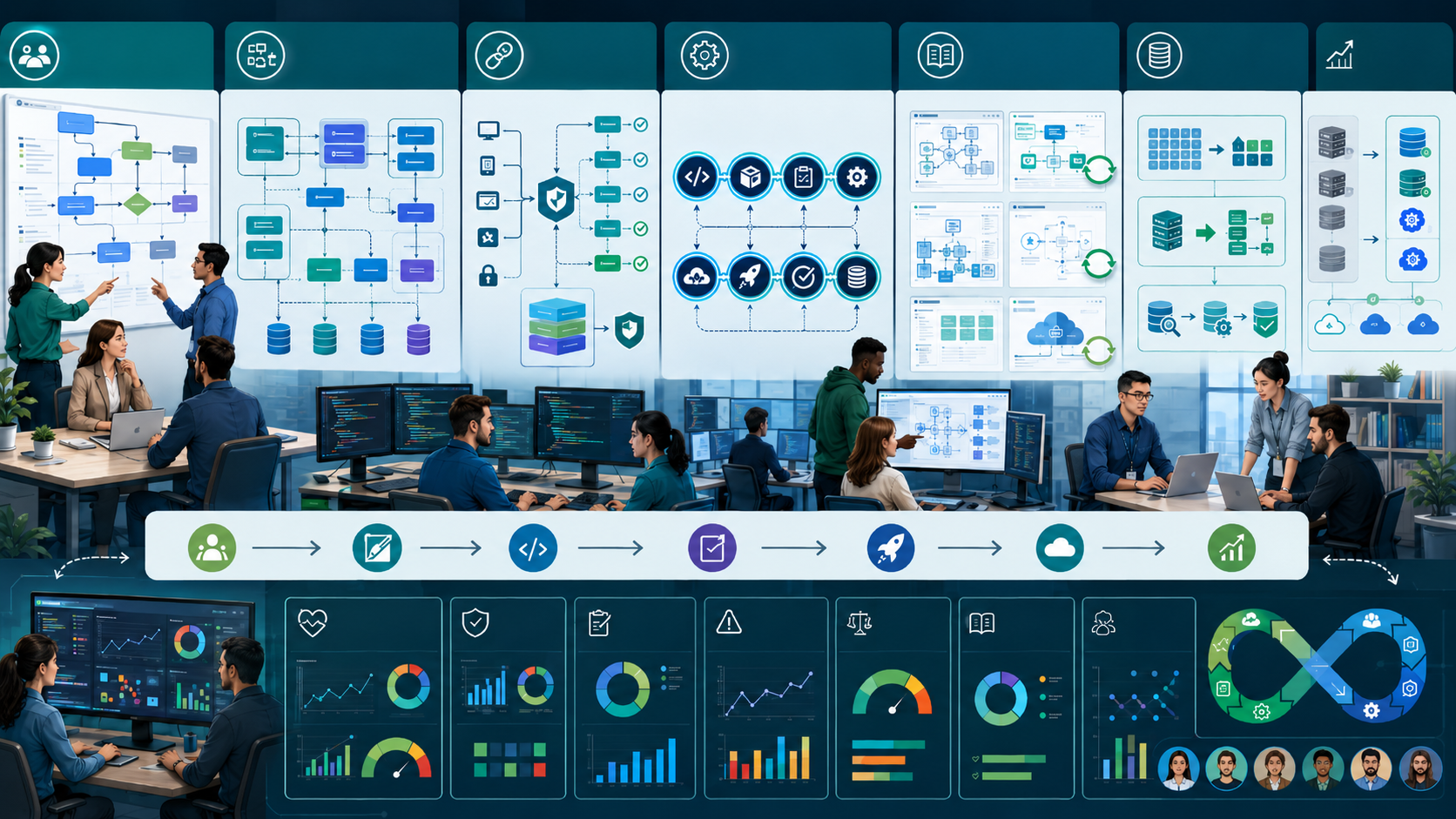
There isn't a universal architecture that solves every enterprise software problem. The best solutions usually simplify existing systems instead of introducing new ones. Working with an enterprise application engineering partner for US organizations can help businesses align architecture, APIs, integrations, automation, database performance, and incremental modernization with real operational requirements.
These are the practices that consistently produced better long-term results across enterprise projects.
Start With Business Processes Before Technology
Before adding a new service, ask one simple question:
Does this improve the business process or only the architecture diagram?
Many enterprise systems become unnecessarily complicated because technical decisions happen independently of business needs.
Understanding how users actually work often eliminates unnecessary development altogether.
Keep the Architecture Understandable
A scalable architecture is not necessarily a complicated one.
Every engineer joining the project should understand the overall platform within a reasonable amount of time.
When introducing a new component, ask:
- Does it solve a real limitation?
- Can another developer maintain it next year?
- Does it reduce future technical debt?
- Will documentation remain manageable?
Simple systems usually scale better than confusing ones.
Standardize API Design
Enterprise applications often expose dozens or hundreds of APIs.
Inconsistent design creates long-term maintenance problems.
Establish clear standards for:
- Naming conventions
- Authentication
- Authorization
- Error responses
- Versioning
- Request validation
- Response formats
Consistency dramatically reduces onboarding time for new developers.
It also makes integrations significantly easier to maintain.
Automate Repetitive Engineering Work
Manual work rarely scales.
Development teams benefit far more from improving deployment workflows than introducing additional architecture layers.
Automate wherever possible:
- CI/CD pipelines
- Testing
- Quality Assurance checks
- Security scanning
- Infrastructure provisioning
- Deployment validation
- Backup verification
Automation reduces human error while improving reliability.
More importantly, it allows engineers to spend time solving product problems instead of repeating operational tasks.
Improve Documentation Continuously
Documentation shouldn't be treated as a separate project.
Update documentation whenever software changes.
Focus on areas developers actually need:
- Architecture diagrams
- Deployment workflows
- API references
- Infrastructure configuration
- Database relationships
- Integration points
- Authentication flow
Well-maintained documentation often saves more engineering time than introducing another development framework.
Optimize Databases Before Scaling Infrastructure
Performance problems are frequently blamed on application architecture.
In reality, database design often becomes the bottleneck.
Before adding additional servers, investigate:
- Query optimization
- Index usage
- Database normalization
- Caching opportunities
- Storage efficiency
- Data lifecycle management
Several enterprise projects I've worked on improved response times dramatically without adding a single new server.
The biggest improvement came from optimizing existing data access patterns.
Modernize Incrementally
Large-scale rewrites rarely finish on schedule.
Incremental modernization produces better outcomes.
Examples include:
- Replacing outdated modules individually
- Improving backend services gradually
- Updating frontend architecture one feature at a time
- Migrating infrastructure in stages
- Introducing cloud services where they provide measurable value
This approach reduces operational risk while maintaining business continuity.
Measure Engineering Health
Enterprise applications shouldn't only measure customer-facing metrics.
Track engineering indicators such as:
- Deployment frequency
- Build reliability
- Testing coverage
- Production incidents
- Recovery time
- Technical debt backlog
- Documentation quality
- Code review turnaround
These measurements often identify architectural problems long before customers notice them.
Encourage Cross-Team Collaboration
Large enterprise systems are rarely owned by one team.
Product managers, backend developers, frontend engineers, DevOps specialists, QA engineers, and infrastructure teams all influence software quality.
Regular collaboration improves:
- Workflow consistency
- Shared ownership
- Knowledge transfer
- Engineering productivity
- Deployment confidence
Applications become more maintainable when architectural knowledge is distributed rather than concentrated in a few senior developers.
Think About the Entire Software Lifecycle
Every architectural decision should consider the complete application lifecycle.
That includes:
- Development
- Testing
- Deployment
- Monitoring
- Maintenance
- Optimization
- Support
- Modernization
- Retirement
Planning for long-term evolution leads to software that adapts more easily as business requirements change.
Rather than continuously rebuilding systems, engineering teams can focus on delivering new capabilities with confidence.
When This Approach Fails
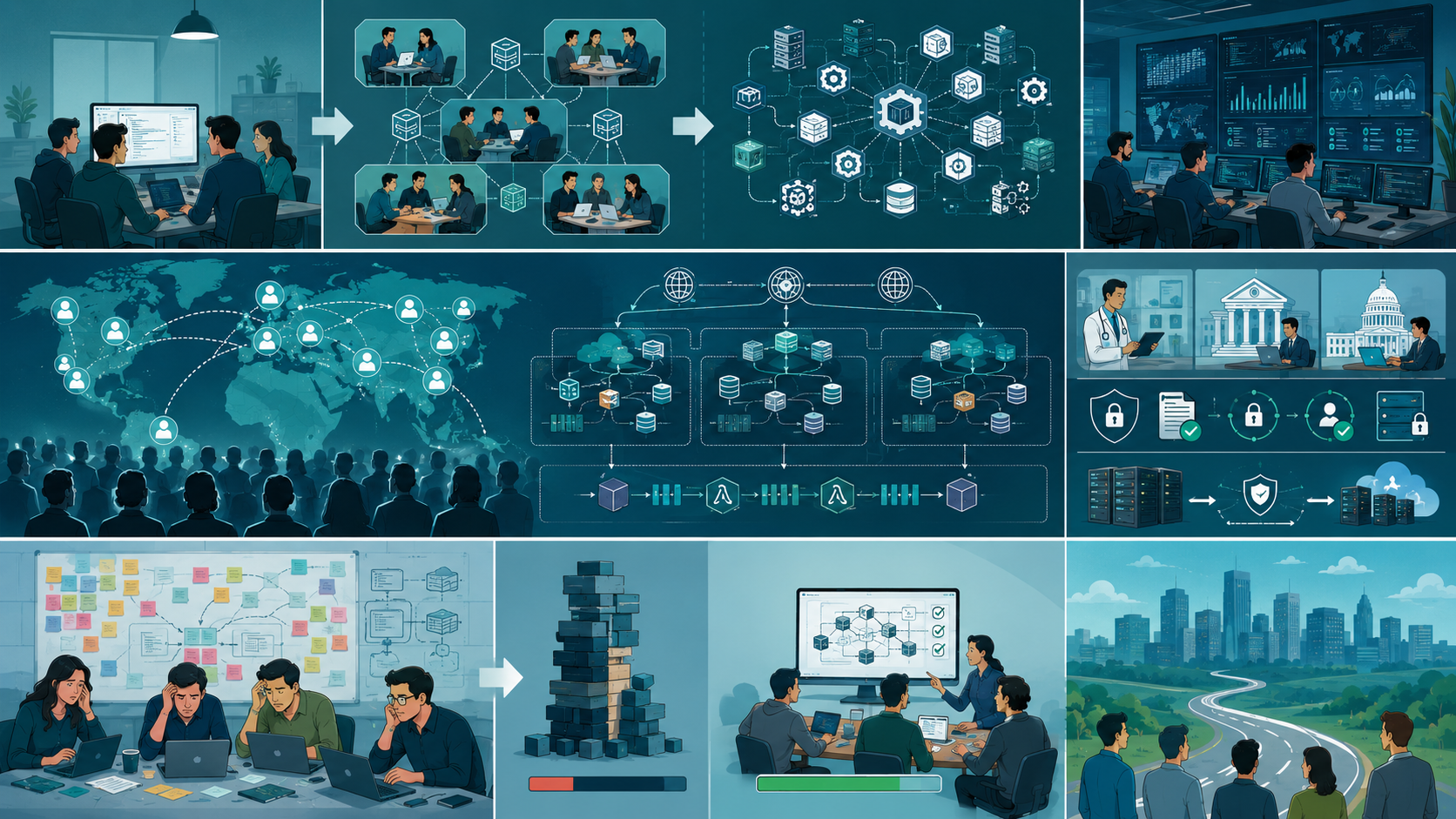
No architectural approach works forever. One mistake I often see is treating a successful solution as something that should never change. Enterprise software evolves alongside the business, and eventually the architecture that supported a growing product may become the next bottleneck.
Recognizing those limits early helps teams plan improvements before delivery velocity begins to decline.
Very Large Engineering Organizations
The recommendations in this article work well for small and mid-sized engineering teams, typically between two and thirty developers.
Once multiple product teams begin working independently, coordination becomes more challenging.
Different teams may own separate business domains, release schedules, and infrastructure. At that point, introducing stronger service boundaries or more distributed architectures can make sense—but only after clear ownership has been established.
Scaling architecture before scaling the organization usually creates unnecessary operational complexity.
Products Serving Millions of Active Users
Applications with extremely high traffic often require architectural patterns that smaller products simply don't need.
Examples include:
- Global load balancing
- Distributed data storage
- Regional deployments
- Advanced caching strategies
- Event-driven processing
- High-availability infrastructure
Introducing these solutions too early increases maintenance costs without solving today's business problems.
The goal should always be to solve the next realistic scaling challenge, not one that may never happen.
Highly Regulated Industries
Applications handling sensitive financial, healthcare, or government data often require stricter engineering controls.
Additional investments may be necessary for:
- Security auditing
- Compliance reporting
- Encryption policies
- Identity management
- Access governance
- Disaster recovery testing
- Availability guarantees
These requirements naturally increase development effort, but they should be introduced because regulations demand them—not because they're fashionable engineering practices.
Limited Engineering Capacity
Small startups sometimes attempt large modernization projects while still delivering new customer features.
That usually creates two competing priorities.
Neither receives enough attention.
If engineering resources are limited, improving one critical area each release is often more sustainable than attempting a complete platform rewrite.
Steady progress consistently produces better long-term results than ambitious projects that never reach production.
Sustainable Practices for Small Engineering Teams
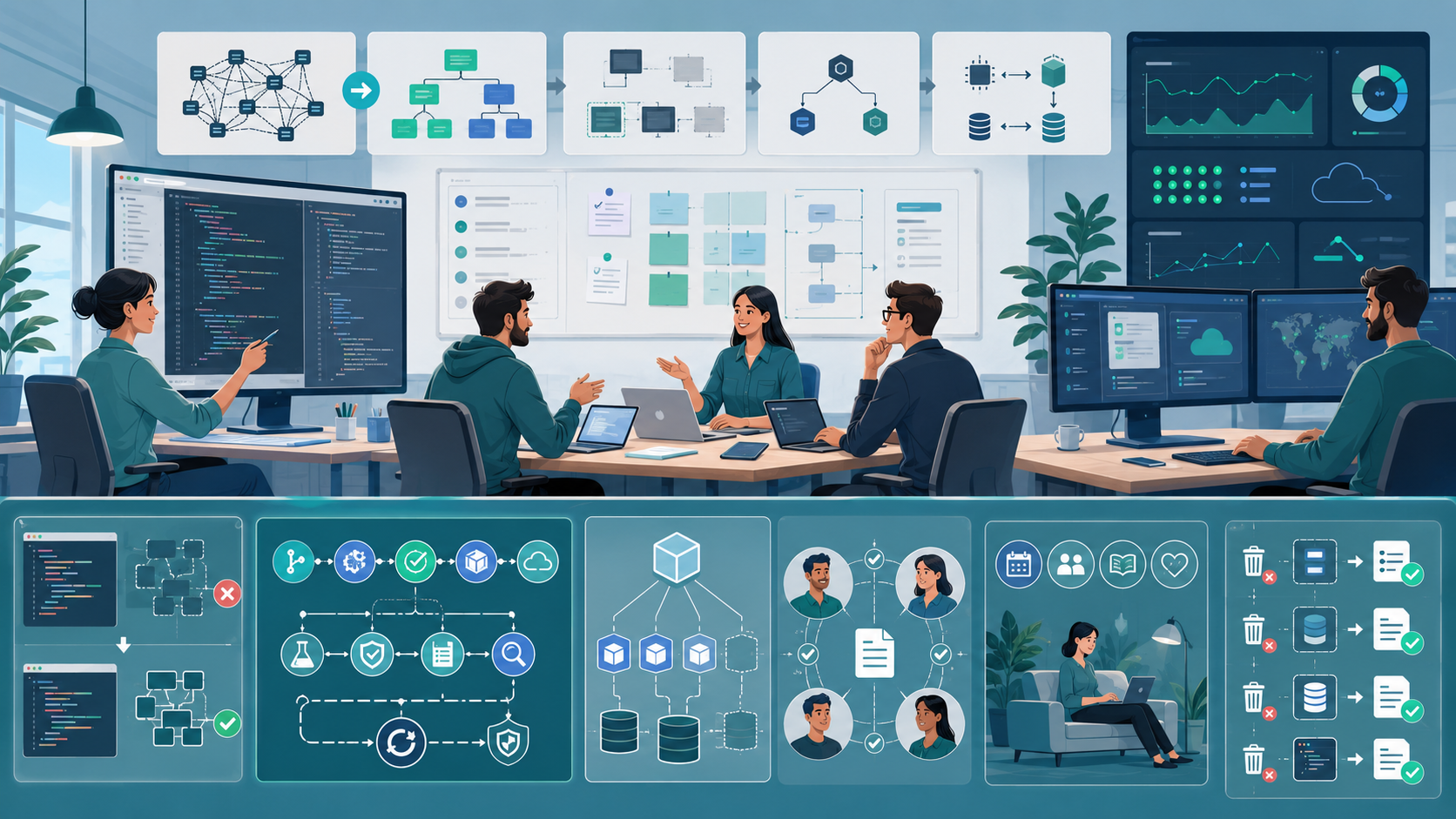
Long-term software quality is rarely the result of one major architectural decision.
It comes from small, repeatable engineering habits that reduce complexity over time.
These practices have consistently helped the teams I've worked with maintain development speed without sacrificing software quality.
Reduce Technical Debt Continuously
Technical debt should never become a yearly project.
Address small improvements during normal development.
Examples include:
- Removing duplicate code
- Simplifying APIs
- Improving documentation
- Refactoring complex modules
- Cleaning outdated dependencies
Small improvements made consistently are far less disruptive than large-scale refactoring initiatives.
Protect Deployment Quality
Reliable deployments build confidence across engineering teams.
Every release should be supported by:
- Automated testing
- CI/CD validation
- Deployment rollback plans
- Infrastructure monitoring
- Production health checks
When deployments become predictable, teams spend less time fixing production issues and more time building valuable functionality.
Keep Collaboration Simple
As products grow, communication often becomes the hidden bottleneck.
Useful practices include:
- Short architecture discussions before implementation
- Clear ownership for every module
- Shared engineering documentation
- Consistent coding standards
- Regular technical reviews
These habits reduce misunderstandings while improving overall development velocity.
Design for Maintainability
Every new feature should make the software easier—not harder—to evolve.
Ask simple questions during implementation:
- Will another developer understand this six months from now?
- Can this component be tested independently?
- Does this introduce unnecessary dependencies?
- Is the business logic clearly separated?
Maintainable software usually outperforms "clever" software over the lifetime of an enterprise application.
Avoid Developer Burnout
Many engineering problems are actually workflow problems.
Constant production emergencies, unclear priorities, and rushed releases eventually reduce software quality.
Healthy engineering teams usually maintain:
- Realistic sprint planning
- Stable release schedules
- Shared ownership
- Continuous learning
- Time for maintenance work
Protecting developer productivity often has a greater impact than introducing another development framework or cloud service.
Review Architecture Regularly
Architecture reviews should become part of normal engineering work.
Every few months, evaluate:
- Components that no longer provide value
- APIs that can be simplified
- Infrastructure that can be consolidated
- Deployment workflows that can be automated
- Documentation requiring updates
Continuous optimization keeps enterprise applications adaptable without requiring expensive rewrites.
Conclusion
Enterprise application development is less about choosing the "perfect" technology stack and more about making consistent engineering decisions that remain practical as the software grows.
The biggest problems I've seen weren't caused by outdated frameworks or limited cloud infrastructure. They were caused by unnecessary complexity introduced one decision at a time. Every additional service, integration, deployment step, or architectural layer increased maintenance effort without always improving the product.
For organizations investing in Enterprise Application Development Services in USA, long-term success comes from balancing scalability with simplicity. A well-designed enterprise application should remain secure, reliable, maintainable, and adaptable throughout its lifecycle. Teams that focus on clear architecture, disciplined development practices, continuous optimization, and sustainable workflows are far more likely to deliver software that supports business growth for years instead of constantly rebuilding what already exists.
Enterprise Application Development Services In USA: FAQs
Enterprise Application Development Services in USA involve designing, developing, modernizing, integrating, deploying, and maintaining large-scale business software that supports operations such as finance, HR, CRM, ERP, inventory management, analytics, and customer services. The focus is on scalability, security, performance, and long-term maintainability.
Modernization becomes necessary when maintenance costs continue increasing, deployments become slower, technical debt affects delivery speed, integrations become difficult to manage, or the existing architecture no longer supports business growth effectively.
No. Kubernetes is valuable for applications requiring advanced container orchestration and large-scale infrastructure management. Smaller engineering teams often benefit more from simplifying deployment workflows before introducing additional operational complexity.
The most effective approach is continuous improvement. Refactor small sections regularly, maintain clear documentation, automate testing and deployments, standardize API design, review architecture periodically, and avoid postponing maintenance for long periods.
Maintainable enterprise applications typically share several characteristics:
- Consistent architecture
- Well-designed APIs
- Strong documentation
- Automated CI/CD pipelines
- Reliable testing
- Modular components
- Regular code reviews
- Continuous monitoring
- Incremental modernization instead of large rewrites
Reference
Written by

Paras Dabhi
VerifiedFull-Stack Developer (Python/Django, React, Node.js)
I build scalable web apps and SaaS products with Django REST, React/Next.js, and Node.js — clean architecture, performance, and production-ready delivery.
LinkedIn