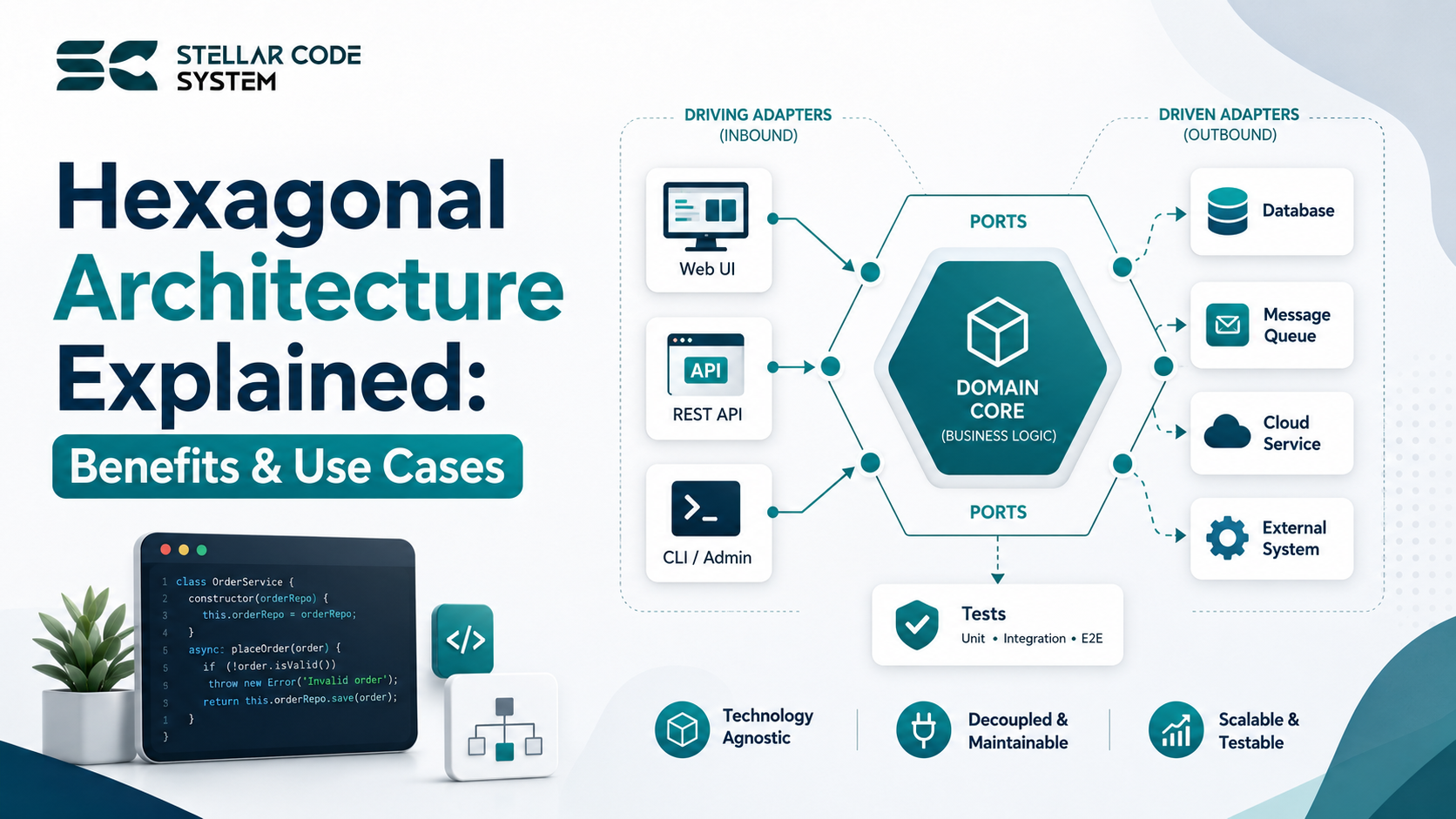
Hexagonal Architecture Explained: Benefits & Use Cases
Most engineering teams don't decide to create a tightly coupled application. It usually happens one deadline at a time.
An MVP grows into a production product, new features arrive every sprint, and before long the business logic depends on the database, external API calls, framework-specific code, and countless shortcuts that once seemed harmless. Changing one feature suddenly affects three others, and even a simple refactor feels risky.
I've seen this happen across startup teams with fewer than ten developers as well as distributed engineering teams building SaaS products. The common assumption is that choosing a modern framework or adopting clean coding practices will automatically keep a codebase maintainable. In reality, architecture decisions made during the first few months often determine how difficult the next two years become.
This is where Hexagonal Architecture becomes practical—not because it's a trendy architectural pattern, but because it forces a development team to protect what changes the least: the business rules that define the product.
Instead of asking, "Which framework should we build around?" Hexagonal Architecture asks a different question:
"How do we keep our domain independent of everything that will eventually change?"
That shift in thinking makes a surprising difference once an application begins integrating new services, additional developers, multiple deployment environments, and evolving customer requirements.

Why This Problem Happens in Real Teams
The biggest misconception about software architecture is that poor designs come from inexperienced developers.
In my experience, they usually come from experienced developers working under aggressive timelines.
When a startup is racing toward product-market fit, every sprint is measured by features delivered rather than architectural quality. Nobody intentionally creates technical debt. Teams simply optimize for shipping.
A typical development cycle looks familiar.
The frontend needs new functionality.
The backend exposes another endpoint.
A repository grows larger.
The service layer handles more responsibilities.
Database queries become more complex.
Everything still works, so nobody questions the design.
Six months later, every component depends on several others, introducing a new module requires changes across multiple files, and unit testing becomes frustrating because every feature relies on infrastructure that wasn't designed to be isolated.
The root problem isn't poor coding.
It's a dependency direction.
Many applications accidentally organize themselves around technology instead of business capabilities.
For example, developers often start with folders like:
- Controllers
- Services
- Models
- Repositories
- Database
- API
At first, this feels organized.
Eventually, every layer begins knowing too much about every other layer.
The domain model starts importing infrastructure code.
Business rules become mixed with persistence logic.
REST endpoints begin containing validation, calculations, and workflow decisions.
The architecture slowly loses its separation of responsibilities.
The Hidden Cost of Framework-Centered Design
One pattern I've encountered repeatedly is treating the framework as the center of the application.
Whether it's Spring Boot, ASP.NET Core, NestJS, Laravel, or another framework, teams naturally begin writing code that revolves around framework conventions.
There's nothing inherently wrong with frameworks.
The problem starts when the framework owns the application instead of supporting it.
Eventually the core business rules become difficult to reuse because they depend directly on framework annotations, HTTP requests, ORM entities, or messaging implementations.
Replacing any infrastructure becomes expensive because business behavior is no longer isolated.
I've worked on projects where changing a persistence mechanism required modifications across dozens of files—not because the database changed dramatically, but because the application never established clear boundaries between business logic and infrastructure.
Where Tight Coupling Quietly Appears
Tight coupling rarely appears in one obvious place.
Instead, it spreads through small convenience decisions.
Common examples include:
- A repository containing business calculations instead of persistence logic.
- A service calling external APIs directly while also implementing business rules.
- Domain entities depending on database annotations.
- Business validation relying on HTTP request objects.
- Integration logic mixed inside application workflows.
- Infrastructure classes importing domain-specific decision-making.
Each shortcut feels reasonable during implementation.
Collectively, they reduce maintainability.
Simple changes begin requiring coordinated updates across multiple layers because dependencies flow inward and outward without clear boundaries.
This is exactly the type of problem Hexagonal Architecture tries to prevent.
Understanding the Core Idea Behind Hexagonal Architecture
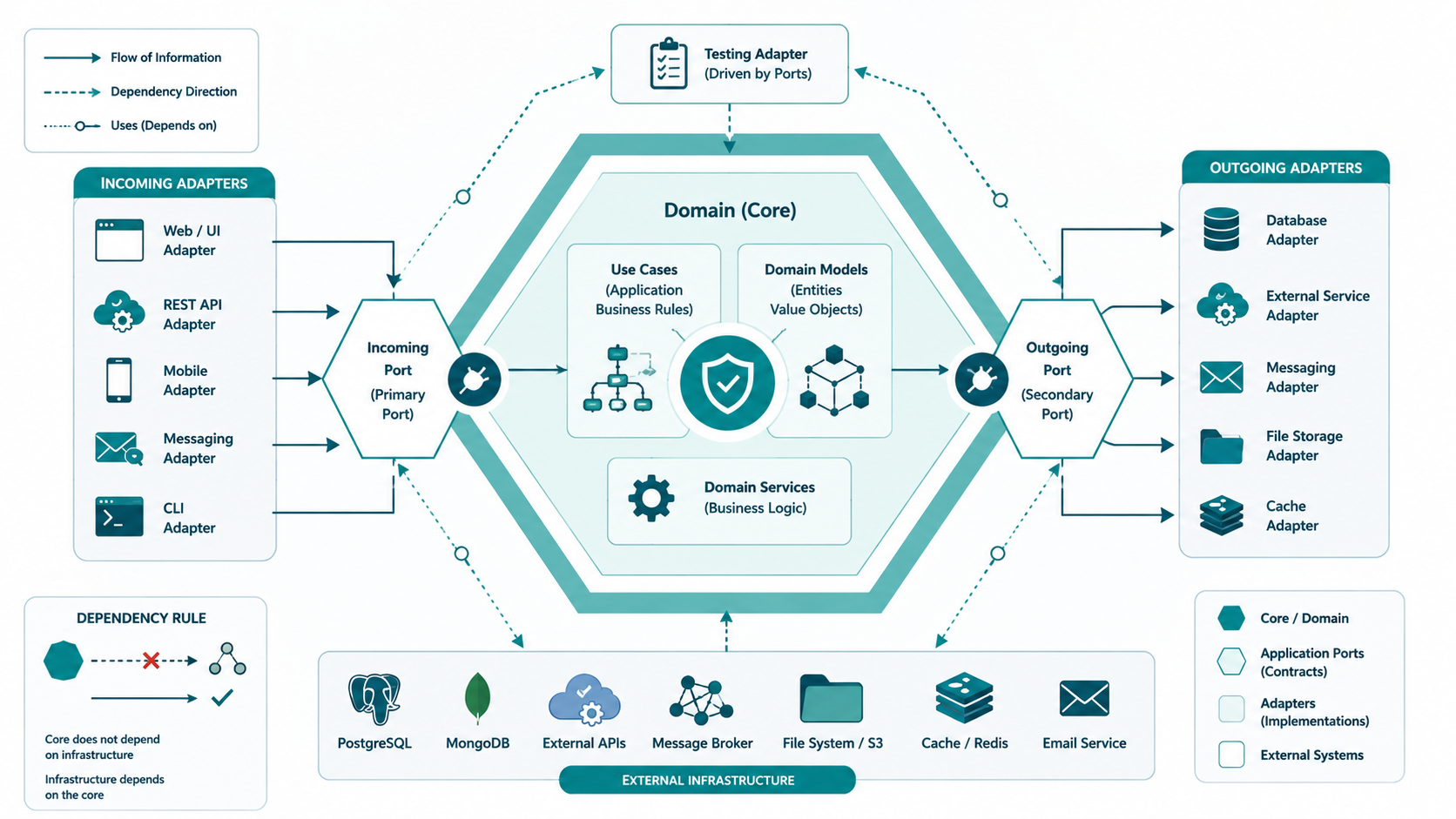
Despite its name, Hexagonal Architecture isn't really about drawing a hexagon.
It's about controlling dependencies.
The architecture separates the application into two broad concerns:
- The domain, where business rules live.
- Everything outside the domain, including databases, user interfaces, external services, messaging systems, and frameworks.
The key principle is simple:
Business logic should not know how data arrives or where it is stored.
Instead, communication happens through ports.
Ports define what the application needs.
Adapters provide the implementation.
For example:
Frontend
   │
   ▼
REST Adapter
   │
   ▼
Application Port
   │
   ▼
Use Case
   │
   ▼
Domain Model
   │
   ▼
Repository Port
   │
   ▼
Database Adapter
Notice the dependency direction.
The use case doesn't know whether data comes from PostgreSQL, MongoDB, a REST service, or even a mock used during testing.
It simply communicates through an abstraction.
That single design decision dramatically improves flexibility over time.
Why Dependency Inversion Matters More Than the Framework
Many developers first encounter the Dependency Inversion Principle while learning SOLID.
In practice, it's often misunderstood as simply using Dependency Injection.
Those are related ideas, but they solve different problems.
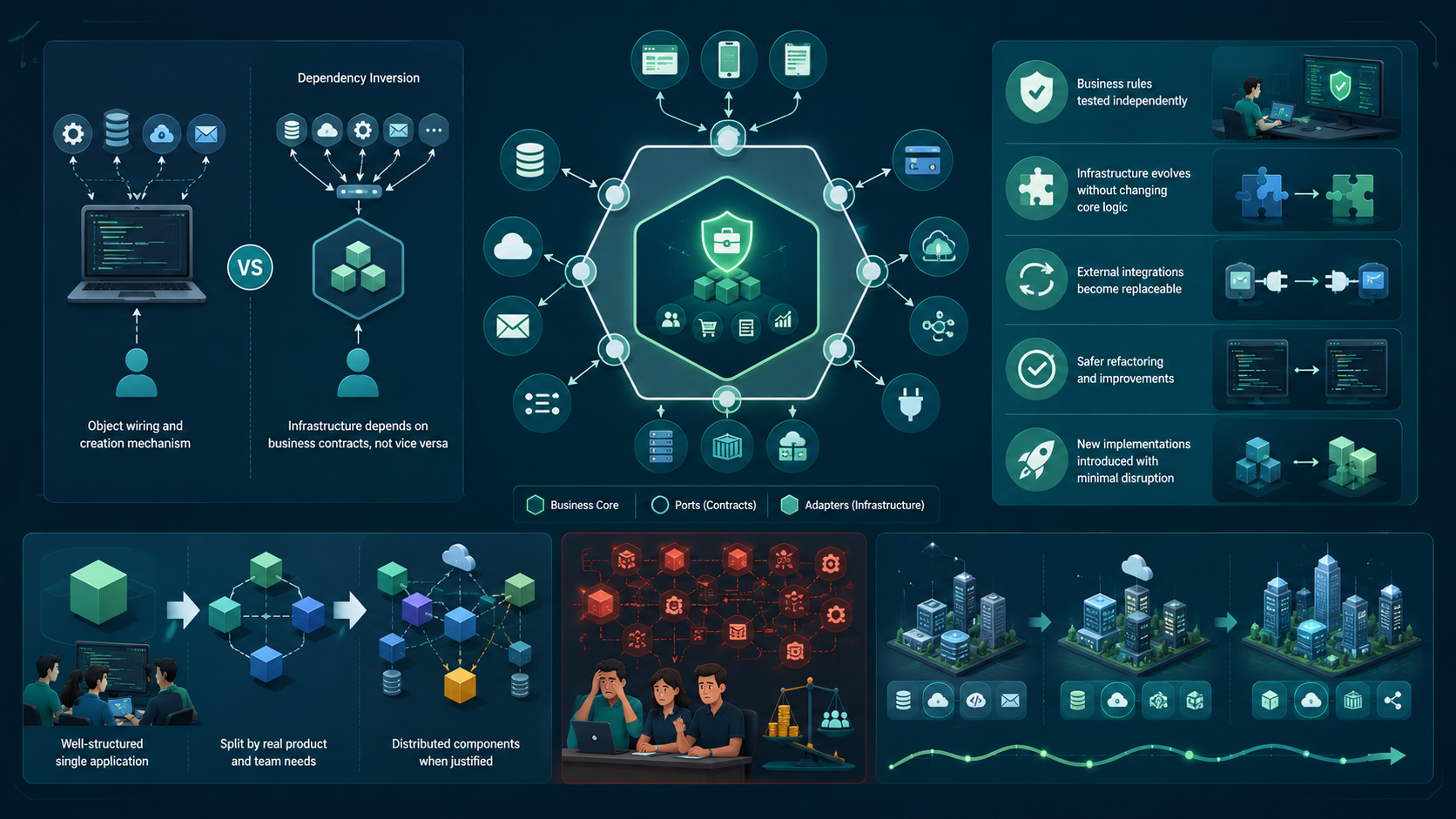
Dependency Injection helps create objects.
Dependency Inversion changes architectural direction.
Instead of high-level business rules depending on infrastructure, infrastructure depends on business contracts.
This inversion creates natural decoupling between the application and external systems.
As a result:
- Business rules become easier to test.
- Infrastructure can evolve independently.
- Integrations become replaceable.
- Refactoring becomes safer.
- New implementations can be introduced with minimal disruption.
For startup teams, these advantages become increasingly valuable as the product grows beyond its initial MVP. Working with software architecture experts for US digital products can help teams keep business rules independent from frameworks, databases, APIs, and external services as application complexity increases.

Where Most Teams Make the Wrong Decision
One of the biggest mistakes I see isn't that teams ignore Hexagonal Architecture.
It's that they try to implement every architectural pattern they've ever read about at the same time.
A small SaaS product with three engineers suddenly has dozens of packages, multiple abstraction layers, command handlers, event buses, factories, repositories for every entity, and enough interfaces to make a new developer wonder where the actual business logic lives.
The irony is that the application becomes harder to understand while solving problems it doesn't have yet.
Hexagonal Architecture is about protecting the domain, not maximizing the number of abstractions.
Copying Big-Tech Architecture Too Early
I've worked with startups that adopted the same architecture used by companies with hundreds of engineers.
The motivation usually sounds reasonable:
"If it works for large companies, it'll help us scale."
In reality, large organizations optimize for hundreds of contributors, multiple product teams, independent deployments, and complex organizational structures.
A startup with five developers has a completely different problem.
Its biggest challenge is shipping reliable features without creating unnecessary complexity.
I've seen teams introduce:
- Multiple microservices before reaching a stable product.
- Event-driven communication for features that could have been a simple method call.
- Several layers of abstraction around every service.
- Generic repositories that made implementation harder instead of simpler.
- Separate modules for functionality that never changed independently.
The result wasn't better architecture.
It was slower development, more debugging, and a higher onboarding cost for every new engineer.
Too Many Interfaces, Not Enough Clarity
Another common misunderstanding is believing every class needs an interface.
Interfaces are valuable when they represent stable business contracts.
They're much less useful when they're added simply because "clean architecture says so."
For example, I've reviewed projects where every repository had:
- Repository Interface
- Repository Implementation
- Base Repository
- Generic Repository
- Repository Factory
Yet there was only one database and no realistic plan to replace it.
That isn't flexibility.
It's unnecessary maintenance.
A good abstraction should solve a real problem.
If there is only one implementation and no foreseeable alternative, introducing another layer may add complexity without providing meaningful value.
Mixing Business Rules with Infrastructure
This is where many applications quietly drift away from Hexagonal Architecture.
Imagine an order processing workflow.
Instead of the use case focusing on business decisions, it starts handling:
- Database transactions
- REST response formatting
- Authentication details
- Third-party API calls
- Message publishing
- Logging
- Retry logic
Everything works initially.
But over time, the business logic becomes impossible to understand without reading infrastructure code.
I've seen teams hesitate to refactor pricing calculations simply because they couldn't tell which parts affected external integrations.
That's usually a sign the architecture has lost its separation between the core domain and the surrounding infrastructure.
Dependency Injection Isn't the Architecture
This misconception appears in nearly every modern framework.
Many developers assume that because they're using Dependency Injection, they've automatically implemented Hexagonal Architecture.
They haven't.
Dependency Injection is simply a mechanism for providing dependencies.
It doesn't determine where those dependencies should point.
I've seen projects where every dependency was injected correctly, yet the domain still depended directly on:
- ORM entities
- HTTP request objects
- Framework annotations
- Database models
- Cloud SDKs
The code was injectable.
It wasn't decoupled.
True dependency inversion means the business rules define the contracts.
Infrastructure adapts to those contracts—not the other way around.
A Practical Example
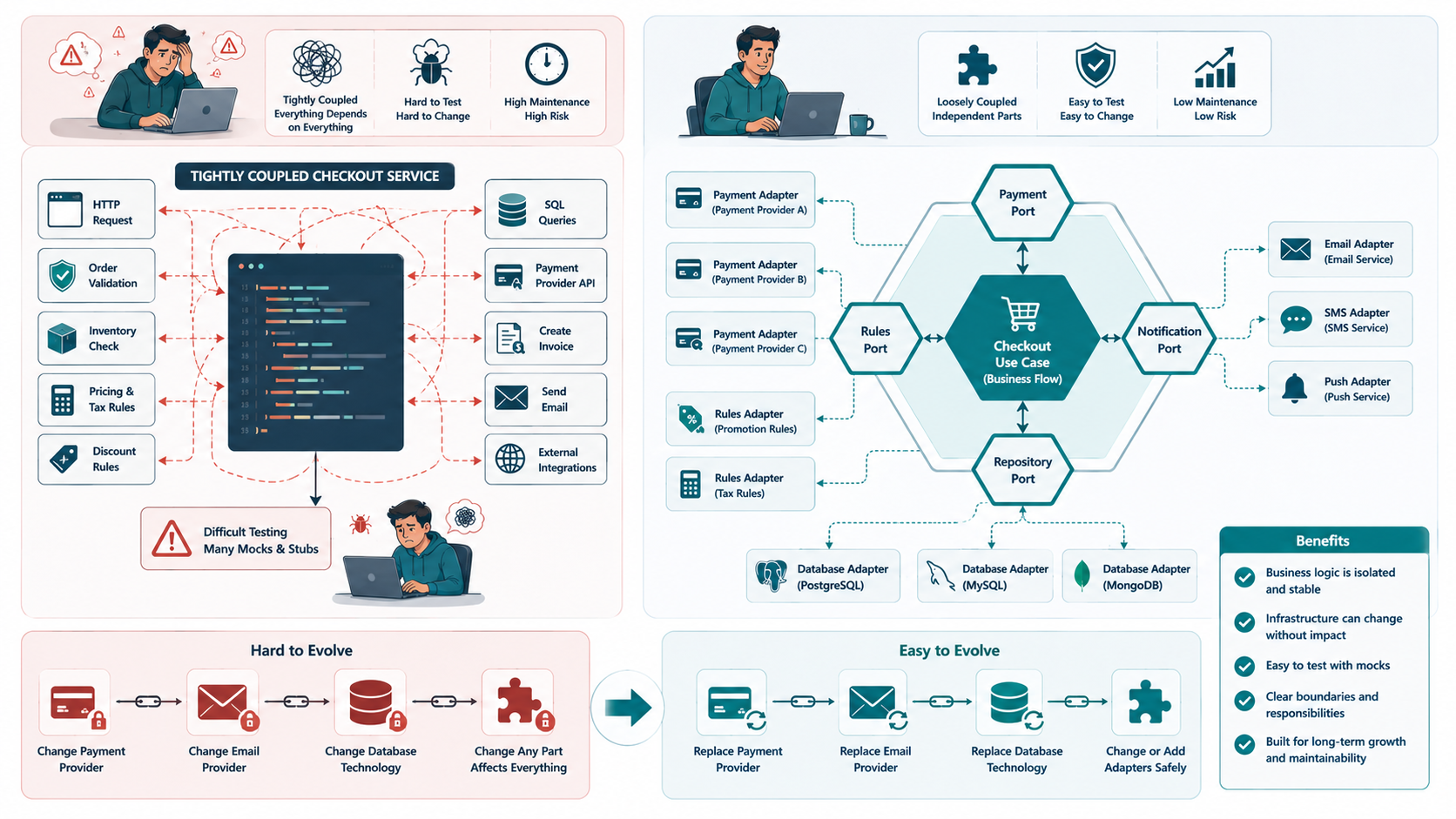
Consider a payment workflow.
A tightly coupled approach often looks like this:
Checkout Service
    ├── SQL queries
    ├── Payment API calls
    ├── Email sending
    ├── Order validation
    └── Invoice creation
Every responsibility is mixed together.
Testing becomes difficult because the workflow depends on external systems.
Now compare that with a Hexagonal approach:
Checkout Use Case
      │
      ├── Payment Port
      ├── Notification Port
      ├── Repository Port
      └── Domain Rules

Adapters
├── Stripe Adapter
├── Email Adapter
└── PostgreSQL Adapter
The use case doesn't know which payment provider is being used.
It doesn't know whether notifications are delivered by email, messaging, or another channel.
Its only concern is executing the business process.
That makes future changes significantly safer.
Practical Fixes That Actually Work
The most successful Hexagonal Architecture implementations I've worked on weren't the most sophisticated.
They were the simplest.
The teams focused on protecting business rules while avoiding unnecessary abstractions.
Here are the practices that consistently paid off.
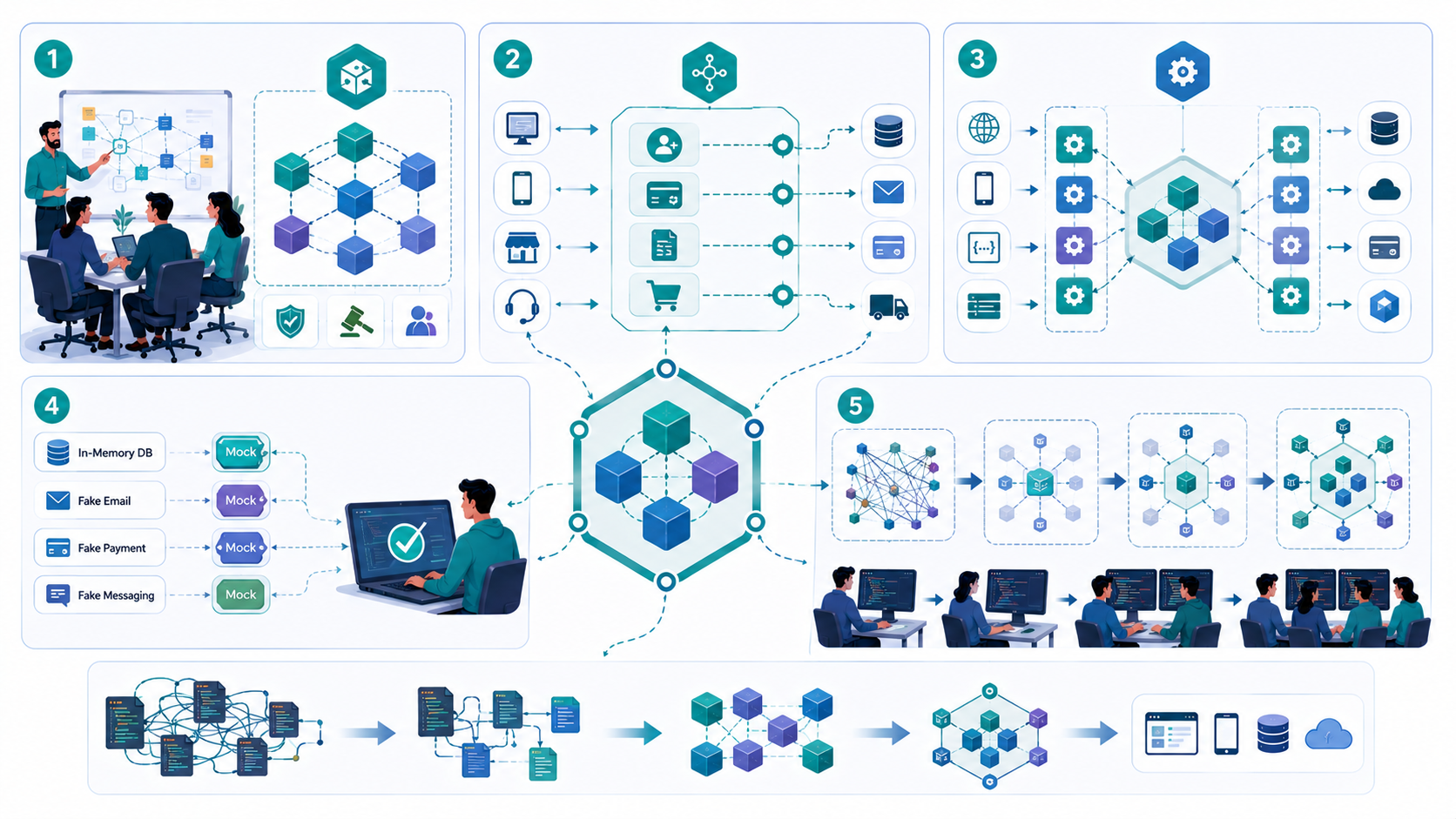
1. Start with the Domain Model
Before creating controllers, APIs, or database schemas, define the domain model.
Ask questions like:
- What are the important entities?
- Which business rules must always remain true?
- Which use cases create business value?
- What decisions belong inside the domain?
Once those answers are clear, infrastructure becomes much easier to organize.
2. Design Ports Around Business Actions
A common mistake is creating ports that mirror database operations.
Instead of this:
- SaveCustomer()
- DeleteCustomer()
- UpdateCustomer()
Think in terms of business capabilities.
For example:
- RegisterCustomer()
- ActivateSubscription()
- ProcessInvoice()
- CompleteOrder()
These contracts remain stable even if the underlying persistence mechanism changes.
3. Keep Adapters Thin
An adapter should translate information.
It shouldn't make business decisions.
Good responsibilities include:
- Mapping API requests
- Reading and writing to the database
- Calling external services
- Converting data formats
- Handling framework-specific concerns
Poor responsibilities include:
- Pricing calculations
- Discount rules
- Workflow decisions
- Validation that belongs to the domain
- Business policies
Whenever business logic starts appearing inside an adapter, it's usually time to move it back into the core application.
4. Test the Core Independently
One of the biggest advantages of Hexagonal Architecture is easier testing.
Your business rules should run without:
- A real database
- A web server
- External APIs
- Cloud infrastructure
- Messaging systems
Most of our automated tests typically focus on the core application using lightweight mocks for the ports.
That keeps unit testing fast and reliable.
For example:
- Use mocking for repository ports instead of connecting to a database.
- Mock payment or notification adapters instead of calling external services.
- Verify business outcomes rather than infrastructure behavior.
Fast tests encourage developers to refactor with confidence.
5. Refactor Incrementally
One mistake I often see is teams trying to migrate an entire application to Hexagonal Architecture in a single project.
That rarely succeeds.
A better approach is to improve one feature at a time.
For example:
- Extract one use case from a large service.
- Introduce a repository port only where coupling already causes problems.
- Move business rules out of controllers gradually.
- Isolate one external integration behind an adapter.
- Simplify dependencies before adding new abstractions.
Small improvements are easier to review, easier to test, and much less disruptive to ongoing product development.

When This Approach Fails
Hexagonal Architecture isn't a universal solution. I've seen teams apply it in situations where it created more work than value.
The first warning sign is when the architecture becomes more complicated than the product itself.
For example, if you're building a simple internal application with a handful of CRUD screens and minimal business rules, introducing ports, adapters, and multiple abstraction layers may not improve the design. The application doesn't have enough domain complexity to justify the additional structure.
Another situation is extremely early-stage MVP development.
When a founding team is still validating an idea, the priority is learning from users, not designing for every future scenario. If the product changes direction every few weeks, investing heavily in architectural boundaries may slow the team down.
I've also seen small engineering teams create ports for every component, every service, and every repository, even though there was only one implementation for each. Maintaining those abstractions became part of the team's daily work without providing meaningful flexibility.
There are also operational trade-offs.
As the application becomes more modular, developers need a shared understanding of architectural boundaries. Without documentation and code reviews, different engineers may interpret those boundaries differently, leading to inconsistent implementations.
Hexagonal Architecture can also become challenging when:
- The product has a very small codebase with limited business rules.
- The team consists of one or two developers working under tight deadlines.
- The application is primarily a data-entry system with minimal domain behavior.
- The organization lacks time for architectural reviews or incremental refactoring.
- Every new feature requires multiple layers of boilerplate before any business value is delivered.
Architecture should reduce complexity, not introduce it.
A good engineering decision always considers the product's current stage—not just its possible future.

Sustainable Practices for Small Engineering Teams
In my experience, maintainable software comes from consistent engineering habits far more than from choosing the "perfect" architecture.
Hexagonal Architecture provides a strong foundation, but the day-to-day practices of the team determine whether that foundation stays healthy.
Keep Business Logic in One Place
Business rules should live inside the core domain.
When pricing calculations, authorization decisions, or workflow rules are duplicated across controllers, adapters, scheduled jobs, or API handlers, inconsistencies appear quickly.
A single source of truth makes future changes much safer.
Review Dependency Direction Regularly
During code reviews, I often ask one simple question:
"Does this dependency belong here?"
If a domain class suddenly imports framework code, persistence models, or infrastructure utilities, it's worth stopping and discussing why.
Small reviews like this prevent architectural drift before it becomes technical debt.
Treat Refactoring as Normal Engineering Work
Many teams postpone refactoring until a "cleanup sprint."
That sprint rarely happens.
Instead, make incremental improvements while delivering features.
Examples include:
- Splitting an oversized module into smaller responsibilities.
- Extracting reusable business rules from controllers.
- Simplifying a complex repository.
- Removing duplicate validation logic.
- Improving naming around a use case.
These small changes accumulate over time without disrupting product delivery.
Invest in Automated Testing
One reason Hexagonal Architecture improves maintainability is that it naturally supports isolated testing.
A balanced testing strategy might include:
- Unit Testing for business rules inside the domain.
- Integration tests for adapters and persistence.
- End-to-end tests for critical user workflows.
Using mocking appropriately allows the team to verify business behavior without depending on external systems.
Fast feedback gives developers confidence to make changes without introducing regressions.
Document Decisions, Not Just Code
Many projects have excellent code but very little context.
When introducing a new port, adapter, or architectural boundary, document why it exists.
A short architecture decision record explaining:
- The problem
- The chosen solution
- The trade-offs
is often more valuable than pages of technical documentation.
This becomes especially important for remote engineering teams working across different time zones.
Build for Today's Product, Not Tomorrow's Assumptions
The most maintainable systems I've worked on evolved gradually.
They didn't begin with dozens of layers or every possible abstraction.
Instead, they started with a clear domain, sensible boundaries, and enough structure to support future growth.
As requirements changed, the architecture evolved alongside the product.
That approach consistently produced software that was easier to understand, easier to extend, and easier to maintain.
Conclusion
If there's one lesson I've learned after working on SaaS platforms, client products, and startup applications, it's this:
Most architecture problems don't come from choosing the wrong framework.
They come from allowing the framework, the database, or external integration concerns to shape the business rules.
Hexagonal Architecture offers a practical way to avoid that trap by placing the domain at the center of the application and treating infrastructure as something that supports it—not something that defines it.
That doesn't mean every project needs a perfectly layered architecture from day one.
For many small teams, the better approach is to introduce ports, adapters, and clear abstractions only when they solve an existing problem. Incremental improvements usually deliver better results than large-scale rewrites.
A maintainable software system isn't the one with the most patterns.
It's the one where developers can confidently add features, replace infrastructure, improve scalability, and continue delivering value without constantly fighting the architecture.
Hexagonal Architecture Explained: FAQs
Yes, if your product contains meaningful business rules that are expected to evolve. For very small MVPs or simple CRUD applications, a simpler design may be more appropriate. Introduce architectural boundaries as complexity grows rather than all at once.
Traditional layered architecture often allows business logic to depend on framework or persistence layers over time. Hexagonal Architecture keeps the core domain independent by communicating through ports and adapters, making the application easier to test and evolve.
Yes. In fact, many microservices benefit from Hexagonal Architecture because each service can maintain its own isolated domain and infrastructure. However, using microservices doesn't automatically mean the internal architecture is well designed.
Not necessarily.
Create an interface when it represents a stable business contract or supports multiple implementations. Adding interfaces everywhere without a clear purpose often increases maintenance without improving the design.
Yes, but avoid rewriting everything at once.
A gradual approach works better:
- Extract one use case at a time.
- Introduce dependency inversion where coupling is highest.
- Move business rules into the domain model.
- Isolate infrastructure behind adapters.
- Continuously refactor while delivering new features.
Reference
Written by

Paras Dabhi
VerifiedFull-Stack Developer (Python/Django, React, Node.js)
I build scalable web apps and SaaS products with Django REST, React/Next.js, and Node.js — clean architecture, performance, and production-ready delivery.
LinkedIn