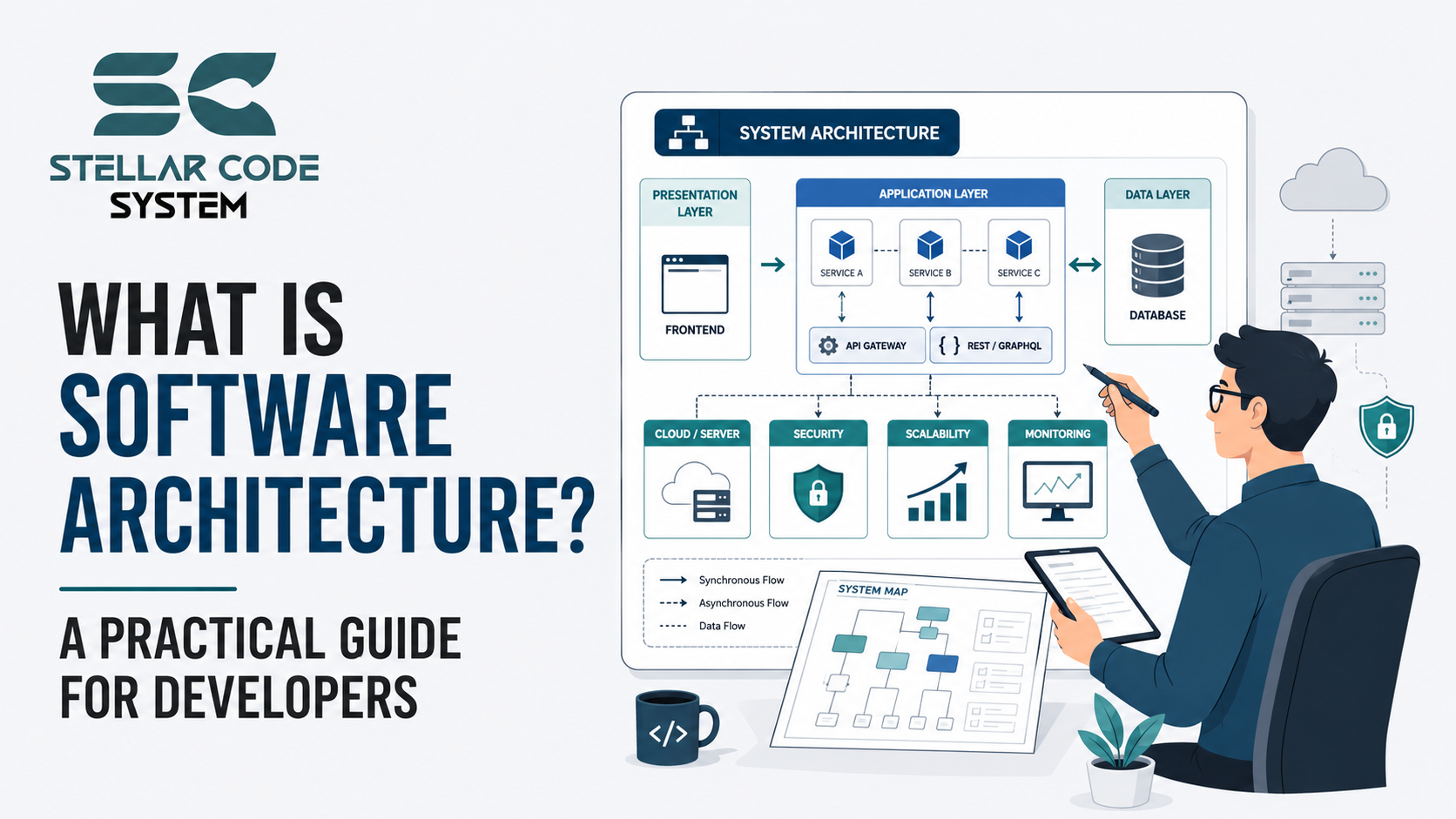
What Is Software Architecture? A Practical Guide For Developers
Most software projects don't fail because developers can't write code. They fail because the overall architecture no longer supports the way the product has evolved.
I've seen this happen with SaaS startups that launched successfully with a small engineering team and a simple feature set. Six months later, every new release took longer than expected, deployments became stressful, and fixing one issue unexpectedly broke another part of the system. The problem wasn't a lack of talented developers—it was that the original software design no longer matched the product's growing complexity.
Many founders assume software architecture is something only enterprise companies worry about. In reality, the earliest architectural decisions often determine how easily a product can grow, how quickly teams can deliver features, and how expensive future changes become.
Good software architecture isn't about drawing impressive diagrams or choosing trendy technologies. It's about creating a structure that allows developers to understand the application, work independently, and make changes without introducing unnecessary risk. When done well, architecture becomes almost invisible because the project feels predictable. When done poorly, every new feature becomes harder than the last.
If you're wondering what software architecture really is, the simplest answer is this:
Software architecture is the high-level organization of a software system that defines how its components interact, how responsibilities are divided, and how the application can evolve over time while remaining reliable, maintainable, and scalable.
That definition sounds straightforward, but applying it in real projects is where most teams struggle.
Why This Problem Happens in Real Teams
One of the biggest misconceptions I encounter is that architecture only matters after a company starts scaling. In practice, architecture decisions begin with the very first feature you build.
A startup with three developers is already making architectural decisions, whether they realize it or not. Choosing how modules communicate, organizing project layers, deciding where business logic belongs, or defining API boundaries all influence the long-term health of the application.
The challenge is that startup teams operate under constant pressure.
Customers are waiting for new features.
Investors expect rapid progress.
Product managers keep adjusting priorities.
Developers naturally focus on shipping rather than refining the foundation beneath the product.
There's nothing inherently wrong with moving quickly. Problems appear when short-term decisions quietly become permanent.
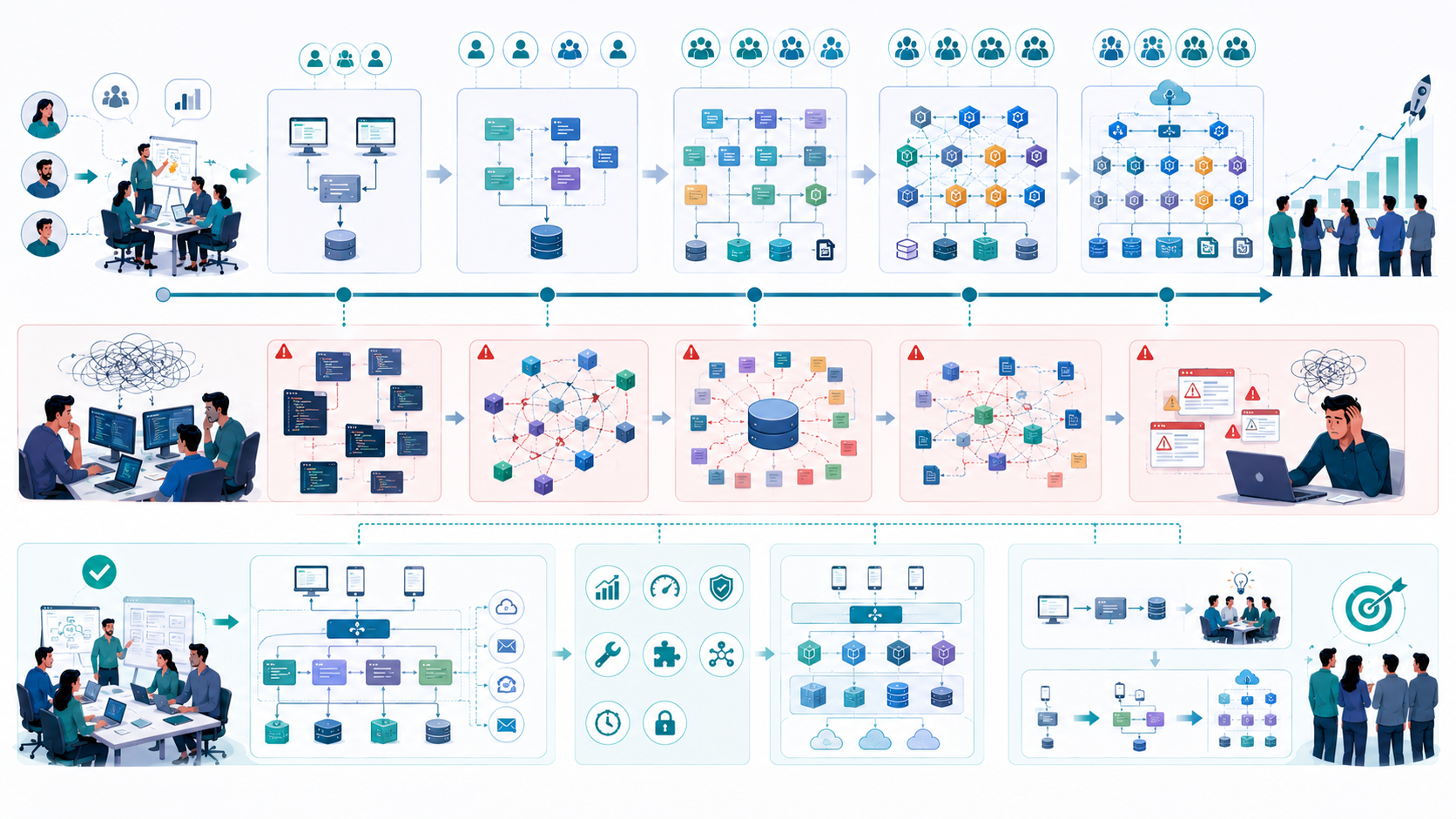
For example, I once worked with a SaaS platform that initially handled only a few hundred users. The application used a straightforward architecture with a single backend, one database, and a clean client-server model. For its first year, that approach worked perfectly.
As customer demand increased, new features were added rapidly without revisiting earlier architectural assumptions. Business logic spread across multiple services, duplicate code appeared in different areas, and dependencies between modules became increasingly difficult to track. Developers started avoiding refactoring because even small changes carried unexpected risks.
The system still functioned, but every sprint became slower.
That's usually the first warning sign.
Good software architecture isn't only about today's requirements. It prepares the application for tomorrow's uncertainty.
A well-designed architecture improves:
- Scalability as traffic and user demand increase
- Overall performance during peak workloads
- System reliability under production conditions
- Long-term maintainability for growing engineering teams
- Code reusability across multiple features
- Future extensibility when product requirements change
- Service availability during deployments and failures
- Application security through clearer responsibility boundaries
Notice that none of these benefits come from selecting a particular framework or programming language.
They're outcomes of thoughtful architectural decisions.
Another common issue is confusing software architecture with implementation.
Choosing a JavaScript framework, a cloud provider, or a programming language isn't architecture by itself.
Architecture defines how the entire system works together.
For example, it answers questions like:
- How should different components communicate?
- Where should business rules live?
- Which services require direct integration?
- How do APIs expose functionality safely?
- How should middleware handle authentication and logging?
- What level of abstraction keeps business logic independent of infrastructure?
- How much modularity is appropriate for the team's current size?
- How can we improve interoperability between internal and external systems?
These decisions have a far greater impact on a project's future than selecting the latest framework.
Another lesson I've learned is that architecture should always reflect business priorities.
Too many teams spend weeks debating whether to adopt microservices, a monolithic application, or an event-driven model before they've validated whether customers actually need the product.
Business goals should always influence technical decisions.
A small SaaS MVP serving its first customers has very different architectural needs than a platform supporting millions of daily users across multiple regions.
The best architecture isn't the most advanced one.
It's the one that allows your engineering team to deliver features consistently while keeping operational complexity under control.
As products mature, architecture naturally evolves. You might introduce service-oriented communication for specific domains, improve deployment pipelines, move parts of the application to the cloud, or redesign infrastructure to support greater flexibility.
The important point is that these changes should happen because the product genuinely requires them—not because they're currently popular in the software industry.
In my experience, successful engineering teams don't chase architectural trends. They solve today's problems while leaving enough room to solve tomorrow's without rebuilding the entire system.

Where Most Teams Make the Wrong Decision
One pattern I've noticed across startups in the US, Europe, and Australia is that teams often mistake complexity for maturity.
A founder reads an engineering blog from a large technology company, watches a conference talk, or listens to a podcast describing how thousands of engineers manage distributed systems. A few weeks later, the same ideas appear in a product that has five developers and a few hundred active users.
I've seen startups introduce Kubernetes, Docker, service discovery, multiple deployment environments, and dozens of microservices before they had even validated their core product.
The result usually isn't better engineering.
It's slower development.
Every new service creates another deployment pipeline to maintain, another API to document, another database connection to monitor, and another point of failure. Instead of shipping features, developers spend their time managing infrastructure.
There's nothing wrong with these technologies. The mistake is introducing them before the product actually needs them.
Architecture Should Solve Today's Bottleneck—Not Tomorrow's Fantasy
A question I often ask during architecture reviews is:
"What problem are we solving?"
If the answer is, "We'll probably need this in the future," that's usually a warning sign.
For example, a simple monolithic application can comfortably support thousands—or even millions—of requests depending on how it's designed. Yet many teams split their application into separate services long before the monolith becomes a limitation.
The same applies to cloud infrastructure.
Moving everything to the cloud doesn't automatically improve performance or scalability. Poor application design simply becomes more expensive to operate.
Another Common Mistake Is Ignoring Boundaries
As deadlines become tighter, developers often place business logic wherever it's quickest to implement.
A validation rule ends up inside a controller.
Database queries appear inside API endpoints.
Authentication checks get duplicated across multiple modules.
At first, nothing seems wrong.
Months later, changing one feature requires editing code in six different places because there was no clear encapsulation or abstraction from the beginning.
Eventually, the project becomes difficult to understand, especially for new developers joining the team.
I've seen engineers spend an entire day tracing a single request through multiple services simply because responsibilities weren't clearly separated.
That's not a coding problem.
It's an architectural one.
Teams Also Underestimate Communication Between Components
As applications grow, the way components exchange information becomes increasingly important.
Every API call introduces latency.
Every shared dependency creates tighter coupling.
Every unnecessary integration increases maintenance costs.
A good architecture reduces communication to what is genuinely required.
If two modules constantly depend on each other, it's often a sign that their responsibilities haven't been properly defined.
One useful exercise during code reviews is asking:
- Does this module really need to know about another module?
- Can this dependency be removed?
- Should this responsibility belong somewhere else?
These questions often uncover architectural improvements that no static analysis tool will find.

Practical Fixes That Actually Work
After working on products that have grown from MVPs into mature SaaS platforms, I've found that successful architecture isn't about choosing the "perfect" design. Working with a US software architecture partner for scalable product development can help teams define clear system boundaries, maintainable APIs, practical dependencies, resilient infrastructure, and an architecture that evolves alongside the product.
It's about making decisions that remain easy to change.
Here are the practices that consistently produce healthier codebases.
1. Start With a Simple Structure
Don't optimize for scale before you've reached it.
A clean project with clear layers, organized modules, and well-defined responsibilities is usually more valuable than an elaborate distributed system.
A typical separation might look like:
- Presentation layer
- Business logic layer
- Data access layer
- Infrastructure layer
Keeping these responsibilities separate improves maintainability without introducing unnecessary complexity.
2. Design Around Business Capabilities
Instead of organizing code by technology, organize it around what the product actually does.
For example:
- User Management
- Billing
- Notifications
- Reporting
- Analytics
Each area owns its own business rules, APIs, and data where appropriate.
This improves modularity, reduces cross-team conflicts, and makes future integration work much easier.
3. Keep APIs Predictable
Every public API becomes a long-term contract.
Changing it later affects frontend developers, mobile applications, third-party integrations, and sometimes customers.
A few practical habits help:
- Use consistent naming conventions.
- Return predictable response formats.
- Version APIs when breaking changes are unavoidable.
- Document expected behavior instead of relying on assumptions.
Stable APIs reduce friction across engineering teams.
4. Reduce Unnecessary Dependencies
Every dependency increases future maintenance.
Before introducing another library, service, or framework, ask:
- Does it solve a recurring problem?
- Will we still want this dependency in two years?
- Can we solve the issue ourselves with simpler code?
Keeping dependencies under control improves long-term flexibility and lowers maintenance costs.
5. Treat Documentation as Part of the Architecture
Many startups avoid writing documentation because it feels like it slows development.
The opposite is usually true.
Good documentation allows developers to understand:
- System responsibilities
- Service interactions
- Deployment procedures
- Architecture decisions
- Integration points
Without documentation, architectural knowledge exists only in developers' heads.
That's a serious operational risk.
6. Plan Deployment Before It Becomes Painful
I've seen teams build excellent applications that become difficult to release.
A complicated deployment process often signals deeper architectural issues.
Aim for deployments that are:
- Repeatable
- Automated
- Easy to roll back
- Easy to monitor
This is where DevOps practices become valuable—not because they're fashionable, but because they reduce operational mistakes.
Using Docker containers can help ensure consistent environments, while containerization simplifies testing and releases across development, staging, and production.
However, introducing Kubernetes only makes sense once managing containers manually becomes a genuine bottleneck.
7. Build for Resilience, Not Perfection
No production system is free from failures.
Instead of assuming everything will always work, design for recovery.
That includes:
- Graceful error handling
- Retry mechanisms
- Timeouts
- Logging
- Monitoring
- Sensible caching
As traffic grows, techniques such as load balancing, fault tolerance, and high availability become increasingly important.
The goal isn't eliminating failures.
It's preventing one failure from bringing down the entire system.
8. Let Architecture Evolve With the Product
One of the healthiest habits I've seen in experienced engineering teams is scheduling periodic architecture reviews.
Every few months, ask questions like:
- Does the current structure still support our business goals?
- Are there parts of the system becoming difficult to change?
- Have new features increased technical debt?
- Is our technology stack still appropriate?
- Have our system requirements changed significantly?
Architecture isn't a document that's written once and forgotten.
It's an ongoing engineering decision that should evolve alongside the product—not ahead of it.
When This Approach Fails
One mistake I try to avoid is presenting any architectural approach as universally correct. Every architecture involves trade-offs, and the right decision depends on the product, the team, and the business.
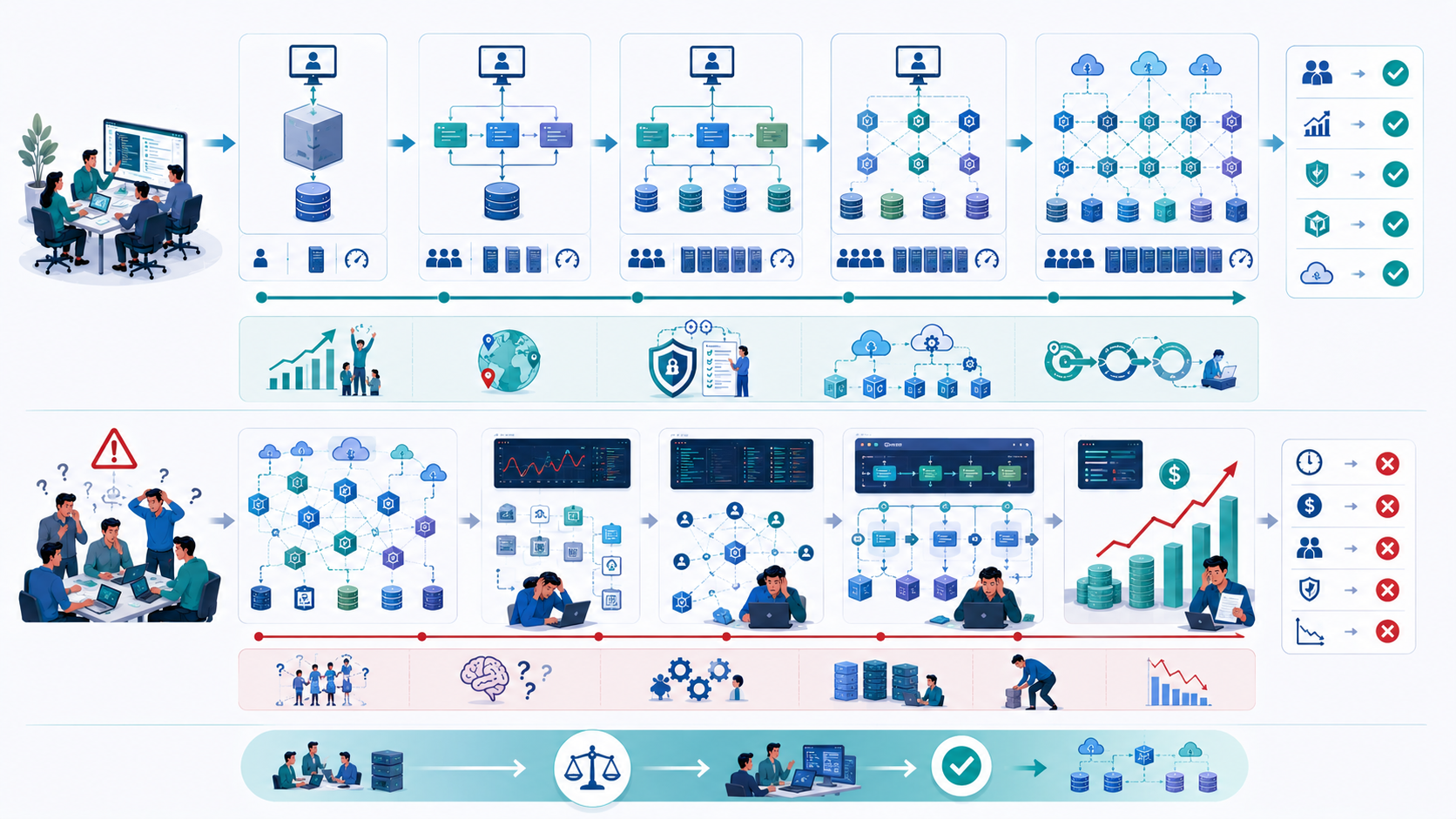
For example, recommending a well-structured monolith works well for many startups, but there are situations where it eventually becomes a limitation.
I've seen products outgrow a single application when:
- Multiple engineering teams need to release features independently.
- Different parts of the product have very different scaling requirements.
- Regulatory or security requirements demand strict service isolation.
- Certain workloads require specialized infrastructure.
- Independent deployments become essential to maintain development velocity.
In these situations, moving toward a distributed or service-oriented architecture may be justified.
The opposite can also happen.
Some teams adopt a distributed architecture far too early and spend more time maintaining services than building features. Suddenly, developers need to manage service discovery, distributed logging, monitoring, network communication, and deployment pipelines for systems that could have comfortably remained inside a single application.
Budget is another factor that often gets ignored.
A sophisticated cloud architecture may look impressive, but every additional service increases operational costs. Small engineering teams rarely have dedicated platform engineers, so the developers building features also become responsible for maintaining the infrastructure.
That's rarely sustainable.
The best architecture is rarely the most advanced.
It's the one your current team can confidently understand, maintain, and improve.
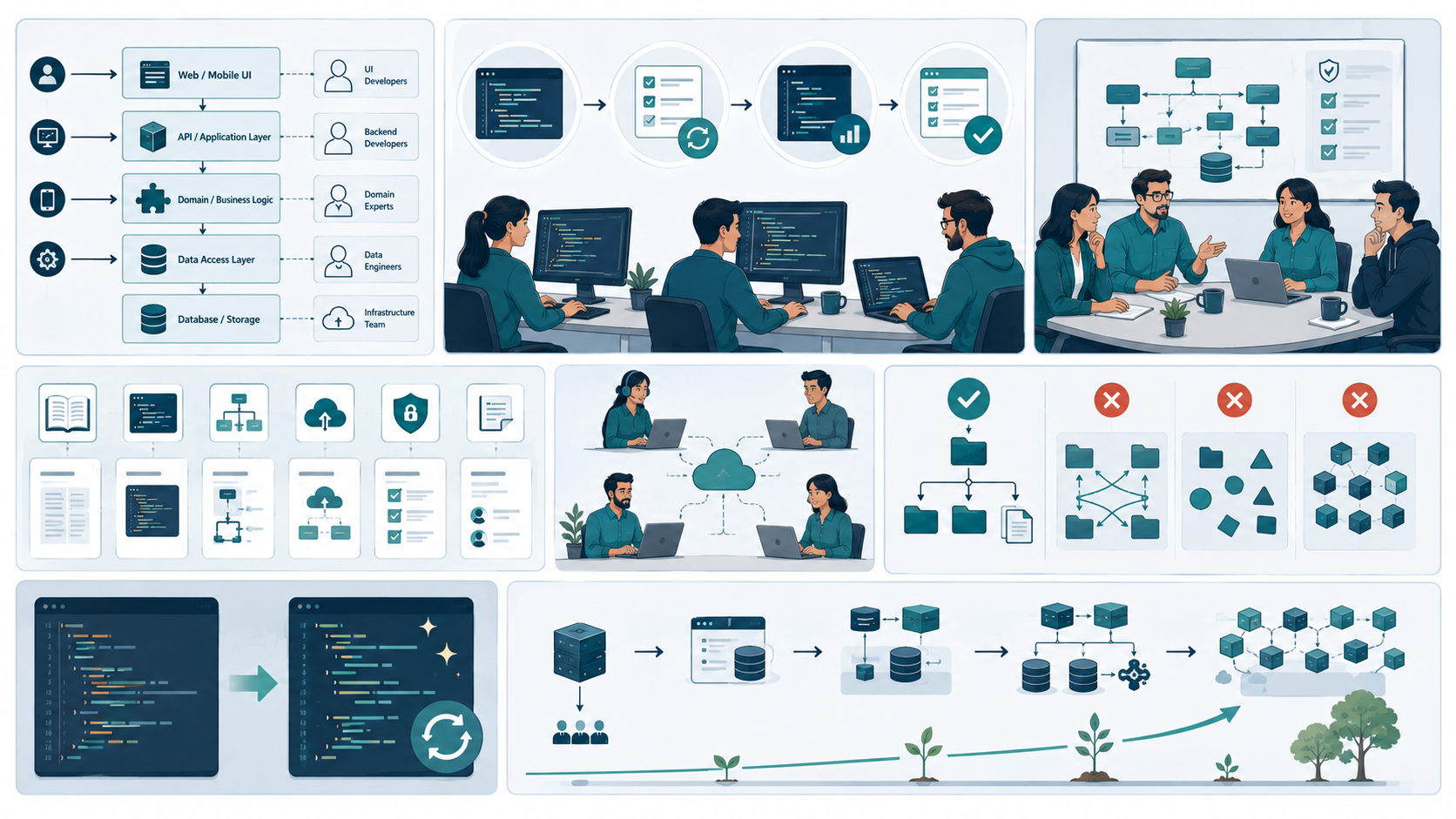
Sustainable Practices for Small Engineering Teams
Over the years, I've noticed that successful engineering teams aren't necessarily the ones using the newest technologies. They're the ones that consistently make sensible architectural decisions.
A few practices have proven valuable across almost every project I've worked on.
Keep Responsibilities Clear
Every module should have a single, well-defined purpose.
When developers immediately know where new functionality belongs, the codebase stays organized as it grows.
Refactor Continuously
Many teams postpone refactoring because they're focused on shipping features.
In reality, small improvements made every sprint prevent technical debt from becoming overwhelming.
Waiting six months to "clean everything up" almost never works.
Review Architecture—Not Just Code
Most pull requests focus on syntax, formatting, or implementation details.
Architecture deserves regular discussion too.
Questions worth asking include:
- Does this increase unnecessary coupling?
- Are we creating hidden dependencies?
- Is this design still aligned with our product?
- Will another developer understand this decision six months from now?
These conversations often prevent long-term problems before they're introduced.
Make Documentation Part of Development
Documentation shouldn't be treated as something you write after the project is finished.
Simple architecture diagrams, API references, deployment notes, and decision records save countless hours for future developers.
Even lightweight documentation dramatically improves onboarding for remote engineering teams.
Prefer Consistency Over Cleverness
I've inherited projects where every developer used a different pattern.
One module followed clean architecture.
Another used MVC.
A third relied heavily on custom abstractions.
Individually, none of these decisions were wrong.
Together, they created confusion.
Consistency across the codebase is often more valuable than choosing the "perfect" pattern.
Build Only for Today's Realistic Growth
Planning for growth is important.
Planning for imaginary scale isn't.
It's perfectly acceptable to redesign parts of the architecture as the product evolves.
In fact, that's exactly what healthy engineering teams do.
Trying to predict every future requirement usually leads to unnecessary complexity instead of flexibility.
Conclusion
Software architecture isn't about choosing between microservices, monoliths, or the latest cloud platform.
It's about making thoughtful decisions that help your software remain understandable, reliable, and adaptable as both the product and the engineering team grow.
The biggest mistake I continue to see is treating architecture as a one-time decision made at the beginning of a project.
In reality, architecture evolves alongside the business.
A good architecture supports change instead of resisting it. It keeps responsibilities clear, reduces unnecessary complexity, and gives developers confidence to add new features without constantly worrying about breaking existing functionality.
If there's one lesson I've learned from working with startup teams over the years, it's this:
The simplest architecture that solves today's real problem is almost always better than an elaborate architecture designed for problems that may never exist.
As your product grows, your architecture should grow with it—deliberately, incrementally, and always with the team's ability to maintain it in mind.
What is Software Architecture?: FAQs
Software architecture is the high-level blueprint of a software system. It defines how different components are organized, how they communicate, and how the application supports qualities like scalability, maintainability, security, and performance over time.
In many cases, yes. A well-structured monolith is easier to develop, test, deploy, and maintain for small engineering teams. Microservices become valuable only when the product's complexity, scaling needs, or team size justify the additional operational overhead.
Architecture should be reviewed regularly—typically every few months or after significant product changes. Reviewing architectural decisions helps identify growing technical debt, changing system requirements, and opportunities to simplify the system before issues become costly.
Yes, but indirectly. Performance depends on implementation details as well as architectural decisions. Poor service boundaries, unnecessary network communication, inefficient database interactions, or tightly coupled components can all reduce application performance even when the underlying code is well written.
Startup codebases usually become difficult to maintain because features are prioritized over architectural consistency. As deadlines increase, responsibilities become blurred, technical debt accumulates, documentation falls behind, and developers introduce shortcuts that eventually slow future development. Consistent architectural reviews and gradual refactoring help prevent these problems.
Reference
Written by

Paras Dabhi
VerifiedFull-Stack Developer (Python/Django, React, Node.js)
I build scalable web apps and SaaS products with Django REST, React/Next.js, and Node.js — clean architecture, performance, and production-ready delivery.
LinkedIn