
How To Design APIs For Growing Business Applications
A small SaaS application can start with a handful of API endpoints and still work perfectly well. The problems usually appear later.
A product gains customers, more developers join the team, integrations are added, and suddenly an endpoint that once served one frontend is being used by mobile apps, internal tools, third-party systems, and automated workflows.
At that point, changing the API becomes risky.
A field that looked unnecessary six months ago may now be consumed by another service. A database query that worked for 500 users may become a performance bottleneck at 50,000. An authentication change can break integrations you did not even know existed.
I have seen this happen repeatedly in small SaaS and client projects. The API itself was not necessarily badly written. The bigger problem was that the team designed it for today's application instead of the business application it was likely to become.
Good API design is therefore less about predicting the future and more about making future changes safe.

Why API Design Becomes Difficult in Real Teams
The first version of an API is usually created under time pressure.
A startup needs an MVP. A product manager needs a feature by Friday. Developers have limited engineering resources. The simplest implementation often wins.
That is not necessarily a bad decision.
The problem begins when temporary decisions quietly become permanent architecture.
Startup deadlines encourage shortcuts
Early teams commonly create endpoints around immediate screens:
GET /users
GET /orders
GET /dashboard
GET /reports
This can work initially.
But as the application grows, these endpoints often become responsible for too much business logic. A dashboard endpoint might start fetching users, orders, payments, notifications, analytics, and account information in one request.
The endpoint becomes difficult to test, slow to respond, and dangerous to modify.
Scaling assumptions are often wrong
Teams sometimes design APIs around an expected scale without knowing whether that scale will actually arrive.
Other teams do the opposite and build complex infrastructure for millions of users before they have a thousand.
Both approaches create problems.
The better approach is to identify the parts of the system that are likely to grow independently:
- API traffic
- database queries
- background processing
- third-party integrations
- file storage
- authentication
- reporting workloads
That gives the architecture room to evolve without introducing unnecessary complexity.
Limited engineering resources change the decision
A team of three developers cannot maintain the same architecture as a company with 300 engineers.
This matters when deciding between a modular monolith and microservices.
Microservices may provide strong isolation, but they also introduce service communication, deployment complexity, monitoring requirements, authentication between services, logging, network failures, and operational overhead.
For many small teams, a well-structured modular application is easier to maintain.

Where Most Teams Make the Wrong API Decision
One of the biggest mistakes I see is treating API architecture as a framework decision.
Teams spend time debating REST, GraphQL, microservices, API gateways, or particular frameworks while ignoring the more important questions:
What will change? Who consumes the API? What must remain stable? Where does business logic belong?
Overengineering the first version
A common pattern is building an API as though the company already has millions of users.
That can lead to:
- Multiple microservices
- Complex API gateways
- Distributed authentication
- Event-driven infrastructure
- Several databases
- Kubernetes deployments
- Multiple message queues
None of these technologies are inherently wrong.
The issue is operational complexity.
If two developers need half a day to understand how a simple customer update moves through five services, the architecture may be too complicated for the current product.
Treating endpoints as permanent contracts
An API endpoint is effectively a contract between systems.
Once external clients depend on it, changing the response structure can become expensive.
For example, changing:
{
  "customer_name": "John Smith"
}
to:
{
  "name": "John Smith"
}
looks harmless.
But if multiple clients depend on customer_name, that change can break them.
This is where versioning and backward compatibility become important.
You do not necessarily need multiple API versions for every small change. But you should recognize which changes are breaking and establish a process for handling them.
Putting business logic directly inside controllers
Another common mistake is allowing API controllers to become the application's business-logic layer.
A controller might eventually contain:
- Authentication checks
- Validation
- Database operations
- Pricing calculations
- Payment logic
- Notification handling
- Third-party integration logic
- Error handling
That becomes difficult to maintain.
A cleaner architecture separates responsibilities:
Request
   ↓
Controller
   ↓
Validation
   ↓
Service Layer
   ↓
Business Logic
   ↓
Repository / Database
This separation makes testing and future changes much easier.
Practical API Design That Actually Works
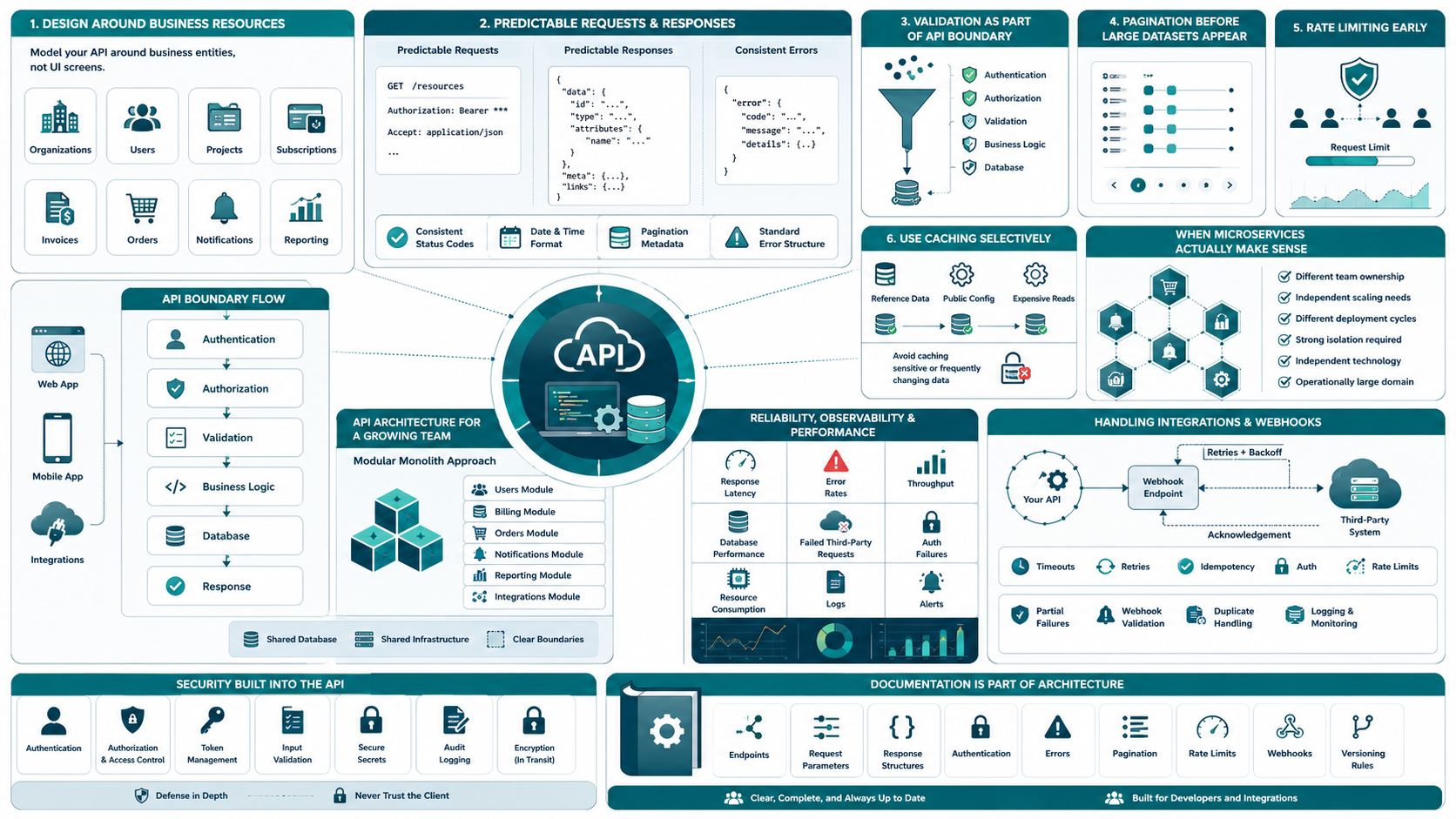
You do not need a perfect architecture from day one. You need an architecture that can change safely. Working with a US software engineering team for scalable API design helps businesses plan API resources, predictable responses, validation, pagination, rate limiting, caching, modular architecture, integrations, webhooks, security, observability, documentation, and versioning before the application grows harder to change.
1. Design around business resources
Start by identifying the application's core resources.
For a SaaS product, these might include:
- Organizations
- Users
- Projects
- Subscriptions
- Invoices
- Orders
- Notifications
Then define endpoints around those resources rather than individual frontend screens.
For example:
GET    /organizations
GET    /organizations/{id}
POST   /organizations
PATCH  /organizations/{id}
DELETE /organizations/{id}
This gives the API a consistent structure as new frontend applications and integrations appear.
2. Keep requests and responses predictable
Consistency becomes increasingly valuable as the API grows.
Use consistent patterns for:
- HTTP status codes
- Error responses
- Pagination
- Resource naming
- Validation errors
- Authentication failures
- Date and time formats
- Response structures
For example:
{
  "error": {
    "code": "INVALID_REQUEST",
    "message": "The email address is invalid"
  }
}
A predictable error structure is much easier for frontend developers and external integrations to consume.
3. Treat validation as part of the API boundary
Never assume the client will send valid data.
Validation should happen before business logic executes.
For example:
Who are you?
Authorization answers:
Are you allowed to perform this operation?
Validation answers:
Is the request itself valid?
Keeping these concerns separate makes security and maintenance easier.
Request
   ↓
Authentication
   ↓
Authorization
   ↓
Validation
   ↓
Business Logic
Authentication answers:
4. Design pagination before large datasets appear
Returning every record might work during development.
It becomes a problem later.
Instead of:
GET /orders
returning thousands of records, introduce pagination:
GET /orders?page=2&limit=50
For very large datasets or frequently changing data, cursor-based pagination can be more appropriate.
The important point is to avoid designing endpoints that assume datasets will remain small.
5. Think about rate limiting early
As APIs become accessible to mobile clients, partners, integrations, and automated processes, uncontrolled traffic can affect availability.
Rate limiting helps protect the system from:
- Accidental request loops
- Abusive clients
- Misconfigured integrations
- Traffic spikes
- Expensive API operations
Throttling can also be applied differently depending on the operation.
A read endpoint may tolerate higher traffic than an expensive report-generation endpoint.
6. Use caching selectively
Caching can improve API performance significantly, but it should not become a substitute for fixing inefficient architecture.
Good caching candidates often include:
- Frequently requested reference data
- Public configuration
- Relatively stable resources
- Expensive read operations
Be careful with highly dynamic business data.
Incorrect caching can produce a faster API that returns incorrect information, which is usually worse than a slower API.
API Architecture for a Growing Team
As the product grows, modularity becomes more important than simply adding infrastructure.
A modular monolith can be a strong choice for small and medium-sized SaaS applications.
For example:
Application
│
├── Users
├── Billing
├── Orders
├── Notifications
├── Reporting
└── Integrations
Each module can have clear boundaries around its business logic.
Later, if the Billing module becomes large enough to require independent scaling or deployment, it has a cleaner path toward becoming a separate service.
This is usually safer than starting with ten microservices and discovering later that nobody knows where a particular business rule belongs.
When microservices actually make sense
Microservices become more attractive when you have a genuine reason for service boundaries.
For example:
- Different teams own different domains
- One workload requires independent scaling
- Services have significantly different deployment cycles
- Strong isolation is required
- Independent technology choices are necessary
- A specific domain has become operationally large
The important word is reason.
Do not introduce microservices simply because the application is growing.
Reliability, Observability, and Performance Matter More as Traffic Grows
API design is not finished when an endpoint returns the correct JSON.
A production API also needs to be observable.
At minimum, monitor:
- Response latency
- Error rates
- Throughput
- Database performance
- Failed third-party requests
- Authentication failures
- Resource consumption
Logging should provide enough context to diagnose failures without exposing sensitive information.
Observability becomes particularly important in remote engineering teams because developers may not be online at the same time.
A developer in Germany might deploy a change that causes an issue for a team working in the US several hours later.
Good monitoring and logging reduce the dependency on someone being available to explain what happened.
Handling Integrations and Webhooks
Growing business applications rarely operate alone.
They connect with payment providers, CRMs, email systems, analytics platforms, shipping services, identity providers, and other business tools.
This is where API integration design becomes critical.
Do not assume that third-party requests will always succeed.
A practical integration should consider:
- Timeouts
- Retries
- Idempotency
- Authentication
- Rate limits
- Partial failures
- Webhook validation
- Duplicate events
- Logging
For example, if a payment webhook is delivered twice, your application should not create two invoices simply because it received the same event twice.
That is a reliability problem, not merely an integration problem.
Security Should Be Designed Into the API
Security should not be added after the API has already become widely used.
At minimum, growing APIs should consider:
- Authentication
- Authorization
- Access control
- Token management
- Input validation
- Rate limiting
- Secure secrets
- Audit logging
- Transport encryption
Token management deserves particular attention.
Poor token handling can create security problems across multiple clients, especially when mobile applications, web applications, and third-party integrations use the same backend.
The API should also enforce authorization at the server rather than relying on frontend controls.
Hiding a button does not prevent a user from calling the endpoint directly.
Documentation Is Part of API Architecture
Documentation is often treated as something to write after development.
In growing teams, that approach creates unnecessary friction.
Good API documentation should make it easy to understand:
What does this endpoint actually return?
if the answer can be documented clearly.
Documentation also improves developer experience when external partners begin consuming the API.
- Available endpoints
- Request parameters
- Response structures
- Authentication requirements
- Error responses
- Pagination
- Rate limits
- Webhooks
- Versioning rules
This is particularly valuable for remote teams.
A developer should not have to ask another developer:
Read More:
Software Development Ownership Models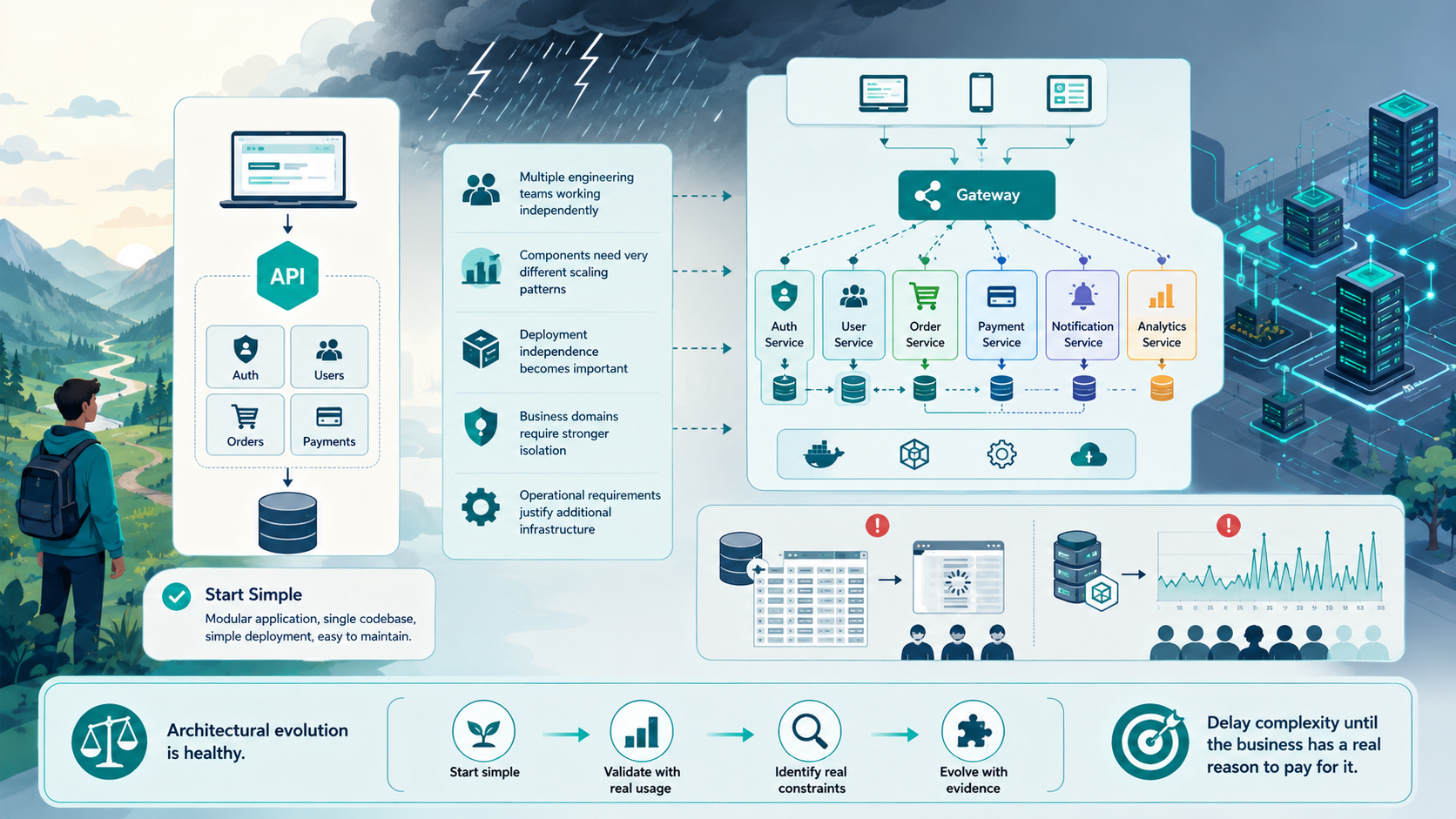
When This Approach Fails
There is no universal API architecture.
A simple modular application can eventually become difficult to maintain if the business becomes extremely large or the domain boundaries become too complex.
You may need independent services when:
- Multiple engineering teams work independently
- Certain components require very different scaling patterns
- Deployment independence becomes important
- Business domains need stronger isolation
- Operational requirements justify the additional infrastructure
Similarly, basic pagination may not be enough for extremely large datasets, and simple caching may become insufficient when traffic patterns change significantly.
The goal is not to avoid architectural evolution.
The goal is to delay complexity until the business has a real reason to pay for it.
Sustainable API Practices for Small Engineering Teams
A growing API benefits from a few disciplined habits more than from a large technology stack.
Keep API contracts explicit
Before changing an endpoint, identify who consumes it and whether the change is backward compatible.
Keep modules understandable
Developers should be able to locate business logic without searching through unrelated controllers and services.
Test important contracts
Focus testing on critical business workflows and API contracts rather than trying to test every implementation detail.
Monitor production behavior
Performance problems are easier to solve when you can see latency, errors, throughput, and database behavior.
Document decisions
You do not need hundreds of pages of architecture documentation.
Record important decisions such as:
- Why a module exists
- Why an endpoint behaves a certain way
- Why a particular versioning strategy was selected
- Why a service boundary exists
Avoid architecture driven by fear
One of the most expensive habits in software development is building infrastructure for problems that may never happen.
Design for reasonable growth.
Measure actual bottlenecks.
Then change the architecture when the evidence justifies it.
Conclusion
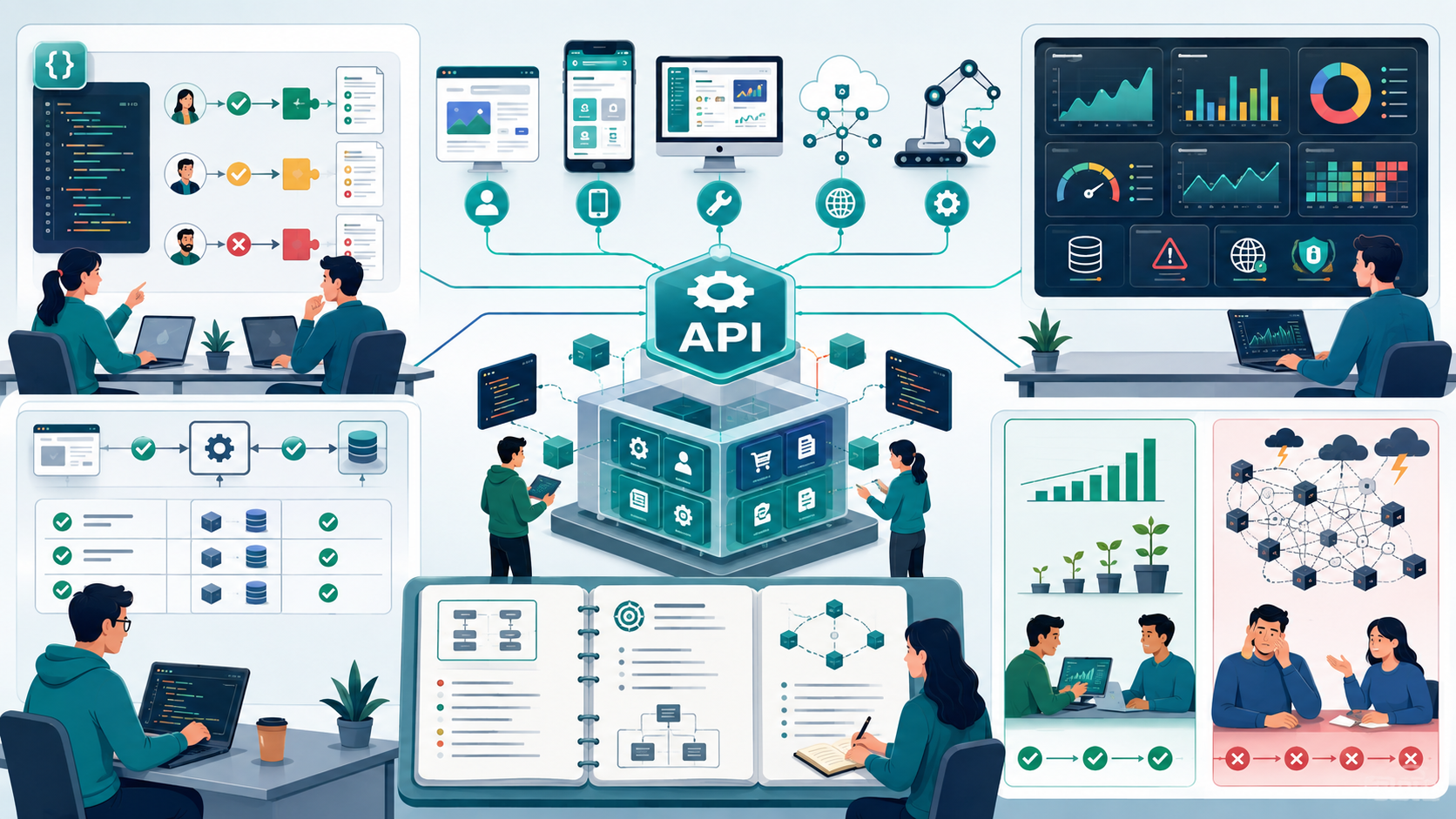
Designing APIs for growing business applications is less about choosing the most advanced architecture and more about creating stable boundaries that can evolve.
The biggest mistake small engineering teams make is either keeping everything informal for too long or introducing unnecessary complexity too early.
A better approach is to build consistent endpoints, separate business logic from transport concerns, validate requests, plan for pagination, protect the API with authentication and authorization, document contracts, monitor production behavior, and treat backward compatibility seriously.
Start simple, but do not make the code disposable.
The API you build for an MVP may eventually become the foundation for your web application, mobile clients, internal tools, and third-party integrations. Designing those boundaries carefully from the beginning can save your team from a painful rewrite later.
How To Design APIs For Growing Business Applications: FAQs
Yes. For many small and medium-sized SaaS teams, a modular monolith provides clear boundaries without the operational complexity of microservices. It can also provide a practical path toward extracting individual services later.
Versioning is most important when you need to introduce breaking changes while existing clients still depend on the current contract. Not every API change requires a new version.
Start by measuring actual bottlenecks. Pagination, database optimization, caching, rate limiting, load balancing, and horizontal scaling can address different types of growth. Avoid adding infrastructure before understanding the constraint.
No. An API gateway can be useful when routing, authentication, rate limiting, or service aggregation needs justify it. A small application may not benefit enough to justify another operational layer.
Treat API responses as contracts. Use backward-compatible changes where possible, document changes, test important contracts, and introduce versioning when a breaking change is unavoidable.
Reference
Written by

Paras Dabhi
VerifiedFull-Stack Developer (Python/Django, React, Node.js)
I build scalable web apps and SaaS products with Django REST, React/Next.js, and Node.js — clean architecture, performance, and production-ready delivery.
LinkedIn