
Mobile App Development Cost In Ahmedabad
A founder once asked me why one company quoted ₹3 lakh for a mobile app while another quoted ₹22 lakh for what sounded like the same idea.
This situation happens all the time in Ahmedabad’s startup and SME ecosystem.
From the outside it looks like agencies are randomly pricing projects.
But in most cases, the real reason is something else — the scope of the app is unclear, and everyone is estimating different things.

Why mobile app development cost varies so much in Ahmedabad
The biggest misconception founders have is that an app idea has a fixed price.
In real projects, the cost changes because the actual work behind the app changes a lot depending on the decisions made early.
Here are the biggest factors that create huge price differences.
1. MVP vs full product confusion
Many founders say they want a “simple app,” but when the feature list is discussed, it often includes everything planned for the final product. An MVP (Minimum Viable Product) focuses only on the core functionality needed to test the idea. When teams estimate a full product instead of an MVP, the development scope grows quickly, which significantly increases the cost and timeline.
Many founders describe their idea as “just a simple app.”
But when you break it down, the feature list usually looks like this:
- User login
- Real-time notifications
- Payment integration
- Admin dashboard
- Analytics
- Messaging
- Cloud storage
- Third-party integrations
That is not a simple app anymore.
Some development teams estimate only the MVP, while others estimate the full product vision.
That alone can multiply the cost.
2. Backend complexity
Many people assume the mobile interface is the main part of the app, but in most projects the backend handles the majority of the logic. Features like user authentication, data storage, notifications, payment systems, and API integrations all run behind the scenes. As these systems become more complex, the development time and cost increase significantly.
Most founders think the app screen is the main work.
In reality, the backend usually takes more time than the mobile interface.
Things that increase backend complexity include:
- real-time syncing
- role-based user systems
- payments and transaction records
- notification services
- integrations with other platforms
I’ve worked on apps where the mobile UI took 4 weeks, but the backend took 4 months.
3. Native vs cross-platform development
One major factor that affects app development cost is whether the app is built using native technologies or a cross-platform framework. Native apps require separate development for Android and iOS, which usually increases time and cost. Cross-platform development can reduce initial effort, but the choice depends on performance needs and long-term scalability.
Another cost difference comes from the technical approach.
Some teams build:
- Native apps (separate Android and iOS apps)
- Cross-platform apps (shared codebase)
Native apps usually cost more initially because they require two development environments.
Cross-platform apps can reduce early cost but sometimes require extra work later if performance issues appear.
Different teams choose different approaches — which changes the estimate.
4. Design expectations
Design expectations can significantly affect the cost of building a mobile app. A simple interface using standard components takes much less time than a fully customized UI with animations, unique layouts, and detailed user flows. When founders expect a highly polished design similar to large consumer apps, the design and testing effort increases considerably.
Design is another area founders underestimate.
Basic UI design may include:
- simple layouts
- standard components
- basic user flows
But if the product needs:
- custom animations
- advanced onboarding flows
- complex UX interactions
- brand-focused UI
Then design alone can take weeks or months.
Many estimates change significantly depending on how polished the app needs to be.

Where most founders and teams miscalculate app development cost
After working with startups for years, I’ve seen the same mistakes happen repeatedly.
Expecting accurate estimates with unclear requirements
Many founders ask for development quotes before the app’s features and workflows are clearly defined. When requirements are vague, developers have to make assumptions about functionality, integrations, and complexity. This often leads to very different estimates from different teams because each one is imagining a different scope for the same idea.
I’ve seen founders ask for a price with a one-paragraph description of the app idea.
At that stage, every development team is forced to guess the scope.
One team may estimate conservatively, another may assume fewer features.
That’s why the quotes look completely different.
Ignoring infrastructure costs
Many founders focus only on the cost of building the mobile app itself and overlook the infrastructure required to run it. Things like cloud hosting, databases, storage, and notification services are essential for most modern apps. These components add ongoing costs and development effort that are often not considered in early budget estimates.
Many people only think about the mobile app itself.
But production apps usually need:
- cloud hosting
- databases
- notification systems
- analytics tools
- monitoring tools
These are not huge costs individually, but they add up over time.
Assuming version one is the final version
Many founders expect the first version of the app to be the finished product. In reality, most apps go through several updates after launch based on user feedback and real-world usage. New features, improvements, and bug fixes are common, which means additional development time and cost after the initial release.
Almost every successful product goes through multiple iterations.
The first version usually reveals:
- missing features
- UX issues
- scalability problems
- user behavior surprises
Founders who assume the first version is the final product often underestimate the budget.

Practical ways to estimate mobile app development cost realistically
When founders ask me how to estimate app cost properly, I usually suggest a simple process.
1. Define a strict MVP
Before estimating development cost, it’s important to clearly define the Minimum Viable Product (MVP). This means focusing only on the core features needed to solve the main problem the app addresses. By removing non-essential features, startups can reduce development time, control costs, and launch the product faster to test the idea.
Start by identifying the core problem the app solves.
Then remove every feature that doesn’t directly support that problem.
For example:
Instead of building:
- chat
- analytics
- admin roles
- social sharing
Start with just:
- user registration
- core feature
- basic admin panel
This dramatically reduces the initial cost.
2. Break the project into modules
Instead of estimating the entire app as one large project, it helps to divide it into smaller modules. For example, separate the mobile app, backend system, admin panel, and third-party integrations. This makes the development effort clearer and allows teams to estimate costs more accurately for each part.
Instead of estimating the whole product at once, divide it into modules:
- mobile app
- backend system
- admin dashboard
- integrations
- design
This makes cost estimation more transparent.
3. Separate design from development
Design and development are often treated as a single task, but they involve very different work. Design includes wireframes, user flows, and UI layouts, while development focuses on building the actual functionality of the app. Separating these stages helps teams estimate time and cost more accurately and prevents confusion during the project.
Design work is often mixed into development estimates.
But design usually includes:
- wireframes
- UX flow mapping
- UI design
- revisions
Separating design helps founders understand where time is actually going.
4. Budget for iteration
The first version of an app rarely stays unchanged after launch. Once real users start using it, teams usually discover bugs, usability issues, or features that need improvement. Setting aside a budget for these iterations helps ensure the product can evolve without unexpected financial pressure.
Even well-planned apps need changes.
Plan a budget for:
- bug fixes
- feature adjustments
- performance improvements
Ignoring iteration costs is one of the most common budgeting mistakes.
When lower app development cost becomes risky
Lower pricing isn't automatically bad.
But extremely cheap development usually leads to problems later.
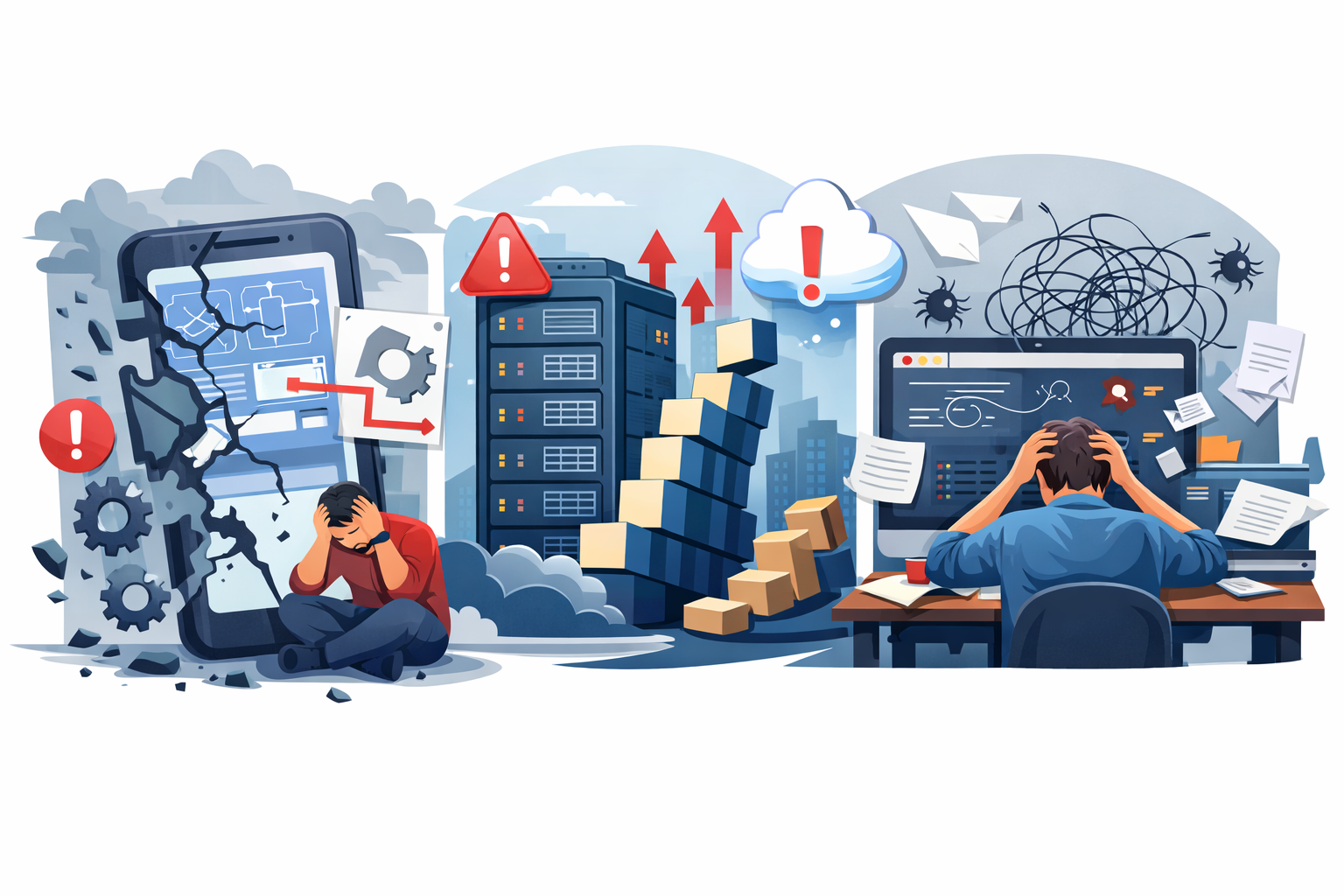
I’ve seen apps where the initial build was cheap but caused serious issues within a year.
Poor architecture
When apps are built quickly to reduce cost, teams sometimes skip proper architecture planning. This can lead to issues like slow performance, difficulty adding new features, and unstable systems as the app grows. Fixing these problems later often requires major refactoring, which can cost more than building it correctly in the beginning.
Quick builds often skip proper architecture planning.
Later problems include:
- slow performance
- difficulty adding new features
- unstable releases
Scalability problems
An app might work perfectly when only a few users are using it, but problems appear as the user base grows. Without proper scalability planning, the system can struggle with higher traffic, slower performance, or frequent crashes. Fixing scalability issues later often requires significant backend changes and additional development effort.
An app that works for 100 users may fail at 10,000 users. If scalability isn't considered early, fixing it later becomes expensive.
Unmaintainable code
When development is rushed or done without proper coding standards, the codebase can become difficult to understand and modify. New developers may struggle to work with poorly structured or undocumented code. Over time, even small updates can take longer to implement, increasing maintenance effort and cost.
Some projects are rushed with little documentation. When the original developers leave, new developers struggle to understand the codebase.
That can make future updates extremely slow.
Read More → Mobile App Development cost factors for startups

Best practices for startups building mobile apps with limited budgets
For small startups, the goal shouldn’t be building the perfect app immediately.
The goal should be building something usable and improving it quickly.
Here are a few practical habits that help.
Build the MVP first
Instead of trying to launch a complete product with every possible feature, startups should begin with a Minimum Viable Product (MVP). This version focuses only on the core functionality needed to solve the main user problem. Launching an MVP helps teams validate the idea faster and improve the app based on real user feedback.
Avoid over-engineering
Early-stage apps often fail when teams try to build complex systems before they are actually needed. Startups usually make better budget decisions when they work with an experienced team for cost-effective app development that can keep the product simple in the beginning and improve it as real user needs become clearer. Adding unnecessary layers, advanced architectures, or heavy frameworks can slow development and increase costs.
Early products don’t need complex systems.
Simple architecture often works better for early-stage startups.
Document architecture early
Even for small apps, documenting the basic system architecture early can save a lot of confusion later. Things like API structure, database models, and deployment setup help developers understand how different parts of the system connect. This makes it easier for new developers to work on the project and reduces future maintenance problems.
Even small projects benefit from basic documentation.
Things like:
- API structure
- database models
- deployment setup
This prevents confusion later.
Prioritize core features
When building a new app, it’s important to focus on the features that directly solve the main problem for users. Adding too many secondary features in the first version can increase development time and cost. By prioritizing core functionality first, teams can launch faster and improve the product gradually based on real user feedback.
Plan for iteration cycles
Most successful apps improve through multiple updates after launch. User feedback, performance issues, and new feature ideas often require ongoing changes. Planning for iteration cycles helps teams continuously refine the product without disrupting development or budget expectations.
The first version is just the beginning.
Expect to refine the product based on real user feedback.
Conclusion
Mobile app development cost in Ahmedabad isn’t random.
The biggest factor isn’t the city or the development company — it’s how clearly the product scope is defined.
When founders start with vague ideas, development teams are forced to estimate based on assumptions.
That’s why quotes can range from a few lakhs to several tens of lakhs.
The most reliable way to estimate cost is to focus on a clear MVP, realistic feature scope, and an iterative development plan.
Once those things are defined, pricing becomes much easier to understand.
FAQ
For most startup MVPs, costs usually range from a few lakhs to higher depending on backend complexity, integrations, and design requirements.
Because many estimates are created before the product scope is clearly defined, so teams make different assumptions.
It can reduce development time initially, but the trade-offs depend on performance requirements and long-term maintenance.
The most effective way is launching with a focused MVP instead of trying to build every feature in the first version.
Backend complexity, third-party integrations, and unclear product scope are usually the biggest cost drivers.
References
Written by

Paras Dabhi
VerifiedFull-Stack Developer (Python/Django, React, Node.js)
I build scalable web apps and SaaS products with Django REST, React/Next.js, and Node.js — clean architecture, performance, and production-ready delivery.
LinkedIn