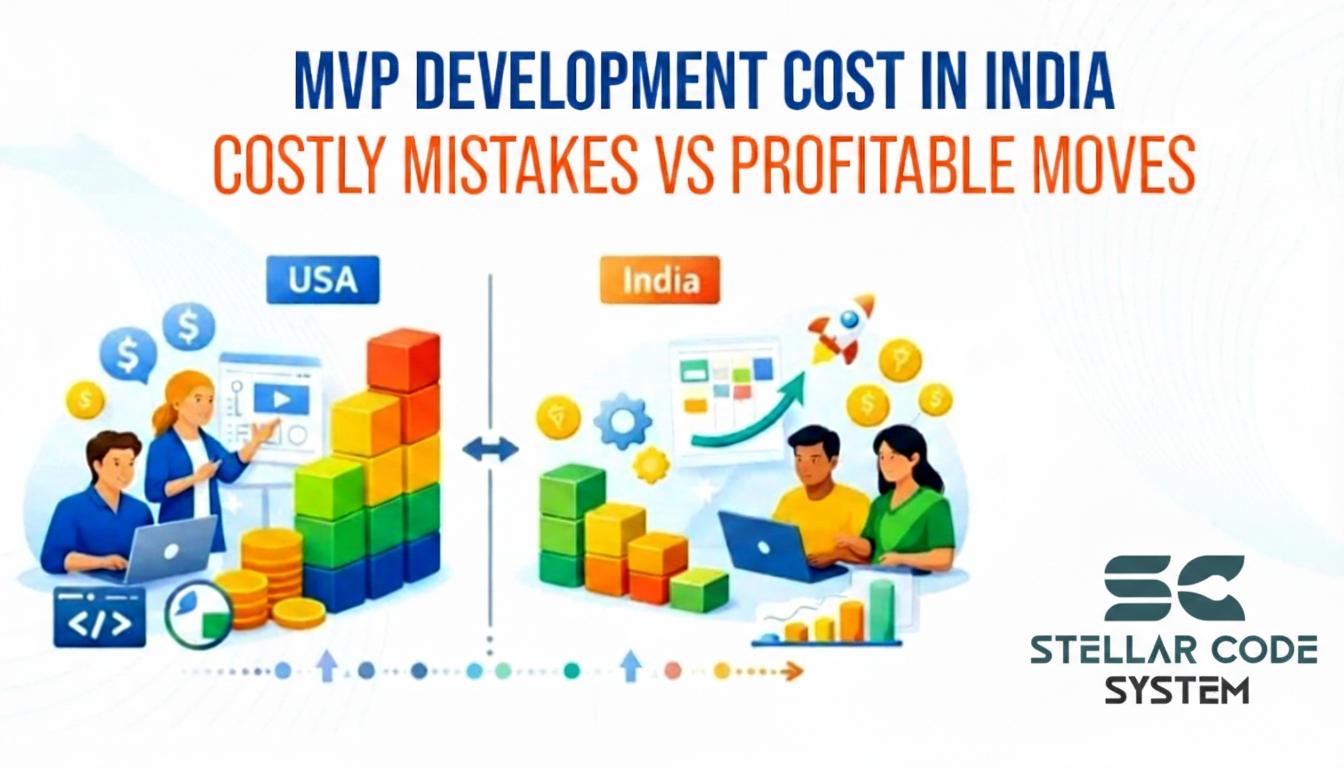
MVP Development Cost in India: Costly Mistakes vs Profitable Moves
A founder once told me, “We were quoted $18K for our MVP. We’ve already crossed $35K and it’s still not stable.” I’ve heard versions of that story too many times.
The problem usually isn’t that MVP development cost in India is “too high.”
It’s that the cost becomes uncontrolled because of how decisions are made.
Let me break down where things actually go wrong.
Why MVP Development Cost in India Actually Becomes Unpredictable

From my experience in small teams, startups, and agencies — unpredictability comes from decisions, not hourly rates.
1. Poor Feature Scoping
Poor feature scoping usually starts with vague requirements that sound simple but hide technical complexity.
What looks like “just a dashboard” can expand into multiple integrations, permissions, edge cases, and UI states.
When features aren’t clearly defined at the start, developers make assumptions — and assumptions lead to rework.
That rework is where MVP budgets quietly start increasing.
Most MVPs are not scoped — they are imagined.
Founders say:
- “We just need login, dashboard, payments, and analytics.”
But each of those can be 2 days of work or 3 weeks of work depending on detail.
When scope is vague:
- Assumptions multiply
- Rework increases
- Estimates become fiction
And suddenly your “3-month MVP” becomes 6 months.
2. No Clear Product Ownership
When no single person owns product decisions, direction keeps shifting based on opinions rather than priorities.
Developers end up building, revising, and rebuilding the same flows because stakeholders aren’t aligned.
Without one clear decision-maker, small disagreements turn into expensive rework — and MVP costs start increasing without obvious technical reasons.
In early-stage startups, everyone has opinions.
- Founder wants feature A
- Co-founder wants feature B
- Investor suggests feature C
- Agency suggests “best practice” D
Without one decision owner, direction keeps shifting.
Every shift costs money.
I’ve seen projects where 20–30% of budget went into rework caused by internal confusion — not technical difficulty.
3. Scope Changes During Active Sprints
Changing requirements in the middle of a sprint disrupts planned work and forces developers to reshuffle priorities.
Even small “quick additions” can impact database structure, APIs, UI logic, and testing cycles.
When scope isn’t frozen during active sprints, timelines stretch and estimates lose meaning — which is how MVP budgets quietly drift upward.
This is the silent killer.
In most early-stage startups, founders assume:
“It’s just a small addition.”
But in development, small additions create:
- New dependencies
- Additional testing
- UI adjustments
- Backend changes
- Deployment risks
If you don’t freeze scope during sprint cycles, cost becomes elastic.
4. Underestimating Infrastructure & DevOps
Infrastructure and DevOps work is often treated as secondary, but it directly affects stability and scalability.
Setting up cloud environments, CI/CD pipelines, monitoring, backups, and security takes real engineering time.
When this effort isn’t accounted for early, it shows up later as “unexpected” cost — even though it was always necessary for a production-ready MVP.
Teams usually underestimate:
- Hosting setup
- CI/CD configuration
- Monitoring
- Staging environments
- Security hardening
These are not “features,” but they consume real time.
And when they’re not planned early, they appear as “unexpected cost.”
5. Hiring Based Only on Hourly Rate
Choosing a team purely because they offer the lowest hourly rate often leads to slower execution, more back-and-forth communication, and higher rework.
The real cost of an MVP is not the hourly price — it’s the total number of hours multiplied by decision quality.
A slightly higher-rate team that works with clarity and fewer mistakes usually delivers cheaper outcomes than a low-rate team that needs constant correction.
This is common in India.
Founder compares:
- Team A: $18/hour
- Team B: $30/hour
- Chooses Team A.
But what matters is:
- Speed of execution
- Clarity in communication
- Rework rate
- Architectural decisions
A slower $18/hour team can easily cost more than a sharper $30/hour team.
Total outcome cost > hourly rate.
Where Most Founders and Teams Get It Wrong

I’ve seen founders assume MVP means:
“Cheap version of the full product.”
That’s not what MVP is.
MVP should be:
- Smallest usable workflow
- One core value proposition
- No secondary features
Instead, what I often see:
Confusing MVP With Version 1.0
Many founders say they want an MVP, but the feature list looks like a polished Version 1.0.
Adding advanced dashboards, role management, analytics, and edge-case handling turns a validation product into a full-scale build.
An MVP is supposed to test one core value proposition — not launch a complete platform.
When that line gets blurred, development time and cost expand quickly.
Adding:
- Admin dashboards
- Complex analytics
- Role management
- Feature toggles
- Advanced reporting
All before validating core demand.
That’s not MVP. That’s early bloat.
Expecting Agencies to Own Product Strategy
Agencies can execute well, but they shouldn’t be responsible for defining your product vision.
When founders expect the development team to decide what to build, priorities become reactive and scope expands without clear validation.
Without strong product direction from the founder or a product owner, agencies tend to overbuild to stay safe — and that safety margin increases MVP cost.
Agencies can build.
They should not decide what to build.
If you don’t come with clarity:
- They will assume
- They will overbuild
- They will protect themselves with larger estimates
And cost expands.
Not Freezing Scope
When scope isn’t frozen, development becomes a moving target.
New ideas keep entering the pipeline, and previously completed work often needs adjustments to fit updated requirements.
Without firm boundaries around what’s included in a sprint or phase, estimates lose reliability — and MVP costs slowly spiral beyond the original plan.
Every mature team I’ve worked with has one rule:
Scope is frozen during the sprint.
Changes go to next cycle.
Without this discipline, cost projections are meaningless.
Comparing Proposals Line-by-Line
Many founders compare proposals by counting features, screens, or estimated hours, assuming that similar-looking lists mean similar outcomes.
On paper, everything appears comparable — but execution quality and architectural decisions rarely show up in those line items.
What actually drives cost is how the team builds, how much rework happens, and how maintainable the codebase is — not how neat the proposal spreadsheet looks.
Founders compare:
- Screens count
- Feature lists
- Estimated hours
But rarely compare:
- Code ownership
- Architecture approach
- Post-MVP flexibility
- Long-term maintainability
The cheapest proposal often optimizes for today — not 6 months later.
Practical Ways to Control MVP Development Cost in India

This is what has worked consistently in real projects.
1. Define Non-Negotiable Core Features
Before development starts, clearly identify the one core workflow your MVP must deliver. If a feature doesn’t directly support that primary value proposition, it’s optional — not essential.
When teams separate “must-have” from “nice-to-have” early, decision-making becomes simpler and cost remains controlled. Clarity at this stage prevents feature creep later.
Before hiring anyone, answer:
- What is the one workflow that must work?
- What can absolutely wait 3 months?
If a feature does not directly support your core value proposition — cut it.
Deletion reduces cost faster than optimization.
2. Freeze Scope During Sprint Cycles
Once a sprint starts, the scope should stay locked until it ends. Even small mid-cycle changes disrupt planned tasks, increase context switching, and create hidden rework.
Freezing scope doesn’t mean ignoring new ideas — it means scheduling them properly. This discipline keeps timelines predictable and prevents MVP costs from drifting unexpectedly.
2-week sprints, No mid-cycle changes, If something feels urgent, document it for the next sprint.
This alone can reduce budget drift by 20–30%.
3. Assign One Technical Decision Owner
Every MVP needs one person responsible for final technical decisions. When architecture, libraries, or trade-offs are debated endlessly between multiple stakeholders, development slows down and clarity disappears.
A single decision owner reduces confusion, avoids contradictory instructions, and keeps the team moving forward — which directly helps control time and cost.
One person makes final calls on:
- Architecture
- Libraries
- Refactoring
- Trade-offs
Not 4 stakeholders.
Faster decisions = fewer wasted hours.
4. Retain Repository and Infrastructure Ownership
Always keep your source code repositories and cloud infrastructure under your company’s control. When these are owned by an external team, switching vendors or making changes later becomes expensive and complicated.
Owning your repo and infrastructure ensures transparency, reduces dependency risk, and protects you from hidden transition costs as your MVP evolves.
Always:
- Own your Git repository
- Own cloud accounts
- Own deployment pipelines
When ownership is external:
- Switching teams becomes expensive
- Knowledge transfer becomes costly
- Dependency risk increases
Control reduces long-term cost risk.
5. Prefer Deletion Over Addition
In MVP development, every new feature adds not just build time, but testing, maintenance, and future complexity. Small additions compound quickly and make the product harder to manage.
Actively choosing to remove or postpone features keeps the codebase lean and focused. In early stages, what you don’t build often saves more money than what you optimize.
In MVP phase:
Adding a feature costs:
- Build time
- Testing time
- Maintenance cost
Deleting a feature costs:
- Nothing
In small teams, subtraction is survival.
6. Review Infrastructure Cost Monthly
Cloud and third-party service costs can quietly increase as your MVP grows. Unused instances, oversized servers, redundant storage, or forgotten subscriptions slowly drain budget without anyone noticing.
A simple monthly review of hosting, APIs, and SaaS tools helps catch waste early. For early-stage startups, this small discipline can prevent unnecessary burn and keep operational costs predictable.
Cloud costs grow silently.
Review:
- Idle services
- Over-provisioned instances
- Unused storage
- Third-party subscriptions
Early-stage startups burn cash in invisible infrastructure waste.
When This Cost-Control Approach Does NOT Work

Let’s be honest.
Some MVPs are naturally unpredictable.
Deep-Tech / AI-Heavy Products
AI-heavy MVPs are difficult to estimate because much of the work is experimental.
Model training, data quality issues, accuracy tuning, and performance optimization often require multiple iterations that can’t be predicted precisely at the start.
Unlike standard CRUD-based products, outcomes depend on research and experimentation.
That uncertainty naturally increases development time and makes cost more variable.
R&D time is uncertain, Model accuracy may require iteration.
Estimates will fluctuate.
Regulated Industries
MVPs in regulated sectors like fintech, healthcare, or legal tech face strict compliance and security requirements.
Documentation, audits, and adherence to standards add significant overhead that doesn’t exist in typical startups.
Even a simple feature can take longer to implement, test, and approve, making cost estimates less predictable and requiring extra budget for regulatory work.
Fintech, healthcare, compliance-heavy platforms require:
- Documentation
- Security audits
- Legal review
These increase costs beyond normal MVP scope.
Hardware-Dependent Products
MVPs that rely on hardware—like IoT devices, sensors, or custom peripherals—face unique challenges.
Integration issues, device failures, and firmware updates often require repeated development cycles.
These physical dependencies make timelines and costs less predictable, as delays and unforeseen technical problems are almost inevitable compared to pure software MVPs.
IoT, device integrations, sensor-based apps:
- Hardware failures
- Firmware adjustments
- Integration delays
Budget control becomes harder.
Highly Experimental Startups
Startups testing unproven concepts face high uncertainty in both requirements and implementation.
Frequent pivots, prototype failures, and unknown technical challenges make estimates unreliable.
In these cases, MVP cost is harder to control because the team spends more time experimenting, iterating, and validating assumptions rather than building predictable, repeatable features.
If your value proposition itself is unclear, expect iteration cost.
Clarity reduces cost. Experimentation increases it.
Sustainable Cost Practices for Small Indian Dev Teams

For teams of 2–10 engineers, this matters even more.
Clear Sprint Boundaries
Defining clear start and end points for sprints ensures work stays focused and measurable.
Without boundaries, tasks can bleed into each other, causing confusion and hidden delays.
Strict sprint limits help small teams track progress, manage priorities, and prevent cost overruns by keeping development organized and predictable.
Never allow ongoing tasks to stretch indefinitely, Unfinished work multiplies confusion.
Documentation Discipline
Even minimal, well-structured documentation saves significant time in the long run.
Recording decisions, API contracts, and architecture notes prevents repeated questions and miscommunication within the team.
For small MVP teams, maintaining discipline around documentation reduces onboarding overhead, avoids costly mistakes, and keeps development efficient.
Not 50-page documents.
Just:
- Decision logs
- Architecture notes
- API contracts
This reduces onboarding cost and future refactor expense.
Keep Architecture Replaceable
Design your MVP’s architecture so that components can be swapped or refactored without breaking the entire system.
Over-engineered or rigid structures make future changes costly and slow.
A replaceable architecture allows teams to iterate quickly, experiment safely, and control long-term maintenance costs while keeping the MVP flexible for evolving requirements.
Avoid over-engineering.
Choose:
- Simple patterns
- Modular code
- Reversible decisions
An MVP should be replaceable without destroying the company.
Small, Stable Team Structure
Keeping the MVP team small and consistent improves communication, reduces context switching, and preserves project knowledge.
Frequent team changes lead to lost context, repeated explanations, and higher chances of mistakes.
A stable, compact team ensures faster decision-making, smoother execution, and better control over timelines and budget.
Frequent team changes increase:
- Context loss
- Communication gaps
- Rework
Stability is cheaper than constant replacement.
Conclusion
MVP development cost in India is not inherently cheap or expensive.
It becomes expensive when:
- Scope is unstable
- Ownership is unclear
- Decisions are scattered
- Features keep expanding
The teams that control cost are not the cheapest teams.
They are the teams that control decisions.
Cost is a byproduct of discipline.
FAQs
Because scope clarity, team structure, ownership model, and rework rate vary more than hourly pricing.
Yes, but only with tightly limited scope and minimal complexity.
Sometimes upfront, but coordination and quality risks often increase total cost.
Most likely due to scope changes, unclear ownership, or underestimated infrastructure work.
Freeze scope during sprints, assign one decision owner, and cut features aggressively.
About the Author
Paras Dabhi
VerifiedFull-Stack Developer (Python/Django, React, Node.js) · Stellar Code System
Hi, I’m Paras Dabhi. I build scalable web applications and SaaS products with Django REST, React/Next.js, and Node.js. I focus on clean architecture, performance, and production-ready delivery with modern UI/UX.

Paras Dabhi
Stellar Code System
Building scalable CRM & SaaS products
Clean architecture · Performance · UI/UX