
Nearshore vs Offshore Software Development
Choosing between nearshore and offshore software development often looks like a simple cost decision.
It rarely is.
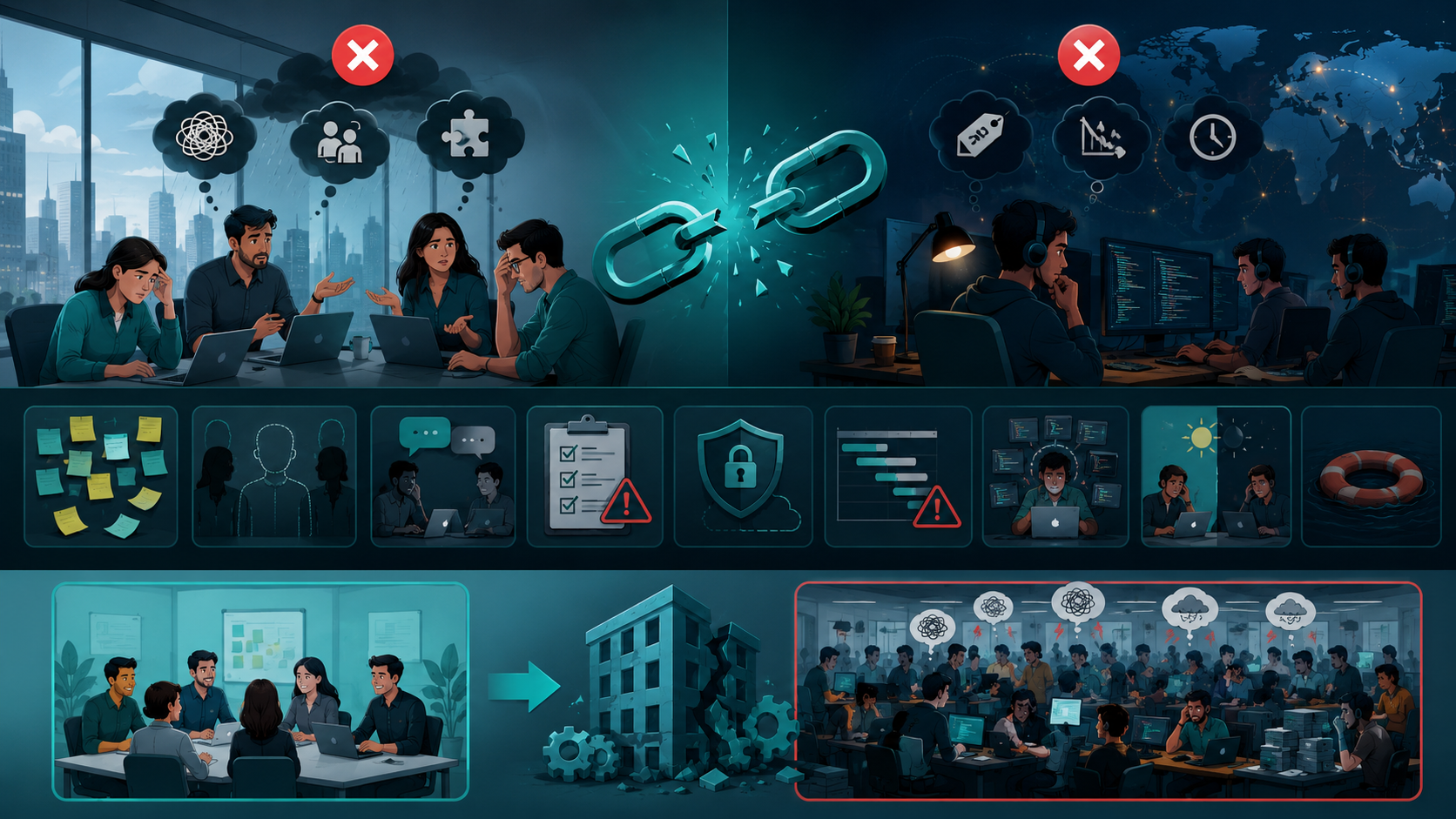
I’ve worked with remote development teams where the initial discussion was almost entirely about costs, pricing, and savings. Six months later, the real problems had nothing to do with the original hourly rate. The issues were around communication, timezone differences, scheduling, availability, unclear requirements, delayed feedback, and coordination between developers and product teams.
That is the part many teams underestimate.
A development team can have excellent engineers and still struggle if the working relationship makes collaboration difficult. Likewise, a geographically distant team can work extremely well when expectations, processes, infrastructure, documentation, and communication are designed properly.
So the real question is not simply nearshore vs offshore software development.
The better question is:
Which delivery model gives your team the right balance of proximity, expertise, cost, flexibility, quality, and operational reliability for the way you actually work?

Why This Decision Happens Differently in Real Teams
Small engineering teams usually make outsourcing decisions under pressure.
A startup may have a product deadline approaching. An internal team may not have enough developers. A SaaS company may need backend expertise that is difficult to hire locally. A product team may need additional engineering resources without committing to a permanent workforce.
Under those conditions, budget naturally becomes important.
But budget is only one variable.
The other variables include:
- Geographic proximity
- Location and distance
- Timezone compatibility
- Language
- Cultural expectations
- Developer availability
- Technical expertise
- Workforce quality
- Communication
- Collaboration
- Coordination
- Infrastructure
- Security
- Compliance
- Project management
- Delivery expectations
- Long-term support
This is why two teams can choose completely different outsourcing models and both make the right decision.
A US startup that needs several hours of daily overlap with its engineering team may benefit from a nearshore model. Another company with a mature documentation process and asynchronous workflow may be perfectly comfortable working with an offshore team several time zones away.
The delivery model needs to fit the operating model.

Nearshore vs Offshore: What Actually Changes?
The basic distinction is geographic.
Nearshore development usually means working with a team in a nearby or relatively compatible region, often with significant timezone overlap.
Offshore development generally means working with a team located farther away, potentially across several time zones.
That geographic difference affects more than travel.
It can influence:
| Factor | Nearshore | Offshore |
|---|---|---|
| Geographic proximity | Higher | Lower |
| Timezone overlap | Usually higher | Can vary significantly |
| Communication | Often easier in real time | May rely more on asynchronous communication |
| Cultural alignment | Often closer | Can require more adaptation |
| Cost | Can be higher | Often lower |
| Talent pool | Strong, but geographically limited | Potentially much larger |
| Scheduling | Easier for synchronous teams | Requires deliberate planning |
| Collaboration | More real-time opportunities | More documentation may be necessary |
| Scalability | Depends on region | Often broad access to talent |
| Travel | Usually easier | Can require longer planning |
These are tendencies, not rules.
A strong offshore team can outperform a poorly managed nearshore team. Geographic proximity does not automatically produce quality.

Where Most Teams Make the Wrong Decision
The biggest mistake I see is treating hourly pricing as the total cost.
Suppose one team has a lower development rate. That looks attractive until developers spend extra time waiting for clarification, product managers repeat requirements, engineers work around timezone limitations, or releases require additional coordination.
The cheaper rate may not produce cheaper delivery.
The same problem happens in reverse.
Some companies assume that paying more for proximity automatically solves communication and project management problems.
It doesn't.
A nearby team can still have:
- Poor accountability
- Weak technical expertise
- Unclear requirements
- Slow responses
- Poor documentation
- Low-quality code
- Weak security practices
- Inconsistent delivery
I’ve seen both situations.
The better decision starts by identifying where your team is actually losing time.
Don't confuse proximity with collaboration
Being in a similar timezone makes collaboration easier, but it does not create collaboration.
A team still needs clear ownership, good communication, documented requirements, predictable scheduling, and accountability.
Don't choose offshore only because it is cheaper
Lower pricing can create meaningful savings, particularly when a company needs a larger development workforce.
But the decision should consider the complete delivery lifecycle.
Ask:
- How much management will the team require?
- How much timezone overlap do we need?
- How quickly must developers respond?
- How complex are the requirements?
- How much documentation already exists?
- What level of technical expertise is required?
- How important is real-time communication?
- What security and compliance requirements apply?
Those questions are more useful than comparing hourly rates alone.

The Real Trade-Off: Cost vs Coordination
The most useful way to think about nearshore vs offshore development is as a trade-off between cost, coordination, and complexity. Working with a remote software development partner for US product teams helps businesses balance timezone overlap, communication habits, technical expertise, documentation, security expectations, and long-term delivery reliability instead of choosing only by hourly pricing.
Nearshore teams can make sense when real-time collaboration is important.
For example, imagine a 10-person product organization working on a SaaS platform. Product managers regularly discuss requirements with developers. Designers need quick engineering feedback. Backend and frontend engineers frequently coordinate changes.
If those conversations happen several times throughout the working day, timezone overlap can provide significant value.
The team does not need to wait until the next day to resolve every question.
Offshore teams can work extremely well when the project is structured differently.
Suppose the engineering team uses detailed tickets, documented acceptance criteria, pull requests, automated testing, and asynchronous communication. Work can move forward without constant meetings.
In that environment, distance becomes less problematic.
The key is not whether the team is near or far.
The key is whether the workflow can absorb the distance.

Practical Fixes That Actually Work
If you're deciding between nearshore and offshore development, I would not start by contacting vendors.
Start by analyzing your engineering workflow.
1. Measure required timezone overlap
Don't simply ask whether a team works in your timezone.
Determine how much overlap your project actually requires.
For example:
- 1–2 hours may be enough for an asynchronous team.
- 3–5 hours can support regular engineering collaboration.
- Significant daily overlap may be necessary for highly collaborative product teams.
The right amount depends on your requirements and communication habits.
2. Separate synchronous and asynchronous work
Not everything requires a meeting.
Use synchronous communication for:
- Architecture discussions
- Production incidents
- Complex technical decisions
- Blockers
- Planning
- High-impact requirement changes
Use asynchronous communication for:
- Status updates
- Documentation
- Code review
- Routine questions
- Task progress
- Release notes
This makes timezone differences much easier to manage.
3. Make requirements difficult to misunderstand
Remote teams expose weak requirements very quickly.
A ticket that says:
Improve the checkout process.
is not enough.
A useful requirement should explain:
- Expected behavior
- User scenario
- Business rules
- Edge cases
- API expectations
- Acceptance criteria
- Dependencies
- Definition of done
Better requirements reduce communication overhead regardless of whether the team is nearshore or offshore.
4. Evaluate technical expertise before team size
A common mistake is asking:
How many developers can you provide?
A better question is:
Which developers do we actually need?
A small team of experienced engineers may deliver more effectively than a large workforce that requires constant management.
Evaluate expertise in the technologies, architecture, infrastructure, testing, security, and product domain that your project actually uses.
5. Establish ownership early
Every major area should have clear accountability.
For example:
- Backend ownership
- Frontend ownership
- Infrastructure ownership
- QA ownership
- Product ownership
- Release ownership
When ownership is unclear, coordination becomes expensive.
6. Treat documentation as infrastructure
For distributed teams, documentation is not administrative overhead.
It becomes part of the development infrastructure.
Document:
- Architecture decisions
- API contracts
- Deployment procedures
- Environment configuration
- Business rules
- Incident procedures
- Coding conventions
- Release processes
Good documentation allows an offshore team to continue working even when the client team is offline.

When Nearshore Development Makes More Sense
Nearshore development can be a strong option when proximity and real-time collaboration matter significantly.
It may fit teams that:
- Need frequent meetings
- Have rapidly changing requirements
- Work closely with product managers
- Need substantial timezone overlap
- Expect regular technical discussions
- Want easier business travel
- Prefer closer cultural alignment
- Need faster feedback loops
It can also be useful when the product is still evolving and requirements are not completely stable.
In those situations, quick communication can reduce unnecessary waiting.
But nearshore development is not automatically better.
If the technical requirements are stable and the team already operates asynchronously, paying a premium for geographic proximity may provide limited additional value.

When Offshore Development Makes More Sense
Offshore development can be a practical choice when cost efficiency, scalability, and access to a broader talent pool are important.
It can work particularly well for teams with:
- Strong engineering processes
- Clear requirements
- Mature project management
- Good documentation
- Automated testing
- Defined release workflows
- Experienced technical leadership
- Comfortable asynchronous communication
The model can also make sense when a company needs to scale its workforce quickly.
However, offshore development requires discipline.
If your team depends on constant verbal communication and decisions are made informally during meetings, a large timezone difference can become a serious operational problem.
When This Approach Fails
Neither model is universally suitable.
Nearshore can fail when a company assumes proximity will compensate for poor management.
Offshore can fail when a company assumes lower pricing will compensate for weak processes.
Both models become risky when:
- Requirements are constantly changing without documentation
- Nobody owns technical decisions
- Communication is inconsistent
- Quality expectations are unclear
- Security responsibilities are undefined
- Project management is weak
- Developers are overloaded across multiple projects
- The client expects instant responses across incompatible timezones
- There is no escalation process
There is also a scalability issue.
A small startup may successfully manage a five-person remote team but struggle when the development workforce grows to 30 or 50 people without improving governance and coordination.
The outsourcing model did not necessarily fail.
The operating model failed to evolve.

Security, Compliance, and Privacy Shouldn't Be an Afterthought
Location becomes particularly important when the software handles sensitive information.
Before selecting a development partner, understand your requirements around:
- Data security
- Privacy
- Intellectual property
- Access control
- Compliance
- Infrastructure
- Source-code access
- Developer environments
- Production access
- Data retention
- Incident management
The country where developers are located is only one part of the equation.
You should also understand how the team manages access and protects your systems.
For example, a development team with strict access controls, secure development environments, code-review requirements, and documented processes may present less practical risk than a geographically closer team with poor security practices.
Security is a process, not a location.

Sustainable Practices for Small Engineering Teams
Small teams do not need complicated outsourcing frameworks.
They need predictable working habits.
A few practices make a significant difference.
Keep the team structure simple
Avoid creating unnecessary layers between developers, product managers, and technical leadership.
Too many communication layers slow delivery.
Define working hours
Everyone should understand when real-time communication is expected and when asynchronous work is acceptable.
Create a communication agreement
Document:
- Where technical discussions happen
- Where urgent issues are reported
- How quickly blockers should be acknowledged
- How decisions are recorded
- When meetings are required
Track delivery, not activity
Don't measure an offshore or nearshore team by how many hours people appear online.
Look at:
- Completed work
- Quality
- Reliability
- Defect rates
- Deployment stability
- Response to production issues
- Technical progress
Protect engineering quality
Cost savings are not useful if they create long-term technical debt.
Maintain:
- Code reviews
- Automated testing
- Version control discipline
- Deployment checks
- Documentation
- Monitoring
- Security controls
Build trust gradually
Don't hand over an entire system on day one.
Start with a clearly defined scope. Establish communication and quality expectations. Then increase responsibility as the partnership demonstrates reliability.
That approach gives both sides time to understand how they work together.
A Practical Decision Framework
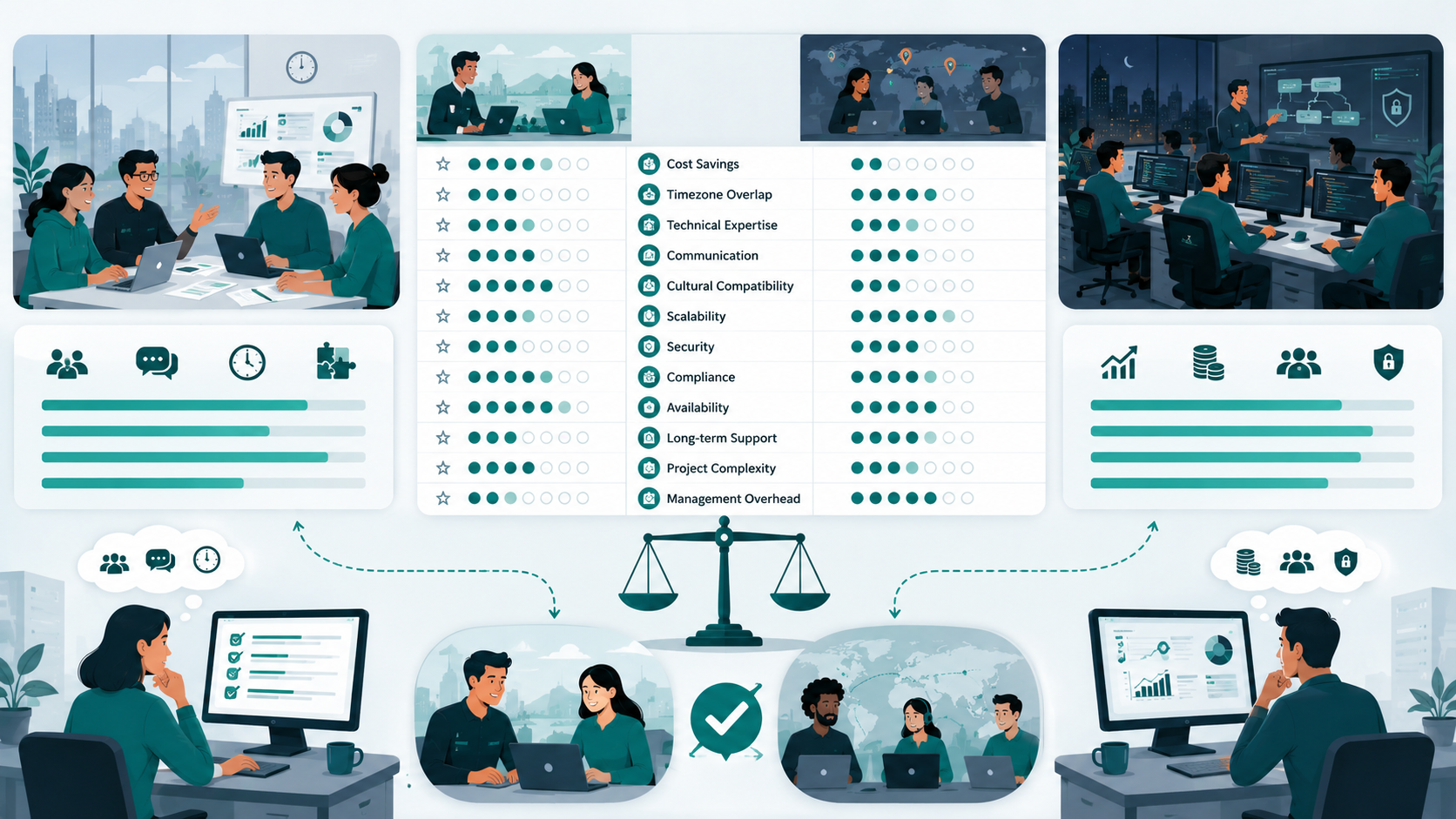
When comparing nearshore and offshore development, I use a simple scoring approach.
Rate each factor from 1 to 5 based on how important it is to your project:
| Factor | Importance |
|---|---|
| Cost savings | 1–5 |
| Timezone overlap | 1–5 |
| Technical expertise | 1–5 |
| Communication | 1–5 |
| Cultural compatibility | 1–5 |
| Scalability | 1–5 |
| Security | 1–5 |
| Compliance | 1–5 |
| Availability | 1–5 |
| Long-term support | 1–5 |
| Project complexity | 1–5 |
| Management overhead | 1–5 |
Then compare potential partners against those factors.
This prevents one attractive number—usually the development rate—from dominating the entire decision.
For a small SaaS startup with a highly collaborative product team, timezone and communication may receive higher scores.
For a mature engineering organization with strong documentation and asynchronous workflows, scalability and cost may carry more weight.
There is no universal winner.

The Biggest Lesson From Remote Development Teams
After working with distributed teams, the biggest lesson is that distance itself is rarely the real problem.
Poor coordination is.
A team can be thousands of miles away and still feel highly connected when requirements are clear, communication is predictable, ownership is defined, and technical decisions are documented.
A nearby team can feel completely disconnected when nobody knows who owns a decision or when developers wait days for answers.
That is why I would not make the decision based only on nearshore vs offshore pricing.
Look at the entire operating system around the development team:
people + proximity + communication + expertise + processes + infrastructure + accountability + quality.
If those pieces fit together, either model can work.
If they don't, geographic proximity will not save the project.
Conclusion
The nearshore vs offshore software development decision is ultimately a question of fit, not simply cost.
Nearshore development can provide stronger timezone compatibility, easier coordination, and more real-time collaboration. Offshore development can provide access to a broader workforce, potentially lower costs, and greater scalability.
But neither model guarantees quality.
The most reliable approach is to first understand your project's requirements, communication patterns, technical complexity, security expectations, budget, and management capacity.
Then choose the model that matches how your engineering team actually works.
The biggest mistake is optimizing for the lowest development price.
The better goal is optimizing for reliable delivery over the lifetime of the product.
Nearshore vs Offshore Software Development: FAQs
Not necessarily. Nearshore development can be better for teams that need frequent real-time collaboration and timezone overlap. Offshore development can be more effective for teams with strong documentation, asynchronous workflows, and a greater focus on cost and scalability.
Usually, offshore development can offer lower development rates, but the total project cost depends on management, communication, quality, rework, delivery speed, and technical expertise. A lower hourly rate does not automatically mean lower total cost.
Timezone differences affect availability, scheduling, communication, and response times. They become less problematic when teams use clear documentation and asynchronous workflows. Projects requiring frequent real-time collaboration generally benefit from greater timezone overlap.
Start with clear requirements, defined ownership, documented architecture, predictable communication, code reviews, automated testing, and clear escalation procedures. Small teams should avoid relying entirely on meetings to transfer knowledge.
Startups should choose based on their product complexity, budget, required expertise, communication style, and management capacity. A startup with rapidly changing requirements may benefit from more timezone overlap, while a mature asynchronous workflow may work effectively with an offshore team.
Reference
Written by

Paras Dabhi
VerifiedFull-Stack Developer (Python/Django, React, Node.js)
I build scalable web apps and SaaS products with Django REST, React/Next.js, and Node.js — clean architecture, performance, and production-ready delivery.
LinkedIn