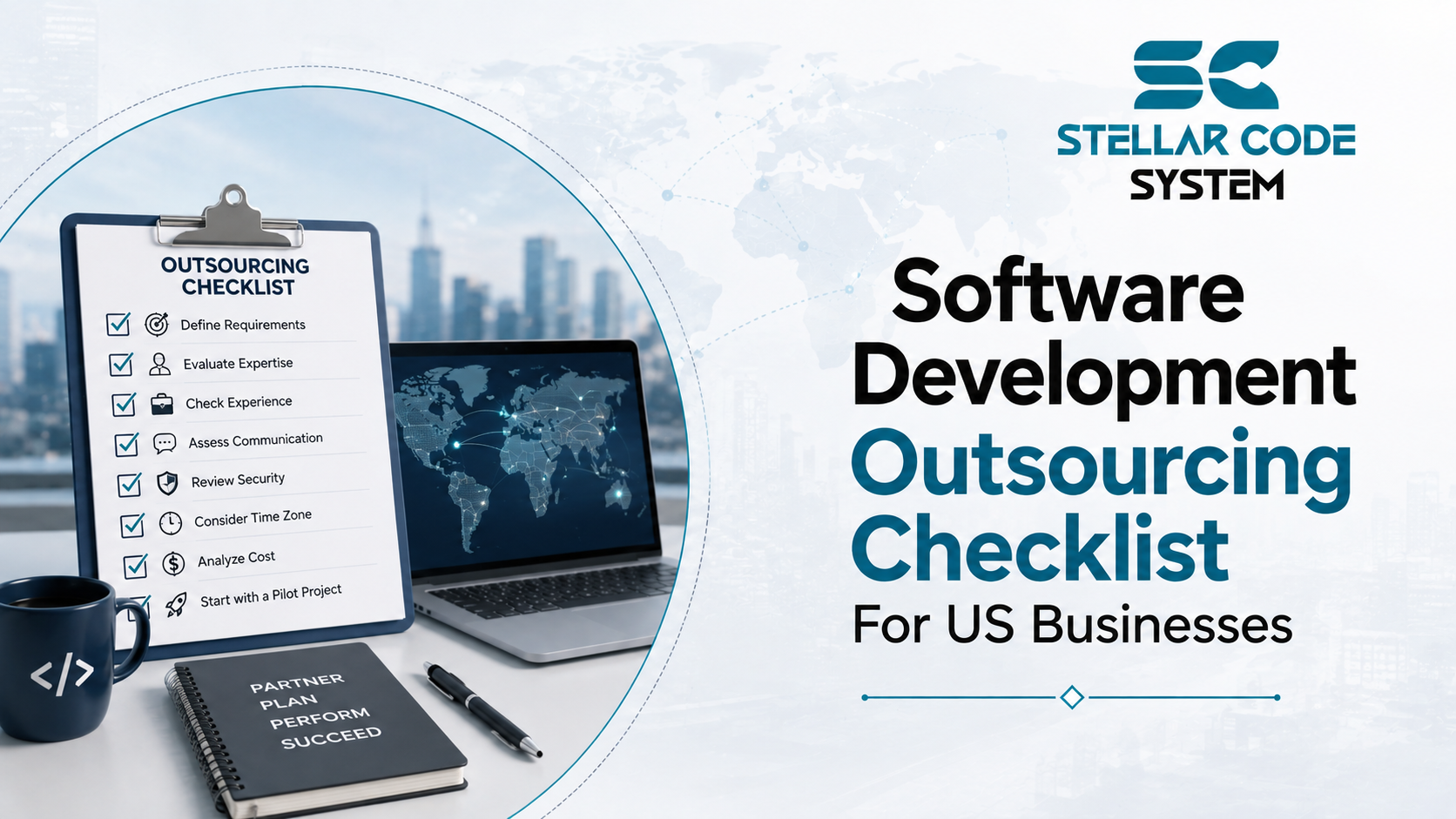
Software Development Outsourcing Checklist For US Businesses
Outsourcing software development isn't usually where projects fail.
Most failures happen long before the first developer writes a line of code.
I've worked with startup founders hiring their first remote engineering team, SaaS companies replacing underperforming vendors, and enterprise organizations expanding development capacity across multiple countries. In almost every troubled project, the technical problems traced back to decisions made during vendor selection—not coding ability.
The assumption is often simple: find experienced developers, agree on a budget, sign an NDA, and development can begin.
Reality is very different.
Successful outsourcing depends on planning, communication, architecture alignment, delivery processes, security expectations, and ownership long before the first sprint starts. A strong outsourcing relationship feels less like hiring contractors and more like extending your own engineering organization.
This checklist focuses on the questions that experienced product teams ask before outsourcing software development, helping US businesses reduce project risk while building long-term engineering partnerships.
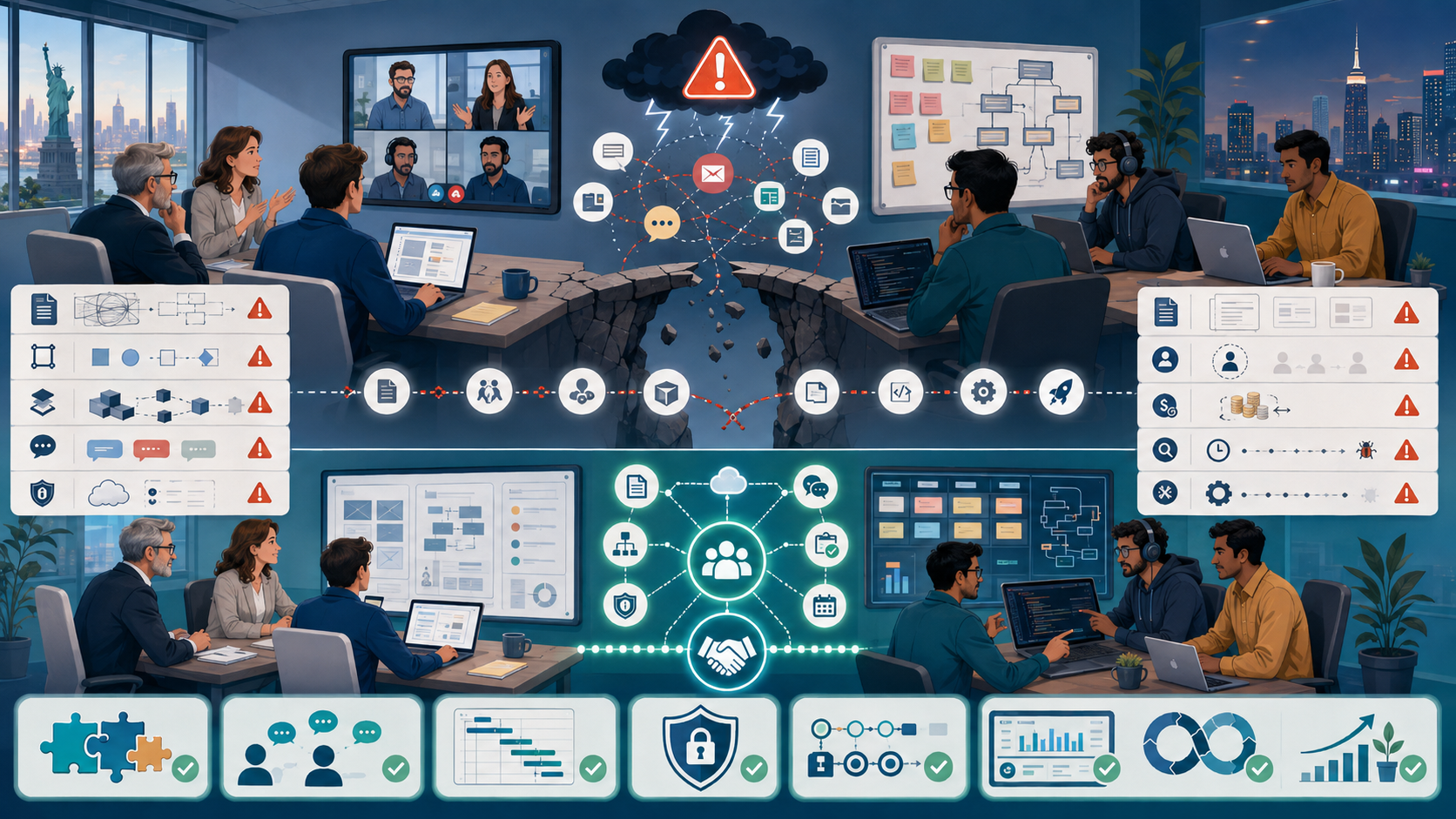
Why Software Development Outsourcing Projects Go Off Track
Many outsourcing projects begin with good intentions.
The business has validated an idea, secured funding, or needs additional engineering capacity. Internal developers are overloaded, hiring locally is taking too long, or specialized expertise is unavailable.
The common response is to look for an offshore, nearshore, or onshore development partner.
The mistake isn't outsourcing.
It's assuming software delivery works like purchasing a finished product.
Software development is an ongoing collaboration involving business goals, technical decisions, changing priorities, and continuous feedback.
In practice, most outsourcing challenges come from issues such as:
- Incomplete project requirements
- Undefined project scope
- Unrealistic timeline expectations
- Budget estimates without technical validation
- Poor communication channels
- Lack of technical ownership
- Missing documentation
- Weak quality assurance processes
- Security expectations discussed too late
- No long-term maintenance strategy
None of these problems are caused by geography.
I've seen highly effective offshore teams outperform local engineering organizations because they established transparent processes from day one.
Likewise, I've seen expensive local vendors struggle because expectations were never aligned.

Where Most US Businesses Make the Wrong Decision
One of the biggest misconceptions is believing that developer hourly rates determine project success.
Cost certainly matters.
But software projects rarely fail because developers charge too much.
They fail because nobody defined how engineering decisions would be made.
Some common mistakes include:
Choosing the Cheapest Vendor
Low pricing often means:
- Smaller QA teams
- Limited project management
- Junior developers
- Minimal documentation
- Weak testing practices
The initial savings often disappear through delays and rework.
Prioritizing Team Size Instead of Team Structure
A proposal offering twenty developers sounds impressive.
In reality, most projects need:
- Dedicated engineers
- One experienced technical lead
- A project manager
- QA specialists
- DevOps support when required
Adding developers without clear ownership usually increases communication overhead.
Copying Enterprise Delivery Models
Startups frequently request:
- Complex approval workflows
- Multiple reporting layers
- Enterprise architecture
- Large Scrum ceremonies
For a five-person engineering team, these processes slow development more than they improve delivery.
Lean collaboration almost always works better.
Ignoring Technical Discovery
Many businesses request fixed-price estimates before discussing:
- Existing infrastructure
- API integrations
- Security requirements
- Scalability expectations
- Legacy systems
Without technical discovery, every estimate contains significant assumptions.
Eventually those assumptions become change requests.

Software Development Outsourcing Checklist Before Hiring a Vendor
A reliable outsourcing partnership starts with preparation rather than procurement. Working with an outsourced software engineering partner for US businesses helps companies validate scope, review architecture, plan communication, define QA expectations, protect IP ownership, and prepare long-term maintenance before development begins.
1. Define Business Goals
Clarify:
- What problem are you solving?
- Who are the users?
- What business outcome defines success?
- Which features are essential for launch?
Developers can build software more efficiently when priorities are clear.
2. Prepare Functional Requirements
Document:
- User workflows
- Business rules
- Integrations
- Permissions
- Reporting needs
- Expected performance
Perfect documentation isn't necessary.
Clear documentation is.
3. Validate Project Scope
Separate features into:
- Must-have
- Should-have
- Nice-to-have
Scope changes are inevitable.
Priority changes should be manageable.
4. Review Technical Architecture
Discuss:
- Backend architecture
- Frontend approach
- Database strategy
- Cloud infrastructure
- Third-party integrations
- Scalability plans
Good vendors challenge assumptions instead of simply agreeing with them.
5. Evaluate Engineering Experience
Ask questions like:
- Who will actually build the product?
- How many senior developers are involved?
- Will the team remain dedicated?
- How is technical knowledge shared?
- What happens if key engineers leave?
Consistency matters more than impressive resumes.
6. Understand Project Management
Clarify:
- Sprint length
- Communication frequency
- Status reporting
- Escalation process
- Change request workflow
Strong project management reduces uncertainty throughout development.
7. Verify Quality Assurance Process
Testing should include:
- Functional testing
- Regression testing
- API validation
- Performance verification
- User acceptance support
QA should be integrated throughout development—not postponed until release.
8. Review Security and Compliance
Discuss early:
- Data handling
- Access control
- Encryption
- Authentication
- Compliance obligations
- Secure development practices
Security becomes significantly more expensive when added after development.
9. Protect Intellectual Property
Every agreement should clearly define:
- Intellectual property ownership
- Source code ownership
- NDA obligations
- Repository access
- Documentation ownership
There should never be uncertainty about who owns the finished product.
10. Plan Long-Term Maintenance
Ask:
- Who handles production issues?
- How are updates delivered?
- What support hours are available?
- How quickly are critical bugs resolved?
- Is ongoing maintenance included?
Launching software is only the beginning.

Practical Practices That Improve Outsourcing Success
After working with distributed engineering teams across different time zones, several habits consistently improve delivery.
Keep Communication Centralized
Avoid scattered conversations.
Maintain technical discussions, documentation, and decisions in shared project spaces.
Document Important Decisions
Every architecture decision should answer:
- Why was this chosen?
- What alternatives were rejected?
- What assumptions exist?
This prevents repeated discussions months later.
Build Incrementally
Rather than requesting every feature upfront:
- Deliver small milestones
- Validate with users
- Adjust priorities
- Reduce unnecessary development
Smaller releases reduce overall project risk.
Measure Delivery, Not Activity
Track outcomes like:
- Features completed
- Bugs resolved
- Deployment frequency
- Customer feedback
- Sprint predictability
Hours worked rarely reflect business progress.
Treat the Vendor as Part of the Team
The strongest outsourcing relationships involve:
- Transparent planning
- Shared responsibility
- Honest technical discussions
- Collaborative problem solving
Good engineering partnerships rely on trust rather than rigid contracts.

When This Checklist Isn't Enough
No checklist eliminates every outsourcing challenge.
Certain situations require additional planning.
For example:
- Products with strict regulatory requirements
- Large enterprise modernization projects
- Multi-vendor engineering environments
- High-frequency financial platforms
- Safety-critical healthcare applications
These projects often require dedicated architecture reviews, security audits, compliance specialists, and governance processes beyond standard software delivery.
Similarly, if your product direction changes every week, even the best outsourcing partner will struggle to maintain predictable delivery.
Stable priorities remain one of the biggest contributors to successful software development.
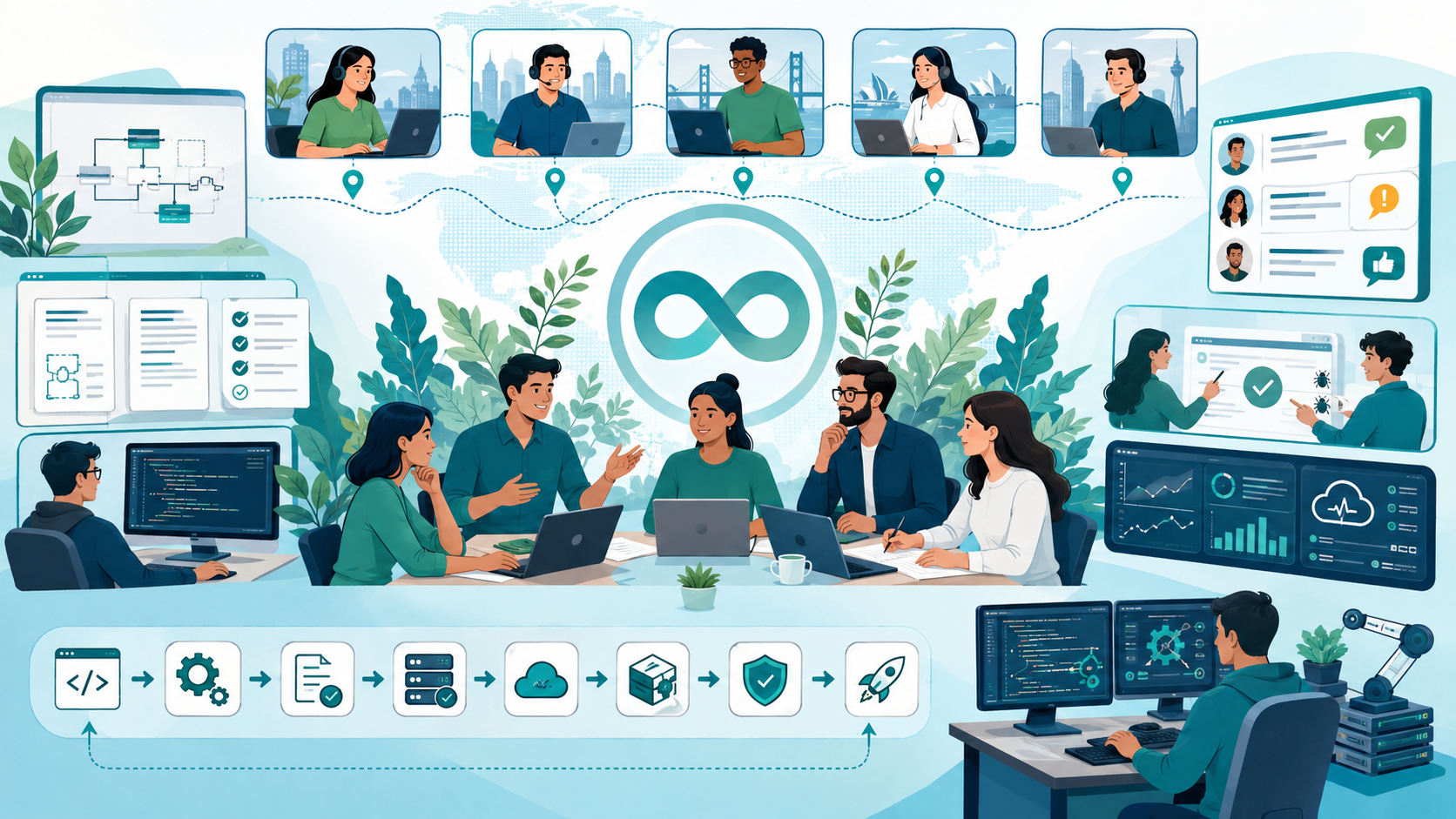
Sustainable Practices for Long-Term Engineering Partnerships
Successful outsourcing isn't measured by how quickly version one launches.
It's measured by how effectively the team continues improving the product over the next several years.
I've found these practices consistently lead to healthier engineering relationships:
- Keep architecture simple until complexity becomes necessary.
- Maintain shared technical documentation.
- Review project priorities every sprint.
- Invest in automated testing early.
- Include QA throughout development.
- Monitor performance continuously.
- Encourage engineers to challenge unrealistic requirements.
- Schedule regular technical reviews.
- Keep infrastructure reproducible through automation.
- Build deployment processes that minimize manual intervention.
These habits improve collaboration regardless of whether your team is offshore, nearshore, onshore, or entirely in-house.
Conclusion
Software development outsourcing succeeds long before development begins.
The strongest partnerships aren't built on the lowest cost or the largest vendor. They're built on shared expectations, transparent communication, realistic planning, and disciplined engineering practices.
Before signing any outsourcing agreement, verify that your vendor understands your business goals, technical architecture, delivery process, security requirements, and long-term support expectations.
A comprehensive checklist won't guarantee project success, but it dramatically reduces the misunderstandings that cause most outsourcing engagements to fail.
Software Development Outsourcing Checklist For US Businesses: FAQs
Focus on project scope, vendor experience, technical architecture, communication processes, security practices, intellectual property ownership, quality assurance, maintenance plans, and realistic delivery timelines before signing any agreement.
Not necessarily. Project success depends more on communication, engineering maturity, transparency, and delivery processes than geographic location.
An NDA is important for protecting confidential business information, but it should be combined with clear intellectual property agreements, repository ownership, and contractual security responsibilities.
For most growing products, a dedicated team with consistent project management and shared technical ownership usually delivers better long-term results than coordinating multiple independent developers.
Define clear requirements, validate project scope, establish communication routines, involve quality assurance early, review technical architecture before development, and maintain ongoing collaboration throughout the project lifecycle.
Reference
Written by

Paras Dabhi
VerifiedFull-Stack Developer (Python/Django, React, Node.js)
I build scalable web apps and SaaS products with Django REST, React/Next.js, and Node.js — clean architecture, performance, and production-ready delivery.
LinkedIn