Small Team vs Agency: What's Better for Software Development in Ahmedabad?
I've seen founders in Ahmedabad burn 3–6 months just because they chose the wrong development setup.
Not because the idea was bad. Not because the budget was too small.
But because they picked an agency when they needed a tight small team — or hired a small team when the project needed structure.
This decision looks simple at the start. It rarely is.

Why this problem actually happens
In most early-stage projects, the decision comes down to pressure.
Budget pressure
Startups don't have the luxury to experiment. You're trying to stretch every rupee. Agencies look expensive. Small teams look risky, especially when the product may later expand into longer-term product models that need more structure than founders initially expect.
Agency sales vs execution reality
Most agencies sell confidence, not clarity. You talk to a senior person during sales, but your project gets handed to junior developers later.
I've seen this happen a lot in Ahmedabad-based agencies.
Small teams lack structure
On the other hand, small teams move fast but often skip the process. No proper planning, no documentation, no ownership clarity. Works fine for 2 weeks. Breaks after 2 months.
Works fine for 2 weeks. Breaks after 2 months.
Communication gaps
Founders assume "they'll handle it." Teams assume "the founder knows what they want." Both are wrong.
Where most developers or teams get this wrong
This is where things go off track early.
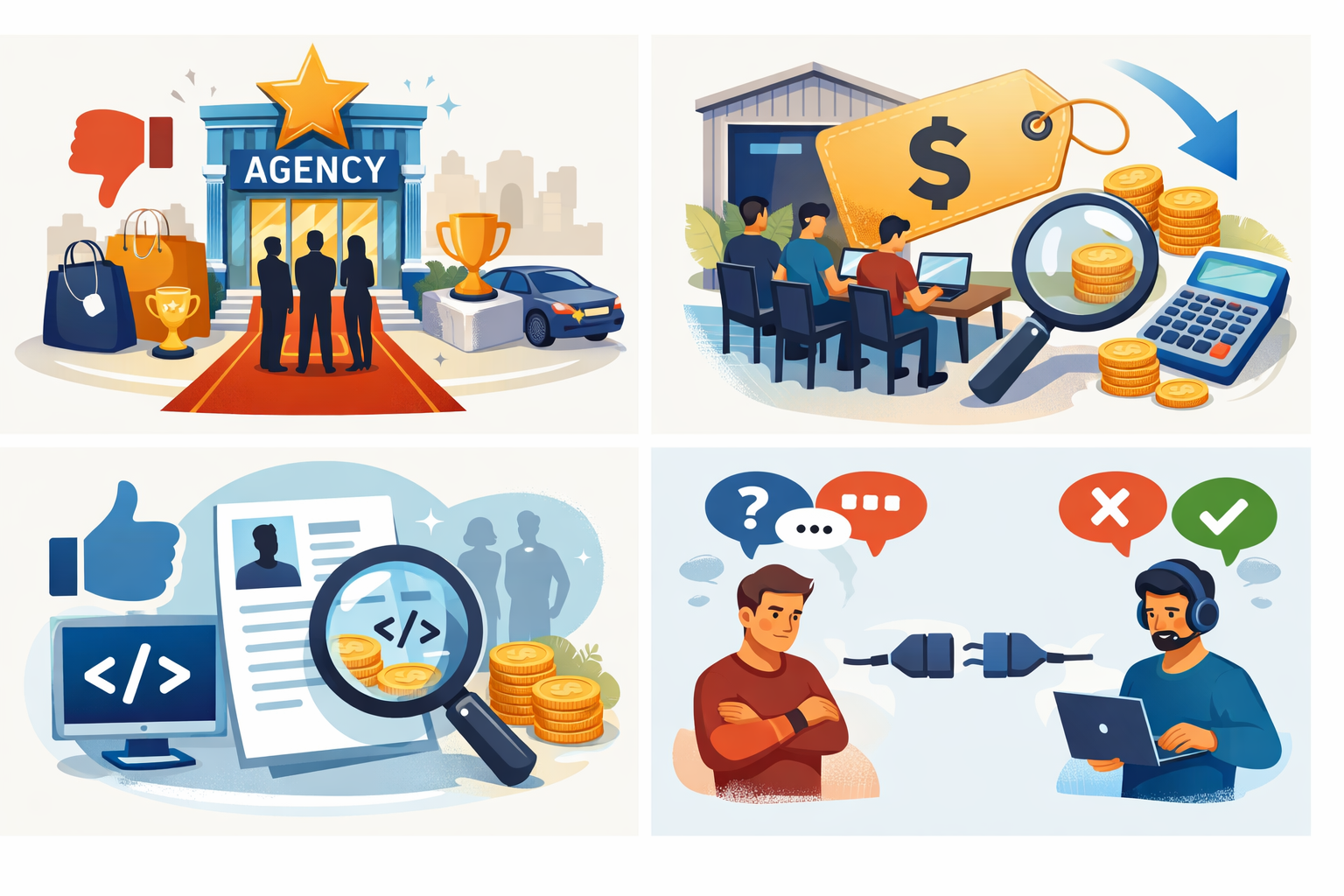
1. Choosing agencies based on brand
Founders often assume a well-known agency guarantees good results. In reality, the execution depends on the developers assigned to your project, not the brand name. Many times, the experienced people you meet during sales are not the ones building your product, which matters even more in delivery-heavy work like Custom Software Development where execution quality depends on the actual team, not the sales promise.
I've seen founders pick agencies just because:
- They have a good website
- They worked with "big clients"
- They have a sales team that sounds convincing
But none of that tells you who will actually build your product. In most Ahmedabad agency projects, execution depends on the assigned team — not the company name.
2. Choosing small teams based on price
Small teams are often picked because they are cheaper, especially under tight budgets. But low cost usually comes with trade-offs like limited bandwidth or inconsistent delivery.
- "They're cheaper"
- "They're flexible"
- "We can save cost"
Yes, but cheap teams often mean overloaded developers or inconsistent quality.
3. Ignoring developer-level evaluation
Most founders evaluate the company but never the actual developers. This is the biggest mistake. I've seen founders spend lakhs without ever:
- Talking to the actual developer
- Reviewing past work properly
- Understanding how they think
You're not hiring a company. You're hiring people who will write your product.
4. Assuming communication will "just work"
Communication is often taken for granted at the start of a project. In most failed projects I've seen:
- Requirements were unclear
- Updates were inconsistent
- Decisions were delayed
And then suddenly everything is "urgent." Good communication needs to be planned, not assumed.

Practical solutions that work in real projects
This is what actually works, based on real projects I've been part of.
1. Evaluate developers, not just the company
Instead of focusing only on portfolios and client lists, talk directly to developers. Founders usually make better decisions when they choose a software company that understands practical business goals rather than relying only on brand perception or sales conversations. Don't stop at portfolio, website, or client logos.
- Talk directly to the developer
- Ask how they would approach your feature
- Check how they explain trade-offs
A good developer will question you. That's a good sign.
2. Start with a small paid task
Before committing to a full project, give a 1–2 week paid task — something real, not a dummy assignment. This works especially well for focused build validation where execution quality becomes visible very quickly.
- Code quality
- Communication style
- Delivery speed
This saves months of regret.
3. Define ownership early
Projects fail when responsibilities are unclear. Decide clearly from the beginning:
- Who owns the backend?
- Who handles deployment?
- Who makes final decisions?
In small teams, lack of ownership creates chaos. In agencies, it creates delays.
4. Check communication flow, not just skills
I've seen average developers deliver better results than highly skilled ones — just because they communicated well. Look for:
- Regular updates
- Clear blockers
- Honest timelines
No communication = hidden problems.
5. Avoid lowest-cost decision making
This is where most startups lose money. Cheap choices often lead to:
- Rework
- Delays
- Frustration
In Ahmedabad's dev ecosystem, there's a wide pricing range. The lowest one is rarely the right one.
Trade-offs: Small Team vs Agency in Ahmedabad
Both options have clear advantages and limitations. The right choice depends on your project complexity and involvement level.
Small Team — Pros: faster decisions, direct communication, more ownership. Cons: limited bandwidth, risk of burnout, less process.
Agency — Pros: structured process, multiple skill sets, backup resources. Cons: slower execution, communication layers, less flexibility.

When this approach does NOT work
Being honest here matters.
When agencies are necessary
Agencies work better for large, complex projects that require multiple specialists. In these cases, structure matters more than speed.
- Large-scale platforms
- Compliance-heavy systems (finance, healthcare)
- Multi-team coordination
When small teams fail
I've seen small teams collapse under pressure simply because they overcommitted.
- When they take on too much
- When there's no technical lead
- When deadlines are unrealistic
When founder involvement is missing
No team can succeed without active founder involvement. This applies to both agencies and small teams.
- Reviewing progress
- Making decisions
- Clarifying requirements
If you're not doing these, no setup will work.

Best practices for small development teams
If you go with a small team (which works well for many startups here), these are non-negotiable.
1. Keep communication simple
Simple communication works better than complex processes. Consistency matters more than volume.
- Daily or alternate-day updates
- No long meetings
- Clear next steps
2. Define task ownership clearly
Every task should have one responsible person. Shared responsibility often leads to missed deadlines and confusion.
- One owner
- One deadline
- No shared responsibility confusion
3. Use lightweight processes
You don't need heavy tools or complex systems in early stages.
- Task tracking (Trello, Notion, etc.)
- Version control (Git)
- Basic documentation
4. Avoid overcommitment
Most small teams fail here. It's better to:
- Deliver less
- Deliver correctly
- Rather than promise everything and miss deadlines
5. Maintain code quality from day one
Skipping this early leads to problems that are always more expensive to fix later. I've seen projects where fixing bad code cost more than building it, which is exactly why disciplined Software Testing should never be treated as optional even in small, fast-moving projects.
- Bugs
- Slow development
- Rewrites
Conclusion
There's no universal answer to small teams vs agencies in Ahmedabad.
What matters is who is building your product, how they communicate, and how decisions are made.
I've seen small teams outperform agencies. I've also seen agencies save failing projects.
The difference is always execution — not team size.
FAQ
For early-stage startups, small teams usually work better due to speed and flexibility.
Because of layered communication, approvals, and internal processes.
Evaluate actual developers, start with a small task, and check communication quality.
Usually not, unless the project needs structured execution or multiple specialists.
Choosing based on price or brand instead of execution capability.
References
Written by

Paras Dabhi
VerifiedFull-Stack Developer (Python/Django, React, Node.js)
I build scalable web apps and SaaS products with Django REST, React/Next.js, and Node.js — clean architecture, performance, and production-ready delivery.
LinkedIn