Software Development Cost in India 2025: A Complete Founder's Guide (With Real Examples)

Software is no longer simply a tool in the world of startups, software is your product, your brand and in many cases, it is your business model altogether. Be it a founder of your first MVP or a global-level entrepreneur who is looking at going offshore, this knowledge of software development cost in India (2025) will equip you with intelligent people, go big, and prevent financial shocks.
We are going to deconstruct everything, including MVP and enterprise SaaS, with actual numbers, most recent tendencies, and cost-saving considerations in accordance with the existing Indian market data.
You may have read this thinking: As an entrepreneur and founder, or a business leader, you went out and did research on the cost of building software in India in 2025 and have likely posed the big question: How much does it really cost to build software in India in 2025?
The reality is- there is no universal solution. The cost of software development in India is different and relies on various factors: the product you are developing (a basic MVP or large-scale SaaS product), your technology stack, the knowledge of your development team, and, not least, the engagement model. However, there is one thing constant about it and that is that India has had one of the best rates of software development in the world without losing on the quality and innovativeness of the work.
By 2025, an Indian tech ecosystem is even at a greater stage. India has more than 6 million skilled developers as well as thousands of international software outsourcing firms, a fast-growing AI and cloud talent pool, and is viewed as a favorable place for startups and firms to create scalable and cost-effective digital product development.
The guide developed by this founder will help shred down what can make software development company in India, most price ranges of any software projects, and what you can expect to get out of your budget, develop an MVP to approach investors with, or develop an enterprise-level project.
We will also discuss actual instances of success stories of software projects developed in India and, therefore, you would have a clear and real picture of what to expect in 2025; when it comes to cost as well as the end product.
In conclusion, you will be well informed on how you will approach budget planning for your project and how you will get the best development partner to cooperate with to bring your idea to life.
Why India Is Still the Best Place for Software Development in 2025
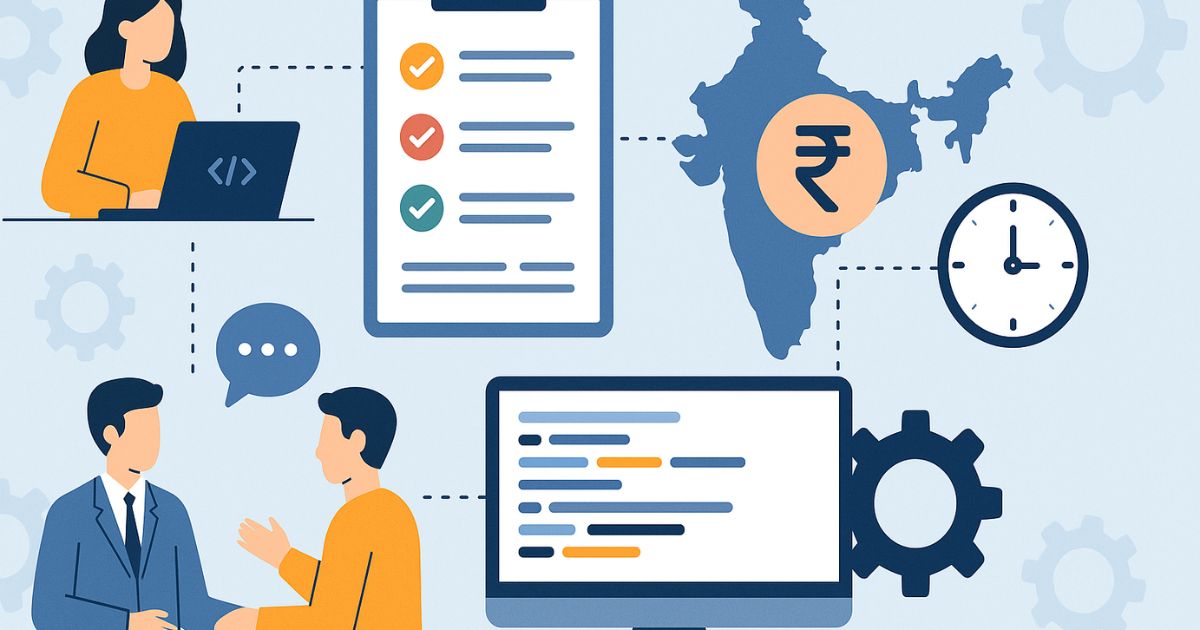
India is a technology powerhouse all over the world. Also boasting more than 5 million software developers, low price per hour, and a huge source of talent web, mobile, AI, and cloud, India still provides good development at reasonable rates.
Average hourly rate: ₹700 – ₹2,500 (≈ $8 – $30)
Global comparison:
India: ₹700–₹2,500/hour
Eastern Europe: ₹2,500–₹4,500/hour
USA: ₹7,000–₹12,000/hour
You save 60–70% without compromising quality, especially when you work with top-tier Indian agencies or dedicated remote teams.
India's Developer Ecosystem
India has remained a largest talent hub in the world, with more than 5 million skilled web, mobile, AI and cloud technology developers. The ecosystem is innovation-driven, competitive and with good English speaking skills - which renders it the best place to be either in business or in a startup.
Talent pool and expertise in 2025
A more specialized developer base than ever India In 2025, India has developed expertise regarding AI, machine learning, blockchain, and cloud-native development. Full-stack engineers, DevOps specialists, and designers experienced in a startup can be readily identified and employment offered to create a world-class digital product.
Cost vs Quality Advantage
The best thing about India is its affordability and quality of technical ability. The rates of development are half or even two times as compared to the Western countries, however, the output is on the international level - due to highly educated engineers, the maturity of the processes, and up-to-date technology stack.
Hourly rate comparison (India vs Global)
Indian coders cost 700-2500/ hour (8-30 dollars) which is more affordable than 30-60 dollars East European coders or 80-150 dollars American coders. This enormous cost differentiation enables startups to develop scalable products on top of early-stage budgets incineration.
Key reasons startups choose India
To startups, India is cheap, has a large population of English speaking work force, and has experience with international customers. On top of that, a time-zone overlap, a clear-cut project management, and high-quality delivery - India emerges as the place to be in terms of software innovation.
Software Development Cost in India: 2025 Overview
Prices of software development depend upon the scope of project, complexity and technology. Here's a practical breakdown:
Project Type | Estimated Cost Range (₹ INR) | Timeline
Basic MVP / Prototype | ₹1,50,000 – ₹5,00,000 | 1–3 months
Medium Complexity App | ₹5,00,000 – ₹10,00,000 | 3–6 months
Enterprise / SaaS Solution | ₹10,00,000 – ₹20,00,000+ | 6–12 months
AI / ML-Powered Platform | ₹12,00,000 – ₹25,00,000+ | 8–14 months
Average Cost by Project Type
In India, software development rates depend on the size and complexity of the project. Basic MVP can be as low as ₹1.5– 5 lakhs, and mid-level SaaS can be as much as 5-10 lakhs. Depending on features and integrations, the full-scale enterprise/AI-based products can cost more than 20 lakhs.
MVP, SaaS, and Enterprise cost ranges
MVP is all about basic functionality and rapid market feedback and is low cost. SaaS solutions need to be scale-based, APIs, and analytics - an increase that is somewhat moderate to the budget. Enterprise systems or AI applications imply high-level security, automation, and integrations, and are therefore the most costly level.
Typical timelines by complexity
Basic MVPs only require 1-3 months, medium complexity products need 3-6 months and platform enterprise is a span of up to a year. Such factors as scope of features, technology stacking, and size of the team have a direct impact on the delivering time and the cost of development.
How Project Scope Impacts Budget
The size of your project determines how much you are going to invest in the project, the more features, platforms, and integrations you put in, the more it will cost. A clear scope will keep the costs down, deliver quickly and prevent costs from growing in the middle of the projects.
Custom features vs pre-built components
The advantage of starting completely new is to have complete control at the cost of more time and budget. Compatibility Pre-built modules and open-source libraries save up to 40 percent and offer flexibility, which is a prudent solution when working with MVPs and startups on a budget.
Cost Breakdown by Development Stage

Understanding where your money goes helps in better budgeting and vendor negotiations.
1. Discovery & Planning (10–15%) - Every successful product starts with a clear plan. Activities include: market research, user personas, scope definition, tech stack selection. Average cost: ₹75,000 – ₹2,00,000. Pro tip: Don't skip this stage — it prevents expensive mid-project pivots later.
1. Discovery & Planning (10–15%)
This is what your software project shall be built on- ideas that are translated into action plans. Teams establish objectives, users to be considered, technological stack, and milestones to eliminate risks and overspending. One of the solid phases of discovery is clarity that all ensures the start of coding is clear.
Deliverables & key activities
Project deliverables will be project scope, user journey, wireframes, and the technical architecture documents. Market research and feature prioritization are some of the activities that enable you to realistically match your vision with both costs and timelines.
Typical cost range and time
Discovery is a type of project that often takes between 2 and 4 weeks, at a cost of 75,000-200,000 rupees. By eliminating incompatible requirements or mid-way alterations, the investment saves time and money in the future.
2. UI/UX Design (15–20%)
Design determines the experience of your product by the users. The Indian Ui/Ux specialists design intuitive UIs that will match with the brand and user behaviour- ensure interaction and retention.
Wireframes, prototypes, and visuals
Wireframes are structured and prototyping simulates interactions and lastly some final visuals are used to make your app take shape. Designers can work effectively with the help of such tools as Figma or Adobe XD to provide an app user-friendly experience.
3. Development & Testing (40–50%)
It is the most important stage when your product is developed and experimented. It entails the coding of the front-end, back-end, APIs, and making sure that all of this will work without a problem by conducting die-intensive QA cycles.
Front-end, back-end, QA
Front-end designers and software developers care about usability and precision in design whereas back-end software development teams take care of databases, APIs and integrations. QA engineers perform both quality and bug testing in order to present the bug free product.
Impact of tech stack choice
Your technology stack has a direct relationship in terms of speed and cost. As an example, MERN or Flutter frameworks are much less expensive in terms of scale but more sophisticated technologies, such as AI or Blockchain, are more complex and expensive.
4. Deployment & Launch (5–10%)
After the testing, your software is implemented to live systems. The stage is characterized by last-minute optimization, configuration of the cloud and verification of the app working well in the real-life situation.
Cloud setup and automation
Cloud servers (AWS, Azure, GCP) will be configured by the developers, and CI/CD pipelines will be created and deployed in an automated way to update them seamlessly. Speed of release is also improved by automation as well as releasing manual labor is minimized.
5. Maintenance & Support (15–20% annually)
Maintenance will make sure that once your product is launched, it is always safe, stable, and features new functionality. A failure to consider this stage may result in downtime or computer leaks.
Updates, bug fixes, and server costs
Maintenance involves bug fixing, performance optimization, and other server or hosting costs. In general, companies need to spend 15-20 per cent. of their annual budget on constant support.
Factors Influencing Software Development Cost in India
Project Complexity
The complexity of your project directly impacts the cost. Simple projects with basic features cost less, while complex projects with advanced features, integrations, and custom logic require more time and resources.
Low, medium, and high-complexity examples
Low complexity: Simple landing pages, basic CRUD apps. Medium complexity: E-commerce platforms, SaaS dashboards with analytics. High complexity: AI-powered platforms, blockchain applications, enterprise systems with multiple integrations.
Team Structure
The composition of your development team affects costs. Freelancers are cheaper but may lack coordination, agencies provide structured teams but at higher rates, and dedicated teams offer the best balance of cost and quality.
Freelancers vs agencies vs dedicated teams
Freelancers: ₹500–₹1,500/hour, good for small projects. Agencies: ₹1,500–₹3,000/hour, provide full-stack teams and project management. Dedicated teams: ₹1,200–₹2,500/hour, offer long-term collaboration with better integration.
Emerging Tech Costs in 2025

Technology | Average Cost Range (₹) | Notes
AI / ML Solutions | ₹12,00,000 – ₹25,00,000+ | NLP, predictive analytics, chatbots
Blockchain Development | ₹10,00,000 – ₹22,00,000 | Smart contracts, DeFi apps
Cloud-Native Software | ₹8,00,000 – ₹18,00,000 | Microservices, Kubernetes
IoT Development | ₹9,00,000 – ₹20,00,000 | Device integration, sensors
AR/VR Apps | ₹8,00,000 – ₹15,00,000 | Training, gaming, simulations
These segments are booming in India's tech ecosystem and attracting both domestic and international startups.
AI/ML Solutions
Some of the fastest-growing fields in Indian software development are AI and machine learning projects. Predictive analytics up to the use of chatbots and recommendation engines, these applications are in need of experienced data scientists and ML engineers. The development of AI/ML in India in the year 2025 is estimated to cost between 30 and 60 USD/hour according to the complexity and data needed. MVPs which are frequently aimed at automation or personalization tend to be used as starting points to prove use-cases at cheap cost.
Blockchain Development
Fintech, logistics and identity management systems are among the areas where blockchain technology is transforming the world. The Indian blockchain developers are focused on Ethereum, Hyperledger, and Solidity, which offer scalable and secure decentralized applications (dApp). Cryptography, smart contracts, and depth of integration are the following parameters that push development costs to the upper levels of 35-70/hour. Most of the startups outsource blockchain projects to India to innovate at reduced costs and speeds without any security losses.
Cloud-Native Applications
By 2025, the default option of scalable software is cloud-native development. The developers at India engage in developing on AWS, Azure, and Google cloud with an aim of achieving performance, uptime and flexibility. The other common features of these projects are the integration of microservices and Kubernetes, as well as automation of DevOps, with an average rate of $25-50 per hour. The outcome: optimization of deployment pipelines will help startups to save up to 40 percent in terms of infrastructure.
IoT and AR/VR Solutions
The development environment in India currently provides advanced IoT and AR/VR applications - connected devices or on-the-job learning and shopping. Such projects include 3D design, sensors and hardware integration which demand cross domain knowledge. Average prices are 30-65/hour based on the equipment configuration and the experience design of the environment. In these cutting-edge technologies, startup players are using India as a source of low-cost engineering expertise to develop novel technologies.
Cost insights for modern tech stacks
New technologies such as AI, Blockchain, IoT, and AR/VR require specialized knowledge thus tend to be more expensive than the conventional web or app development. But the talent pool is in the maturing stage in India and thus, the rates are 40-60 percent lower than in the Western markets. Startups can develop the state of the art, scale solutions and very competitive worldwide prices by combining local knowledge with cloud and open-source applications.
Real-World Cost Examples (2025)
Hidden & Long-Term Costs:
1. Infrastructure & Hosting - Cloud hosting: ₹5,000 – ₹50,000/month. App Store fees: Google Play $25 one-time, Apple $99/year. SSL, CDN, and domain renewals: ₹5,000 – ₹15,000 annually.
2. Marketing & Acquisition - Digital marketing: ₹50,000 – ₹5,00,000/month. App Store Optimization: ₹20,000 – ₹1,00,000 initially. User acquisition (CPI): ₹100 – ₹3,000 per user.
3. Legal & Compliance - Company registration & contracts: ₹25,000 – ₹75,000. IP protection, NDAs, data compliance: Variable.
Example 1 — E-commerce MVP
The basic components of an e-commerce MVP are the product listing, user authentication, shopping cart, and payment incorporation. In India, the cost of such a project will range between $8,000 and 15000 (₹6-12 lakhs) with the time spent taking 8 to 12 weeks to construct one. MERN or Laravel are the frameworks that startups usually resort to to deliver faster, test the market in the least amount of time. Cloud hosting and third-party APIs enable the control of infrastructure costs but ensure that the company is scalable in the future.
Example 2 — SaaS CRM Tool
A cloud CRM incorporates capabilities such as user dashboard, lead management, analytics and user role-based access. The mean cost of development in India is between 12000-25000 dollars (₹10-20 lakhs). The timeframes tend to be in 3-5 months with flattening depending on the complexity of the automation, integrations and the complexity of the design. Most startups like using React + Node.js or Django stacks to develop MVPs to launch sooner and later refine it according to feedback obtained.
Example 3 — Fintech / Wallet App
The components to a fintech or wallet include secure payment gateways, KYC verification, transactions tracking, and encryption of any data. The developers of Indian fintechs bill around 15000-30000 dollars (₹12-25 lakhs) for an expression-ready version. The timeframe is approximately 4-6 months based on the compliance and testing consuming a substantial portion. Apps in Fintech are usually maintained continuously to maintain security and regulation.
Example 4 — Healthcare Platform
Healthcare software applications comprise patient portal, physician portal, schedule appointments and EHR connections. In India, these platforms require investment of approximately 20,000-40,000 (₹16-32 lakhs), when considering the HIPAA compliance and data security requirements. Average durations of these projects are 5-8 months and are usually based on cloud-native, API-first systems to process sensitive medical data in a safe and efficient way.
Cost summary table with feature highlights
Project Type | Key Features | Estimated Cost
E-commerce MVP | Product catalog, cart, payments | ₹3,00,000 – ₹6,00,000
Marketplace Platform | Multi-user roles, bookings, reviews | ₹7,00,000 – ₹12,00,000
SaaS CRM Tool | Analytics, roles, automation | ₹10,00,000 – ₹18,00,000
Fintech App (UPI/Wallet) | KYC, payments, dashboard | ₹12,00,000 – ₹20,00,000
Healthcare Platform | Records, scheduling, reports | ₹12,00,000 – ₹18,00,000+
How to Reduce Software Development Cost (Without Sacrificing Quality)

1. Start with an MVP
Creating an MVP will enable you to develop quickly and get to test the actual market needs at no cost. Attention should only be paid to those features that are necessary to warrant your core idea. The practice would save approximately 50 per cent start up cost. Once user feedback is in hand then add the scales in data improvement bits.
2. Outsource Smartly
Outsourcing to the services of the experienced software teams in India who have achieved a lot would save the cost by a whopping margin and the quality would not be compromised. Choose the providers with an international record of successful portfolio, responsive process and communications. Outsourcing is also elastic in that you can hire as many or as few people as your product increases. The result: there will be a faster delivery time and a decrease in the overheads.
3. Choose Open-Source Tech
A high cost is not on the licenses on the open-source technology of React, Node.js, or Laravel. They are also equipped with enormous developer communities and inbuilt modules fastening the development. When it comes to startups, this will save time, money, as well as being scalable. It can be attributed to the fact that being an economy with much of the ongoing SaaS and mobile application taking place on open-source stacks.
4. Go Cross-Platform
Instead of using iOS and Android applications, use Flutter or React Native frameworks. This allows you to share common code items 80 percent with cross platform sharing. The savings of costs by cross-platform development is 30-40 percent less and the efforts of long-term maintenance are diminished. It is most effective with the start ups that operate on a lean budget and schedule.
5. Use Agile & Automation
Agile development ensures that the speed of the iterations are faster, fewer errors, and the effortless follow-up of the progress. This can be included into automated testing and CI/CD pipelines to decrease the occurrence of repetition. This lowers bugs, wastage of time in QA, and enhances product deliveries. Agaration of agile + automation has been a practice that majority of the major agencies in India have adopted to offer quality software at cheap cost.
Practical cost-saving examples
Agile development is faster and has fewer errors, and visible reporting of progress. This can be integrated into automated tests and CI/CD pipelines to minimize the repetition of burden by the human factor. This will minimize bugs, cut off QA time and provide a faster service delivery of the products. Most of the top agencies in India now have adopted the concept of agile + automation as a method of unleashing good software at the cheapest of prices.
2025 Trends Affecting Software Development Cost in India
AI-Assisted Development Tools
The way people write the code is being altered by crunching AI tools like GitHub Copilot and Tabnine. They are of help with automation and making monotonous tasks, the development of functions and speeding up the debugging process. This will reduce 20-30 percent of the development cost and time. It is possible that with the increased number of Indian teams that use AI assistants in 2025, more companies will be able to offer software at a higher quality and speed than ever.
Low-Code/No-Code Platforms
No-code or low-code apps such as Bubble, OutSystems and Zoho Creator enable customers to bring their MVPs to market faster. They did not need to do extensive coding since the non-technical founders were in fact capable of producing prototypes or internal tools. This is able to cut the project costs by half in case the startup occurs. Many Indian agencies have added custom features to their systems using low-code pension in order to create scalable hybrids.
Cloud-Native Adoption
The future of software in 2025 is that of cloud-native architecture. It gives the automatic scaling, improved performance and reduction of the infrastructure expenses. Indian developers are going to AWS, Azure, or Google Cloud directly with Microservices and Kubernetes. This change ensures long term flexibility and saving in both large and small start up firms.
Rise of Tier-2 Remote Teams
The tier-2 cities that are tier-upgraded include Pune, Ahmedabad, and Kochi as the remote development hubs. The talent on these teams is also of good quality and cost 30-40 percent less than that of the metro city. Tier-2 developers operate with enterprise quality due to having a better infrastructure and world interconnection. This trend leads to the fact that even the software ecosystem of India makes it even more affordable and convenient to start-ups worldwide.
Example Budget Breakdown (Medium SaaS Project)
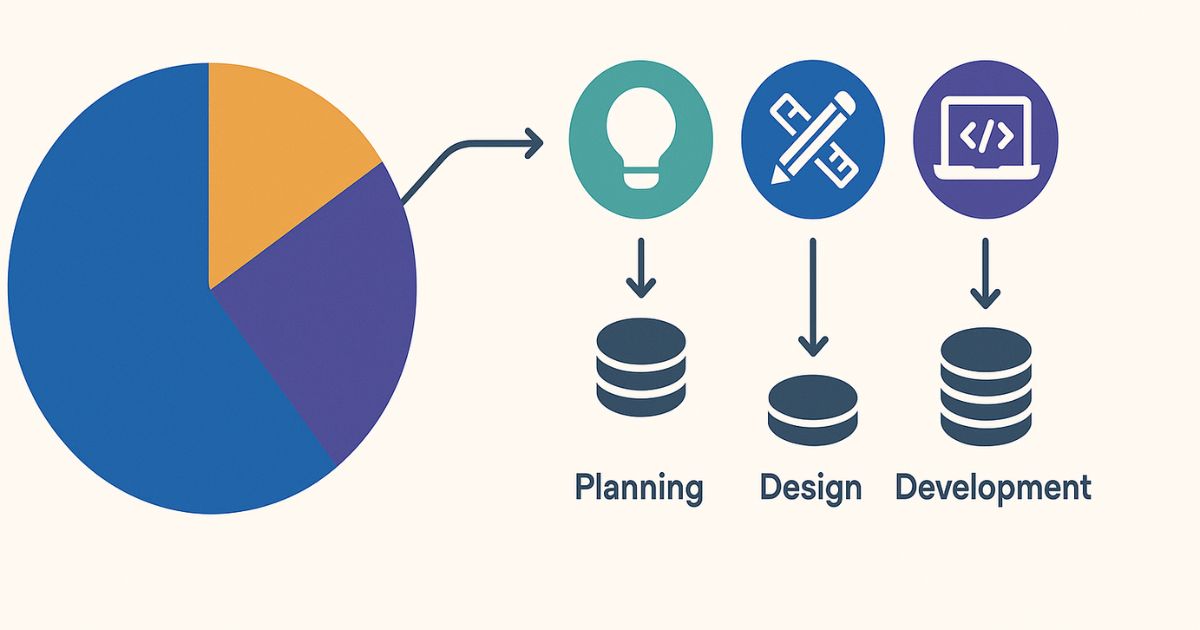
Stage | % of Total | Estimated Cost (₹)
Discovery | 10% | ₹1,00,000
Design | 15% | ₹1,50,000
Development | 45% | ₹4,50,000
QA & Testing | 10% | ₹1,00,000
Deployment | 5% | ₹50,000
Project Management | 10% | ₹1,00,000
Total | 100% | ₹10,00,000
FAQs
The average hourly rate ranges from ₹700 to ₹2,500 (approximately $8 to $30 USD), depending on experience, technology stack, and project complexity. This is significantly lower than rates in Western countries while maintaining high quality.
An MVP typically costs between ₹1,50,000 to ₹5,00,000 (approximately $2,000 to $6,000 USD) and takes 1-3 months to develop, depending on features and complexity.
Key factors include project complexity, team structure (freelancers vs agencies vs dedicated teams), technology stack, timeline, and required integrations. Custom features and advanced technologies like AI/ML or blockchain increase costs.
Freelancers are cheaper (₹500–₹1,500/hour) but may lack coordination for complex projects. Agencies (₹1,500–₹3,000/hour) provide structured teams and project management. Dedicated teams offer the best balance of cost and quality.
Start with an MVP, outsource to experienced Indian teams, use open-source technologies, go cross-platform with Flutter/React Native, and adopt Agile methodologies with automation. These strategies can save 30-50% while maintaining quality.
Hidden costs include infrastructure and hosting (₹5,000–₹50,000/month), marketing and user acquisition, legal and compliance fees, app store fees, and ongoing maintenance (15-20% of initial cost annually).
Timelines vary: Basic MVPs take 1-3 months, medium complexity apps take 3-6 months, and enterprise solutions take 6-12 months or more. AI/ML-powered platforms typically require 8-14 months.
India offers a massive talent pool (6+ million developers), cost-effective rates (60-70% savings vs Western countries), strong English communication, time-zone advantages, and expertise in modern technologies like AI, cloud, and blockchain.
Conclusion
The software development cost in India (2025) remains one of the most competitive in the world — without compromising on quality or innovation. Whether you're building a SaaS platform, mobile app, or enterprise solution, India offers the ideal blend of affordability, expertise, and scalability. Start small, validate fast, and scale smart — that's the formula successful founders follow.
With a clear budget plan, trusted Indian developers, and a focus on user value, you can turn your idea into a sustainable product faster than ever before.
About the Author
Paras Dabhi
VerifiedFull-Stack Developer (Python/Django, React, Node.js) · Stellar Code System
Hi, I’m Paras Dabhi. I build scalable web applications and SaaS products with Django REST, React/Next.js, and Node.js. I focus on clean architecture, performance, and production-ready delivery with modern UI/UX.

Paras Dabhi
Stellar Code System
Building scalable CRM & SaaS products
Clean architecture · Performance · UI/UX