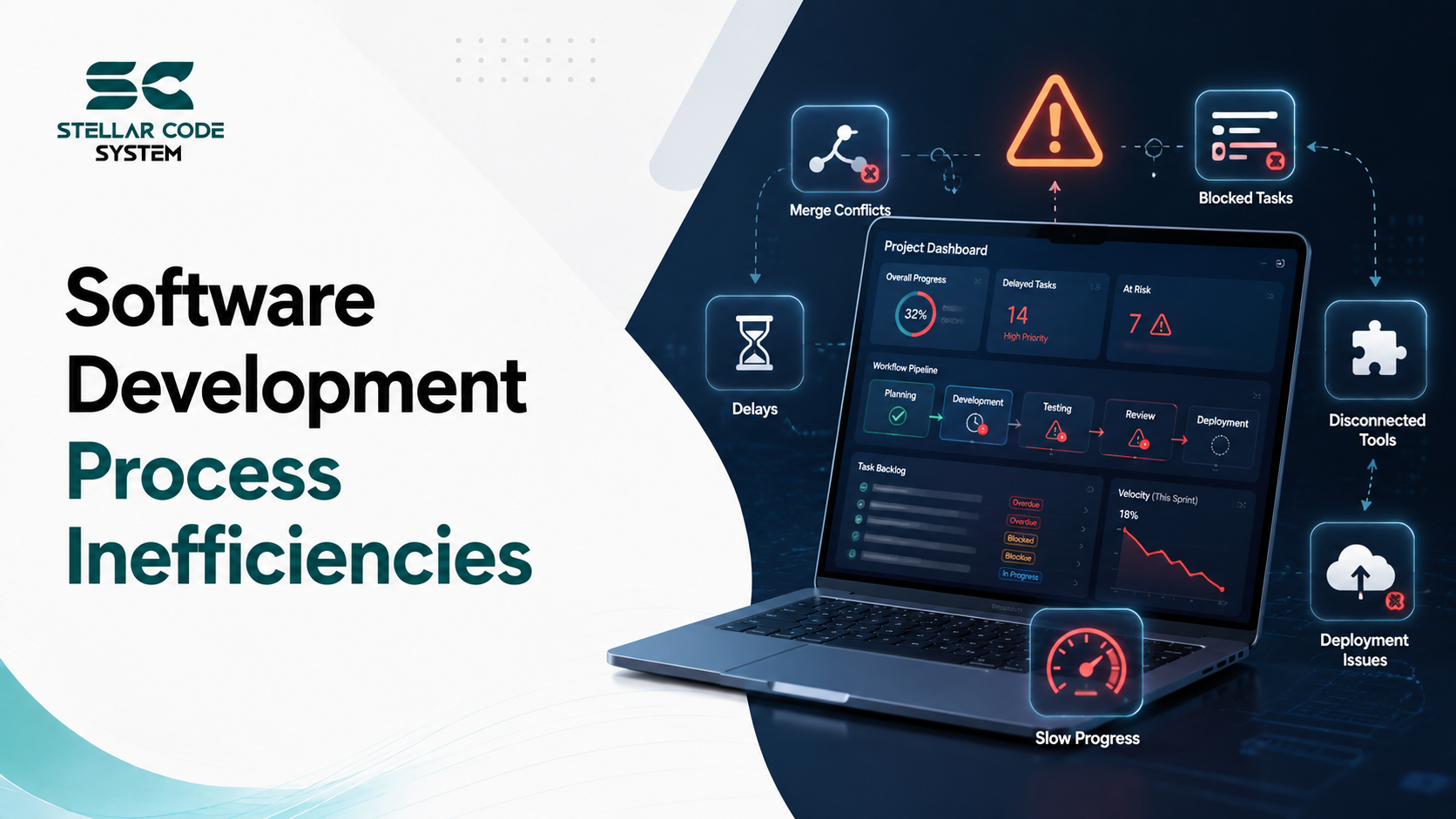
Software Development Process Inefficiencies
Software development process inefficiencies rarely start with one major mistake. More often, they appear as small problems that seem harmless at first: a developer waits for clarification, a pull request sits for two days, two engineers duplicate the same work, testing happens late, or a deployment requires several manual steps.
In a small SaaS team, these issues compound quickly. A team of six can lose a surprising amount of productive time without anyone obviously being idle.
I have seen this happen in teams where the developers were technically strong and working hard. The problem was not individual performance. The problem was how work moved through the team.
When the process creates unnecessary friction, adding more developers does not automatically solve it. Sometimes it makes the situation worse because there are more dependencies, handoffs, communication gaps, and decisions to coordinate.
The real goal is not to create a perfect development process. It is to remove the parts of the workflow that repeatedly waste engineering time.

Why Software Development Process Inefficiencies Happen in Real Teams
Most inefficiencies come from the interaction between people, technology, and time pressure.
A process that works for a two-person startup may become difficult when the team grows to ten developers. Likewise, a workflow designed for a mature engineering organization can create unnecessary overhead for a small product team.
Time Pressure Encourages Shortcuts
Startup teams rarely have unlimited time.
A feature needs to ship, a customer is waiting, or an investor milestone is approaching. Developers start skipping documentation, reducing testing, combining unrelated changes, or postponing cleanup.
One shortcut is rarely a serious problem.
The problem is repetition.
A missing test today becomes debugging work later. A poorly documented decision becomes another developer's question. A temporary workaround becomes technical debt.
Eventually, the team spends more time maintaining the process than improving the product.
Limited Resources Increase Dependencies
A small engineering team often has specialists responsible for critical areas.
For example:
- One developer understands the payment integration.
- Another owns the deployment workflow.
- One person knows the database structure.
- Another handles the frontend architecture.
This creates dependencies.
If the person responsible for a specific component is unavailable, another developer may have to wait, investigate the existing implementation, or ask for context.
The team is still working, but progress slows because the workflow depends too heavily on individual knowledge.
Poor Planning Creates Rework
Planning is not about predicting every technical detail.
It is about identifying enough context before implementation begins.
When requirements are ambiguous, developers make assumptions. Product teams may interpret those assumptions differently. The feature eventually works technically but does not solve the intended problem.
That creates rework.
The team then spends time changing code that could have been implemented correctly the first time.
Process Maturity Does Not Automatically Scale
A workflow that works at one stage of a company can become inefficient at another.
A startup may begin with informal communication:
Just ask me if you need anything.
That works when three people are sitting together.
It becomes problematic when developers work remotely across different time zones and multiple projects are moving simultaneously.
More people create more coordination requirements. Without some standardization, communication becomes fragmented.

Where Most Teams Make the Wrong Decision
The biggest mistake is often treating every process problem as a tooling problem.
Teams introduce project management platforms, automation systems, additional meetings, complex branching strategies, or new architectural patterns without understanding where the actual friction exists.
Overengineering the Workflow
A small team does not need a process designed for a 500-person engineering organization.
For a team of five developers, requiring multiple approval stages for a low-risk UI change may create more overhead than value.
The process should reflect the risk of the change.
A useful distinction is:
- Low-risk change: lightweight review and fast deployment
- Medium-risk change: normal review and testing
- High-risk change: deeper review, testing, monitoring, and controlled release
Not every change deserves the same amount of process.
Confusing Activity With Productivity
A busy team is not necessarily a productive team.
Developers can spend an entire day in meetings, responding to messages, fixing merge conflicts, reviewing repetitive pull requests, and switching between tasks.
From the outside, everyone appears busy.
But actual product progress may be limited.
Productivity should be measured by useful outcomes rather than the number of tasks completed or hours spent online.
Copying Large Engineering Organizations
Large technology companies have complex systems for good reasons.
But copying their workflow too early can introduce unnecessary complexity.
A small SaaS team may not need:
- Multiple service boundaries
- Extensive approval chains
- Complex release trains
- Large-scale infrastructure
- Excessive abstraction
- Heavy documentation requirements
The right question is not:
How do large engineering teams solve this?
It is:
What level of process does our current team and product actually require?
Ignoring Communication Friction
Remote development makes communication more important.
A developer working in the UK may finish a task while another team member in the US is offline. If the next step depends on that person, work can remain blocked for hours.
This is why visibility matters.
Developers should be able to understand:
- What needs to be done
- Who owns it
- What is blocked
- What decision has already been made
- What information is still missing
Good visibility reduces unnecessary communication without eliminating collaboration.

Practical Fixes That Actually Work
You do not need to redesign your entire engineering organization to improve efficiency. Working with a US software engineering partner for lean development workflows helps small SaaS teams reduce unclear requirements, unnecessary handoffs, blocked work, manual deployment steps, repeated rework, communication gaps, and process overhead without adding unnecessary complexity.
Start with the points where work repeatedly stops.
1. Find the Actual Bottlenecks
Before changing the process, measure where time is being lost.
Look at:
- How long tasks remain blocked
- How long pull requests wait for review
- How often work is reopened
- How frequently requirements change
- How long deployments take
- How often production bugs require urgent intervention
- How many tasks depend on one person
You may discover that coding itself is not the problem.
The bottleneck might be testing, communication, deployment, or decision-making.
2. Reduce Unnecessary Handoffs
Every handoff introduces the possibility of delay, confusion, or information loss.
For example:
Product → Designer → Developer → QA → DevOps → Product
This can work, but excessive separation creates overhead for smaller teams.
Where practical, bring related responsibilities closer together.
A developer should understand enough product context to make reasonable implementation decisions. QA should be involved before the end of development rather than becoming the final gate.
The objective is not to eliminate roles. It is to reduce unnecessary waiting between them.
3. Make Ownership Explicit
Ambiguous ownership creates delays.
For important components, everyone should know who is responsible for maintaining them.
Ownership does not mean that only one developer can touch the code.
It means someone is accountable for its quality, documentation, and long-term maintenance.
This becomes particularly important for:
- APIs
- Authentication
- Payments
- Database infrastructure
- Deployment
- Monitoring
- Critical integrations
Clear ownership improves accountability without creating unnecessary hierarchy.
4. Automate Repetitive Work
Automation should target repeated friction rather than exist simply because automation is fashionable.
Good candidates include:
- Automated testing
- Code formatting
- Linting
- Build verification
- Deployment checks
- Database migration checks
- Dependency updates
- Basic monitoring alerts
If developers repeatedly perform the same manual operation, ask whether it can be made consistent and automated.
Automation improves consistency while reducing human error.
5. Keep Documentation Close to the Code
Documentation becomes inefficient when it requires maintaining a separate knowledge system that developers rarely update.
For technical decisions, useful documentation can be relatively small:
- Why the system works this way
- Important dependencies
- Known limitations
- Deployment requirements
- Common failure scenarios
- Architectural decisions
The goal is not documentation volume.
The goal is preserving useful context.
6. Reduce Rework Before Increasing Speed
Teams often try to make developers code faster.
That is usually the wrong starting point.
First reduce the amount of work that needs to be repeated.
Before implementation, make sure the team understands:
- The expected behavior
- Important edge cases
- Dependencies
- Acceptance criteria
- Technical constraints
A developer who spends two hours clarifying requirements before coding may save ten hours of rework later.
7. Improve the Deployment Workflow
Deployment inefficiency is one of the easiest problems to underestimate.
If releasing software requires several manual steps, developers may avoid deploying frequently. Changes accumulate, releases become larger, and debugging becomes harder.
A healthier workflow makes deployment predictable.
For example:
Code → Review → Automated checks → Build → Deploy → Monitor
The exact implementation depends on the product, but the principle is consistent: reduce unnecessary manual intervention.

When This Approach Fails
Improving process efficiency does not mean simplifying everything.
There are situations where additional controls are necessary.
High-Risk Products Need More Process
Financial systems, healthcare software, security-sensitive applications, and systems with strict compliance requirements may require additional review, testing, documentation, and monitoring.
Removing those controls simply to increase speed can create much greater costs later.
Larger Teams Need More Coordination
A workflow that works for five developers may not work for fifty.
As team size increases, dependencies and communication requirements also increase.
At that point, stronger standards, ownership structures, documentation, and coordination become necessary.
The important point is to introduce them because the team needs them—not because they are considered industry best practices.
Automation Has Its Own Maintenance Cost
Automation is not free.
A complicated deployment pipeline can become another system developers need to understand and maintain.
If a script saves five minutes but requires several hours of maintenance every month, it may not be worthwhile.
Measure the actual benefit.
Too Much Flexibility Can Create Inconsistency
Giving developers complete freedom can initially feel efficient.
Over time, however, different approaches to testing, deployment, documentation, and code structure can create inconsistency.
Some standards are useful precisely because they reduce decision-making.
The objective is controlled consistency, not absolute freedom or rigid standardization.

Sustainable Practices for Small Engineering Teams
The most effective process improvements are usually boring.
They are not revolutionary frameworks. They are habits that prevent small problems from becoming recurring operational overhead.
Keep Work Visible
Developers should quickly see what is:
- Planned
- In progress
- Blocked
- Under review
- Ready for deployment
- Completed
Visibility reduces confusion and makes dependencies easier to identify.
Protect Developer Focus
Constant interruptions destroy productivity.
A developer switching between coding, meetings, support requests, and messages may spend more time recovering context than solving the actual problem.
Teams should create periods where developers can focus on implementation without unnecessary interruptions.
Review Process Problems Regularly
Do not wait for a major failure.
During retrospectives, ask:
- Where did work wait?
- What caused rework?
- Which dependency slowed us down?
- What was manually repeated?
- Where did communication fail?
- Which process created unnecessary overhead?
Then fix one or two recurring problems.
Small improvements compound.
Measure Flow, Not Just Output
Useful measurements can include:
- Cycle time
- Deployment frequency
- Rework
- Failed deployments
- Review waiting time
- Blocked tasks
- Defect rates
These measurements provide more useful information than simply counting completed tickets.
A team that closes 100 tickets but repeatedly fixes production problems may be less effective than a team that completes 60 well-defined changes with fewer failures.
Maintain Technical Quality While Moving Quickly
Speed without quality creates future inefficiency.
Developers eventually pay for shortcuts through debugging, maintenance, support, and rework.
Good engineering teams therefore balance velocity with reliability.
The goal is not to eliminate technical debt completely. That is unrealistic.
The goal is to understand when debt is intentional and when it is becoming a drag on development.
Conclusion
Software development process inefficiencies rarely come from developers simply working too slowly.
They usually come from friction between activities: unclear requirements, unnecessary handoffs, excessive dependencies, repetitive work, poor visibility, manual deployment, inconsistent standards, and communication gaps.
The biggest mistake small engineering teams make is trying to solve these problems with more complexity.
A better approach is to identify where work actually stops, understand why it stops, and remove that specific friction.
For a small SaaS team, sustainable efficiency usually comes from simple things: clear ownership, better planning, fewer unnecessary handoffs, useful documentation, targeted automation, predictable deployment, and regular measurement.
The objective is not to create a perfect process.
It is to build a development workflow where developers can spend more time solving product problems and less time fighting the process around them.
Software Development Process Inefficiencies: FAQs
Usually not. Inefficiency is often caused by unclear requirements, dependencies, communication problems, excessive handoffs, manual work, or weak processes. Strong developers can still become inefficient inside a poorly designed workflow.
Measure where work spends time waiting. Look at task cycle time, code review delays, blocked work, deployment failures, rework, and recurring dependencies. The largest bottleneck is often outside the actual coding process.
No. Automation is valuable when it removes repetitive, error-prone work. Poorly designed automation can introduce maintenance overhead and additional complexity.
Remote teams can experience more communication delays, context switching, handoffs, and dependency problems. Clear ownership, documentation, visibility, and asynchronous communication can reduce these issues.
Yes, but the process should remain proportional to the team's size and product risk. Small teams need enough structure to create consistency and accountability without introducing unnecessary administrative overhead.
Reference
Written by

Paras Dabhi
VerifiedFull-Stack Developer (Python/Django, React, Node.js)
I build scalable web apps and SaaS products with Django REST, React/Next.js, and Node.js — clean architecture, performance, and production-ready delivery.
LinkedIn