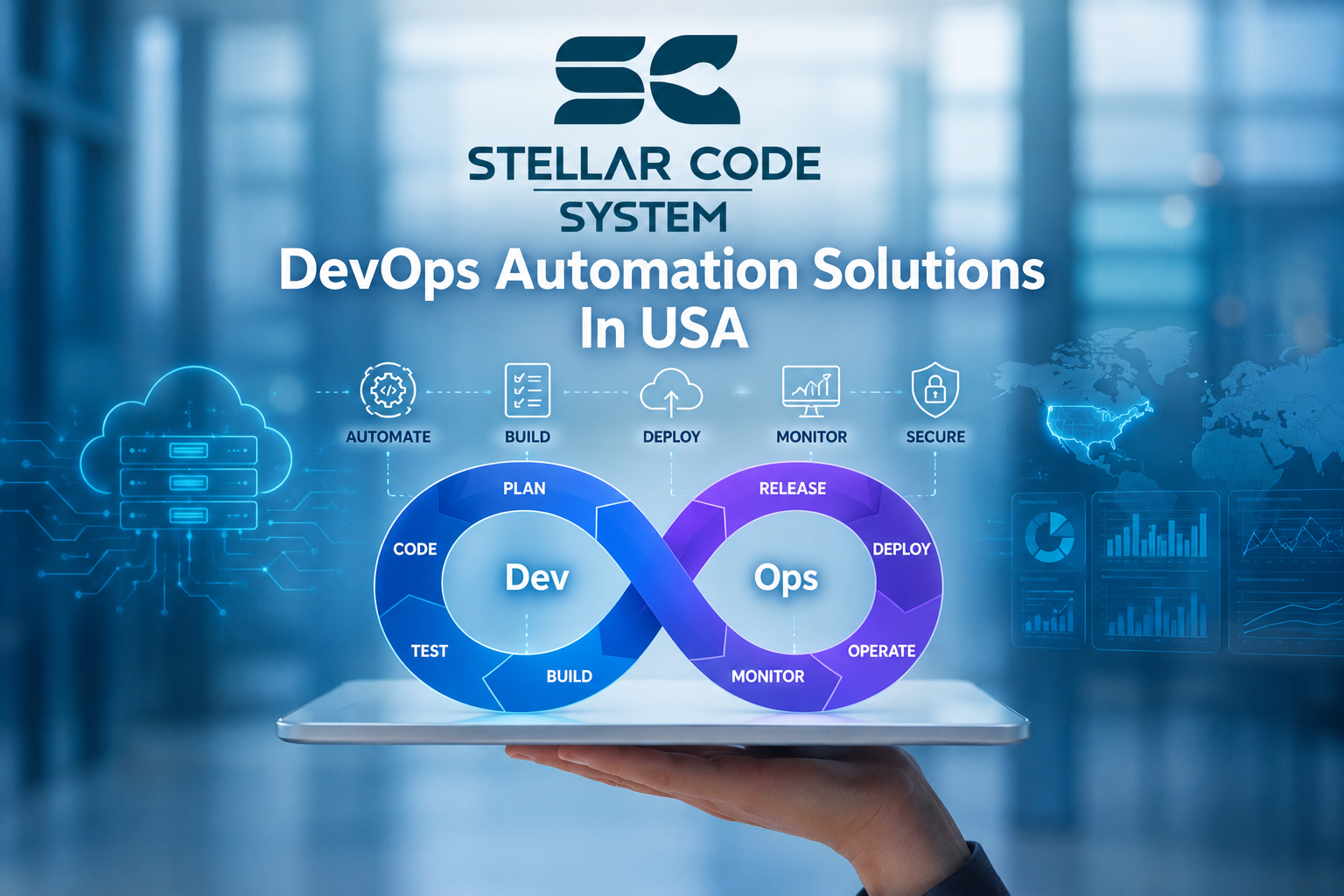
DevOps Automation Solutions In USA
Many startup teams believe that adopting DevOps Automation Solutions in the USA means faster releases, fewer production issues, and happier developers. In reality, I've seen the opposite happen more than once. Teams invest months building sophisticated automation, yet every release still feels stressful because the underlying engineering process hasn't improved.
The pattern is surprisingly common. A small engineering team with five or six developers introduces automated deployment pipelines, Kubernetes, Docker, and Infrastructure-as-Code, expecting enterprise-level stability. Instead, they inherit a system that requires constant maintenance, slows onboarding, and becomes difficult to troubleshoot.
The problem isn't DevOps itself. It's introducing automation before the team has consistent engineering habits. When core development workflows are still changing every week, adding more automation often magnifies existing problems instead of solving them.
For most early-stage SaaS products, the biggest bottleneck isn't the technology stack. It's deciding what should actually be automated, when to automate it, and how much operational complexity the team can realistically support.

Why This Problem Happens in Real Teams
After working with startups across the USA, Germany, Australia, Canada, and the UK, I've noticed that unsuccessful DevOps initiatives rarely fail because of the tools. They fail because the engineering environment isn't ready for the level of automation being introduced.
Small product teams usually operate under tight deadlines. Investors expect rapid feature delivery, customers request continuous improvements, and developers are responsible for everything from backend services to production support. Under these conditions, automation becomes a shortcut rather than a carefully planned engineering investment.
Instead of improving existing processes, teams attempt to automate unstable workflows.
For example, I frequently see teams building complex CI/CD pipelines before establishing a reliable branching strategy or consistent code review process. Every automated release simply pushes inconsistent code into production more quickly.
Another common issue is treating automation as a replacement for engineering discipline.
Automation cannot compensate for:
- Poor configuration management
- Inconsistent versioning
- Weak documentation
- Missing testing standards
- Unclear ownership across engineering teams
These weaknesses remain hidden until production systems begin failing.
Infrastructure Grows Faster Than the Product
One mistake many startups make is expanding their infrastructure before validating their product.
Instead of running a straightforward application on a single cloud environment, teams introduce:
- Containerization
- Multiple microservices
- Advanced orchestration
- Dedicated repository strategies
- Separate staging environments
- Automated provisioning
- Complex networking rules
None of these technologies are inherently bad. They're incredibly valuable when they solve an actual operational problem.
The issue is that many startups build for scale they haven't reached yet.
Maintaining sophisticated infrastructure consumes engineering hours that could otherwise improve the product itself.
Tool Adoption Replaces Process Improvement
Modern DevOps offers excellent platforms:
- AWS
- Azure
- Google Cloud
- Terraform
- Ansible
- Jenkins
- GitOps
Each solves genuine operational challenges.
However, I've seen startups introduce nearly every popular DevOps platform within a few months, assuming that more tooling automatically creates better engineering practices.
It rarely does.
Every new platform introduces:
- Additional maintenance
- New learning curves
- More documentation
- Increased integration complexity
- Operational overhead
Without a mature engineering process, every new tool simply becomes another system developers must maintain.
Automation Without Standardization Creates Inconsistent Environments
One lesson that repeats across projects is this:
Automation only works well when the underlying process is already predictable.
If developers deploy applications differently, manage environments differently, or configure services differently, an automation framework only reproduces those inconsistencies faster.
This often appears in cloud deployments where each engineer maintains slightly different infrastructure settings.
Eventually, teams experience:
- Failed deployments
- Environment drift
- Unexpected dependency conflicts
- Broken rollback procedures
- Production inconsistencies
Automation isn't creating the problem.
It's exposing problems that already existed.
Scaling Assumptions Arrive Too Early
Many founders worry about future growth long before current systems experience meaningful load.
As a result, teams optimize for theoretical scale rather than actual business needs.
They prioritize:
- Extreme scalability
- Distributed microservices
- High-availability clusters
- Complex load balancing
- Multi-region architecture
- Advanced serverless deployments
Meanwhile, their application might only serve a few thousand active users.
Engineering effort shifts toward solving problems that don't yet exist, while real customer issues remain unresolved.
Where Most Teams Make the Wrong Decision
The internet is full of advice that encourages startups to copy engineering practices from companies operating at massive scale.
You'll often find articles recommending Kubernetes from day one, extensive GitOps workflows, dozens of independent services, and fully automated infrastructure before the first major product release.
In practice, this advice rarely fits teams with fewer than fifteen developers.
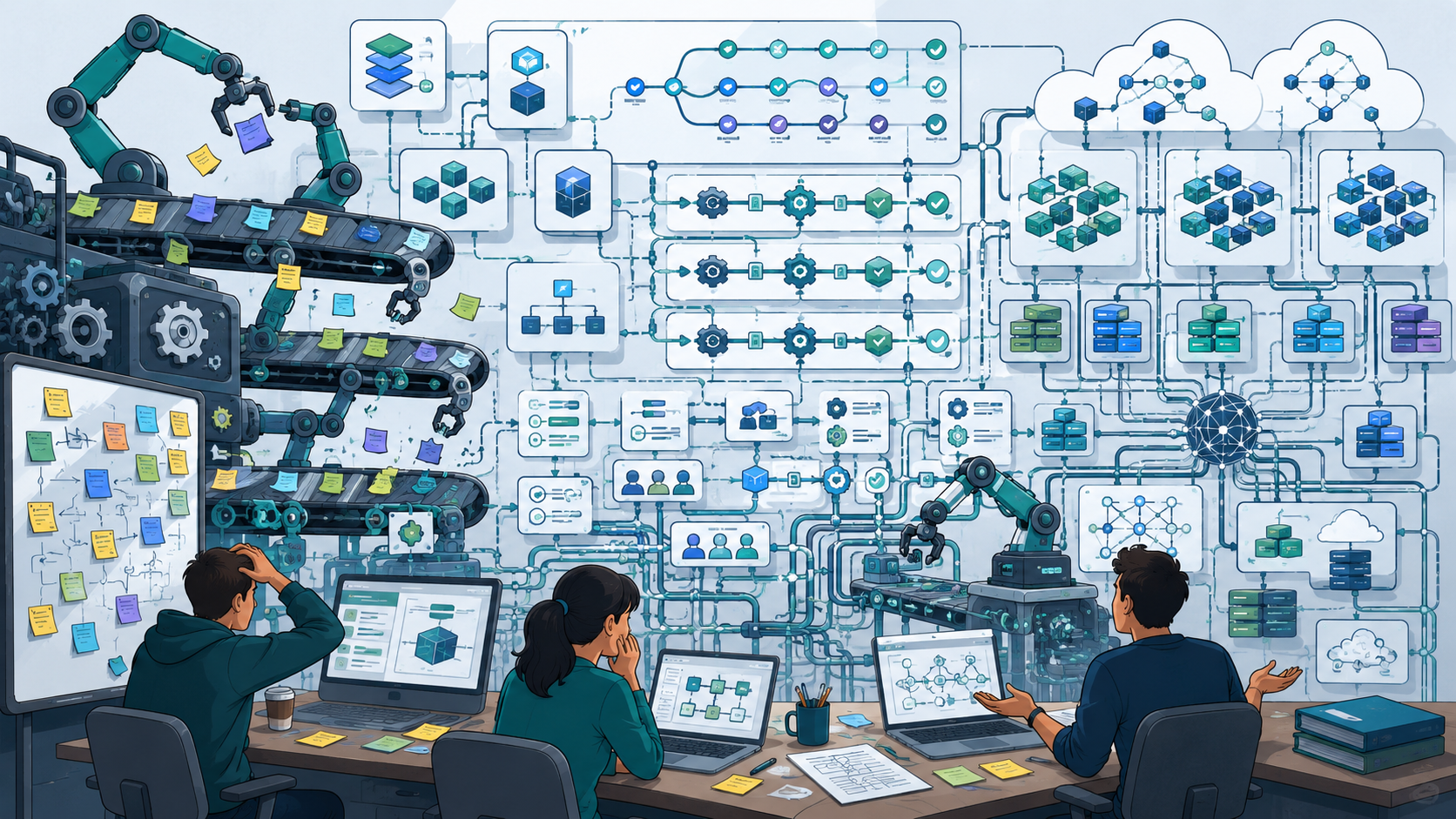
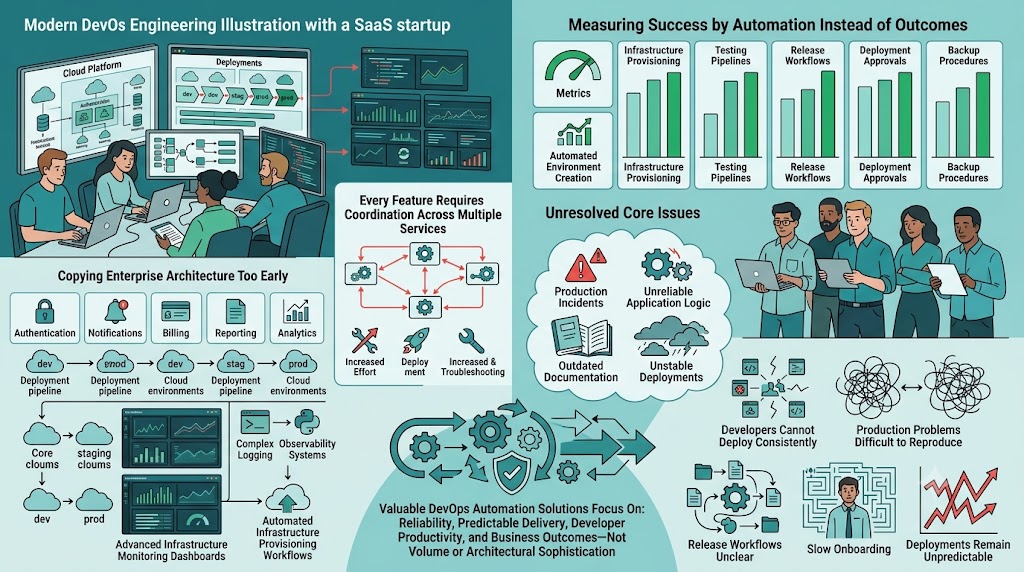
One SaaS startup I worked with introduced Kubernetes, Terraform, Ansible, automated Infrastructure-as-Code, and multiple production clusters before reaching product-market fit. The system looked impressive on paper, but every infrastructure change required several approvals, multiple pipeline updates, and careful coordination across developers.
Simple feature releases that previously took a few hours started consuming an entire day because every change touched deployment automation, infrastructure definitions, and configuration management.
The technology wasn't the problem.
The team had optimized for operational complexity instead of delivery speed.
Another common mistake is assuming that every manual task should immediately become automated. In reality, some manual processes are still evolving. Automating them too early often locks teams into inefficient workflows that become expensive to change later.
Where Most Teams Make the Wrong Decision (Continued)
One pattern I've seen repeatedly is teams treating DevOps as an infrastructure project instead of an engineering practice.
The discussion quickly becomes about which cloud platform to use, how many deployment stages to create, or whether to adopt the latest automation tool. Meanwhile, the questions that matter most are often ignored:
- Can every developer deploy the application the same way?
- Are production issues easy to reproduce?
- Does the team understand the deployment workflow?
- Can a new engineer become productive within a week?
- Is every release predictable?
If the answer to these questions is "no," adding more automation usually increases complexity instead of reducing it.
Copying Enterprise Architecture Too Early
Large technology companies often operate hundreds of services maintained by dozens of specialized teams. Their architecture exists because they have organizational complexity, not because the technology itself is inherently better.
Small engineering teams frequently copy these patterns without considering the operational cost.
For example, a startup with six developers might introduce:
- Separate services for authentication, notifications, billing, reporting, and analytics
- Independent deployment pipelines for each service
- Multiple cloud environments
- Advanced observability dashboards
- Dedicated logging systems
- Automated infrastructure provisioning
Technically, the architecture is modern.
Operationally, it creates far more work than the product requires.
Every feature now spans multiple services, increasing deployment coordination, testing effort, and troubleshooting time.
Instead of improving development speed, the architecture becomes the bottleneck.
Measuring Success by Automation Instead of Outcomes
Another misconception is believing that more automation automatically means better engineering.
I've worked with teams that proudly automated almost everything:
- Environment creation
- Infrastructure provisioning
- Release workflows
- Testing pipelines
- Deployment approvals
- Backup procedures
Yet production incidents still occurred every week.
Why?
Because automation cannot fix poor engineering decisions.
If application logic is unstable, deployments are risky, or documentation is outdated, automated workflows simply execute those problems more consistently.
Good DevOps focuses on reliability, not automation for its own sake.
Practical Fixes That Actually Work
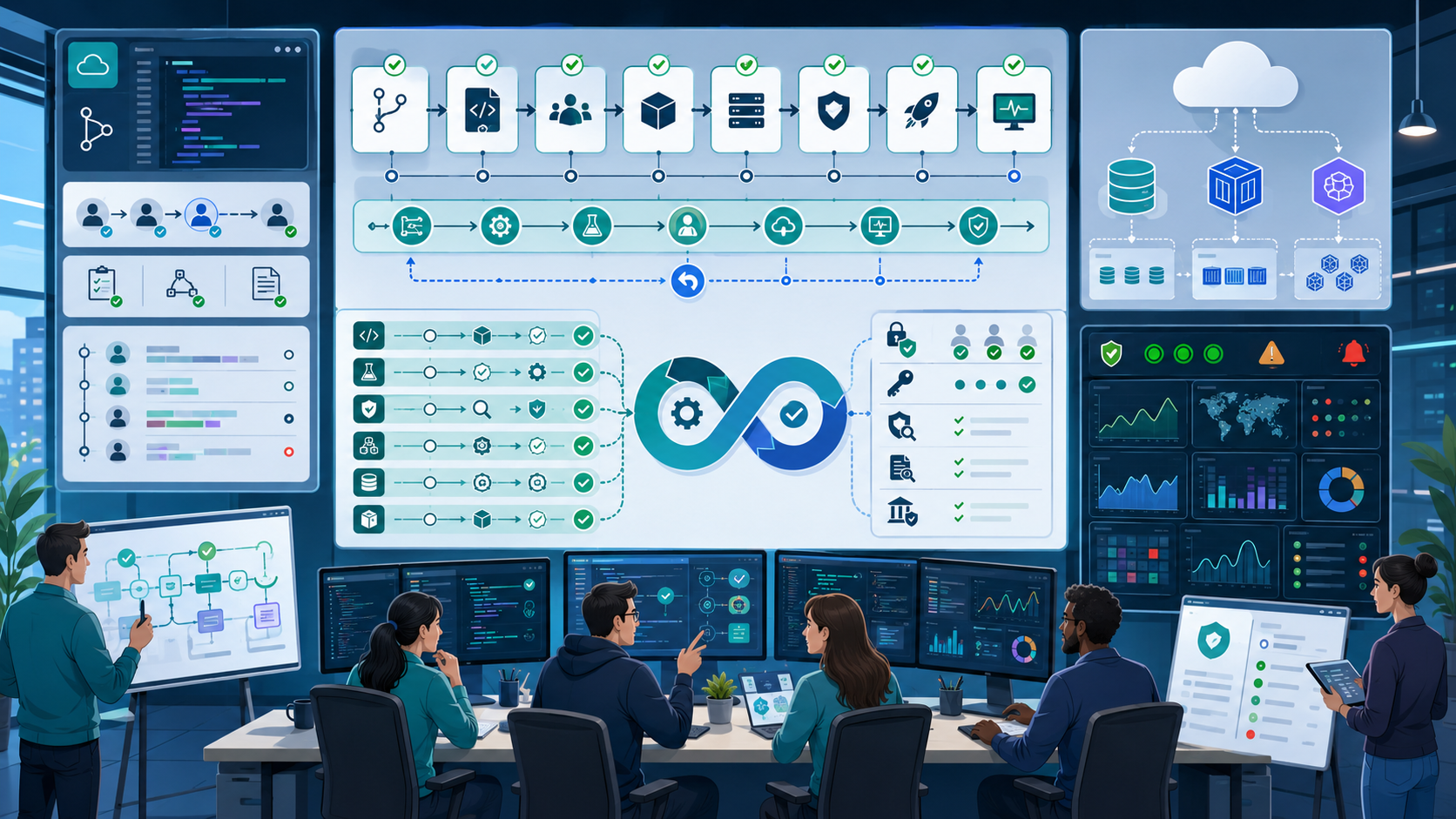
The most successful startup teams I've worked with rarely have the most complicated DevOps environments. Working with a software automation partner for US product teams can help businesses standardize repeatable workflows, automate CI/CD and infrastructure carefully, and improve software delivery reliability without adding unnecessary operational complexity.
Instead, they build simple systems that become more sophisticated only when the product genuinely requires it.
Here are the practices that consistently deliver better results.
1. Standardize Before You Automate
Before writing a single deployment script, make sure every engineer follows the same workflow.
Create clear standards for:
- Branch naming
- Code reviews
- Build process
- Environment configuration
- Release procedures
- Rollback strategy
Only after those processes become predictable should you automate them.
Automation works best when it's repeating a process that already works manually.
2. Keep Deployment Workflows Boring
Reliable deployment is usually more valuable than clever deployment.
A simple deployment process should allow every developer to understand:
- How code reaches production
- When releases happen
- How failures are handled
- How rollback works
The fewer moving parts involved, the easier production becomes to manage.
Complicated deployment workflows often fail during high-pressure production incidents.
3. Treat Infrastructure-as-Code Like Application Code
Many teams adopt Infrastructure-as-Code but forget that infrastructure deserves the same engineering discipline as software.
Infrastructure changes should include:
- Peer reviews
- Version control
- Testing where possible
- Documentation
- Change history
This makes infrastructure predictable instead of mysterious.
Whether you're using Terraform or another provisioning tool, infrastructure should never become a collection of undocumented scripts.
4. Build Automation Around Repeatable Work
Not every task deserves automation.
I generally ask one question:
Will this task still exist six months from now?
If the answer is yes, it's usually worth automating.
If the workflow changes every sprint, manual execution is often cheaper than maintaining automation that constantly requires updates.
Good candidates include:
- Application builds
- Test execution
- Security scanning
- Dependency updates
- Database backups
- Release packaging
Poor candidates include rapidly changing business workflows that haven't stabilized yet.
5. Make Monitoring Useful, Not Impressive
Many teams collect enormous amounts of operational data but rarely use it.
Effective monitoring should answer practical questions:
- Is the application healthy?
- Are users experiencing failures?
- Which deployment introduced the issue?
- Is response time getting worse?
- Are background jobs completing successfully?
Likewise, observability should help engineers understand why problems happen, not simply generate more dashboards.
Useful logging focuses on actionable information instead of recording every possible event.
During incidents, clarity matters far more than volume.
6. Prioritize Reliability Over Feature Velocity
Fast releases are valuable only if they're stable.
Engineering teams often optimize for deployment frequency while overlooking:
- Reliability
- Availability
- Application performance
- Customer experience
A deployment that introduces production failures creates more work than delaying the release by one day.
Consistent releases build confidence across engineering, product, and customer support teams.
7. Build Security Into the Pipeline From the Beginning
Security should be part of the development workflow—not something added before launch.
Even lean teams can include:
- Automated vulnerability scanning
- Secret management
- Dependency checks
- Access controls
- Basic compliance validation
Security automation is far less expensive than responding to a production breach.
Similarly, lightweight governance around deployments helps teams understand who changed what and when, making audits and troubleshooting much easier.
8. Optimize Only After Measuring
Many startups begin optimizing systems long before they have evidence that optimization is needed.
Instead, collect real data.
Measure:
- Deployment duration
- Build failures
- Recovery time
- Infrastructure costs
- Application latency
- Release frequency
Real metrics reveal where optimization actually provides value.
Assumptions usually don't.
9. Use Cloud Services Strategically
Platforms like AWS, Azure, and Google Cloud provide excellent managed services.
The temptation is to use every feature available.
Resist that temptation.
Choose services that directly reduce operational effort.
For many SaaS startups, managed databases, managed container platforms, or managed CI/CD services provide enough capability without introducing unnecessary operational burden.
Cloud platforms should reduce engineering work—not become another product your team has to maintain.
10. Focus on Operational Efficiency, Not Architectural Perfection
One lesson I've learned over the years is that perfect architecture rarely wins.
Teams that consistently ship quality software usually prioritize operational efficiency.
That means:
- Fewer production surprises
- Faster incident resolution
- Simpler release management
- Clear documentation
- Predictable workflows
- Sustainable engineering practices
Those habits create far more value than constantly rebuilding infrastructure in search of a "perfect" architecture.

When This Approach Fails
One mistake I often see in technical blogs is presenting a single DevOps strategy as if it works for every company. It doesn't. The practices that help a six-person startup can become limitations once the organization grows.
Being honest about those trade-offs helps engineering teams make better decisions.
As Engineering Teams Grow
A straightforward deployment process works well when everyone understands the entire application.
Once the engineering organization reaches 20–30 developers, that assumption usually disappears.
Different teams begin owning different areas of the product:
- Backend services
- Frontend applications
- Internal platforms
- Data pipelines
- Infrastructure
At that point, a single deployment process may no longer be practical. Separate ownership often requires more structured release processes and clearer boundaries between systems.
Product Complexity Changes the Requirements
An early SaaS MVP might only consist of:
- One application
- One database
- A handful of background jobs
- A small API
Keeping everything together makes maintenance easier.
As products evolve, new requirements emerge:
- Multiple customer regions
- High traffic
- Independent scaling
- Different deployment schedules
- Compliance requirements
- Dedicated engineering teams
This is where breaking services apart can make sense.
The important point is that architecture should evolve because the product requires it—not because a technology trend suggests it.
High Availability Comes With Operational Costs
Many startups pursue maximum uptime from the beginning.
In theory, that's a great goal.
In practice, highly available systems require significantly more operational work.
You may need:
- Redundant infrastructure
- Cross-region deployments
- Advanced load balancing
- Continuous health checks
- Failover testing
- Disaster recovery planning
These systems improve resilience, but they also increase maintenance effort.
For a product with a relatively small customer base, the additional operational overhead may outweigh the business value.
Automation Still Requires Maintenance
One misconception is that automation reduces engineering work forever.
It doesn't.
Automation itself becomes software that must be maintained.
Deployment scripts require updates.
CI/CD pipelines evolve.
Infrastructure definitions change.
Cloud providers introduce new services.
Security policies change.
Build systems require upgrades.
Even scripting that saves time today can become technical debt if nobody owns it.
I've seen teams spend entire sprints fixing broken automation instead of delivering customer features.
That's why every automation project should have a clear owner.
Cloud-Native Doesn't Automatically Mean Lower Costs
Many founders assume moving everything to managed cloud services automatically reduces operational expenses.
Sometimes it does.
Sometimes it doesn't.
Using managed services across AWS, Azure, or Google Cloud certainly removes infrastructure management responsibilities.
However, managed services also introduce:
- Higher operating costs
- Vendor-specific configurations
- Migration challenges
- Pricing complexity
Choosing managed infrastructure should be a business decision as much as a technical one.
The goal isn't simply moving everything to the cloud.
The goal is reducing engineering effort while maintaining predictable operating costs.
DevOps Maturity Takes Time
Perhaps the biggest misconception is expecting DevOps transformation to happen in a few weeks.
Real engineering maturity develops gradually.
Teams improve through:
- Better communication
- Consistent engineering standards
- Cleaner deployment workflows
- Reliable documentation
- Regular retrospectives
- Continuous learning
No automation platform replaces those habits.
Sustainable Practices for Small Engineering Teams
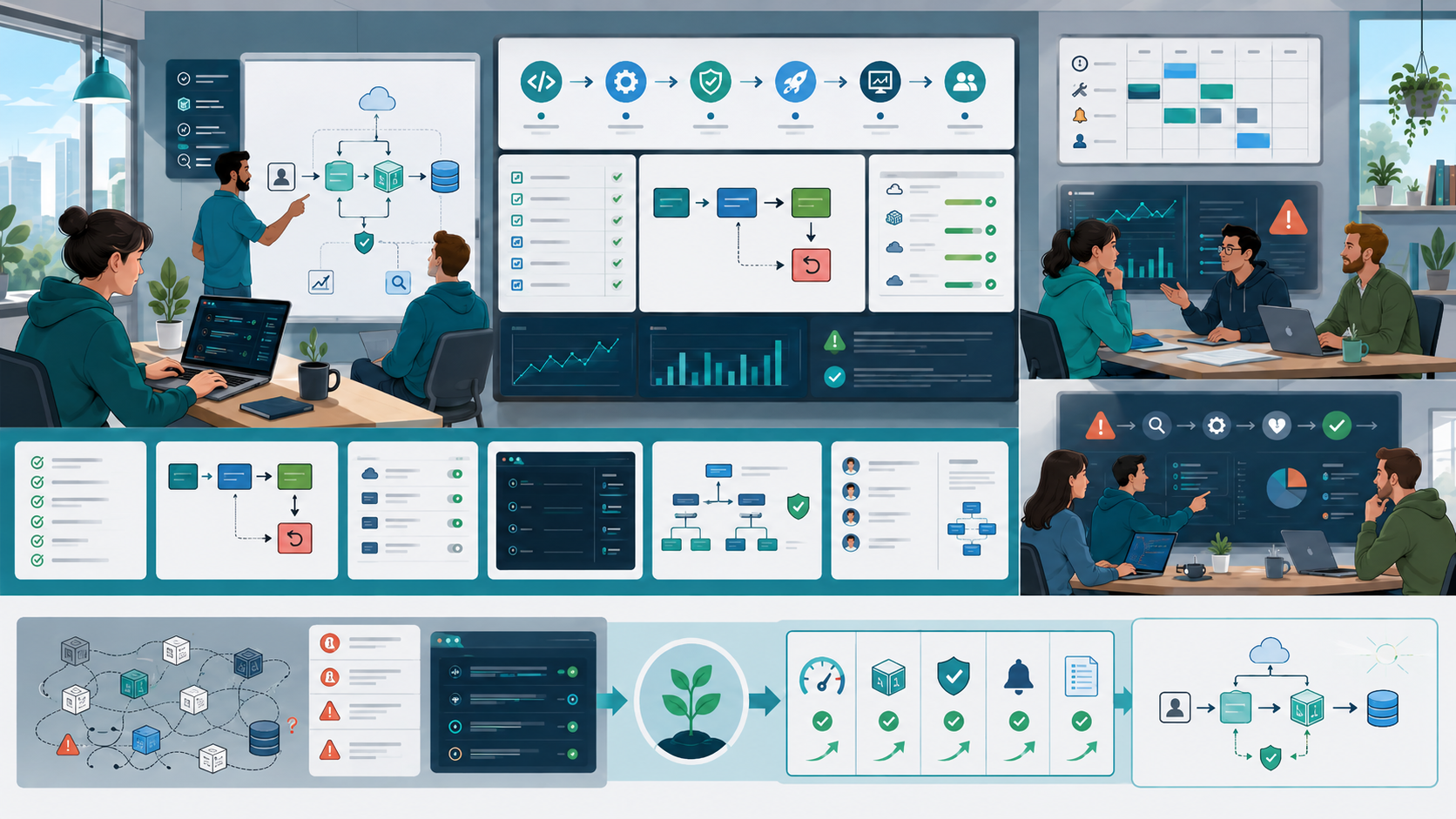
The startup teams that consistently deliver software over several years usually aren't the ones with the most advanced infrastructure.
They're the ones with the most sustainable engineering habits.
Those habits don't attract conference talks, but they prevent countless production issues.
Keep Architecture Simple Until Reality Proves Otherwise
A simple architecture is easier to understand.
It's easier to test.
It's easier to document.
It's easier to deploy.
Most importantly, it's easier for new developers to learn.
Whenever someone proposes a major architectural change, I usually ask:
"Which current production problem does this solve?"
If nobody can answer clearly, the change can probably wait.
Document Operational Knowledge
One hidden source of technical debt is undocumented operational knowledge.
Every engineering team should document:
- Deployment steps
- Rollback procedures
- Environment variables
- Infrastructure changes
- Production recovery process
- Common troubleshooting steps
Documentation isn't about writing lengthy manuals.
It's about reducing dependency on individual engineers.
If one developer takes vacation, the team should still be able to release software confidently.
Reduce Unnecessary Meetings Around Releases
Healthy deployment workflows shouldn't require multiple meetings every week.
The release process should already define:
- Who approves changes
- When deployments happen
- How releases are verified
- How incidents are handled
- How changes are communicated
When the workflow is clear, engineers spend more time building software and less time coordinating deployments.
Make Production Incidents Learning Opportunities
Every incident should improve the engineering process.
Instead of asking:
"Who caused the outage?"
Ask:
"Why did our system allow this to happen?"
That small mindset shift leads to better engineering.
After every significant incident, review:
- Detection time
- Root cause
- Recovery time
- Missing monitoring
- Missing documentation
- Process improvements
Small improvements after every incident compound over time.
Protect Developer Focus
Context switching quietly destroys productivity.
When developers constantly move between feature work, production support, infrastructure maintenance, and emergency fixes, quality inevitably suffers.
Small teams should establish predictable engineering routines:
- Dedicated release windows
- Planned infrastructure work
- Scheduled maintenance
- Clear ownership of production support
Protecting uninterrupted development time often produces bigger gains than introducing another automation platform.
Continuously Improve Instead of Rebuilding
One of the healthiest engineering cultures I've worked with followed a simple rule:
Improve one thing every sprint.
Not rebuild.
Not replace.
Improve.
That could mean:
- Simplifying a deployment script
- Removing duplicate configuration
- Improving monitoring alerts
- Cleaning outdated repositories
- Improving build performance
- Removing unnecessary dependencies
- Simplifying release management
Those incremental improvements create remarkably stable engineering organizations over time.
Build Engineering Habits Before Engineering Complexity
The strongest DevOps environments I've seen weren't defined by the number of tools they used.
They were defined by predictable engineering behavior.
Developers knew how releases worked.
Infrastructure changes were reviewed.
Deployments were repeatable.
Incidents were documented.
Ownership was clear.
Those habits matter far more than adopting every new DevOps technology that appears.
Conclusion
Many conversations about DevOps Automation Solutions in USA focus on choosing the right tools. In my experience, the tools are rarely the deciding factor. Teams struggle because they automate inconsistent processes, adopt complex infrastructure too early, or optimize for hypothetical scaling instead of solving today's engineering problems. A reliable deployment workflow, consistent engineering standards, and shared ownership usually deliver more value than introducing another platform into the stack.
The teams that build sustainable SaaS products don't try to imitate large technology companies from day one. They automate repeatable work, keep their architecture as simple as possible, monitor systems that matter, and improve their processes incrementally. DevOps is most effective when it supports the way a team already works—not when it forces unnecessary complexity. Long-term success comes from balancing automation with practicality, allowing engineering teams to deliver software confidently while maintaining quality, reliability, and operational efficiency.
DevOps Automation Solutions In USA: FAQs
Yes, but only when they solve an existing operational problem. Small startups benefit most from automating repetitive tasks like builds, testing, and deployments. Introducing complex infrastructure before the product or team requires it often increases maintenance instead of improving productivity.
Usually not. For most SaaS startups, simpler deployment approaches are easier to manage and require less operational overhead. Kubernetes becomes valuable when applications, traffic, or team size grow enough to justify container orchestration and advanced scaling capabilities.
Standardizing deployment workflows is more effective than adding more tools. Consistent branching strategies, automated testing, peer reviews, documented release procedures, and rollback plans help remote teams release software with fewer production issues.
Start with tasks that are repetitive and unlikely to change frequently, such as:
- Application builds
- Automated testing
- CI/CD pipelines
- Infrastructure provisioning
- Security scans
- Database backups
Avoid premature architecture decisions, document operational knowledge, review infrastructure changes, improve deployment processes continuously, and only introduce new technologies when they solve a measurable problem. Small, incremental improvements are usually more sustainable than large architectural rewrites.
Reference
Written by

Paras Dabhi
VerifiedFull-Stack Developer (Python/Django, React, Node.js)
I build scalable web apps and SaaS products with Django REST, React/Next.js, and Node.js — clean architecture, performance, and production-ready delivery.
LinkedIn