On Demand App Development Company In Ahmedabad
Hiring an on-demand app development company usually feels straightforward in the beginning. You get a demo, timelines sound reasonable, and everything seems under control.
But a few weeks in, things stop lining up — features behave differently than expected, timelines stretch, and no one can clearly explain why.
That's usually the point where the real problems start surfacing.
Why this problem actually happens
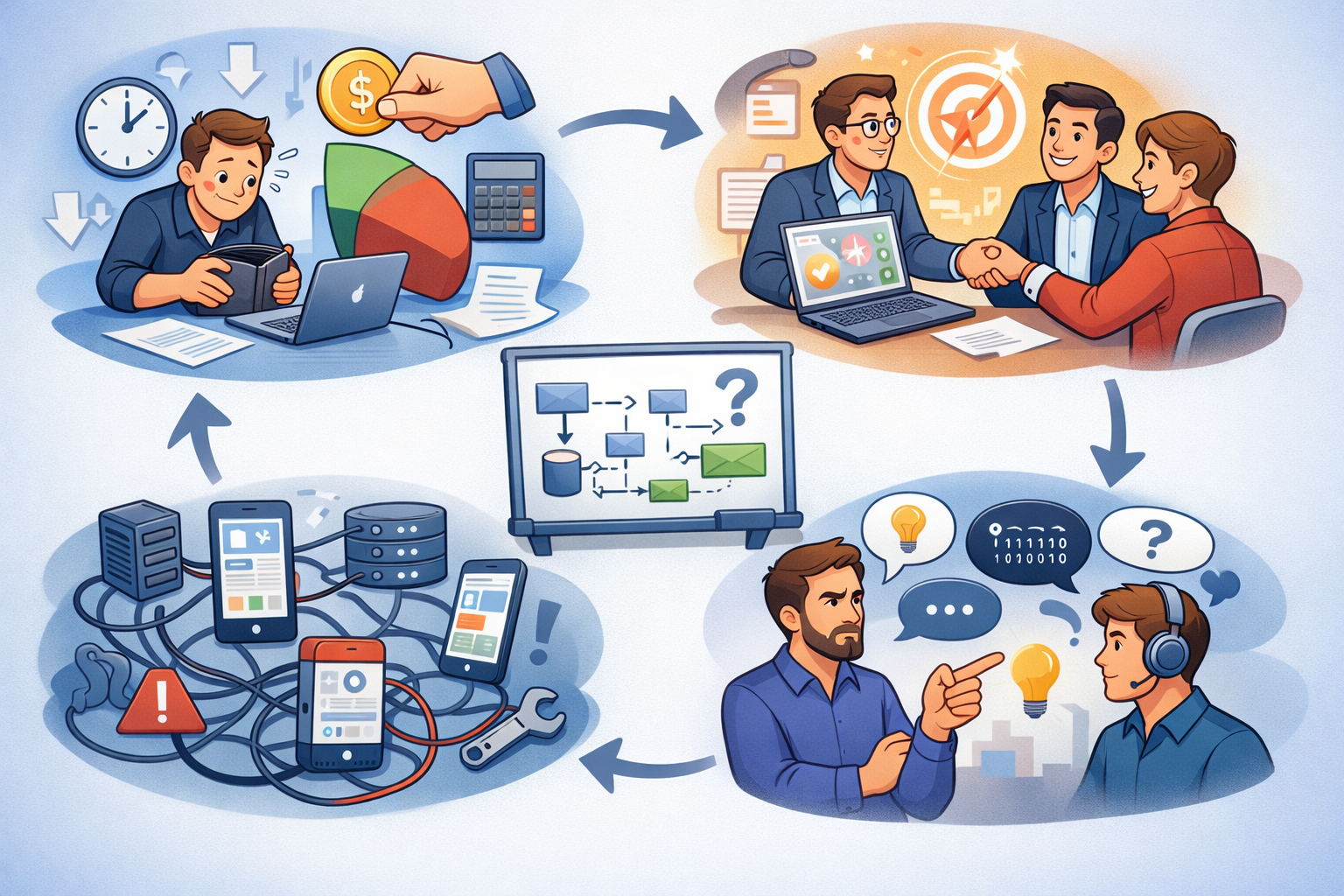
Budget pressure leads to wrong technical decisions
In most early-stage projects, cost becomes the primary decision factor, not system quality. Founders try to fit a complex on-demand app into a limited budget, and agencies agree just to secure the deal. This usually results in shortcuts — skipping proper backend planning, ignoring edge cases, and underestimating infrastructure needs, especially in projects that clearly require stronger Mobile App Development execution from the start. The problem doesn't show immediately, but it surfaces when the app starts handling real users.
- Founders trying to reduce cost
- Agencies agreeing to unrealistic scope
Agencies overpromise to close deals
A lot of small agencies focus more on closing the project than evaluating its feasibility. They'll say "yes" to features like real-time tracking or instant booking without defining how they'll implement them. There's rarely a clear execution plan behind these promises — just assumptions that things will work out during development. This leads to delays, rework, and unstable features later in the project.
- Saying yes to complex features
- No real execution plan behind it
Lack of system design for on-demand apps
On-demand apps rely heavily on backend logic, but many teams jump straight into UI and API development. They do not properly design how bookings flow, how states change, or how failures are handled. Things like retries, timeouts, and data consistency are often ignored in the initial phase. As a result, the app works in demos but breaks in real-world scenarios.
- Ignoring booking lifecycle
- No planning for failures or retries
Communication gap between founders and developers
Founders usually describe what they want in terms of features, while developers think in terms of systems and constraints. If there's no proper alignment, both sides assume different things about how the app should behave. Important details get lost — especially around edge cases and failure scenarios. This gap creates confusion, delays, and a product that doesn't behave as expected.
- Feature thinking vs system thinking
- Misalignment from day one

Where most founders or teams get this wrong
Choosing based on lowest price
Most founders assume they're comparing similar solutions and just picking the cheaper option. In reality, lower quotes often skip critical parts like backend architecture, scalability, and failure handling. The app may look complete initially, but it's usually fragile underneath. What you save upfront often turns into higher costs when things need to be rebuilt.
- Cheap ≠ same product
- Hidden technical compromises
Trusting timelines without validation
Timelines are often given based on optimism, not actual technical planning. Without a clear breakdown of phases, it's hard to know what's realistically achievable. Founders accept delivery estimates without questioning dependencies, complexity, or edge cases. This leads to delays, rushed development, and features that don't behave reliably.
- Unrealistic delivery expectations
- No breakdown of development phases
Not asking about backend logic
A lot of attention goes into the UI because it is easy to see and demo. But on-demand apps fail in backend logic — things like booking flow, real-time updates, and data consistency. If these are not discussed early, they are either poorly implemented or completely overlooked. The result is an app that looks fine but does not function reliably in real usage.
- Over-focus on UI
- Ignoring system reliability
Assuming all development companies are the same
Not every development team has experience building complex, real-time systems. Some are good at simple apps, while others understand scalability and system design. When founders treat all companies as equal, they risk hiring a team that can't handle the project's complexity. This mismatch usually shows up midway, when fixing it becomes expensive and time-consuming.
- No differentiation in technical depth
- Wrong team for complex apps

Practical solutions that work in real projects
Evaluate how the team thinks
Do not just judge a team based on past apps or UI quality — that does not tell you how they solve problems. What matters is how they think through real scenarios like failures, delays, and system behavior under load. Strong teams will explain trade-offs and limitations clearly, not just say yes to everything.
Ask system-level questions:
- Failure handling
- Real-time updates
- Data consistency
Ask for system flow before development
Before any coding starts, the team should be able to walk you through how the system will actually work. This includes a step-by-step breakdown of the booking lifecycle from request to completion. It should also cover edge cases like cancellations, retries, and partial failures. If this isn't clearly defined, the implementation will likely be inconsistent later.
- Step-by-step booking lifecycle explanation
- Edge case handling defined upfront
Start with a controlled MVP
Trying to build everything at once is one of the fastest ways to break an on-demand app. A controlled MVP helps teams validate the core product early and creates a stronger foundation for on demand app solutions for growing businesses by focusing first on the flows that matter most before expanding features.
This reduces risk and makes it easier to identify problems early.
- Booking flow
- Matching logic
- Admin visibility
Understand trade-offs clearly
Every decision in development comes with a trade-off, whether it's cost, speed, or scalability. Cheap solutions may save money upfront but often limit future growth. Understanding these trade-offs helps you make decisions consciously instead of reacting later.
- Cheap vs scalable
- Fast vs stable
- Feature-rich vs reliable
Do regular technical reviews
Consistent check-ins are critical to keep the project aligned and avoid surprises. Weekly reviews help you understand what's actually been built, not just what was planned. They also surface risks early — before they turn into bigger problems. Without this, issues usually stay hidden until it's too late to fix them easily.
- Progress clarity
- Risk identification

When this approach does NOT work
High-complexity applications
Some on-demand apps go beyond what small teams are equipped to handle. If you're building multi-city systems with heavy real-time operations, the architecture becomes significantly more complex. This requires experience with scaling, distributed systems, and performance optimisation. Without that expertise, even a well-planned approach can fall short.
- Multi-city systems
- Heavy real-time operations
Unrealistic budgets
There's a limit to how much can be achieved within a constrained budget. Advanced features like real-time syncing, high concurrency handling, and scalability need proper investment. If the budget is too low, teams are forced to cut corners in critical areas. This usually results in an unstable product that needs rework later.
- Expecting advanced systems at low cost
Constantly changing requirements
Frequent changes in scope create confusion and slow down development significantly. When priorities keep shifting, teams can't build a stable foundation. Features get half-implemented or repeatedly modified, increasing technical debt. Even a good team will struggle to deliver quality under constant changes.
- Scope instability
- Product confusion

Best practices for small teams & founders
Keep communication structured
Unstructured communication leads to missed details and misaligned expectations. Regular weekly calls and clear documentation help keep everyone on the same page. Decisions should be written and tracked, not just discussed verbally. This reduces confusion and ensures accountability throughout the project.
- Weekly calls
- Clear documentation
Build in phases
Breaking development into phases makes the project more manageable and predictable. Start with core functionality, then gradually improve and scale the system. This approach allows you to test assumptions early and adjust as needed.
- Phase 1 → Core
- Phase 2 → Improve
- Phase 3 → Scale
Avoid early scope creep
Adding extra features early in development can quickly derail the project. What seems like a small addition often introduces hidden complexity. It's better to delay non-essential features until the core system is stable. This keeps development focused and reduces unnecessary risk.
- Delay non-essential features
Prioritise system stability
A stable system is far more valuable than a feature-rich but unreliable app. Users expect core actions like booking or payments to work consistently. Focusing on reliability early helps avoid major issues later. UI improvements can always come later, but fixing broken logic is much harder.
- Reliability over UI polish
Always validate assumptions
Many issues in projects come from assumptions that were never properly checked. If something sounds unclear or too optimistic, it probably needs deeper discussion. Founders should ask questions and challenge decisions when needed. This helps catch problems early before they become expensive mistakes.
- Question unclear decisions
Conclusion
Most on-demand apps don't fail because the idea is wrong or the developers lack basic skills.
They fail because the wrong team was chosen for a problem that needed deeper system thinking.
Once development starts, it's hard to course-correct without losing time, money, and momentum. Fixing a poorly built foundation is always more expensive than getting it right in the beginning.
If there's one thing to prioritise, it's this: choose a team that understands how the system works under real conditions — not just how the app looks or how fast it can be delivered.
Speed and cost matter, but they don't save a project that isn't built to handle real usage.
FAQ
Focus on how they explain system logic like booking flow, failures, and real-time updates. Clear, detailed answers matter more than UI portfolio or promises.
For on-demand apps, cheap teams often skip backend architecture and scalability. You may save upfront, but usually pay more fixing issues later.
Yes, if they focus on strong system design and phased development. Experience matters more than team size in handling real-world complexity.
Ask about booking flow, failure handling, and real-time system behaviour. Avoid teams that give vague or overly simplified answers.
Local teams help with communication, but technical expertise is more important. Choose based on system understanding, not just location.
References
Written by

Paras Dabhi
VerifiedFull-Stack Developer (Python/Django, React, Node.js)
I build scalable web apps and SaaS products with Django REST, React/Next.js, and Node.js — clean architecture, performance, and production-ready delivery.
LinkedIn