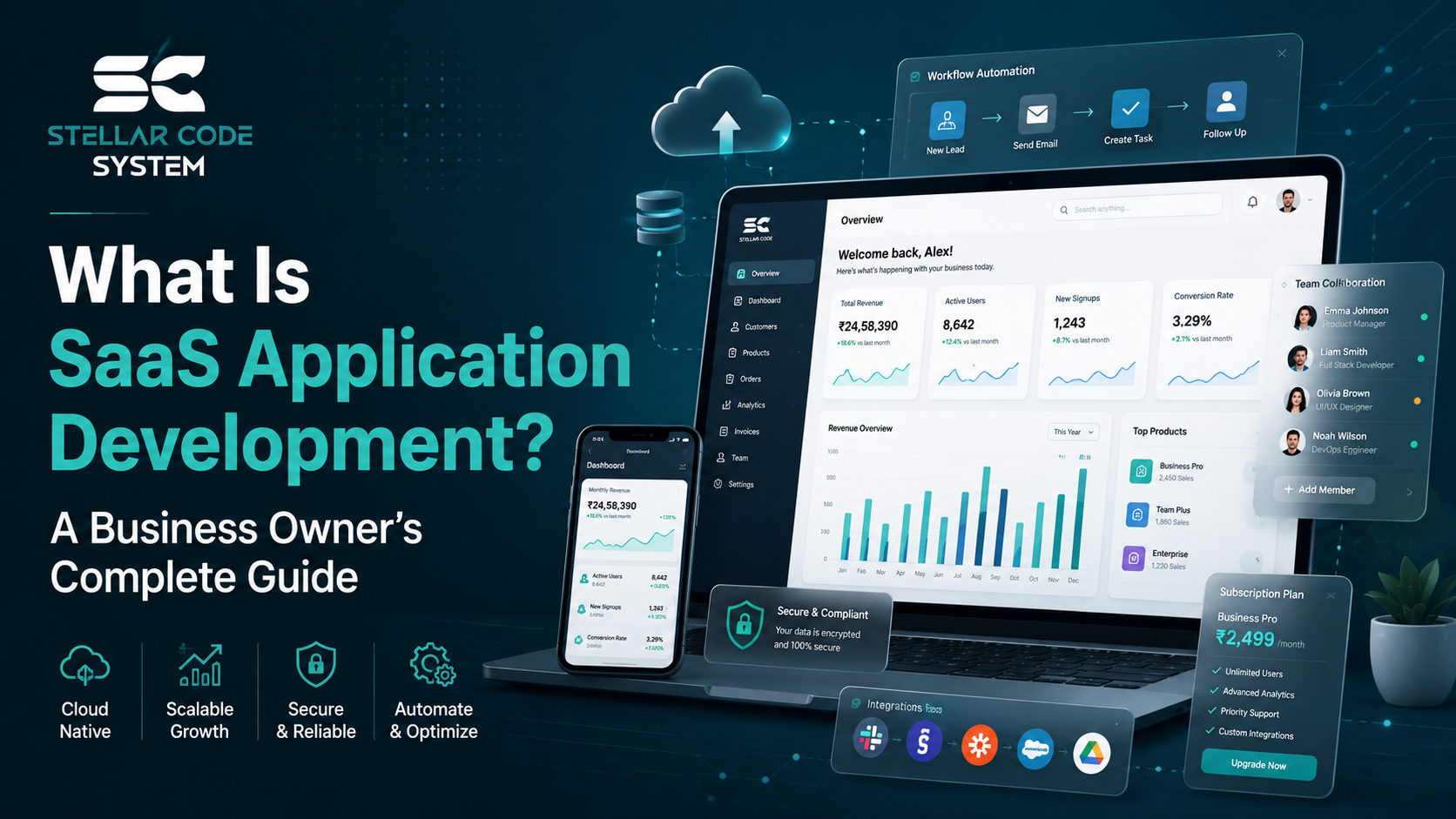
What Is SaaS Application Development? A Business Owner’s Complete Guide
Many startup teams launch their first SaaS product with a simple goal: get to market quickly and validate the idea before competitors do.
The problem is that what works during the first six months often starts breaking once customer adoption grows. Features become harder to ship, deployment cycles slow down, and engineering teams spend more time fixing issues than building new functionality.
I've seen this repeatedly across SaaS startups with teams of 3–15 developers. The product launches successfully, but the underlying application development decisions made during the MVP stage create long-term maintenance challenges.
Understanding SaaS application development is not just about building cloud-based software. It is about creating a scalable, maintainable, and reliable product that can evolve without overwhelming the engineering team.
In practice, the difference between successful SaaS products and struggling ones often comes down to architecture decisions, development workflows, and how technical debt is managed from the beginning.

What Is SaaS Application Development?
SaaS application development is the process of designing, building, deploying, and maintaining software that users access through the internet on a subscription model rather than installing it locally.
Unlike traditional software products, SaaS applications operate within a cloud computing environment and serve multiple customers through a shared infrastructure.
Common characteristics include:
- Cloud-based applications
- Subscription model billing
- Multi-tenant architecture
- Centralized deployment
- Continuous updates
- User management systems
- API integrations
- High availability requirements
Popular examples include CRM platforms, project management tools, collaboration software, analytics systems, and other business applications delivered through the web.
The goal is not simply to create software. The goal is to build a SaaS platform that remains scalable, secure, and maintainable as customer demand grows.
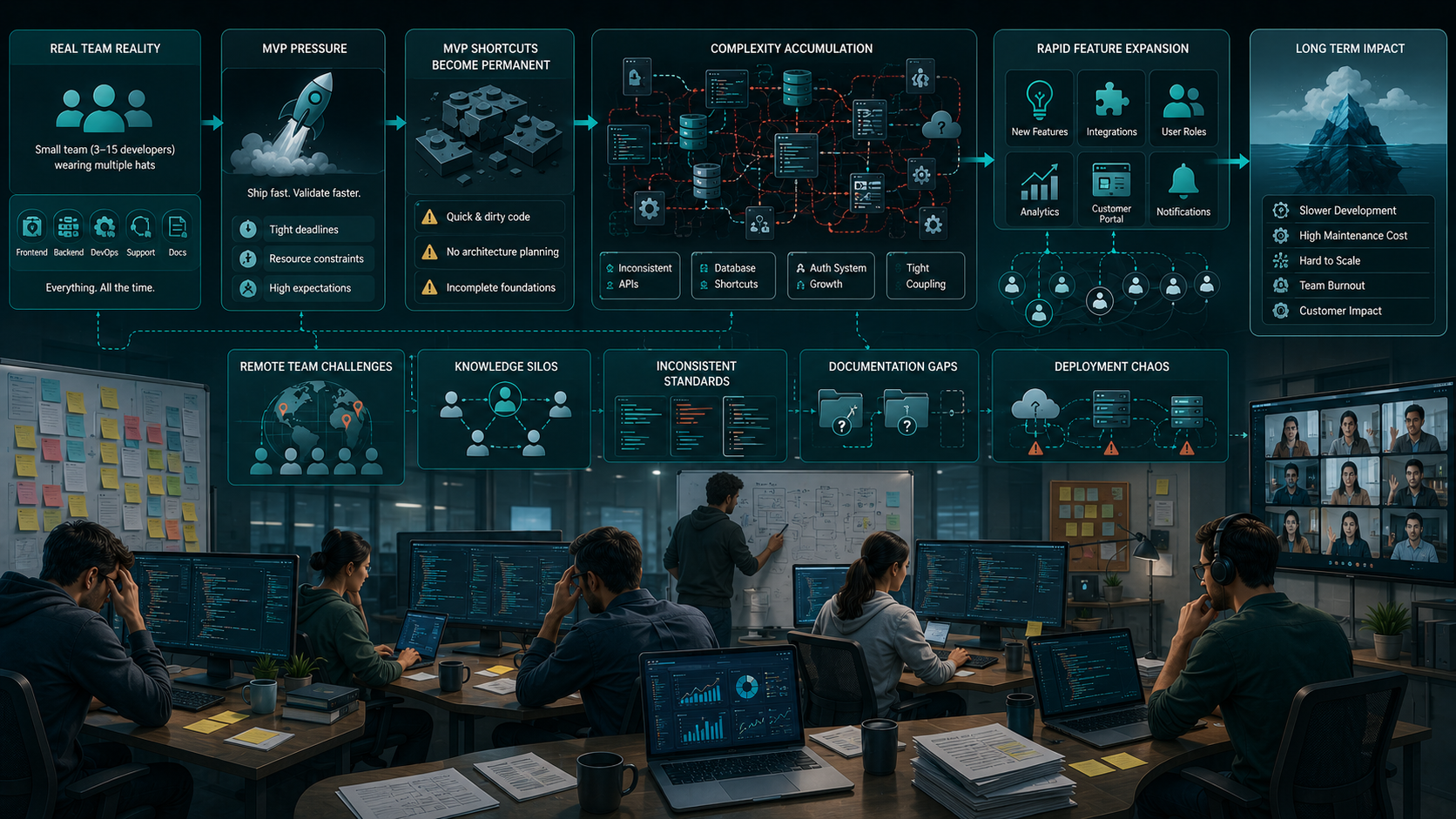
Why SaaS Application Development Becomes Difficult in Real Teams
The technical challenges rarely come from writing code.
Most problems emerge from the realities of startup environments.
Limited Engineering Resources
Small SaaS teams often operate with a limited number of developers while managing multiple responsibilities across frontend, backend, deployment, and support. This creates pressure to prioritize speed over long-term maintainability. As workloads increase, architectural shortcuts can lead to technical debt and slower development cycles.
Small engineering teams often have:
- Aggressive release schedules
- Limited backend development capacity
- Shared responsibilities across frontend and backend systems
- Minimal documentation
Developers are forced to prioritize delivery speed over long-term architecture.
MVP Pressure
Most startups focus on launching an MVP quickly to validate market demand and gather user feedback. In this rush to release, teams frequently make temporary development decisions that remain in production longer than intended. These shortcuts can create scalability and maintenance challenges as the product grows.
Most SaaS startups begin with MVP development.
The objective is validation rather than perfection.
As a result:
- Temporary solutions become permanent
- Database management shortcuts accumulate
- Authentication systems evolve without proper planning
- APIs grow inconsistently
What started as a quick prototype gradually became production infrastructure.
Rapid Feature Expansion
As customer adoption increases, product teams continuously add new features, integrations, and workflows. While this growth supports business objectives, it also introduces additional complexity into the codebase. Without proper planning, feature expansion can reduce development velocity and increase system instability.
Every new customer request introduces complexity:
- Additional integrations
- New user roles
- Expanded authorization requirements
- Analytics dashboards
- Customer portals
Without architectural discipline, scalability problems appear much sooner than expected.
Remote Team Challenges
Remote engineering teams can deliver excellent results, but distributed collaboration introduces unique challenges. Communication gaps, inconsistent documentation, and varying development practices can make coordination more difficult. Over time, these issues may lead to knowledge silos and operational inefficiencies.
Remote developers can be highly productive, but distributed product teams often experience:
- Knowledge silos
- Inconsistent coding standards
- Documentation gaps
- Deployment coordination issues
These operational problems frequently become technical problems later.

Where Most Teams Make the Wrong Decision
The internet is full of advice written for companies operating at a completely different scale.
That creates dangerous assumptions.
Introducing Microservices Too Early
Many startup teams adopt microservices because large technology companies use them successfully. However, managing multiple services adds complexity, deployment overhead, and operational challenges. For small engineering teams, a well-structured monolith is often easier to maintain and scale in the early stages.
A small SaaS product with:
- One engineering team
- One codebase
- One deployment workflow
usually benefits more from a well-structured monolith.
Instead, teams often create:
- Service boundaries
- Multiple repositories
- Complex API communication
- Additional deployment overhead
The architecture becomes harder to maintain before customer growth even justifies it.
Copying Enterprise Architecture
Enterprise software architectures are designed for large organizations with dedicated engineering resources. Startups that replicate these complex systems too early often create unnecessary operational burdens. Simpler architectures usually provide greater flexibility and faster development during the growth phase.
Large enterprise software companies solve enterprise-level problems.
Early-stage SaaS products do not.
Yet many founders attempt to replicate:
- Kubernetes clusters
- Advanced containerization strategies
- Event-driven systems
- Distributed databases
Long before their workload requires them.
The result is operational complexity instead of business value.
Tool Obsession
Teams sometimes spend more time evaluating and implementing new tools than solving actual product problems. Constantly changing technologies can introduce learning curves, integration issues, and workflow disruptions. Focusing on engineering fundamentals often delivers better results than chasing the latest tools.
I've seen teams spend months rebuilding infrastructure while ignoring obvious issues such as:
- Poor deployment workflows
- Missing automated testing
- Weak monitoring
- Lack of performance optimization
Tools rarely fix process problems.
Ignoring Technical Debt
Technical debt builds gradually when short-term development decisions are made without considering long-term maintenance. While these shortcuts may speed up initial releases, they can create future challenges for scalability and code quality. Regular refactoring helps prevent technical debt from becoming a major obstacle.
Initially everything seems manageable.
In the early stages, most SaaS applications appear easy to maintain because the codebase is small and feature requirements are limited. As the product grows, hidden architectural weaknesses and accumulated technical debt begin to surface. Without proactive improvements, development speed and system reliability can suffer over time.
Then feature velocity slows because:
- Dependencies become tightly coupled
- Code ownership becomes unclear
- Refactoring feels risky
- Software engineering complexity increases
By that stage, fixing the problem becomes expensive.
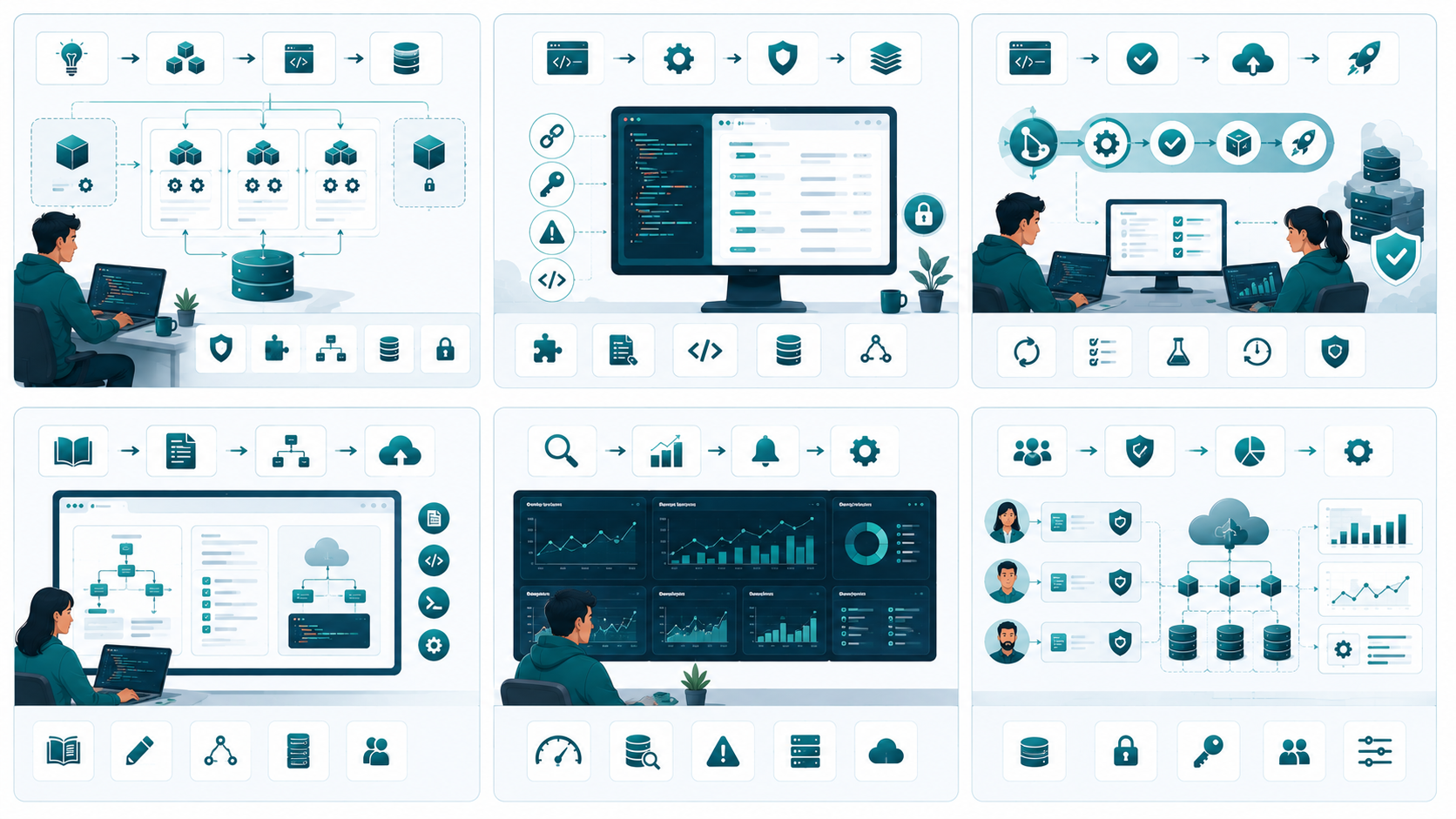
Practical Fixes That Actually Work
The best SaaS application development practices are often surprisingly simple. Choosing a software development company in USA for SaaS application development helps businesses build cloud-based products with simple architecture, reliable deployment workflows, clear documentation, and long-term scalability.
1. Keep Architecture Simple Early
Most SaaS startups do not need highly complex architectures during the early stages of product development. A modular monolith with a shared database and clearly defined service boundaries is often sufficient for supporting growth. Prioritizing maintainability helps teams move faster and reduces unnecessary operational complexity.
For most SaaS startups:
- Modular monolith architecture
- Shared database
- Clear service boundaries inside the application
is usually enough.
Focus on maintainability rather than theoretical scalability.
2. Standardize API Design
API inconsistencies can create significant maintenance and integration challenges as a SaaS product evolves. Establishing standards for endpoint naming, authentication, error handling, and versioning improves reliability across the application. Consistent API design also makes future integrations easier to implement and maintain.
Create standards for:
- Endpoint naming
- Authentication
- Error responses
- Versioning
This prevents future integration headaches.
3. Invest in Deployment Automation
Manual deployments increase the risk of errors, downtime, and delayed releases. Implementing CI/CD pipelines, automated testing, rollback mechanisms, and deployment monitoring creates a more reliable delivery process. Automation allows engineering teams to release updates more confidently and efficiently.
Reliable deployment processes reduce operational stress.
Minimum requirements should include:
- CI/CD pipelines
- Automated testing
- Rollback capability
- Deployment monitoring
Automation reduces mistakes significantly.
4. Improve Documentation Discipline
Effective documentation helps teams collaborate more efficiently and reduces dependency on individual developers. Even simple documentation covering architecture, workflows, integration points, and deployment procedures can provide significant value. Clear documentation also accelerates onboarding and minimizes knowledge gaps.
Simple documentation covering:
- System architecture
- Core workflows
- Integration points
- Deployment procedures
can eliminate many team bottlenecks.
5. Monitor Before Optimizing
Many performance issues are addressed based on assumptions rather than actual system data. Monitoring key metrics such as response times, database performance, error rates, and resource consumption helps teams identify real bottlenecks. Data-driven optimization leads to more effective and sustainable improvements.
Many teams attempt performance optimization without understanding actual system behavior.
Start with monitoring.
Track:
- Response times
- Database queries
- Error rates
- Resource usage
Then optimize based on evidence rather than assumptions.
6. Design for Multi-Tenancy Carefully
Multi-tenancy is a core component of many SaaS applications and should be planned thoughtfully from the beginning. Decisions around data isolation, security, customer configurations, and resource allocation can have long-term architectural impacts. A well-designed multi-tenant system supports scalability while maintaining performance and reliability for all users.
Multi-tenant architecture affects nearly every aspect of SaaS development.
Plan early for:
- Data isolation
- Authorization controls
- Usage analytics
- Customer-specific configurations
Retrofitting multi-tenancy later is significantly harder.
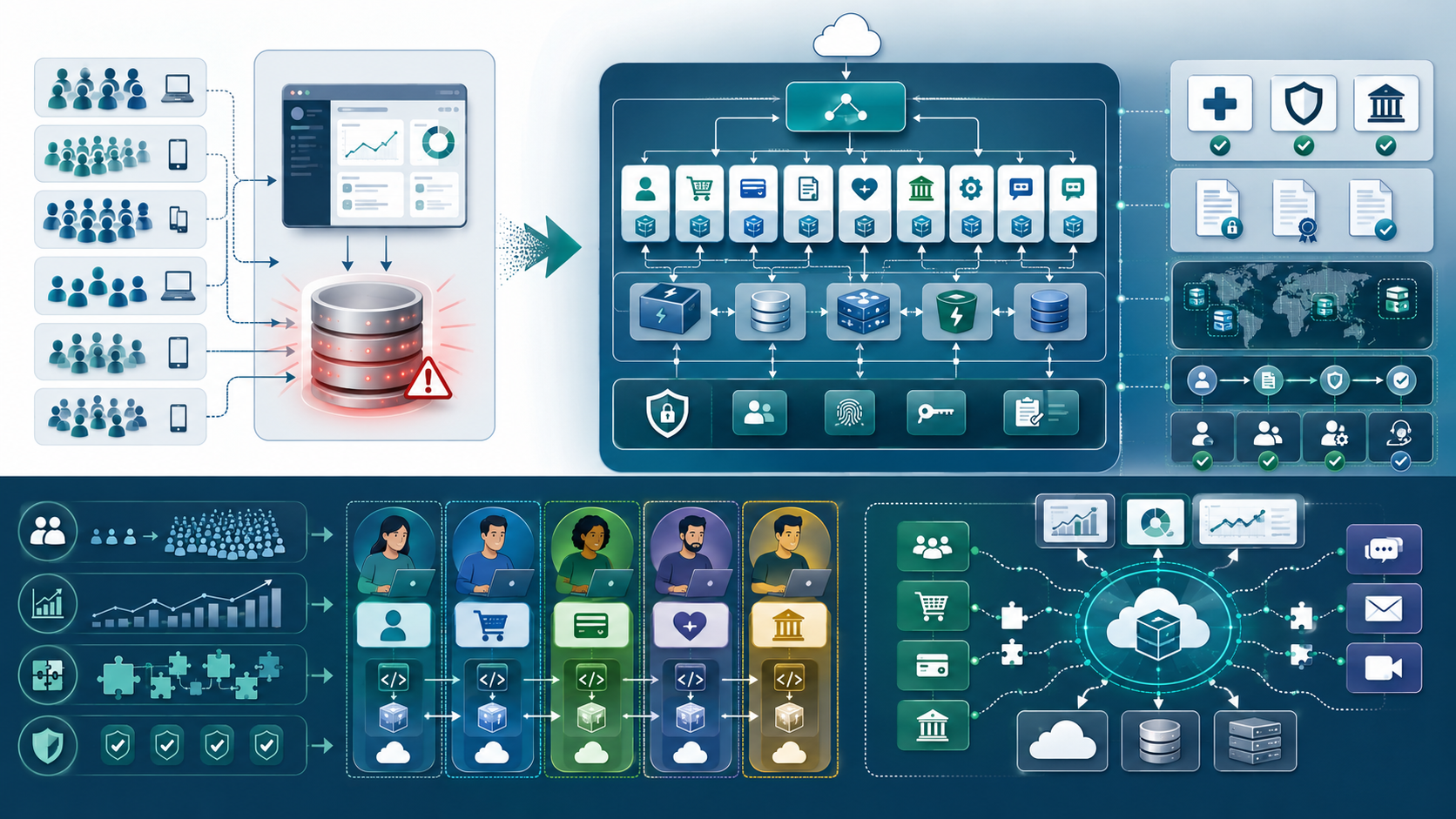
When This Approach Fails
No architectural approach works forever.
There are situations where simple SaaS architectures stop being sufficient.
Large User Bases
As a SaaS product grows and attracts hundreds of thousands or even millions of users, infrastructure demands increase significantly. Shared databases can become performance bottlenecks, and application workloads may require more advanced scaling strategies. At this stage, service separation and distributed architectures often become necessary to maintain reliability.
Once a product serves hundreds of thousands or millions of users:
- Shared databases become bottlenecks
- Scaling requirements increase
- Service separation becomes necessary
Highly Regulated Industries
Industries such as healthcare, finance, and government services operate under strict compliance requirements. These environments often require advanced security controls, detailed audit trails, data residency management, and sophisticated authorization systems. Simple application architectures may struggle to meet these regulatory and operational standards.
Compliance-heavy industries often require:
- Strict security controls
- Audit trails
- Data residency requirements
- Advanced authorization systems
Simple architectures may not satisfy these constraints.
Complex Product Ecosystems
Many successful SaaS products evolve beyond a single application and expand into larger ecosystems. Additional integrations, analytics platforms, cloud services, and connected products introduce new technical challenges. Supporting this level of complexity typically requires more specialized infrastructure and architectural planning.
Products that expand into:
- Multiple SaaS solutions
- Partner integrations
- Large analytics platforms
- Extensive cloud services
eventually require more specialized infrastructure.
Multiple Engineering Teams
As organizations grow, multiple engineering teams begin working on different parts of the product simultaneously. Coordination, ownership, and deployment management become increasingly important to prevent bottlenecks. Architectures that worked for a small team may need to evolve to support independent development and faster release cycles.
Architecture must support:
- Team independence
- Clear ownership boundaries
- Separate deployment cycles
This is often where microservices become practical rather than premature.

Sustainable Practices for Small Engineering Teams
Long-term SaaS success usually comes from consistency rather than technical sophistication.
Prioritize Maintainability
Before adding new technologies or architectural patterns, teams should consider whether future developers will easily understand the system. Maintainable codebases are easier to update, debug, and scale over time. Simplicity often provides more long-term value than unnecessary complexity.
Ask: "Will this still be understandable in two years?"
before introducing complexity.
Reduce Technical Debt Continuously
Technical debt should be addressed regularly rather than postponed indefinitely. Scheduling time for refactoring, code cleanup, dependency updates, and architecture reviews helps keep systems healthy. Consistent improvements prevent small issues from turning into costly rebuild projects.
Allocate dedicated time for:
- Refactoring
- Code cleanup
- Dependency updates
- Architecture reviews
Small improvements prevent major rebuilds.
Establish Clear Ownership
Every critical component of a SaaS application should have a clearly assigned owner. This includes backend systems, frontend architecture, deployment processes, and monitoring infrastructure. Clear ownership improves accountability, accelerates decision-making, and reduces confusion during incidents.
This includes:
- Backend systems
- Frontend architecture
- Deployment workflows
- Monitoring infrastructure
Ownership improves accountability.
Simplify Collaboration
Effective collaboration is essential for remote and distributed engineering teams. Shared documentation, coding standards, architecture guidelines, and deployment checklists help reduce communication gaps. Consistent processes enable teams to work more efficiently and deliver changes with greater confidence.
Maintain:
- Shared documentation
- Coding standards
- Architecture guidelines
- Deployment checklists
Build Reliable Feedback Loops
Successful SaaS products rely on accurate data to guide development decisions. Monitoring product usage, feature adoption, performance metrics, and system reliability helps teams identify issues and opportunities early. Data-driven insights are typically more reliable than assumptions when prioritizing improvements.
Track:
- Product usage
- Feature adoption
- Performance metrics
- System reliability
Data-driven decisions typically outperform assumptions.
Avoid Burnout-Driven Development
Constant pressure to deliver features quickly can lead to developer burnout and declining code quality. Sustainable development practices help teams maintain productivity without sacrificing long-term maintainability. A balanced approach supports both product growth and engineering team well-being.
Constant urgency leads to:
- Poor code quality
- Increased technical debt
- Slower future development
Sustainable velocity almost always beats short-term acceleration.
Conclusion
SaaS application development is much more than building cloud-based software.
It involves designing scalable architecture, managing deployment workflows, securing customer data, supporting continuous updates, and maintaining development velocity as the product grows.
The biggest mistake most startup teams make is optimizing for future scale before solving present-day problems. Premature complexity often creates more engineering bottlenecks than it prevents.
The most practical approach is usually straightforward: build a maintainable SaaS platform, automate deployments, standardize development practices, monitor system behavior, and address technical debt before it becomes a business problem.
The SaaS products that scale successfully are rarely the ones with the most advanced architecture. They are typically the ones with the simplest architecture that remained maintainable long enough to support growth.
What Is SaaS Application Development?: FAQs
Usually not in the early stages. Most SaaS startups benefit more from a modular monolith until team size, product complexity, and scaling requirements justify service separation.
Many successful SaaS MVPs are maintained by 2–6 developers, depending on product complexity and customer requirements.
Common reasons include technical debt, inconsistent API design, poor documentation, rushed feature development, and premature architectural complexity.
In most cases, no. Kubernetes introduces operational overhead that many early-stage SaaS products do not yet need.
Implement CI/CD automation, deployment checklists, monitoring systems, code reviews, and clear ownership of production infrastructure.
Reference
Written by

Paras Dabhi
VerifiedFull-Stack Developer (Python/Django, React, Node.js)
I build scalable web apps and SaaS products with Django REST, React/Next.js, and Node.js — clean architecture, performance, and production-ready delivery.
LinkedIn