
Why Software Development Projects Go Over Budget
A software development project can start with a clear scope, a reasonable estimate, and a confident deadline—and still end up costing significantly more than expected.
The problem is usually not that developers are working too slowly.
More often, the original estimate was built on assumptions that turned out to be wrong. Requirements changed. A third-party integration became more complicated than expected. Testing uncovered problems that required rework. A deadline forced technical shortcuts that later created additional effort.
I've seen this pattern repeatedly in small SaaS teams and client projects. The budget rarely explodes because of one massive decision. It usually happens through a series of smaller changes that nobody recalculates properly.
A feature takes two extra days.
Then another integration takes a week.
A requirement changes.
A production bug requires rework.
The deadline moves.
By the time everyone realizes the project is significantly over budget, the additional effort has already accumulated.
The good news is that these problems are often predictable.
If you understand where software projects typically lose time and money, you can identify the risks much earlier.

Why Do Software Development Projects Go Over Budget?
Software development projects commonly go over budget because of inaccurate estimates, unclear requirements, scope changes, technical complexity, unexpected dependencies, rework, delays, poor planning, and insufficient testing.
The important point is that these factors are connected.
An unclear requirement can produce a wrong estimate.
A wrong estimate can create unrealistic deadlines.
An unrealistic deadline can cause shortcuts.
Shortcuts can create bugs and technical debt.
Those bugs create rework.
Rework increases development effort and pushes the project over budget.
That chain reaction is what small engineering teams need to prevent.
1. Estimates Are Based on Optimistic Assumptions
One of the most common mistakes is treating an estimate as a fact.
Suppose a developer estimates that a feature will take three days.
That estimate might assume:
How many hours will this take?
They also ask:
What needs to be true for this estimate to be realistic?
- The requirements are complete
- The existing architecture supports the feature
- No database migration is required
- The API behaves as expected
- Authentication is already available
- Testing is straightforward
- No stakeholder changes occur
If any of those assumptions are wrong, the estimate changes.
This is why experienced developers don't just ask:
A better estimation approach
Instead of producing one overly precise number, identify:
- Expected effort
- Known dependencies
- Technical uncertainty
- External dependencies
- Testing requirements
- Potential rework
- Major assumptions
For example:
Optimistic: 80 hours
Likely: 110 hours
High-risk scenario: 150 hours
This gives product and engineering teams a more realistic view of uncertainty.
That second question is often more valuable.
2. Requirements Are Not Defined Clearly Enough
A surprising amount of development work begins before the team fully understands what needs to be built.
Consider a requirement such as:
Users should be able to approve invoices.
That sounds simple.
But developers eventually need answers to questions such as:
- Who can approve an invoice?
- Can multiple people approve it?
- What happens after rejection?
- Can an approval be reversed?
- Should users receive notifications?
- Should approval history be stored?
- Can administrators override an approval?
- What happens when an approver leaves the organization?
Every unanswered question creates additional effort.
This is why requirements analysis has a direct relationship with the project budget.
Before development starts, clarify:
- User roles
- Business rules
- Data requirements
- Error scenarios
- Permissions
- Integrations
- Acceptance criteria
- Non-functional requirements
The objective isn't to predict every possible detail.
It is to remove the uncertainties that could materially affect the scope, architecture, effort, or timeline.
3. Scope Creep Quietly Increases Development Costs
Scope creep doesn't always look like a major feature request.
It often happens through small additions.
A dashboard becomes a dashboard with filters.
Then someone requests exports.
Then role-based permissions.
Then email notifications.
Then custom reporting.
Each request may seem reasonable.
The problem occurs when the team continues adding work without adjusting the original estimate, resources, and deadline.
A project that originally required 1,000 hours may gradually become a 1,400-hour project while everyone still talks about the original 1,000-hour budget.
That's not a development problem.
It's a scope-management problem.
A simple rule for scope changes
Whenever a significant change appears, answer four questions:
- What changed?
- How much additional effort does it require?
- What existing work is affected?
- What happens to the deadline and budget?
This keeps changes visible instead of allowing them to disappear inside day-to-day development.
4. Technical Complexity Is Often Underestimated
A feature can look simple to a product team while being technically complex.
Consider a subscription payment system.
The basic requirement may be:
Customers should be able to subscribe and pay.
But a production-ready implementation may also require:
- Payment processing
- Failed payment handling
- Refunds
- Subscription changes
- Webhooks
- Invoice records
- Retry logic
- Authentication
- Permissions
- Tax requirements
- Security controls
- Logging
- Reconciliation
The visible feature is only part of the engineering work.
This happens with many systems, including:
- CRM integrations
- ERP integrations
- Data migration
- Authentication
- Real-time applications
- Reporting systems
- Multi-tenant SaaS platforms
- Legacy system integrations
The more dependencies a feature has, the more uncertainty should be included in its estimate.
5. Third-Party Integrations Create Unexpected Work
Third-party APIs are another common source of budget overruns.
An API may have good documentation and still require significant engineering effort.
Real-world problems can include:
- Authentication failures
- Rate limits
- Webhook reliability
- Unexpected response formats
- API version changes
- Missing data
- Retry requirements
- Sandbox differences
- Production-specific behavior
- Security restrictions
I've learned that critical integrations should be investigated early.
A small proof of concept can reveal an important technical limitation before the team commits hundreds of development hours.
Before estimating a major integration, check:
- Authentication method
- API documentation
- Rate limits
- Webhook support
- Error handling
- Data availability
- Sandbox environment
- API version
- Security requirements
- Expected volume
This reduces uncertainty before it becomes expensive.
6. Unrealistic Deadlines Increase the Final Cost
A short deadline doesn't necessarily mean a cheaper project.
Sometimes the opposite happens.
When teams are given unrealistic deadlines, they may reduce testing, skip documentation, accumulate technical debt, or implement temporary solutions.
The project appears to move faster.
Then the hidden costs arrive.
A rushed implementation may require:
- Additional debugging
- More production support
- Refactoring
- Security fixes
- Regression testing
- Additional developer hours
The initial deadline may have been met—or nearly met—but the total project cost becomes higher.
Speed matters, but sustainable speed matters more.
7. Adding More Developers Doesn't Always Fix a Delayed Project
When a project falls behind, the natural reaction is often:
We need more developers.
Additional staffing can help when there is enough independent work to distribute.
But adding developers to a highly interconnected project can increase:
- Communication
- Coordination
- Code reviews
- Onboarding
- Architecture discussions
- Merge conflicts
- Management overhead
If a new developer needs two weeks to understand the codebase before becoming productive, the short-term capacity increase may be much smaller than expected.
Before increasing team size, determine what is actually limiting the project:
Is it developer capacity, technical complexity, unclear requirements, decision-making, or dependencies?
Solve the bottleneck rather than simply adding people.
8. Rework Is One of the Most Expensive Hidden Costs
Rework happens when the team has to revisit something that was already considered complete.
For example:
Requirement misunderstood → feature developed → stakeholder rejects behavior → feature redesigned → code modified → tests rewritten → deployment repeated
The organization pays for the original work and the correction.
Rework can come from:
- Unclear requirements
- Poor communication
- Architecture mistakes
- Incomplete testing
- Incorrect assumptions
- Changing business rules
This is why early feedback is valuable.
Finding a misunderstanding during design is much cheaper than finding it after development and deployment.
9. Technical Debt Reduces Productivity Over Time
Technical debt is not automatically bad.
Sometimes a startup intentionally chooses a simpler implementation because shipping quickly is more important than building a highly generalized system.
The problem is unmanaged debt.
A shortcut that takes one day today might create five days of work later.
As technical debt accumulates:
- Changes become slower
- Bugs become harder to isolate
- Testing becomes more difficult
- Developers spend more time understanding existing code
- Architecture becomes harder to change
- Maintenance consumes more resources
Eventually, the team spends a significant amount of its workload maintaining previous decisions instead of developing new functionality.
For small teams, this can have a major impact on project economics.
10. Poor Testing Creates Additional Development Costs
Some teams treat testing as something that happens after development.
That can become expensive.
Imagine a feature that works correctly in development but fails when:
- A user has a different permission level
- An API returns an unexpected response
- A database contains missing data
- A payment fails
- A concurrent request occurs
- A browser behaves differently
- A production configuration differs from staging
The bug is discovered late.
Now the developer has to stop current work, investigate the issue, reproduce it, fix it, test the fix, and potentially investigate related problems.
That's additional effort.
Testing isn't simply a quality activity. It protects the project's budget, schedule, and reliability.
Where Most Teams Make the Wrong Decision
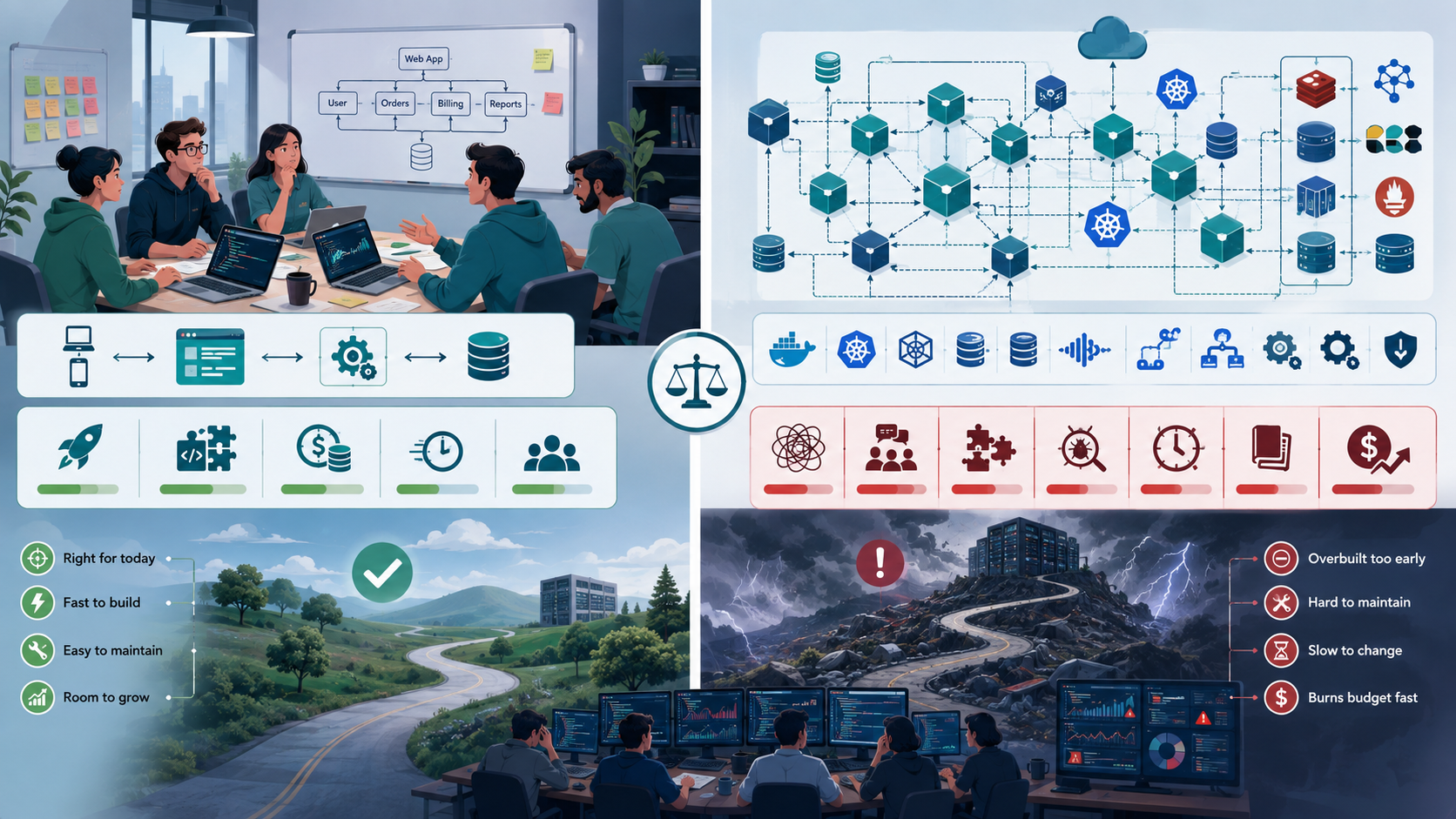
One of the biggest mistakes I've seen is copying engineering practices from large technology companies without considering team size.
A company with hundreds of engineers may need sophisticated infrastructure, service boundaries, complex deployment systems, and specialized teams.
A five-person startup may not.
Overengineering is still a cost
A small SaaS product may not need:
- Multiple microservices
- Kubernetes
- Distributed databases
- Complex event-driven architecture
- Several infrastructure layers
That doesn't mean those technologies are bad.
It means the technology and architecture should match the actual problem.
Every additional system introduces more:
- Dependencies
- Maintenance
- Deployment work
- Monitoring
- Documentation
- Operational complexity
The best architecture isn't necessarily the most sophisticated one.
It is the architecture that solves today's requirements while leaving a reasonable path for tomorrow's needs.
How to Prevent Software Projects From Going Over Budget
There isn't a single technique that eliminates cost overruns. Working with a US software delivery partner for controlled project budgets helps teams clarify requirements, track estimate variance, control scope changes, test risky integrations early, manage technical debt, and keep software budgets aligned with real engineering effort.
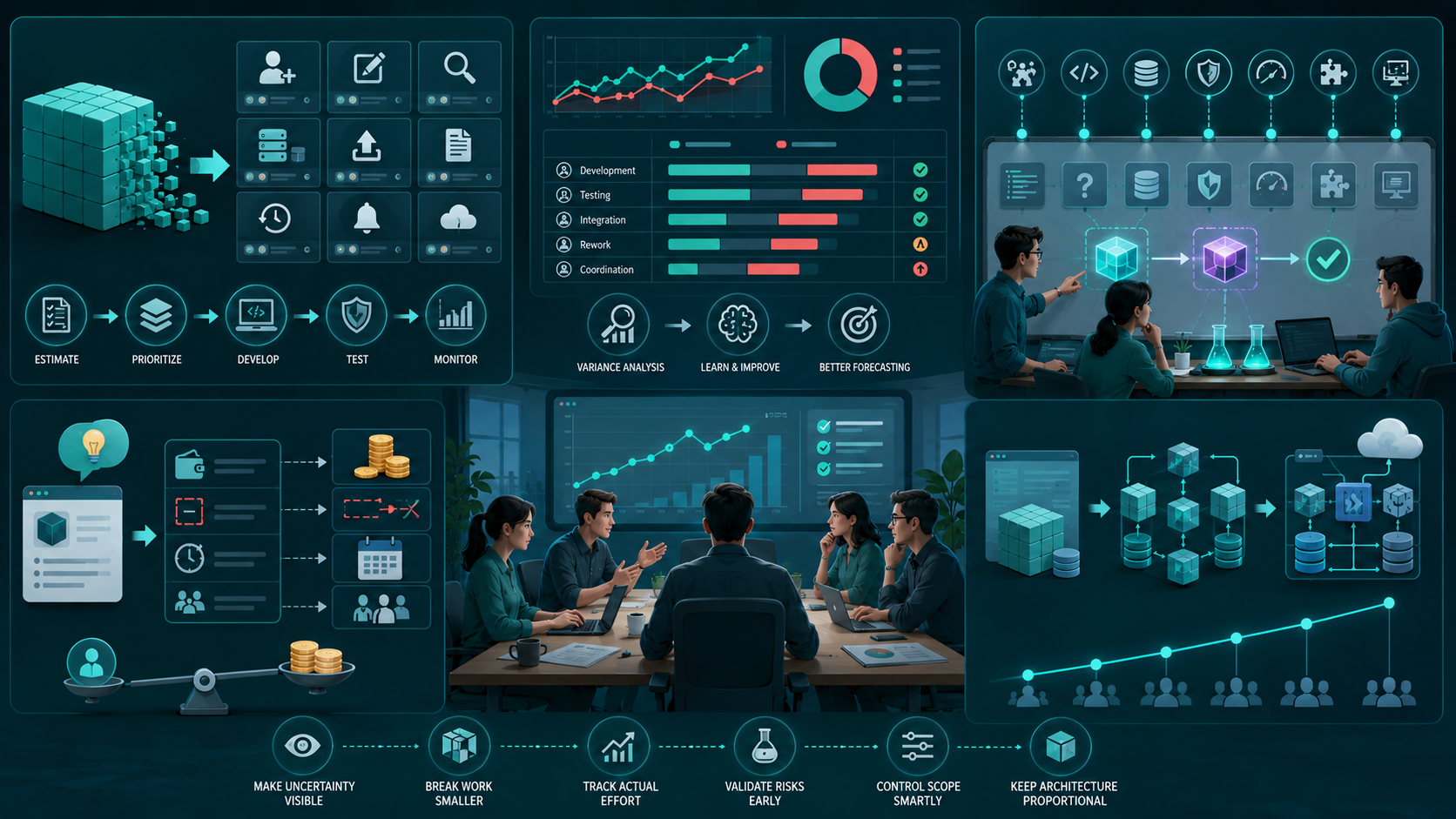
A better approach is to make uncertainty visible and continuously manage it.
1. Break Large Features Into Smaller Units
Breaking large features into smaller tasks makes estimation, prioritization, testing, and monitoring easier.
It also helps teams identify hidden complexity, dependencies, effort, and risks before development begins.
Instead of estimating:
Build the customer management system.
Break it down into:
- Customer creation
- Customer editing
- Search
- Permissions
- Import
- Export
- Activity history
- Notifications
- API access
Smaller units are easier to estimate, test, prioritize, and monitor.
2. Track Estimate vs. Actual Effort
Comparing estimated and actual effort helps teams identify where projects are experiencing variance and unexpected workload.
This historical information improves future forecasting, planning, resource allocation, and estimation accuracy.
Compare it with actual development effort.
For example:
| Work Area | Estimated | Actual |
|---|---|---|
| Development | 400 hrs | 455 hrs |
| Testing | 100 hrs | 145 hrs |
| Integration | 80 hrs | 130 hrs |
| Rework | 50 hrs | 105 hrs |
| Coordination | 40 hrs | 65 hrs |
This gives the team useful information.
If integration repeatedly exceeds its estimate, future projects should account for that.
If rework is consistently high, requirements or review processes may need improvement.
This is where tracking variance becomes useful.
3. Identify High-Risk Work Early
High-risk areas such as APIs, new technology, data migration, security, legacy systems, and complex architecture should be investigated early.
Early validation exposes uncertainty and technical dependencies before they create expensive delays or rework.
Focus early attention on work involving:
- New technology
- Unknown APIs
- Complex architecture
- Data migration
- Security requirements
- Performance requirements
- Legacy systems
- External vendors
A short technical experiment can sometimes save weeks of development.
4. Control Scope Without Blocking Product Progress
Effective scope management does not mean rejecting new requirements; it means understanding their impact on time, budget, resources, and priorities.
Making the opportunity cost visible helps stakeholders make better decisions without unnecessarily slowing product progress.
It means understanding the trade-off.
If a new feature adds 80 hours, the team should know whether that means:
- An additional 80 hours of budget
- Removing another feature
- Extending the deadline
- Adding development capacity
Every new requirement has an opportunity cost.
Make that cost visible.
5. Keep Architecture Proportional to the Product
Start with the simplest architecture that meets the known requirements.
Then evolve it when actual usage justifies the change.
This avoids spending significant resources solving hypothetical scalability problems while neglecting current product requirements.
Good architecture is not about predicting everything.
It's about making today's system maintainable while keeping reasonable options open.
When Cost-Control Strategies Don't Work
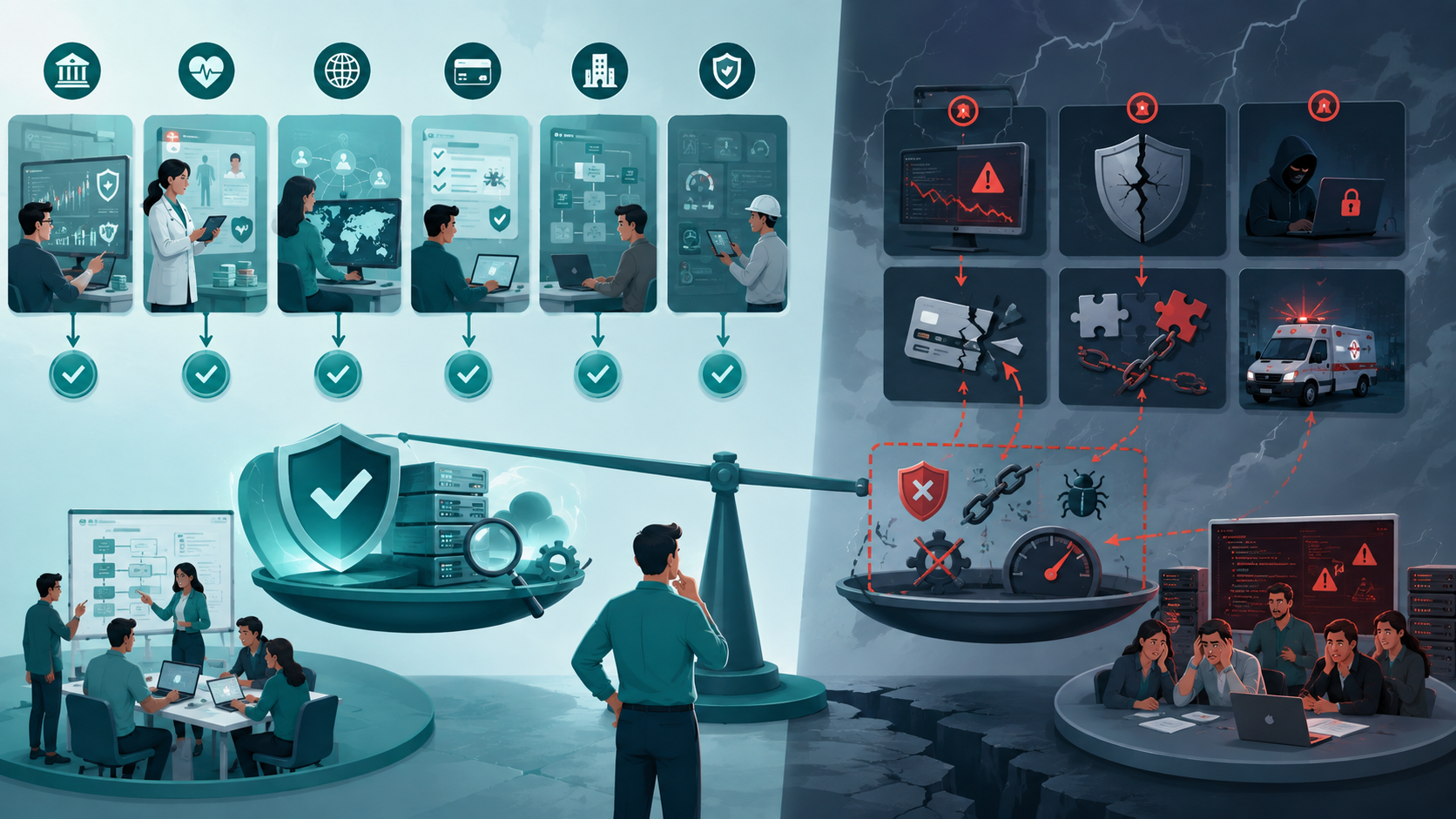
Cost reduction should not become an excuse for cutting essential engineering work.
There are projects where additional investment is necessary.
For example:
- Financial systems may require stronger security.
- Healthcare systems may require strict compliance.
- High-traffic applications may require scalability planning.
- Payment systems require careful failure handling.
- Enterprise systems may need complex integrations.
- Safety-critical systems require extensive testing.
In these cases, reducing testing, security, infrastructure, or compliance simply to hit a budget can create a much larger problem later.
The objective isn't to build software as cheaply as possible.
The objective is to allocate engineering resources intelligently.

Sustainable Practices for Small Engineering Teams
Small teams don't need excessive process to manage software costs.
They need consistency.
Keep estimates connected to assumptions
A software estimate depends on assumptions about requirements, resources, dependencies, and technical complexity.
When those assumptions change, the original estimate may no longer reflect the actual effort required.
Teams should revisit their estimates whenever major requirements, scope, or technical conditions change.
Review scope regularly
Regular scope reviews help teams identify changes before they become expensive problems.
New features or changing requirements can increase workload, development time, and resource needs.
Reviewing scope at each milestone keeps the project aligned with its original objectives and budget.
Track actual effort
Comparing estimated effort with actual effort helps teams understand where their original calculations were inaccurate.
Historical data can reveal patterns in development, testing, rework, and integration work.
These insights improve future forecasting and make project estimates more realistic over time.
Test risky integrations early
Third-party integrations can introduce unexpected technical limitations and additional development effort.
Testing critical APIs and external systems early helps teams discover authentication, data, performance, or compatibility problems.
Early validation reduces the risk of expensive rework later in the development lifecycle.
Document important technical decisions
Important technical decisions should be documented so the team understands why a particular approach was selected.
A short architecture decision record can preserve context when developers join, leave, or revisit the system later.
Clear documentation also reduces repeated discussions and prevents inconsistent implementation decisions.
Protect developer capacity
Developer capacity includes much more than writing code during a project.
Code reviews, debugging, meetings, technical planning, production support, and communication all consume engineering time.
Ignoring these activities can produce unrealistic estimates and create unnecessary pressure on the development team.
Fix technical debt deliberately
Technical debt can gradually increase development effort when shortcuts make the codebase harder to maintain.
Not every shortcut requires immediate refactoring, but significant debt should remain visible and prioritized.
Addressing technical debt deliberately helps prevent maintenance work from eventually controlling the team's development schedule.

The Real Cost of Poor Software Planning
A software project usually doesn't become expensive overnight.
It happens gradually.
A requirement isn't clear.
The team makes an assumption.
The estimate becomes optimistic.
A deadline is established.
The scope changes.
A dependency causes a delay.
The implementation needs rework.
Testing finds additional bugs.
The team adds more resources.
The budget increases.
That's why preventing cost overruns is primarily a planning and decision-making problem, not simply a developer productivity problem.
The most effective teams don't try to predict every hour perfectly.
They identify uncertainty early.
They make assumptions visible.
They track actual effort.
They control scope.
They investigate risky technical decisions before committing significant resources.
And when reality differs from the original plan, they update the plan instead of pretending the original estimate is still accurate.
The goal isn't to create a perfect software estimate. The goal is to create a realistic engineering plan that can adapt when requirements, technology, resources, and risks change.
Conclusion
Software development projects rarely go over budget because of a single mistake. More often, unclear requirements, optimistic estimates, changing scope, technical complexity, dependencies, rework, testing, and unrealistic deadlines gradually increase the total effort.
The most effective way to control costs is to make assumptions visible, break large features into manageable units, track estimated versus actual effort, identify high-risk work early, and review scope throughout the project. Teams should also protect developer capacity and address technical debt before it becomes a major productivity problem.
The goal isn't to predict every development hour perfectly. It is to build a realistic plan, monitor variance and risks, and adjust quickly when project conditions change. When small engineering teams manage uncertainty instead of ignoring it, they have a much better chance of delivering quality software without unexpected budget overruns.
Why Software Development Projects Go Over Budget: FAQs
The most common causes are inaccurate estimates, unclear requirements, scope changes, technical complexity, unexpected dependencies, rework, testing problems, unrealistic deadlines, and poor resource allocation.
Companies can reduce overruns by defining requirements clearly, identifying technical risks early, tracking estimated versus actual effort, controlling scope changes, testing critical integrations, and regularly updating project forecasts.
Yes. Even relatively small scope changes can increase development, testing, integration, documentation, and maintenance effort. If the budget and timeline aren't updated, these changes can lead to significant cost overruns.
Estimates are often based on incomplete requirements and optimistic assumptions. Developers may also underestimate technical complexity, dependencies, testing, rework, and communication time.
Yes. Accumulated technical debt can reduce developer productivity and make future changes, testing, debugging, and maintenance more expensive. However, not every technical shortcut is harmful; the key is managing debt deliberately.
Reference
Written by

Paras Dabhi
VerifiedFull-Stack Developer (Python/Django, React, Node.js)
I build scalable web apps and SaaS products with Django REST, React/Next.js, and Node.js — clean architecture, performance, and production-ready delivery.
LinkedIn