Custom Software Development Agency USA
A custom software development agency can build almost anything a product team can describe. The harder part is deciding what should actually be built.
I have seen this problem repeatedly in startup and client projects: the requirements look clear, the technology stack is selected, development starts quickly, and everyone feels productive. Three or four months later, the application technically works, but the team is fighting confusing workflows, expensive changes, integration problems, performance issues, and architecture decisions that are difficult to reverse.
The mistake usually happens before the first line of production code is written.
Teams often treat customization as the main advantage of custom software. In practice, customization only becomes valuable when it is connected to a real business workflow, user requirement, operational process, or technical constraint.
This is particularly important when working with a custom software development agency in the USA or with a distributed team across the USA, Canada, Germany, Australia, the UK, and other markets. Different teams can interpret the same requirement differently unless the underlying problem is understood first.
The real question is not, “Can the agency develop this feature?”
It is:
Does the proposed software architecture solve the actual problem without creating a larger one six months later?

Why This Problem Happens in Real Teams
The problem usually starts with pressure rather than poor engineering.
Startups want to launch quickly. Established companies want to replace an inefficient system. Product teams have customers waiting. Founders have investors expecting progress. Engineering teams may have only two to fifteen developers available.
Under those conditions, development becomes a race toward visible functionality.
A team says:
- We need a dashboard.
- We need APIs.
- We need automation.
- We need cloud infrastructure.
- We need a mobile application.
- We need third-party integration.
- We need role-based access.
- We need reporting.
All of those requirements may be legitimate. The problem is that they describe what the software should contain, not necessarily how the software needs to behave.
Requirements Are Often More Ambiguous Than They Look
Consider a simple requirement:
Customers should be able to update their account information.
That sounds straightforward.
But an experienced engineering team immediately has questions.
Which information can they change?
Does changing an email address require verification?
Does the change affect billing?
Should existing API integrations receive the new information?
What happens to active sessions?
Does the database keep an audit history?
What happens if two users modify the same record?
Should administrators be notified?
Those decisions affect architecture, security, database design, APIs, testing, usability, and maintenance.
This is why software development is not simply programming. The engineering work involves translating business requirements into reliable systems.
Time Pressure Encourages Shortcuts
When deadlines become aggressive, teams often skip discovery and move directly into coding.
That feels faster.
It rarely is.
A few days saved during planning can become several weeks of rework during development. A poorly understood workflow can affect database structures, application architecture, integrations, automation, and deployment.
I have found that the most expensive development mistakes are often not difficult technical problems. They are reasonable technical decisions made against incomplete information.
Scaling Is Usually Assumed Too Early
Another common issue is designing for a hypothetical future.
A startup may have 500 users but design infrastructure for 50 million.
The team introduces multiple services, complex cloud infrastructure, event-driven workflows, advanced deployment processes, and unnecessary infrastructure layers.
The architecture may look impressive.
But a small team now has more systems to monitor, test, document, secure, deploy, and maintain.
Scalability matters. But scalability without operational simplicity can reduce productivity.

Where Most Teams Make the Wrong Decision
One of the biggest mistakes I see is confusing a sophisticated architecture with a good architecture.
Copying Big-Tech Architecture
A small SaaS team sees how large technology companies structure their platforms and tries to reproduce the same approach.
That is rarely necessary.
A large organization may have hundreds of engineers, dedicated infrastructure teams, specialized security teams, complex compliance requirements, and millions of users.
A startup may have four developers.
The architecture needs to reflect the team that will operate it.
For many early products, a well-structured modular monolith can be easier to develop, test, deploy, and maintain than a collection of microservices.
That does not mean microservices are bad.
It means architecture should follow actual constraints rather than fashion.
Choosing Technology Before Understanding the Workflow
Technology decisions should support the product.
They should not define it.
I have seen teams spend significant time debating programming languages, frameworks, databases, cloud platforms, and infrastructure while the actual business workflow remained unclear.
The result is often a technically modern system solving the wrong problem.
A better sequence is:
Business problem → workflow → requirements → architecture → technology → implementation
Not:
Technology → architecture → features → hope
Assuming Customization Means Unlimited Flexibility
Custom software provides flexibility, but flexibility has a cost.
Every custom workflow introduces decisions that someone must eventually maintain.
A customized platform may require:
- Additional testing
- More documentation
- More complex APIs
- Custom database structures
- Specialized security rules
- More deployment considerations
- Ongoing support
- Compatibility checks
- Additional monitoring
The goal should not be maximum customization.
The goal should be useful customization.

Practical Fixes That Actually Work
The solution is not adding more meetings or producing a 100-page requirements document. Working with a USA custom software agency for workflow-first architecture helps teams define real workflows, clarify requirements, design practical architecture, set integration boundaries, plan deployment, document key decisions, and build maintainable software without adding unnecessary complexity.
Small engineering teams need lightweight processes that improve decisions without slowing development.
1. Define the Workflow Before the Feature
Before building a feature, describe how the user moves through it.
For example:
Customer submits request → system validates information → request enters review → reviewer approves or rejects → API updates status → customer receives notification → activity is recorded.
Now the engineering team can identify:
- Data requirements
- API boundaries
- Automation opportunities
- Security controls
- Failure scenarios
- Database relationships
- Notification requirements
- Testing requirements
The feature becomes much easier to reason about.
2. Separate Must-Have Behavior From Future Ideas
During custom software projects, stakeholders naturally add ideas.
Some are valuable.
Some are simply interesting.
Keep the initial system focused on the workflow that creates measurable value.
A useful distinction is:
- Required now: The product cannot operate without it.
- Important later: It improves the product but is not required for the first release.
- Interesting: It may be useful someday.
This prevents the architecture from becoming unnecessarily complex.
3. Design for the Team That Will Maintain It
Architecture decisions should consider operational ownership.
Ask:
- Who will deploy the system?
- Who will investigate production failures?
- Who owns the database?
- Who handles security updates?
- Who monitors infrastructure?
- Who maintains integrations?
- Who documents important decisions?
A technically powerful architecture can become a liability if nobody on the team understands it deeply.
This is especially important with remote development teams. Knowledge that exists only in one developer's head becomes a serious operational risk.
4. Keep Integration Boundaries Explicit
Third-party integrations are frequent sources of long-term problems.
Payment systems, CRM platforms, ERP systems, analytics tools, communication services, and external APIs all introduce dependencies.
Do not allow external systems to leak throughout the application.
Instead, define clear integration boundaries.
For example:
- API failures
- Authentication
- Retries
- Rate limits
- Data transformation
- Version changes
- Logging
- Testing
It also improves compatibility when an external platform changes later.
Application
    ↓
Integration Layer
    ↓
External API
This makes it easier to handle:
5. Treat Deployment as Part of Development
Deployment should not be something considered at the end.
From early development, decide how code moves from development to production.
A practical workflow might look like:
Local development → automated testing → staging → review → production
The exact process depends on the product.
The important part is consistency.
If every deployment requires someone to manually remember ten steps, mistakes eventually happen.
Automation should remove repetitive operational work without turning the infrastructure into an unnecessarily complicated platform.
6. Document Decisions, Not Everything
Small teams do not need documentation for every line of code.
They do need documentation for decisions that are difficult to reconstruct.
Examples include:
- Why a database structure was selected
- Why a service boundary exists
- Why a particular API behaves differently
- Why a workflow cannot be automated
- Why a security restriction exists
- Why a technology was rejected
A short architecture decision record can save hours months later.

When This Approach Fails
A simple, workflow-first approach is not appropriate for every project.
There are situations where more sophisticated architecture is justified.
A system may require stronger separation because of:
- Very high traffic
- Independent deployment requirements
- Strict compliance requirements
- Multiple engineering teams
- Strong data isolation
- Complex distributed processing
- Significant infrastructure requirements
Likewise, a modular monolith may eventually become difficult to scale organizationally.
The important point is that architecture should evolve when the constraint becomes real.
Do not introduce complexity because you might need it.
Introduce it because you actually need it.
There is also a practical budget constraint. A small company may not have the people or operational budget required to support sophisticated infrastructure. Cloud resources, monitoring, security, testing, and maintenance all have ongoing costs.
The architecture is never just a technical decision.
It is also an ownership and operational decision.
Sustainable Practices for Small Engineering Teams
The best software teams I have worked with are not necessarily the teams that write the most code.
They are the teams that make fewer expensive decisions.
A few practices consistently help.
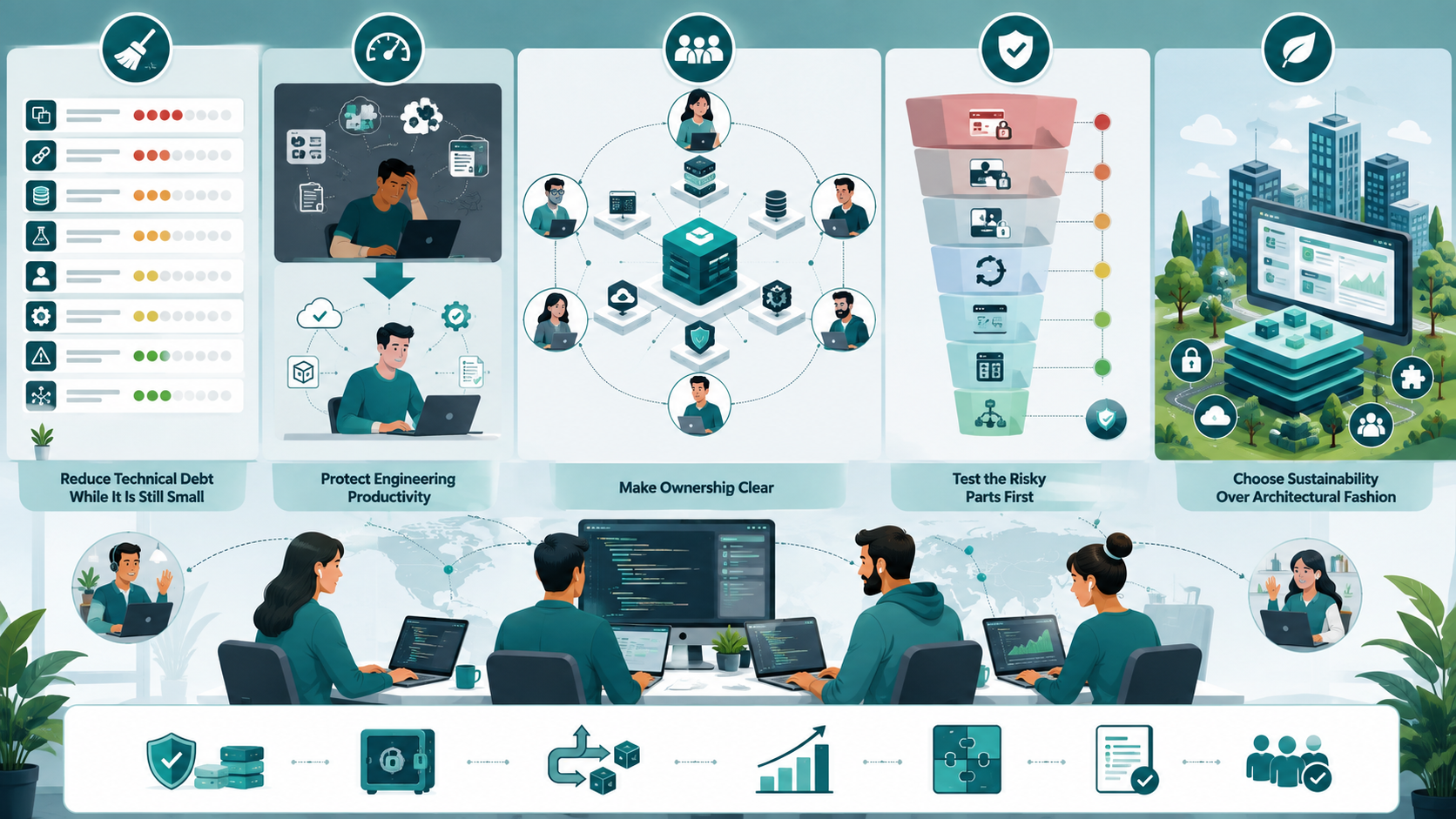
Reduce Technical Debt While It Is Still Small
Technical debt is easier to manage when it is visible.
Do not wait until the codebase becomes difficult to modify.
Track recurring problems such as:
- Duplicated logic
- Fragile integrations
- Slow database queries
- Missing tests
- Unclear ownership
- Manual deployment steps
- Poor error handling
- Inconsistent APIs
Fix the problems that repeatedly slow the team down.
Protect Engineering Productivity
A development team cannot maintain high velocity indefinitely if every release creates operational problems.
Productivity improves when developers spend less time:
- Manually deploying code
- Searching for undocumented behavior
- Debugging inconsistent environments
- Fixing preventable integration failures
- Rebuilding functionality because requirements were misunderstood
Good engineering processes should remove friction.
Make Ownership Clear
Every major part of the system should have an understood owner.
Ownership does not mean one person is responsible for every bug.
It means someone understands the system well enough to make decisions, maintain documentation, and coordinate improvements.
This becomes particularly important as remote teams grow.
Test the Risky Parts First
Not every feature needs the same level of testing.
Focus testing effort on areas where failures are expensive:
- Payments
- Authentication
- Permissions
- Data synchronization
- Critical APIs
- Business calculations
- Automated workflows
This provides better quality without forcing a small team into an unrealistic testing process.
Choose Sustainability Over Architectural Fashion
The strongest architecture is often the one your team can understand six months from now.
Software should be:
- Reliable enough for its users
- Secure enough for its risk profile
- Flexible enough for expected change
- Scalable enough for realistic growth
- Simple enough to maintain
- Compatible with surrounding systems
- Documented enough for team continuity
That is a much more useful definition of engineering quality than simply choosing the newest technology.
Conclusion
The biggest mistake in custom software development is not choosing the wrong programming language or cloud platform.
It is building before understanding the problem deeply enough.
A custom software development agency in the USA can provide strong engineering expertise, architecture, development, integration, testing, automation, cloud infrastructure, and ongoing support. But those capabilities only matter when they are applied to a clearly understood product workflow.
The practical lesson is simple:
Start with the workflow, not the technology.
Understand what users need to accomplish. Identify the constraints. Design the simplest architecture that can support those requirements. Build clear integration boundaries. Automate repetitive deployment work. Document important decisions. Then add complexity only when the product or team genuinely requires it.
That approach may look less impressive during the first few weeks.
In my experience, it usually produces a system that is much easier to maintain a year later.
Custom Software Development Agency USA: FAQs
It can be, particularly when the startup has workflows or requirements that existing platforms cannot support well. The important question is whether the customization creates enough operational or product value to justify its development and maintenance cost.
Usually not unless there is a clear reason. A modular monolith is often easier for a small engineering team to develop, test, deploy, and operate. Microservices become more useful when actual scale, team structure, isolation, or deployment requirements justify them.
Common causes include unclear requirements, excessive customization, duplicated logic, weak documentation, poorly designed integrations, premature architecture decisions, and technical debt that is repeatedly postponed.
Keep workflows and ownership explicit, document important architecture decisions, use consistent development and deployment processes, automate repetitive tasks, and make critical system knowledge accessible to the entire team rather than a single developer.
Look beyond programming skills. Evaluate how the team approaches requirements, architecture, integration, security, testing, deployment, documentation, maintenance, communication, ownership, and long-term support. A strong development partner should be able to explain trade-offs rather than simply recommend technology.
Reference
Written by

Paras Dabhi
VerifiedFull-Stack Developer (Python/Django, React, Node.js)
I build scalable web apps and SaaS products with Django REST, React/Next.js, and Node.js — clean architecture, performance, and production-ready delivery.
LinkedIn